
Note: This website was automatically translated, so some terms or nuances may not be completely accurate.
 How We All Want to Approach Mental Health Together [3/3]
Dentsu Inc. Mental Health Lab's Challenge: Reaching Out to Non-Parties
At Dentsu Inc., employees who have personally experienced mental health challenges within the Group, supporters, and those studying psychology at universities or other institutions voluntarily came together to launch the " Dentsu Mental Health Lab" in 2021.
This series features Mental Health Lab members exploring approaches to mental health based on their personal experiences. The first article covered trends surrounding mental health and the Dentsu Group's initiatives, while the second article detailed the lab's origins and the Mental Health Cafes run by its ERG (Employee Resource Group). Both articles received significant feedback.
What can we do to create a workplace environment where everyone can continue working on an equal footing, whether they themselves are experiencing mental health challenges or have team members facing constraints due to such issues? We believe a crucial step is fostering an atmosphere where many people take an interest in mental health, creating an environment where it's easy to talk about it with anyone, not just those directly affected.
In this final installment, Nao Takemoto from the Dentsu Inc. Mental Health Lab shares the lab's current challenges and initiatives focused on approaches and efforts targeting individuals beyond those with personal experience of mental health issues.
Is Mental Health Information Hard to Access?
Consumer behavior models like "AISAS" (*1) and "SEAMS" (*2) describe the journey from recognizing products/services amidst overwhelming information to purchase and subsequent sharing.
However, health information differs from these consumption models. Once deemed "irrelevant to me," it slips through the cracks of daily information gathering in our busy lives and often fails to reach people.
This is despite the fact that health information carries the potential for anyone to suddenly have to confront it, regardless of their level of interest.
※1 AISAS = A marketing framework explaining consumer purchasing behavior in the digital age. It stands for Attention, Interest, Search, Action, Share.
※2 SEAMS=A marketing framework explaining consumer purchasing behavior in the SNS era. It represents Sympathize, Empathize, Act, Monitor, and Share.
Honestly, it wasn't until I became unwell myself that I panicked over how little I knew about mental health. Or rather, my lack of knowledge meant I never even considered that my discomfort might stem from mental health issues.
I never imagined I'd experience mental distress myself.
Trying to clear away the vague unease and irritation with no identifiable cause, I searched social media. Checklists for depression symptoms and posts about mental health coping strategies immediately caught my eye. Even if I couldn't pick up a book, information would just come to me while I was zoning out on social media. So, even with unreliable, instant posts, I'd find myself reacting with "Oh, I am..." and fluctuating between hope and despair day after day.
It was only after I finally came to terms with accepting my struggles as stemming from mental health issues, and some time into my leave of absence, that it happened.
"Come to think of it, I remember Namikawa-san posting about doing a webinar..." I checked the company intranet and found it: an internal webinar where Lab member Susumu Namikawa (Chief AI Officer / Executive Creative Director / Chief AI Master at Dentsu Japan) spoke about his own experience with mental health struggles.
Dentsu Inc. employees host webinar sharing personal experiences of mental health struggles
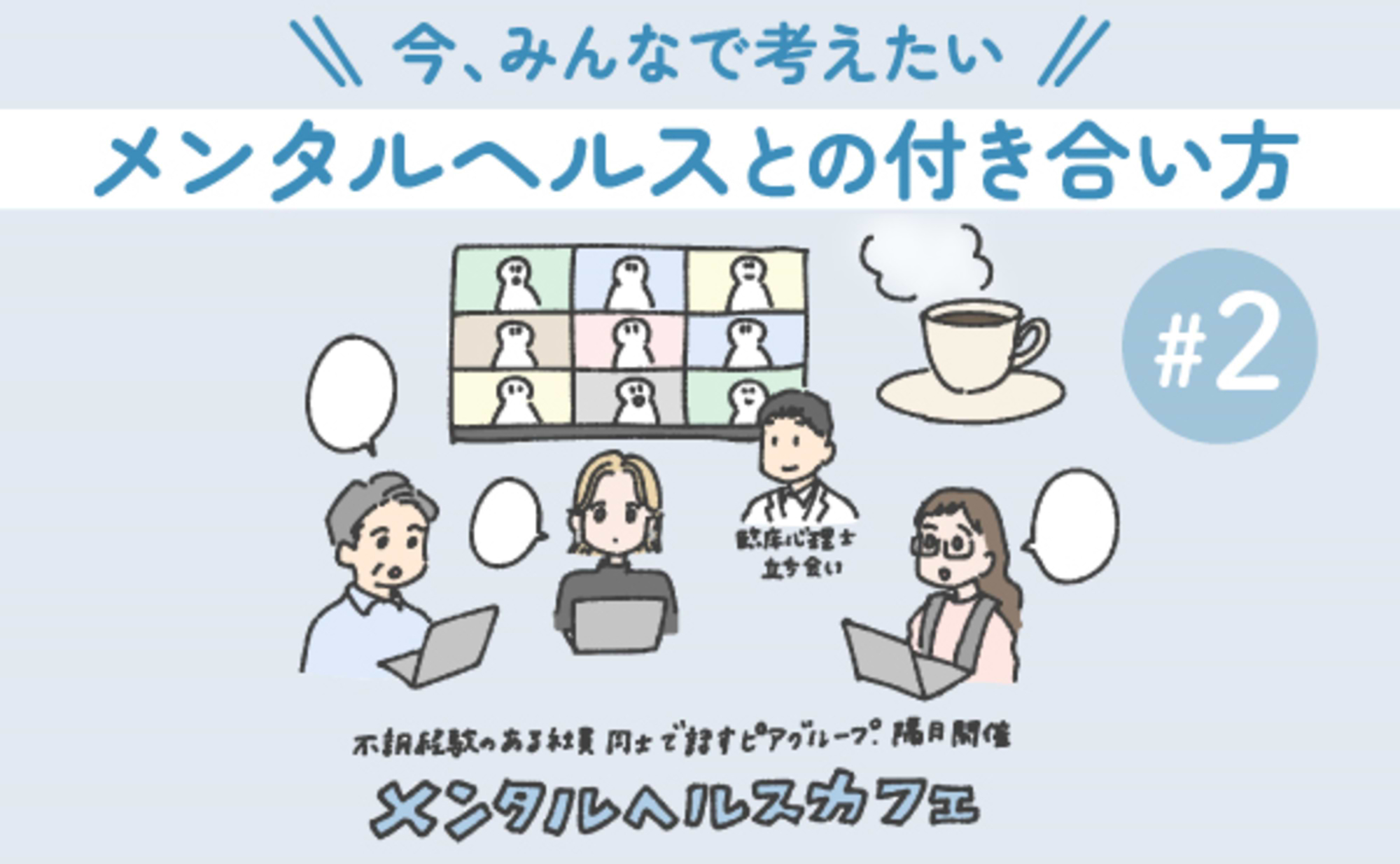
Many participants at the Mental Health Cafe also mention that topics related to mental health are often difficult to relate to personally and tend to be pushed aside.
At the Mental Health Lab, we believe mental health issues are something anyone can experience—they are very close to home. Furthermore, while the scale may vary, everyone experiences fluctuations in their mental and physical state. We view these fluctuations not as something to overcome or eradicate, but as something we live alongside throughout life.
However, the causes, symptoms, coping methods, and the specific worries and emotions experienced when facing mental health issues vary greatly from person to person. This makes it difficult to provide uniform answers or step-by-step solutions.
Therefore, as a first step, Mental Health Lab created a space to hear employees' experiences with mental health challenges. This was the internal webinar I discovered on the company intranet after my leave of absence. Held in July 2021 for dentsu Japan employees, it was titled "Hear from Namikawa and Dr. Yusuke! Experiences with Mental Health Challenges and How to Cope."
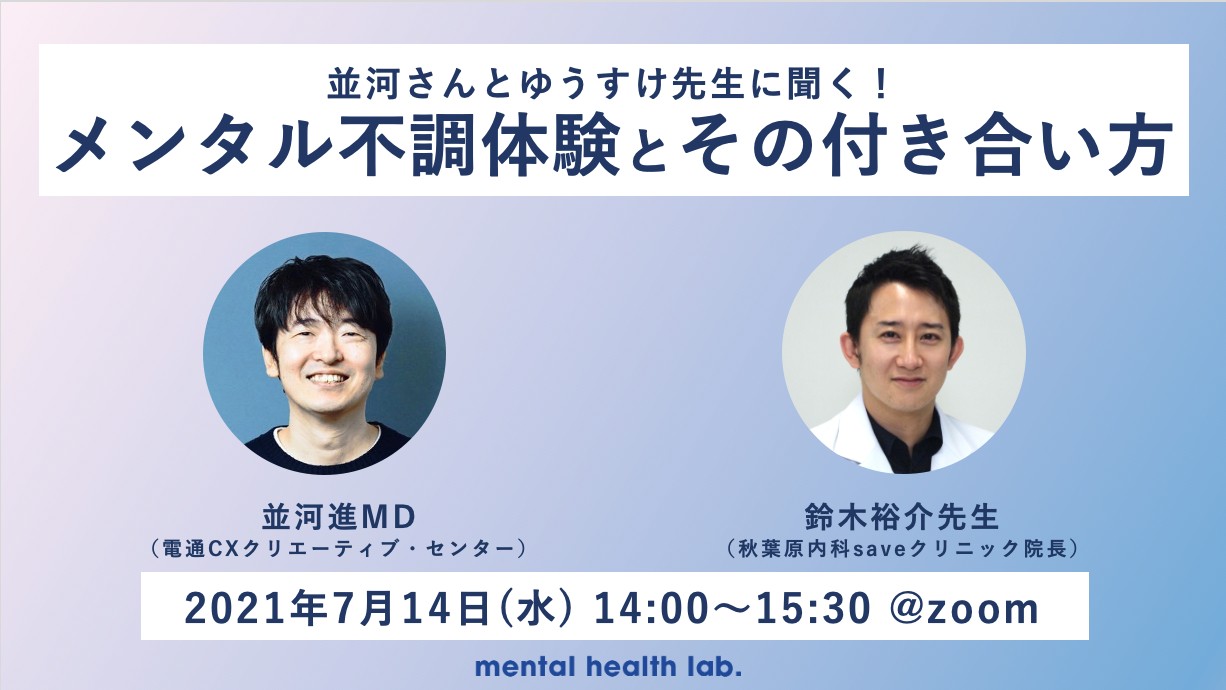
Held in a hybrid format combining in-person and online participation, the webinar featured Lab member Namikawa sharing his own experience with mental health challenges, with insights provided by Dr. Yusuke Suzuki, a psychosomatic medicine specialist.
Reflecting on that time, Watanabe, the lab representative, notes that this was also the Mental Health Lab's first event.
"Back in July 2021, there was still a cautious atmosphere within the company about discussing mental health. But we wanted to help ease that atmosphere. Of course, we weren't forcing anyone to open up, but we wanted to create an environment where talking about mental health felt normal, and where everyone could feel comfortable navigating their own mental health challenges. That's why we pushed to make this event happen."
Namikawa, who shared her personal experience during the webinar, said:
"I did feel hesitation and fear about sharing my own story. But I decided to speak because I hoped that hearing my experience might help someone feel even a little bit better, thinking 'I'm not alone.'
I compared my experiences to an RPG, using phrases like 'my hit points dropped' or 'I learned something important through this struggle and actually leveled up,' trying to keep the expression light and not too heavy."
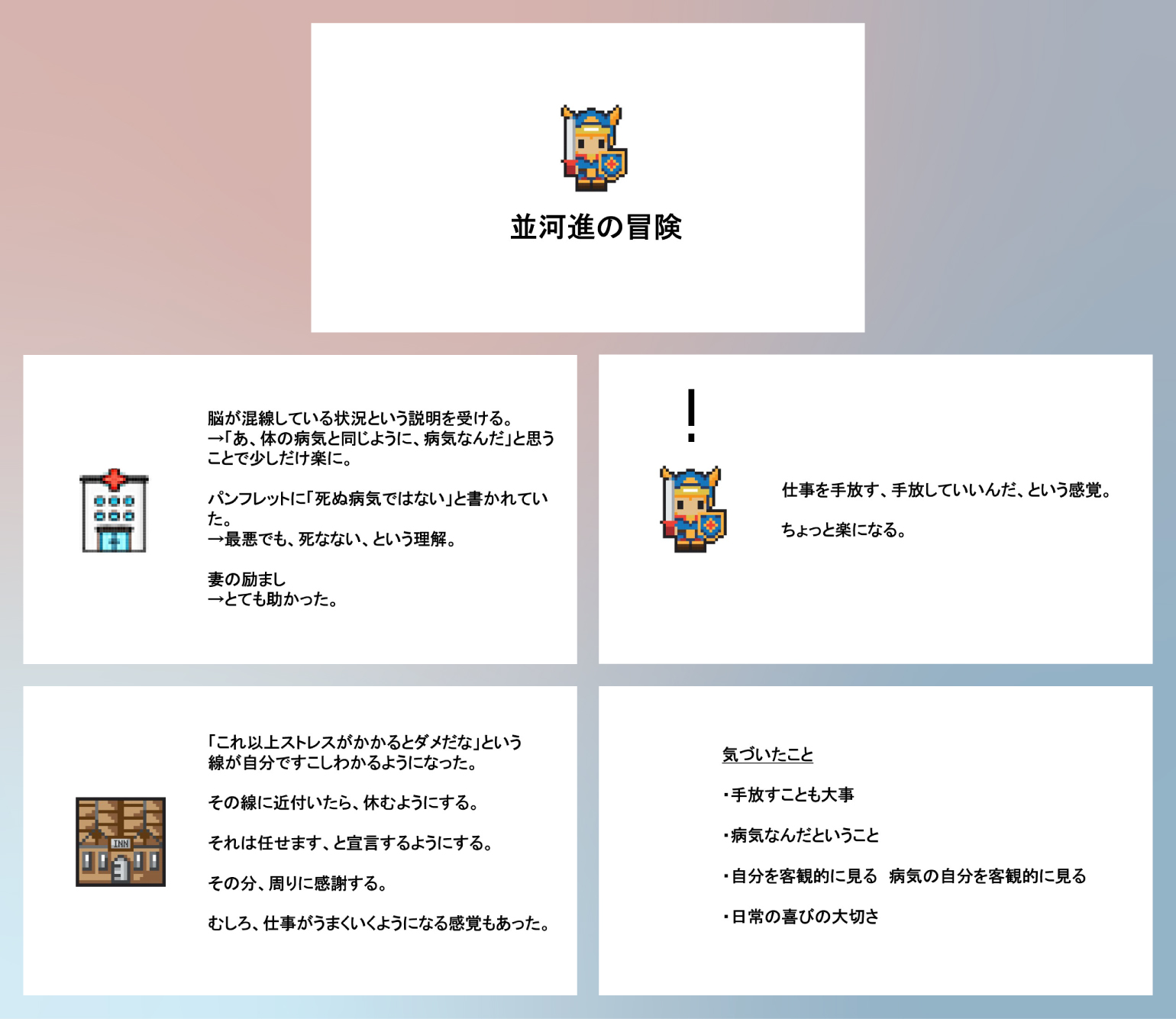
Among the participant feedback,
"I was struck by the comment that they felt a company's strength lies in its ability to speak openly about its weaknesses."
he recalls.
This wasn't a seminar sharing flashy success stories or award-winning examples. Instead, it involved sharing personal experiences of struggling—in a way, exposing one's own vulnerability to the entire company. It was likely the first attempt of its kind within Dentsu Inc.
Though voluntary, nearly 500 people attended this webinar, and 400 feedback comments were submitted. Participants included those experiencing difficulties, those not experiencing difficulties, and those not experiencing difficulties but wanting to learn.
"I felt relieved knowing I'm not alone,"
"I gained some understanding of what people experiencing burnout go through,"
"If even Mr. Namikawa can experience burnout, maybe I shouldn't blame myself too much if I do too."
The "Experiencing Mental Health Challenges and Coping with Them" series has been held four times to date, with speakers including dentus Japan executives and Lab Director Watan
The "Experiencing Mental Health Challenges and Coping with Them" series has now been held four times, featuring different speakers including company executives and Lab representative Watanabe. Over 1,000 dentsu Japan employees have participated cumulatively.
What this event reaffirmed, beyond the content itself, was the importance of "who is speaking." At the time, Namikawa was well-known within the company as a creator. Even if mental health issues still felt like someone else's problem, many employees participated thinking, "If it's Mr. Namikawa speaking, I want to hear it!"
Indeed, for me, Takemoto, experiencing "mental health issues" was something that suddenly came out of nowhere. I watched the recording of this webinar with a feeling of grasping at straws.
In recent years, we've seen more celebrities and athletes openly discussing their own mental health struggles and sharing information. Slowly but surely, it feels like more people are starting to see mental health issues as something relatable. Whatever the trigger, I consider it incredibly valuable that more people are developing an interest in mental health.
Simultaneously, starting this year, the Lab is also focusing on expanding the sharing of "experiences of distress among regular employees." This is because distress exists close to everyone, and these experiences are diverse and difficult to categorize.
For example, we publish personal accounts on the Lab's internal site. During Dentsu Inc.'s 2025 DEI Month (*3), we hosted a light-hearted webinar titled "Dissecting 'Feeling Overwhelmed'," based on employee survey data collected by the Lab. Additionally, Lab members share their personal experiences with mental health challenges at DEI events held by other Dentsu Group companies.
※3 DEI Month: A period during which companies and organizations intensively run related events and programs over a month to promote understanding and practice of Diversity, Equity, and Inclusion.
Training to Learn Appropriate Responses for Those Experiencing Mental Health Challenges
To create opportunities for interaction with those who have not personally experienced mental health challenges, we are also developing training programs based on the voices of those who have experienced mental health issues, aimed at raising awareness and knowledge about mental health.
One such program is the "Recognizing Bias Toward Mental Health Issues" training. This was part of a project promoted by Yuko Kitakaze, Global Chief Sustainability Officer of the Dentsu Group, and was implemented for Dentsu Inc.'s management level in 2023.
The goal was to create time for management to consider how employees could work better, rather than viewing those experiencing mental health issues as difficult to interact with or treating them as special cases.
On the day, Lab member Namikawa took the stage. Alongside explaining mental health issues from a personal perspective, she shared her own experiences. She also introduced numerous voices from individuals who have experienced mental health challenges, including "common biases about mental health" gathered at previous Mental Health Cafes, and "responses that were appreciated versus those that weren't appreciated during periods of distress."
Following the training, an optional "Mental Health Café" for managers was held, providing time to consider how to respond to those experiencing mental health issues—a situation without manuals or clear answers—and to reflect on their own mental health.
As the Mental Health Lab itself is an ERG, we always collaborate with HR, the health promotion section, and the company doctor when organizing internal events, and we consistently provide information about the company's official counseling services.
Furthermore, for every event, just like in running the Mental Health Cafes, we emphasize thorough safety considerations and repeatedly stress the importance of engaging with each individual on a personal level.
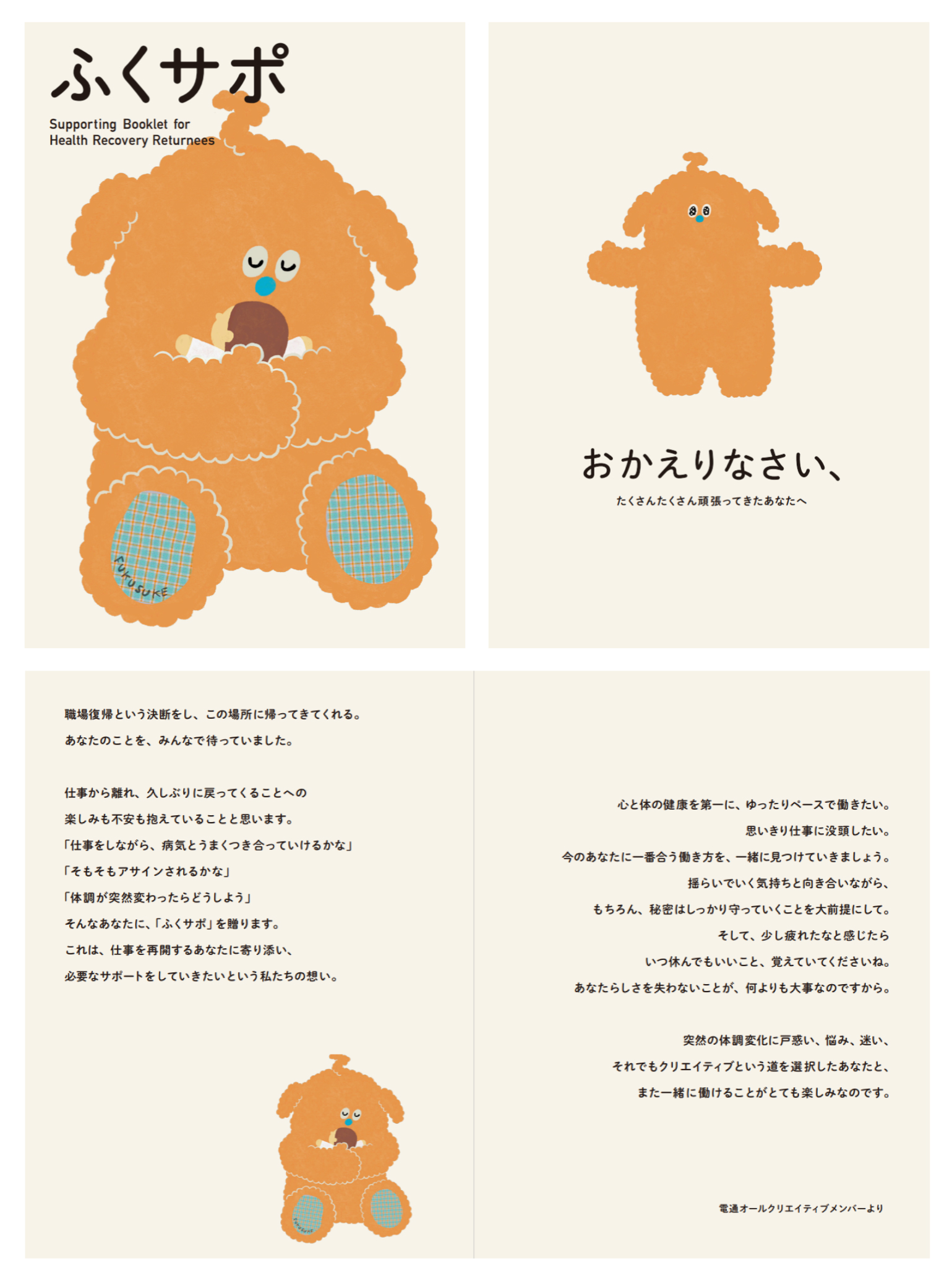
Recently, leveraging our experience of supporting those who have experienced mental health challenges, listening to their voices, and continuously sharing their perspectives, we have participated in planning support actions for employees returning from medical leave and have also been involved in consulting on the expression of advertisements related to mental health.
The Future of the Mental Health Lab
Communicating about mental health is never easy.
Are we pushing anyone too hard or causing harm? Are we reinforcing stigma or risks associated with mental health issues? In a for-profit company, will saying "It's okay to pause" be met with resistance?
There are also unique challenges specific to ERGs. Budget is one thing, but finding time outside of work for a voluntary project, maintaining motivation, and ensuring inclusion of diverse backgrounds are others. Over the past five years, we've listened to each individual's voice, steadily growing our team, and nurtured this initiative step by step with care.
We hear that initiatives like ERGs are spreading across various companies lately. If there are groups currently working on mental health or considering starting such efforts, we'd love to exchange ideas.
Additionally, if you're facing challenges with mental health awareness or supporting those experiencing difficulties, we might be able to offer support from an ERG perspective through our café operations, webinars, or study sessions. Please feel free to reach out.
The Mental Health Lab's journey continues.
The fact that you are reading this article right now is, in itself, a tremendous achievement for Mental Health Lab. From Mental Health Lab, from Dentsu Inc., and from both you and me, we will continue our activities aiming for a society where "thinking freely about mental health" and "being able to continue working even with mental health issues or related limitations" become the norm.
Mental Health Lab
mentalhealth@dentsu.co.jp
Was this article helpful?
Share this article


Newsletter registration is here
We select and publish important news every day
For inquiries about this article
Back Numbers
Author

Mental Health Lab
Nao Takemoto
Dentsu Inc.
Marketing Consultant, Marketing Bureau 5
Susumu Namikawa
Dentsu Japan
Chief AI Officer / Executive Creative Director / Chief AI Master
Advertising Doujinshi Commu-Shifu: My Intellectual Adventures with the Stray BagMom's Potential ValueDentsu Design TalkCorrespondence Regarding Communication ShiftThe Near Future of Advertising from the Device's PerspectiveThe Case for People-Driven Marketing That Connects with IndividualsThe DX Engine Driven by Treasure Data and Dentsu Inc.Organization vs. CreativityTo be supported, loved, and sell for the long haul. Fanbase CX ProgramMonthly CXSpotify Opens the Future of Audio AdvertisingHitachi, Ltd. × Dentsu Inc. × Dentsu Digital Inc.: Tackling Social Issues with Generative AI!How We All Want to Approach Mental Health TogetherGO Future: Growth Officer, Speaking of the Future
Haruka Watanabe
Dentsu Inc.
Creative & Knowledge Promotion Center
Producer