
Note: This website was automatically translated, so some terms or nuances may not be completely accurate.
Kenji Yamamoto × Shusaku Hirota: Work Methods for Those Prepared to Take Risks
In this era of rapid change, where even the near future is unpredictable, we must move beyond following precedents and conventions to proactively discover new roles and ways of working within society. Shusaku Hirota of Dentsu Inc.'s Platform Business Division goes to hear from people who have found and are practicing such new ways of working, not just within the advertising industry.

Leveraging his background in engineering, Shusaku Hirota analyzes consumer needs and information diffusion patterns from social data. He then applies these insights to communication activities and creative development. Currently within Dentsu Inc., he is pioneering a new work style called "Communication Planner." For this discussion, Hirota chose Kenji Yamamoto, CEO of Sumally Inc., the company behind Sumally—a social media platform that creates connections through objects. After joining Dentsu Inc. as a new graduate, Yamamoto moved to Condé Nast Japan, where he became an editor for GQ JAPAN. What does Dentsu Inc. look like today through the eyes of Mr. Yamamoto, who brings editorial experience and now drives new service design as an entrepreneur? What should an advertising agency be?
Theme① What inspired you to launch "Sumally"?
Yamamoto: I've always loved objects. For instance, I felt it was a shame there wasn't a public place where you could see every Nike sneaker model. Beyond sneakers, I thought creating a place to organize and preserve human-made objects might be part of humanity's mission. So, I first considered creating an encyclopedia of things.
Then I started thinking about what form an encyclopedia would take in the 2010s. Naturally, having photos and knowing what something is would be essential. But I also arrived at the idea that, to truly identify an object, it's crucial to know "who wants it," "who owns it," and "who is selling it." As the next step, I envisioned a form of communication where you follow people whose tastes align with yours, and their "wants" and "haves" flow to you. When you "want" something, it flows to your followers too.
By gathering people there and building a rich list of items, we could ultimately reform the current structure of commerce. That's the vision we're pursuing now, taking it as far as we can.
*****
Mr. Yamamoto, now on the service-building side as an entrepreneur, mentions the risk-taking mindset of agency workers and emphasizes the need for resolve. Mr. Hirota also seems to sense that work styles are changing.
Theme② How Far to Commit

Yamamoto: An acquaintance at Dentsu Inc. mentioned wanting to pursue a business model where they receive a fee plus additional performance-based compensation. From my perspective as someone running a business, I can't help but feel, "Why should we have to pay performance-based fees to an advertising agency?" If it's performance-based compensation where they take the risk if it fails, that's fine. But if not, as someone with a sense of ownership, I think there inevitably becomes a significant difference.
Hirota: It's a question of how deeply you commit. That also impacts our work style. My vision is that as communication expands beyond paid media into owned media, advertising agencies might increasingly function like staffing agencies. For example, someone commits fully to an owned media project as that company's employee for three years, taking responsibility for things like UX (user experience). Only then can we even talk about fees, meaning our work style will inevitably have to change.
Yamamoto: I think shifting to a performance-based business model is one direction for ad agencies. However, performance-based pay without taking risks is hard to agree on, right?
*****
As a business leader, Yamamoto-san demands a proactive mindset toward work. Hirota-san asks about the kind of talent and essential qualities Yamamoto-san and Summary seek.
Theme③ What Kind of People Does Summary Need?
Hirota: What qualities do you look for in your own employees?
Yamamoto: Since the company is still small, first and foremost, we need excellent engineers and excellent data analysts.
Hirota: What would be the composition of the smallest team unit?
Yamamoto: First, one engineer. Next, someone to analyze the data—a data analyst. Finally, a storyteller. But often, nothing gets started without the storyteller. That's where I come in.
Hirota: In our case, I feel we haven't approached service design with that kind of mindset.
Yamamoto: When considering the organization, it's about determining at what level and layer to view the PDCA cycle. There are various layers, but fundamentally, web services require at least a structure where the PDCA cycle is run and connected as a core function.
*****
Hirota-san, who is once again feeling the importance of PDCA. Yamamoto-san says that this way of thinking is necessary when building a platform. Here too, the emphasis is on tackling it with resolve.
Theme④ Building a Platform That Maximizes Existing Resources
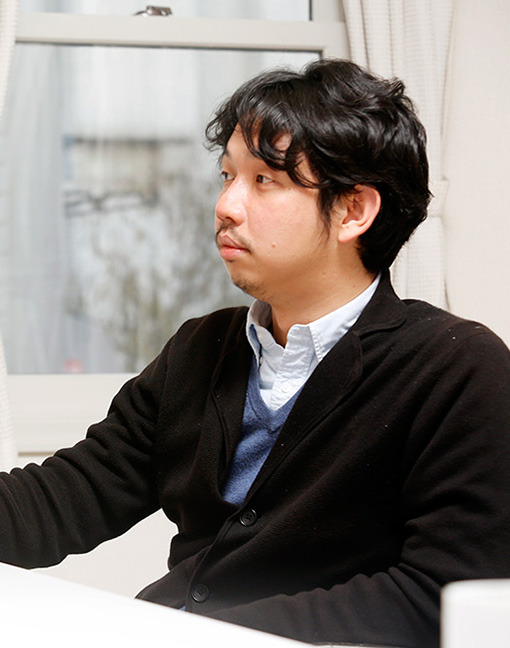
Hirota: Right now, I go to the client's office every morning to verify the results of yesterday's activities and keep the PDCA cycle spinning. Within that continuity, I'm constantly accumulating user insights about why this creative worked or didn't work, aiming to raise the probability of success even slightly. In other words, I'm exploring a style of operational communication—like the PDCA-driven improvement Yamamoto-san does daily with "Sumally."
Yamamoto: Traditional advertising campaigns are like fireworks displays, right? There's no need to run PDCA there; the key is how beautifully you launch the fireworks. I don't think there's much need for accumulation. If there's a need for accumulation in an ad agency's work, it's probably when creating new systems or establishing rules.
Hirota: I wonder if advertising agencies could potentially create services like "Sumally."
Yamamoto: I'm not sure if it's appropriate for an ad agency to create services for general users. If an ad agency were to create a service, it might be something like a system that automatically maximizes ROI by accurately measuring TV commercial effectiveness and continuously improving it.
Hirota: So it's about maximizing the resources we already have.
Yamamoto: I think it would be difficult to create services like Facebook or Google from scratch now. Moreover, advertising agencies have traditionally worked based on client requests. To take the lead and create a service ourselves, we need a vision and a compelling story.
Hirota: And it requires resolve.
Yamamoto: Hideo Yoshida, Dentsu Inc. fourth president, focused on television—a medium just emerging at the time—and built the platform we know today for TV and TV commercials. While I understand the current business model of responding appropriately to client requests, I think the company would become even more exciting if it committed more to creating platforms for the era, even if it meant taking risks.
Hirota: That sense of vision as a story you tell yourself, that commitment... I think what's still needed in advertising companies today is that kind of resolve to take action yourself. Thank you very much.
Read the full interview on Adtai!
Was this article helpful?
Share this article


