
Note: This website was automatically translated, so some terms or nuances may not be completely accurate.
 The Present and Future of Design and Innovation by frog [19/49]
A Bold Experiment in the Design Process

frog
This article presents content originally published in "Design Mind," a design journal operated by frog, under the supervision of Mr. Noriaki Okada of Dentsu Inc. Experience Design Department.
Challenges Designers Can Take on in Collaborative Work
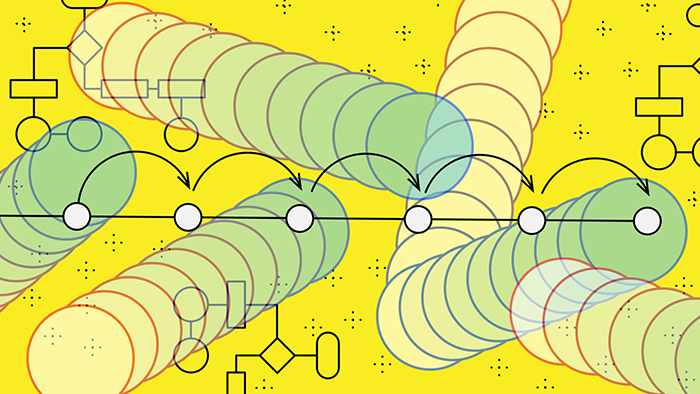
Before graphic design went digital, most designers worked through a "linear process." The beginning and end were clear; once the printed piece was complete, the job was done. However, in a digital environment, even after delivery, minor adjustments, redesigns, or theme changes can occur. Whether the designer who initiated the project is aware of it or not, the design continues to live on.
This led me to wonder: Could we create an environment better suited for collaboration, based on the premise that designs live on beyond the initial designer's involvement? What would a "non-linear process" suited for the digital environment look like? How would it function within a team? What does bold experimentation mean in a design environment?
In the ever-evolving field of graphic design, bold challenges are essential for learning, growing, and moving forward.
Initially, I thought: What if we adapted the collaborative approach between designers and developers seen in product design to the graphic design process? Wouldn't the final deliverables improve if individual designers were more involved throughout the entire process, deepening their shared skills and participating in design decisions? However, some might find this approach difficult.
One of the joys, or even privileges, of being a designer is the freedom to work at your own pace. Yet, by advancing task sharing within the team in some form—by providing interactions and visuals as a collaborative foundation—we might break through traditional work patterns.
Last year, I decided to deconstruct my approach to projects and processes, seeking opportunities for improvement, progress, and innovation. I developed two approaches—"linear" and "cyclical"—and experimented with them on two ongoing projects with frog's project team to refine the process.
Linear Approach: An attempt at collaboration focused on efficiency and rapid completion
The first project involved a request to transform a digital experience. The scope required rebranding a digital platform, creating fresh content, and delivering a working prototype within a tight timeline. The team's designers decided to try a design collaboration approach. This resulted in a highly engaging and efficient working environment.
First, visual designers spent four weeks defining the brand and securing client approval for its direction. The next four weeks required determining how to design and build the prototype. To meet this time constraint, the team had to design the interaction journey and visuals simultaneously, so they developed a shared library.
Interaction designers utilized components and modules created by visual designers like building blocks to design the journey. While visuals were defined in considerable detail before the project started, this approach made it easier to incorporate changes and facilitated smooth sharing across the entire design team.
Applying this approach to other similar projects revealed that while mass production might be difficult, collaboration across various design-related disciplines benefits the overall UX. This meant improved efficiency, more innovative visuals, and compelling interactions.
The increased efficiency allowed the team to dedicate sufficient time to details while working at the capacity of four people. Simultaneously, it enabled a more challenging approach to the visual aspects.
Later, we tried this approach on another client's project, but this time there was no prior work to clearly define the branding for the digital experience. The challenge was figuring out how to start from scratch.
Many designers and stakeholders proposed different solutions to this problem. The most common suggestion was to use "Material Design" (※1), Google's design guidelines. Others proposed using systems like "UX Power Tools" (※2) as a design framework.
These are excellent solutions, but they aren't custom-made, so mastering them takes time. Learning UX Power Tools took a designer new to Sketch (a UI design tool) about four weeks. A seasoned product designer might be faster, but we aren't an in-house team belonging to a specific company. We need flexibility to quickly learn and handle various programs and standards according to each client's requirements.
A major reason for the less-than-ideal results was the lack of sufficient time to thoroughly consider visuals before creating interactions.
※1 Proposed by Google in 2014. Incorporated elements like light, shadow, and depth into flat design to make interfaces intuitively understandable across all devices.
※2 A design system UI kit for Sketch (UI design tool).
Iterative Approach: Starting with a Universal Standard Set
For the next project, we tested whether we could create a set of updatable data compatible with any brand and deliver the final design to the client in the shortest possible time.
Having a universal design makes it easier to handle unforeseen circumstances. The team gains their "most valuable asset" while also leaving undefined backups for future development.
This concept gained team approval. Everyone immediately wanted to adopt this approach for their own projects, and the resulting additional projects enabled us to create unprecedented designs with developer collaboration. This non-linear approach allows designers to engage with various aspects of design without disrupting other workflows or updates.
However, a challenge with this method is that the files become so complex that it's extremely difficult for newcomers to the project or those wanting to introduce new styles, rather than generic ones, to accept the system. This procedure is hard for designers to swallow, so we're still exploring solutions.
All designers start projects by opening a sketchbook and creating concepts, but this automated behavior must be changed. To create digital experiences, we must begin by considering the goals each project demands.
Setting aside brand differentiation, many components seen in the digital realm are fairly standardized. A button is a button and must be recognized as such to trigger immediate action. Unless the project's purpose is to change behavior, altering basic actions is neither necessary nor recommended.
When multiple tasks proceed in parallel, defining the brand and synchronizing the latest information simultaneously can significantly simplify the work. As with the initial experiments, designers are strongly encouraged to collaborate fully with each other.
We haven't mastered anything yet, but we aim to spark widespread interest, drive change, and push boundaries by taking immense risks. Ultimately, this approach will take just as long to fully master as it does to fully utilize frameworks like Material Design or UX Power Tools.
Process Improvements for Further Advancement
Refining the initially tested process could reduce work time. However, it requires a foundational brand definition. The second test revealed that while the work becomes technically complex, it allows building systems without custom-crafting every UI element. Yet, mastering and managing this approach requires further effort.
With this in mind, I want to keep challenging the limits of the process to spread the best designs born from designers and turn them into products. Simply rethinking how computers and humans collaborate might lead to innovative work and unexpected results.
Implementing change is hard work, but change is always wonderful.
Was this article helpful?
Share this article


Newsletter registration is here
We select and publish important news every day
For inquiries about this article
Back Numbers
Author