Note: This website was automatically translated, so some terms or nuances may not be completely accurate.
 Branding in the Age of Co-Creation [8/11]
Organizational Branding to Accelerate Innovation: Goodbye to Corporate Brand Management

Masanori Fukada
Panasonic Corporation

Keisuke Konishi
Dentsu Inc.
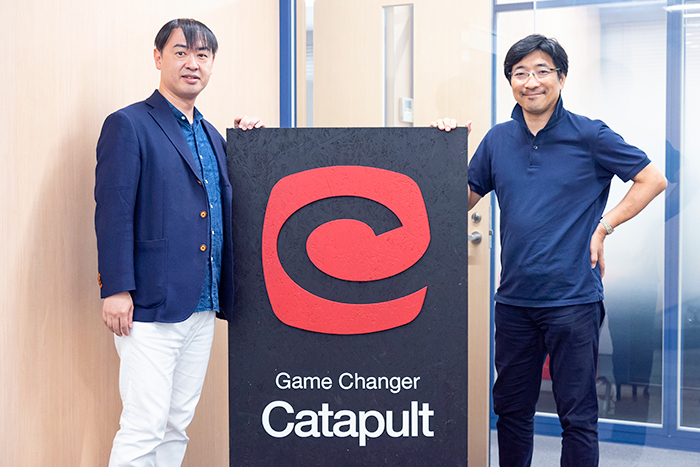
How can large companies and organizations create a culture of innovation through co-creation? This time, we spoke with Masanori Fukada, representative of Game Changer Catapult, who launched an innovation business organization from Panasonic's Appliance Company.
Creating the "Edge" that Generates Innovation
Konishi: Game Changer Catapult, which you launched and lead as CEO in 2016, is a highly unique and pioneering organizational branding initiative. It deliberately operates outside the "Panasonic" corporate banner to tackle new ventures. Could you first explain the philosophy and background behind this?
F ukada: Panasonic has operated a stable business as an electronics manufacturer for 100 years. However, we now live in an era where technology, products, manufacturing processes, and consumers are undergoing drastic change. We discussed "what to do when the very foundations of business are constantly shifting" with Dr. John Seely Brown, former Director of Xerox's Palo Alto Research Center ( PARC).
He stated, "20th-century business activities differ from 21st-century ones. The 21st-century model requires continuously transforming oneself, premised on the ability to learn." Just as Amazon and Google constantly expand and transform their business domains, I felt Panasonic must have the momentum to declare, "We're no longer an electronics manufacturer," starting in its 101st year.
Furthermore, change doesn't happen at headquarters or in core businesses; it always occurs at the "edge" – in business divisions and similar units. In other words, to generate disruptive innovation and new businesses, the key is how to create edges that foster change.
Panasonic has an internal company called the "Appliances Company," which provides home appliances and space equipment products. In 2015, the then-president told us, "Discuss what the Appliances Company should be like in 10 years." In response, we proposed that Panasonic should become a company "leading the lifestyle services industry." Normally, submitting a proposal ends the matter, but we were told, "Actually go do it," and were even given a budget.
Konishi: And as an edge initiative, Appliances Co. launched an organization called Game Changer Catapult (hereafter Catapult). This wasn't positioned as just another new business division within a large corporation. It was designed to function as a completely distinct organizational entity, with its own culture, decision-making processes, and open innovation mindset.
Fukada: Precisely . We created the name as part of organizational branding to break free from the traditional corporate framework. We raised a clear flag and designed a logo so external partners would say, "We want to work with Catapult" or "We want to be involved."
Because of Catapult's red brand color, we're sometimes called "Red Pana" (laughs). We deliberately contrasted it with Panasonic's blue corporate color. Essentially, there's a slight disconnect between what Panasonic promises its customers and proposing entirely new value through disruptive innovation. So we realize that externally. Ultimately, projects can join Panasonic or not.
Konishi: The name and logo certainly have an edgy feel. I often see cases where new business divisions within large corporations struggle to succeed due to organizational culture, accountability, and low risk appetite. As a model for venture-style business entities, Catapult seems to offer valuable lessons for many large corporations.
How do you define Catapult's unique purpose and scope of activities as an organizational brand?
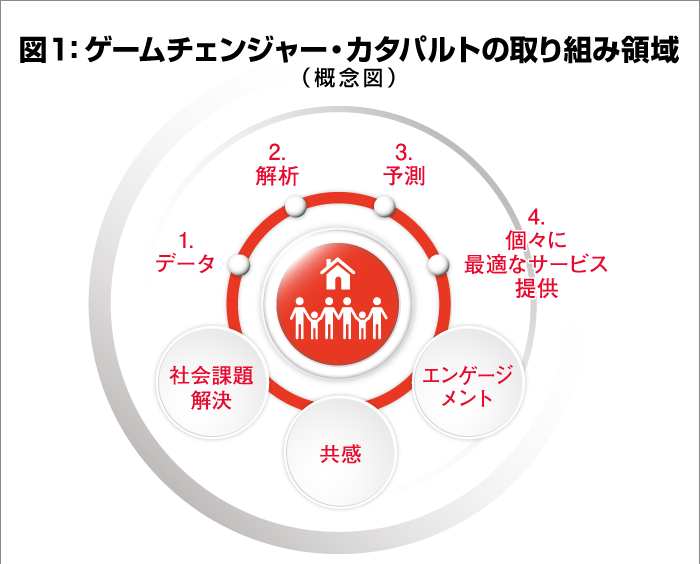
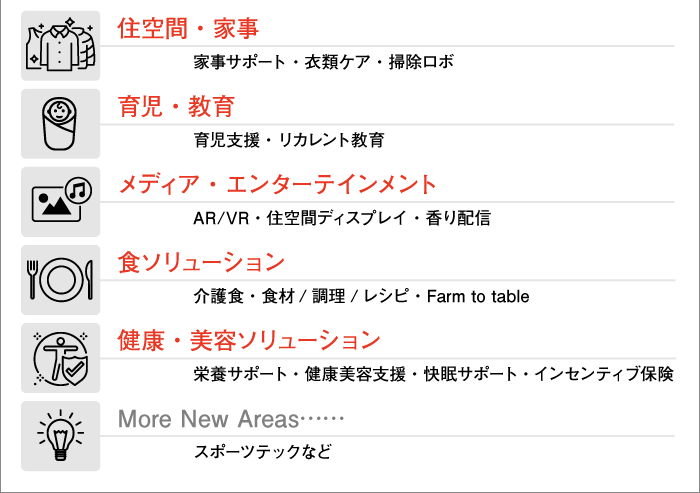
F ukada: Our mission is to shape the future "Kaden." This "Kaden" encompasses more than just electrical appliances; it's a broad concept including the shift from products to experiences, service businesses, and value delivery through content businesses. It's not always easy to grasp, but we aim to make it a kind of experimental ground.
Panasonic is an 8 trillion yen company, primarily focused on hardware. However, all companies will inevitably become service-oriented businesses going forward. This is a Service-Dominant Logic ( ※2 ) approach. As an internal corporate accelerator, Catapult will generate new businesses based on this concept.
It's not just about changing the corporate culture; it's about creating new businesses and taking real action. Specifically, the vision is to expand the value of services and solutions that solve social issues and generate customer empathy and engagement. This involves moving beyond the home appliance domain into areas like "Living Spaces & Housework," "Childcare & Education," and "Media & Entertainment," as shown in Figure 1.
Furthermore, our culture champions "Unlearn" (discarding preconceived notions) and "Hack" (realizing new value). It's crucial not to be bound by past successes. We start from the premise that the ways of working learned from seniors no longer apply at all, and we consciously unlearn them. We believe it's vital to step outside the company's shell, continue learning flexibly, and above all, materialize ideas concretely and reflect them in our business.
Goodbye to "Corporate Brand Management"
Konishi: Hearing you speak, it struck me that in my own experience helping nearly 100 companies build their brands over more than 20 years, I've come to deeply regret one thing in recent years. It's that the brand of a large corporation—its "goodwill"—has now become a factor hindering innovation.
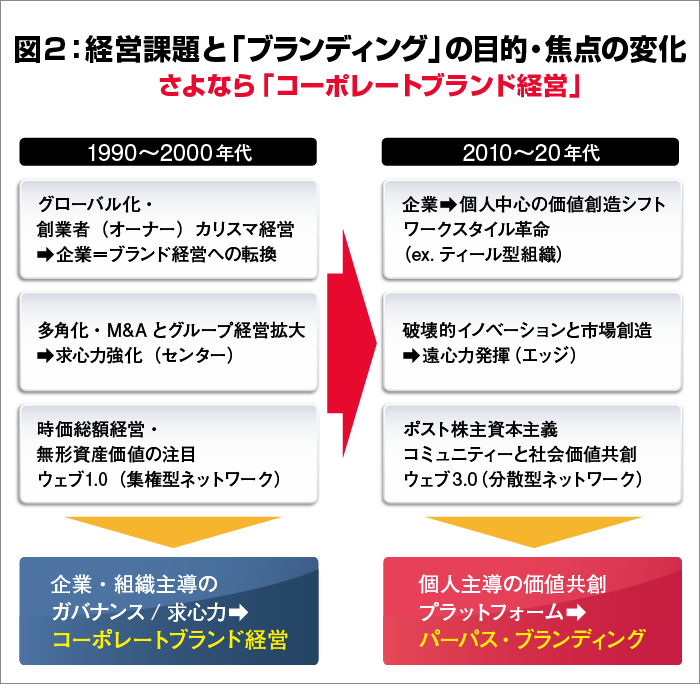
From the 1990s to the 2000s, corporate branding gained significant attention in Japan. This was largely driven by three factors: ① Corporate globalization and the shift from charismatic founder-led management to brand management systems; ② Strengthening centripetal force through business diversification, M&A, and group management expansion; ③ A focus on the value of intangible assets (like brands), often referred to as market capitalization management (Figure 2).
The purpose of branding at that time, particularly for large Japanese corporations, was often seen as a means to strengthen organizational cohesion and governance, visualize built intangible assets, enhance operational efficiency, and serve as a defensive strategy. Yet, with changing times, this "goodwill" has even become a burden.
Fukada: If large corporate brands can negatively impact innovation, it's precisely this "defensive" aspect. Even when they want to change, their established brand is too strong, symbolizing traditional values like quality, safety, and trust. So it becomes natural that they can't do new things. When they try to do something new and challenge those strong past values, it creates a mismatch within the existing businesses tied to that brand.
Konishi: Since the 2010s, disruptive digital innovation has accelerated business environment changes across all industries. Innovation and the shift to service-based business models have become the biggest survival challenge for large corporations. Rather, the centrifugal force at the edges that drives change has become crucial.
(Re-)branding is fundamentally a strategy to accelerate organizational transformation. Yet, traditional corporate brand management—the "goodwill"—has sometimes become an inertia slowing the pace of change. Although the shift was supposed to be from charismatic management to brand management, many overseas investors now believe Japan lacks bold business innovation outside owner-managed companies, making them reluctant to invest. A typical case is the creation of bland, inoffensive corporate slogans that represent the lowest common denominator, often a result of business diversification.
F ukada: That's also why we see the so-called conglomerate discount. Indeed, with Japanese companies often led by accommodating salaried managers, it's quite difficult to implement an approach where a visionary idea drives a business transformation within the company itself, knowing it will likely face resistance internally and from shareholders.
Even a company like Nike couldn't create the FuelBand ( ※4 ) internally, which drastically changed its brand image. They could only conceive of innovation as a "shoe company" focused on footwear. It wasn't about messaging; they shifted only after successfully materializing an entirely new concept.
Konishi: Furthermore, shifts in workstyles and the diversification of values are accelerating the transition from corporate-to-individual value creation. The traditional mindset of pledging loyalty to a single company's values is becoming outdated.
Another point: As creating markets through solving social challenges becomes increasingly vital in business, I feel that "value co-creation" driven by individual-led leadership—transcending the frameworks of specific companies or organizations—is now the focal point of contemporary branding.
To put it bluntly, isn't now the time to evolve beyond the traditional Japanese concept of "corporate brand management"?
※Continued in Part 2
※1 John Seely Brown: After serving as an assistant professor at the University of California, Irvine, he joined Xerox in 1978. He became director of the company's Palo Alto Research Center in 1990. Later, he co-founded the Detroit Center for the Edge. He serves as an advisor to various companies. His co-authored works include "Why IT Doesn't Change Society" and "The Philosophy of PULL."
※2 Service-Dominant Logic: A marketing framework that views all economic activities—including business and product sales—as "services." It emphasizes "value co-creation," where companies build marketing strategies from the perspective of creating value together with customers. Proposed in 2004 by marketing researchers Robert F. Rush and Stephen L. Burgoyne.
※3 Conglomerate Discount: Refers to the state where a large conglomerate holding numerous businesses through diversification or M&A fails to sufficiently generate shared management resources or business synergies, resulting in its (shareholder) value being assessed as less than the sum of the values of its individual businesses.
※4 FuelBand: A wristband launched by Nike in 2012 that quantifies and records all daily movements. As a pioneering proposal in wearable devices, it significantly enhanced the company's innovative brand image.
Was this article helpful?
Share this article


Newsletter registration is here
We select and publish important news every day
For inquiries about this article
Back Numbers
Author
Masanori Fukada
Panasonic Corporation
Appliance Corporation Business Development Center
Game Changer Catapult CEO
Keisuke Konishi
Dentsu Inc.
Solution Development Center
Senior Solutions Director