Note: This website was automatically translated, so some terms or nuances may not be completely accurate.
 Branding in the Age of Co-Creation [9/11]
The Future of Organizational Branding that Promotes Co-creation of Value: What is a Co-creation Platform Organization where Individuals Play the Leading Role?
Masanori Fukada
Panasonic Corporation
Keisuke Konishi
Dentsu Inc.
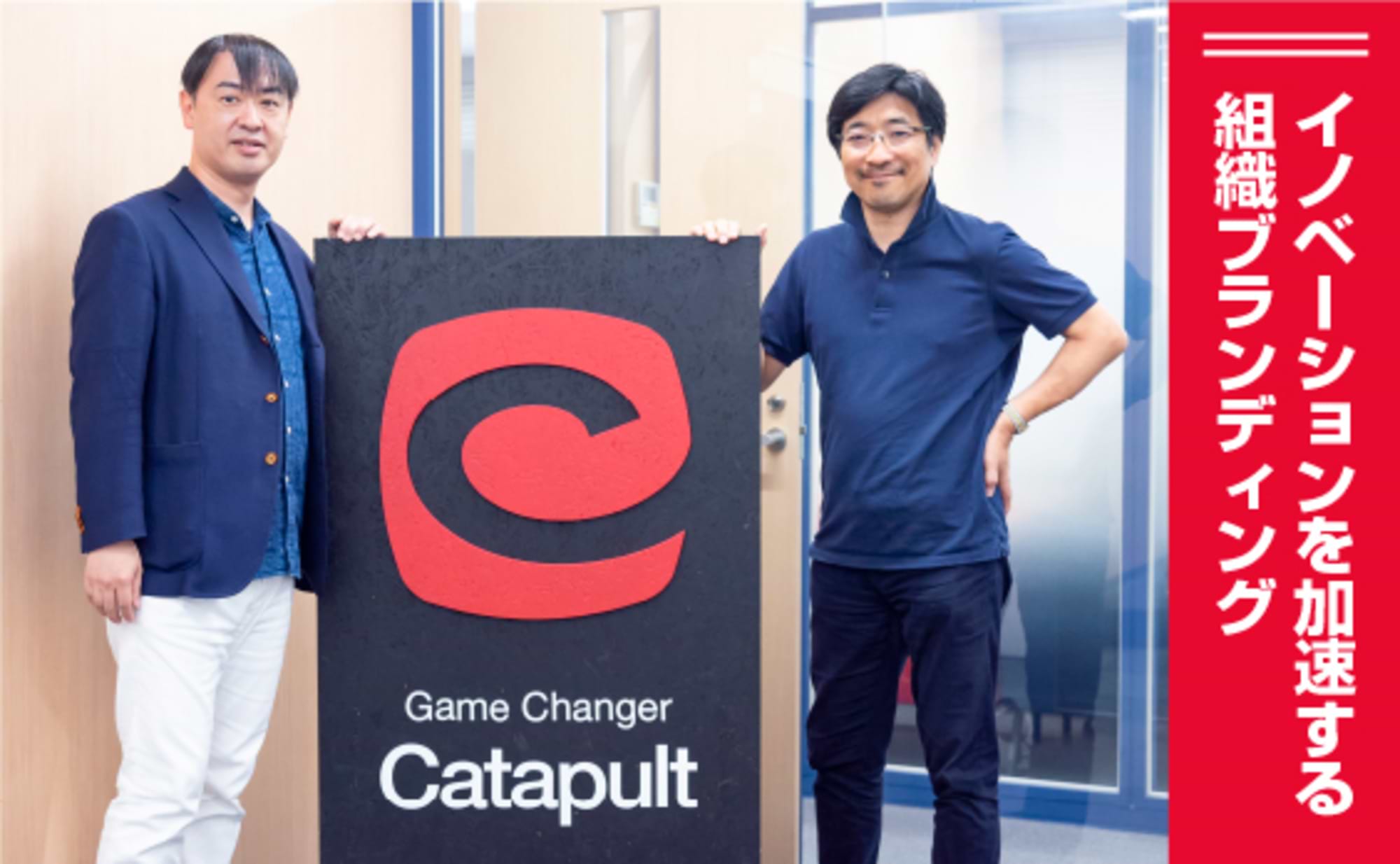
Following up on our previous interview, we spoke with Masanori Fukada, CEO of Game Changer Catapult, about organizational brands that change the way employees work and bring out their potential, and about co-creating new value that transcends companies.
What is Game Changer Catapult?
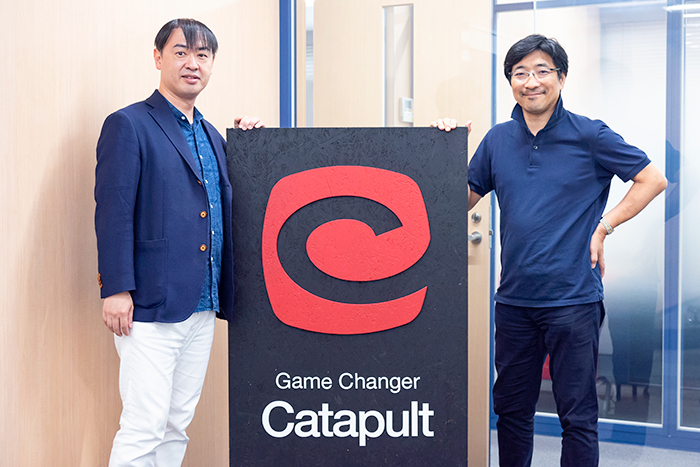
An open innovation project launched in 2016 within Panasonic's home appliance division, Appliances Company. To create the "Kaden of the Future," employees gather beyond organizational boundaries and collaborate with outside partners. They are working to create innovation.
Building an Organizational Platform Where Individuals Take Center Stage
Fukada: Game Changer Catapult (hereafter Catapult) is not merely a new business unit. It is also an organizational brand designed to transform work styles to create new value suited to the times.
In an era where open innovation, transcending traditional companies and organizations, is increasingly valued, barriers between large corporations, startups, and SMEs are lowering, and more people are freely moving between them. In this environment, I believe what matters is not a fixed corporate structure, but a brand that serves as a "platform where you can realize what you want to do."
While more people are choosing to join companies because they enable them to pursue their passions, I believe the role of organizational branding will increasingly shift toward purpose-driven communities where external participants can join, regardless of formal affiliation.
Konishi: That point offers significant insight into the organizational culture and workstyle issues many large corporations face today, not just within new business divisions. It's very interesting.
By the way, when building these purpose-driven communities or organizational engagement, I think the "purpose" – what we aim to achieve as a team and how much we can empathize with it – is crucial as a centripetal force. How has that been in your actual organizational management?
Fukada: That's still a challenge. Why? Because within large corporations, there are still relatively few people willing to take risks to pursue innovation. While some genuinely operate with a "purpose"-driven mindset to change the world, in cross-organizational gatherings, I get the impression many participate more for the enjoyment of the "sense of belonging" found within the community or network.
Then there are also many people interested in "improving their skills" or "self-development." In reality, I think participation motivations vary widely.
Therefore, while we set the organization's overarching purpose as purpose-driven, we don't necessarily require that individuals' motivations stem solely from "resonating with the purpose."
Konishi: The benefits gained from being part of the organization vary from person to person, and we don't push that too hard. Accepting diverse values and motivations is important, isn't it?
Another point: in terms of organizational branding, isn't it effective for large corporations to project distinct values and identities both internally and externally, especially from the perspective of co-creation with external partners?
Fukada: That's exactly what you call "co-creation branding." When co-creation is the theme, it becomes more important to communicate "This is the kind of organization we are" rather than asserting our own capabilities. We need to build a brand that serves as a "banner" – one that makes it easier for people to say, "If you're doing that, let's collaborate." Catapult also articulates its organizational identity with statements like "We're building the future of Kaden" and "We operate on a disruptive model (that challenges existing businesses)," which is why we often get approached by external parties.
Systematizing risk-taking and catalyzing human potential
Konishi: It's been four years since we started activities as Catapult. I believe we're seeing concrete results in terms of the organization's role and achievements, including contributions to Panasonic itself.
Fukada: Our approach involves two directions: top-down, where we test strategic ideas that could lead to future game-changers for the Appliances Company, away from existing businesses. Bottom-up, where we bring in themes that participants themselves are passionate about. We pursue both.
It's about effectively leveraging both the company's strategic perspective and the passion of participating employees. We support this by collaborating with external partners to build prototypes or execute strategic marketing, while providing dedicated staff support to motivated individuals.
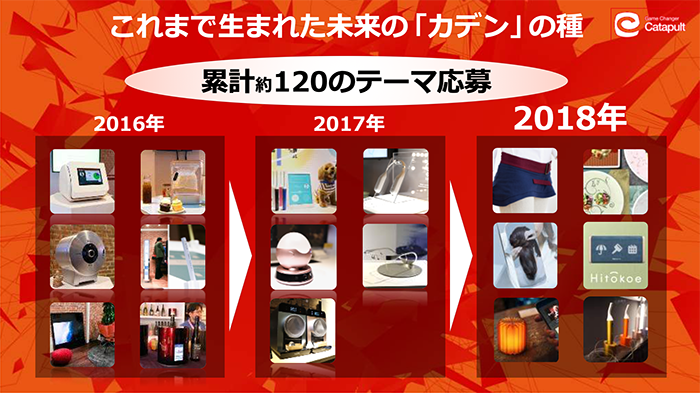
Over the past three years, more than 120 business themes have emerged. Five or six of these are under consideration for commercialization, and about two have already launched as actual companies under BeeEdge, the new business investment company where I serve as a director.
Examples include GIFMO, which is developing "DeliSofter"—a home appliance that softens homemade or store-bought meals for those requiring nursing care while preserving their appearance—and Mitsubachi Products, which is developing a hot chocolate machine business.
Konishi: Systematizing risk-taking and accelerating the commercialization process. In reality, large corporations face challenges like maintaining brand quality standards and reliability, plus constraints from existing businesses, making it difficult to venture into truly disruptive areas.
Fukada: Launching new ventures inherently carries risk, so the key is minimizing that risk. Another point: BeeEdge is a joint venture focused on rapidly commercializing business ideas buried within large corporations. It's funded by three companies—Panasonic, INCJ, and Scrum Ventures—with Panasonic as a minority shareholder.
Since the majority is venture capital, it allows for business risk hedging for the parent company. Moreover, because it's a company that embraces venture capital-like behavior patterns, we are actually learning from them.
The idea is that even if you fail, you should keep going until you succeed. For example, if you try 1,000 things and 990 fail, as long as 10 succeed, that's the world we're creating, and we should call that "success." It's a model of high output and high failure, but within that, we aim for real success.
Konishi: Another significant outcome is the catalytic effect of unlocking individual employees' initiative and potential, which can easily get buried within large corporate structures. By bringing in external talent capable of "0-1" (launching new ventures from scratch) and learning from them, we're creating intangible assets for the future—impactful for talent development and organizational culture change.
F ukada: We call Catapult graduates "Cataplists." There are now over 180 Cataplists within the company, primarily from the younger generation, and this number continues to grow. They are increasingly adopting concepts and approaches like UX ( ※1 ) and rapid prototyping ( ※2 ).
Inspired by these movements, our headquarters divisions have launched initiatives like Panasonic β ( ※3 ), Future Life Factory ( ※4 ), and 100BANCH ( ※5 ) as platforms for external innovation collaboration. The fact that so many are emerging simultaneously is, I believe, an invisible yet significant effect.
Even if we create businesses generating 1 billion or 10 billion yen in sales, the profit impact within a massive corporation might be small. However, the goal is that these very initiatives will strengthen our M&A capabilities and lead to a reshuffling of the entire company's business portfolio.
Co-creating future industrial clusters beyond corporate boundaries
Konishi: Do you have a vision for what Catapult should look like in 5 or 10 years?
Fukada: There are two perspectives. The first is Catapult as an entity within Panasonic. At Panasonic, portfolio restructuring is an ongoing process. Catapult will exist as a forward-deployed base, one or two steps ahead, shaping Panasonic's future. It may even contribute to companies beyond the Appliances Company.
The second perspective views Catapult as a form of new capitalism. Beyond Panasonic's boundaries, I believe it could also play a role in creating "future industrial clusters." This is because when restructuring business portfolios, companies often cannot solve societal challenges alone. Multiple entities—whether companies or organizations—must come together to build new industrial frameworks. For example, it could create frameworks to achieve the SDGs.
Konishi: That's precisely the focus for the coming era. It's often described as "shifting from ego systems to eco systems." In an age where entire value chains are interconnected through networks, the movement toward market creation will be driven not by platform competition where specific companies monopolize data and profits, but by open collaboration and the co-creation of greater social value.
Fukada: At Panasonic, we position home appliances and housing as "co-creation businesses." The trend of multiple companies forming partnerships to tackle challenges beyond any single company's capability will absolutely emerge. We should also expect drastic industry realignments, like the recent merger of Daimler and BMW's car-sharing businesses in Europe. Recent examples like food tech and sports tech show this trend. We hope Catapult can become an entity that creates new frameworks for co-creating value, transcending traditional corporate boundaries.
(After the discussion)
Accelerating Innovation Beyond Corporate and Organizational Boundaries
Amid the challenge of innovation units within large corporations often struggling to function effectively, Game Changer Catapult has established itself as an independent organizational brand from Panasonic. It operates as a highly unique "dynamic entity" that embodies different cultures and visions. Furthermore, this kind of collaboration through the "externalization of " of organizations and talent holds significant potential as one framework for co-creating social value beyond corporate and organizational boundaries – something increasingly demanded in the coming era.
※1 UX = User Experience. This refers to an approach that creates value from the perspective of "experience design" for the user, rather than focusing solely on technology, products, or service functions.
※2 Rapid Prototyping: In product development, creating prototypes in a short timeframe while conducting user evaluation, verification, and improvement processes from an early stage.
※3 Panasonic β: An innovation strategy hub established by Panasonic in Silicon Valley. Positioned as a "mother factory for mass-producing innovation," it fosters cross-functional collaboration that transcends organizational and functional boundaries.
※4 Future Life Factory: A design studio established by Panasonic in 2017, specializing in advanced development. It identifies emerging signs of future lifestyles and values, shaping compelling ideas through unconventional thinking.
※5 100BANCH: A "testing ground for enriching the world 100 years from now" established in 2017 by Panasonic, Loftwork, and Café Company in the JR Shibuya Station New South Exit area. It serves as a hub for over 100 innovation projects.
※6 car2go, the car-sharing business of the Daimler Group, merged with its competitor DriveNow (BMW Group) in 2019 to form the new company Share Now.
Was this article helpful?
Share this article


Newsletter registration is here
We select and publish important news every day
For inquiries about this article
Back Numbers
Author
Masanori Fukada
Panasonic Corporation
Appliance Corporation Business Development Center
Game Changer Catapult CEO
Keisuke Konishi
Dentsu Inc.
Solution Development Center
Senior Solutions Director