Note: This website was automatically translated, so some terms or nuances may not be completely accurate.
 frog × Dentsu Design Consulting [1/3]
Innovation-Driven Business Problem-Solving Methods: What is Design Consulting?
Dentsu Inc. began its business partnership with the global design firm frog in 2016. By combining frog's design capabilities with Dentsu Inc.'s comprehensive strengths, they provide solutions in the new field of "design consulting."
In this series, Mr. Noriaki Okada of the CDC Experience Design Department, who works on projects with frog, explains the fundamentals of what design consulting actually is and the team structure for its implementation.
Design Consulting: Design Teams Driving Projects from Start to Finish
The 'Design Consulting' approach proposed by frog × Dentsu Inc. is grounded in design thinking and experience design principles.
Design thinking focuses on human behavior, comfort, empathy, and similar factors. It involves considering what holds value for people, primarily through research methods like interviews and fieldwork. It then generates ideas and validates their value through repeated cycles of trial and error to solve problems.
Experience design, as previously discussed in Web Dentsu Inc. News, is a methodology for solving problems in business and product development by focusing on the "user experience" across various customer touchpoints. It involves considering user value at each touchpoint, ultimately aiming to deliver an exceptional experience to the end user.
Many companies and organizations are now seeking new ways of thinking and perspectives to solve problems in line with the times. To commit more deeply and effectively to these challenges, frog and Dentsu Inc. collaborate to provide "design consulting."
Our partner, frog, is a globally renowned design firm known for pioneering product designs like Apple's Macintosh. With over 700 staff worldwide, approximately 70% are designers, while the remaining 30% comprise strategists and technologists.
Building on its exceptional product design heritage, frog now tackles digital design, physical design, and today, ecosystem and AI design. Professionals from design, business, and technology work together, understanding each other's domains and sometimes overlapping in their roles.
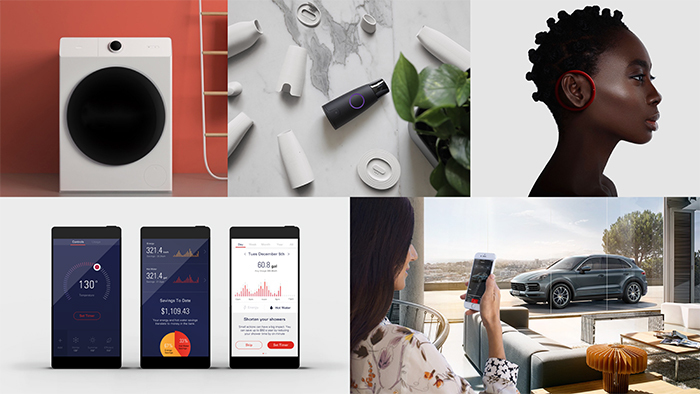
Services and products developed by frog. From top left: IoT appliances, a device that monitors metabolism, wireless earbuds that don't cover the ears, a utility cost reduction solution linking water heaters with an app, and a car app for comfortable driving—all embodying innovative ideas.
The defining feature of frog×Dentsu Inc. design consulting is that designers are involved from the earliest stages—such as vision and strategy development—through to creating the final customer-facing product design, and then continuing their involvement all the way through to activating the resulting deliverables. This approach differs fundamentally from mainstream design thinking, where non-designers generate new ideas from a design perspective. It also diverges significantly from traditional consulting, which often commits only to the upper funnel stages like strategy development.
frog × Dentsu Design Consulting
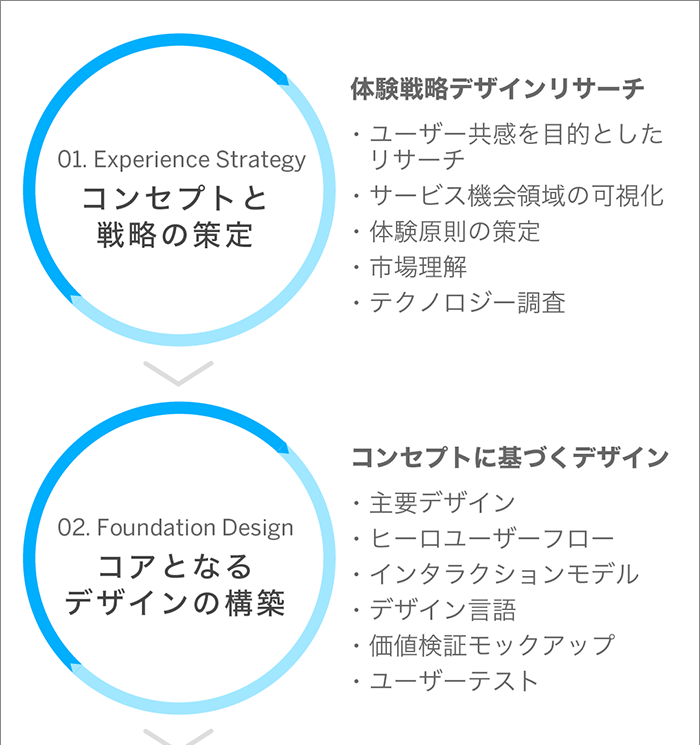
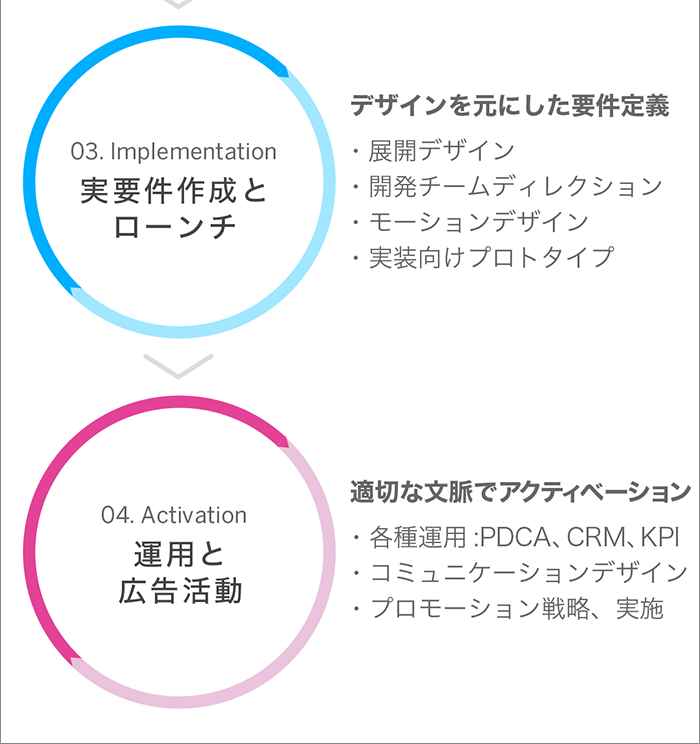 This represents the scope of "design consulting" provided by frog×Dentsu Inc. It is offered as a comprehensive service encompassing everything from the upstream processes of concept and strategy development, through involvement in interaction model development and implementation, to downstream activation.
The benefit of involving designers in the upstream phase lies in their ability to freely consider what truly holds value for people, taking diverse human behaviors into account, and then build business logic upon that foundation. Projects start by considering "what value does this hold for people?" rather than being driven by technology or business first.
Furthermore, by having designers centrally lead the construction of strategy-based design, the development and implementation of interaction models, their launch into the market, and subsequent activation, we ensure projects are realized with unwavering focus.
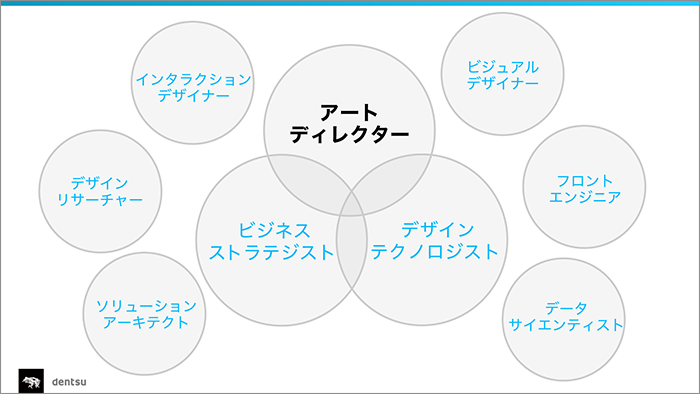
The design consulting team is carefully assembled by selecting the most suitable talent from both frog and Dentsu Inc. It is fundamentally structured around three core roles: Art Director, Business Strategist, and Design Technologist, managed by a Project Manager. Supporting this core are Visual Designers, Interaction Designers, Design Researchers, and Front-End Engineers, who are ready to adapt flexibly to each specific project.
This team structure allows ideas originating from the question "What value does this offer people?" to be examined from cost and technical perspectives, ultimately translating them into "feasible strategies."
Design Consulting Team Structure
frog×Dentsu Inc. aims to create innovation that generates 1,000 from 1
Clients typically approach frog×Dentsu with two main types of projects.
"We know we need to create some kind of innovation, but we don't know what to do."
and
"We want to improve something that already exists."
.
For the former type of project, we've implemented new services and systems to transform the customer experience for a major homebuilder. For the latter type, we're working to transform a listed company's internal portal into a completely new platform aligned with corporate policy.
Working on various projects with frog, I've come to realize anew that "no two projects are the same." It's virtually impossible to simply apply the same methodology and expect innovation to materialize. We always start by listening to the challenge, designing the project, and then changing the framework and structure for each individual client.
While design thinking encompasses multiple methodologies, we often observe projects applying similar customer journey maps or frameworks across the board, simply applying the method as-is. We frequently discuss with frog staff that this approach fails to unlock the true value of design thinking.
We also see cases where the focus is solely on creating something from zero to one. While ideas may be generated, they often fail to materialize into concrete forms that deliver valuable experiences to people.
What frog × Dentsu Inc. aims for goes beyond just generating innovative ideas from 0 to 1. It involves deeply designing the user experience for that idea from 1 to 100, creating concrete designs that bring the envisioned user experience to life from 100 to 1000, and then activating that experience to scale it up from 1000 without diminishing its impact – ultimately driving innovation. In other words, we don't stop at discussing concepts or strategy formulation upstream; we take responsibility for spreading the born 1 into the world.
Next time, we'll share our vision more concretely through a conversation with Ion Nedelcu of frog, who is stationed at Dentsu Inc.
Was this article helpful?
Share this article


Newsletter registration is here
We select and publish important news every day
For inquiries about this article
Author
Noriaki Okada
Dentsu Inc.
CDC Experience Design Department
Creative Director