
Note: This website was automatically translated, so some terms or nuances may not be completely accurate.
 The Past, Present, and Future of Creativity [2/5]
What is the mechanism of creativity? ~ Kenji Shiroto reveals his secrets ~
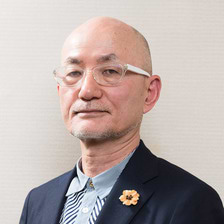
Kenji Shirotsuchi
Thinker, Former Executive Officer at Dentsu Inc.

Creativity ≠ Just a Whim
This is the second installment of a serialized column titled "The Past, Present, and Future of Creativity." In this second part, we'll examine past creative work to uncover the mechanisms of creativity.
(Editor's Note: This column is a re-edited version of a lecture given by Mr. Shiroto at Dentsu Inc.'s Creative Planning Division 3 on August 5, 2019.)
What I feel is somewhat lacking among young people today is, of course, the essential practice of "quality management of expression." I strongly urge professionals to adopt this. One key aspect is "positioning within the expression territory."
For example, if we plot "Serious" and "Funny" on the vertical axis and "Clean" and "Dirty" on the horizontal axis, most commercials are positioned as "Serious and Clean."
While some commercials deliberately go for the tricky "dirty and funny" approach, you almost never see "beautiful yet funny." So, in my case, I think, "Well then, I'll just take that position."

How do you judge the quality of a concept?
Next, I want to talk about how to judge the quality of a concept.
Recently, I spoke with a young American director who told me he never plans anything himself and doesn't even look at storyboards. He meets with the person who pitched the idea, talks for about 30 seconds, and if he leans forward thinking, "This seems interesting," he knows it will definitely be good.
So, I asked him, "Then how do you tell the good from the bad in the commercials out there?"
"That's easy. If you turn off the audio and still can't understand the content, it's no good. Relying on audio means it's just an explanation, not an idea.
When I go to Japan, they play commercials nonstop in hotel rooms, but 95% of them have no ideas. They're just babbling on and on."
That really hit home.
What clicked for me is that "differentiation" is something especially relevant to tell the younger generation, the internet generation. Compared to the past, they don't think as much. So, as a result, we end up with the same kind of commercials over and over.
Don't start by drawing storyboards
Personally, I'm not currently working on planning, but when I do plan, I never start by drawing storyboards. I always create this kind of matrix.
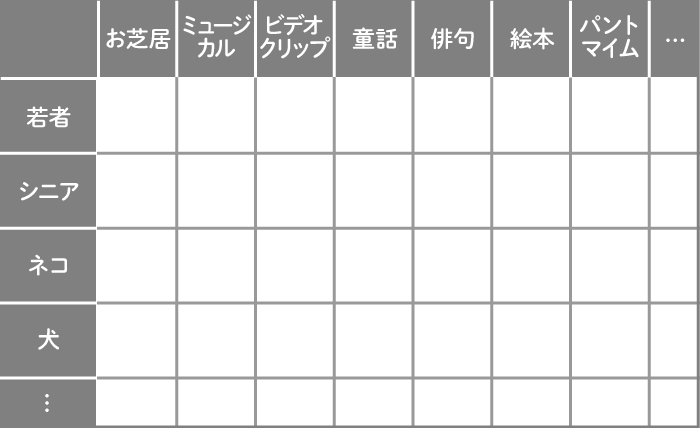
On the horizontal axis, I list "expression genres" like drama, musical, music video, fairy tale, haiku, picture book, pantomime, and so on.
The vertical axis lists "performers" like youth, seniors, cats, dogs, and so on.
I then explore every single combination. This process generates an infinite number of expressions. Next, I apply the message to this matrix according to the "most important rule."
The most important rule is:
- Focus on conveying one thing only
- Always be conscious of "differentiation" from others
That's it.
The techniques of expression—whether visual or copy—aren't that numerous. "Swap," "Shift," "Exaggerate," "Diminish," "Reduce," "Distort"... it's really not that many. Add three more, and ten should be plenty.
Those who create expressions by fitting them into "templates" rather than relying on "spontaneous ideas" or "information" consistently hit the mark. In other words, their output never misses.
No misses. They can mass-produce endlessly while maintaining consistent quality. That, I believe, is the work of a professional.
Relying on others is also a kind of creativity.
Actually, there's another way to unleash outstanding creativity.
It's called "having others create the plans."
People of this type are acutely aware that they themselves have absolutely no ability to create plans. Instead, they pay close attention to others' work. When a job comes their way, their antenna instantly activates, thinking, "For this job, I'll have this person create the plan," and they go to that person for input.
Explained this way, it might sound like they're just opportunists. But from the perspective that they "have more respect for planning than anyone else," isn't this a methodology worth emulating?
"The Past, Present, and Future of Creativity." In this second installment, we've introduced one aspect of how creativity works. Next time, I'd like to discuss the current state of such creativity.
Was this article helpful?
Share this article


Newsletter registration is here
We select and publish important news every day
For inquiries about this article

Author
Kenji Shirotsuchi
Thinker, Former Executive Officer at Dentsu Inc.