
Note: This website was automatically translated, so some terms or nuances may not be completely accurate.
 The Past, Present, and Future of Creativity [3/5]
What is happening to creativity now? ~ Kenji Shiroto roars loudly ~
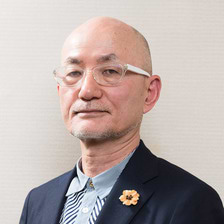
Kenji Shirotsuchi
Thinker, Former Executive Officer at Dentsu Inc.
As advertising commoditization advances, what should creativity look like?
This is the third installment of a serialized column titled "The Past, Present, and Future of Creativity." By examining current creative practices, we aim to uncover the mechanisms of creativity.
(Editor's note: This column is a re-edited version of a lecture given by Mr. Shiroto at Dentsu Inc.'s Creative Planning Division 3 on August 5, 2019.)
Advertising is undoubtedly becoming commoditized. In other words, it has become too homogeneous, making differentiation difficult.
The briefs, the planners, the execution—everything is like this. To put it bluntly, without fear of misunderstanding, "the industry itself is becoming standardized and amateurish."
"When the client's salespeople see that ad, does it give them courage?"
This was a phrase used by Toru Kono, who was in Sony's advertising department, and it really made me stop and think.
No matter how beautiful or technically perfect an expression is, if it fails to differentiate from competitors, it holds little value as a sales tool. At the very least, it's not something that can deliver courage to the people on the sales floor.
Creativity isn't just about expression. I believe that the effort to thoroughly explore what value it holds as a business tool, and that very process itself, is also creativity.
Can creativity become business?
Here's the process I envision for creativity as a business:
- Identifying the challenge 〜 More broadly, from multiple angles 〜
- Problem Formulation (Hypothesis) ~ Deeper, More Fundamental ~
- Generating solutions 〜 More novel, more original 〜
- Planning and Execution 〜 Anticipating the future, systematically 〜
The latter stages seem like the so-called creative process, but the essence of creativity lies in all of these steps.
How to unleash that power? To do so, we must grasp the transformation of business's main power.
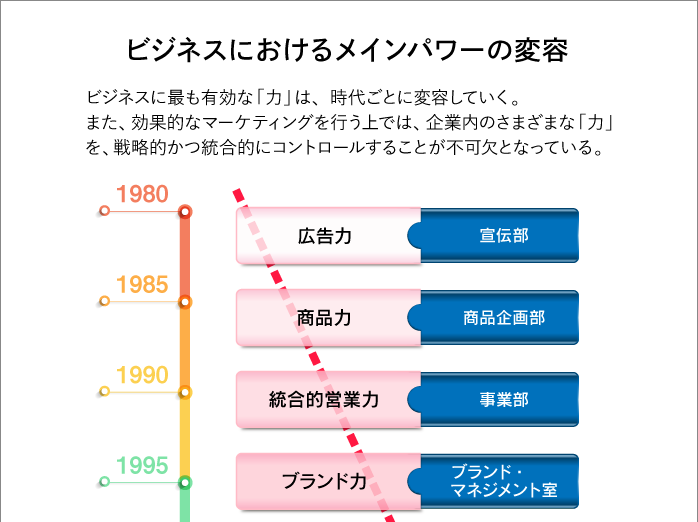
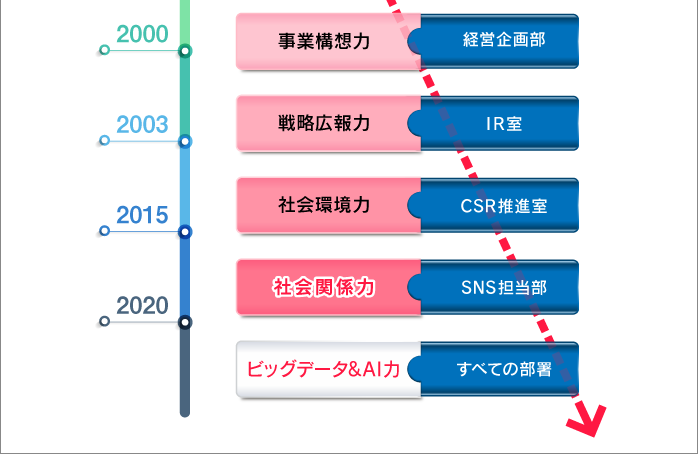
I'll skip the details, but as shown in the diagram, the main power in business today is "social relationship power." In the near future, "big data power" and "AI power" will undoubtedly rise to prominence.
I believe effective marketing is no longer possible without integrating and strategically controlling these elements.
Creativity stems from understanding organizational structure
Furthermore, we should also pay attention to the transformation of power structures within corporate organizations.
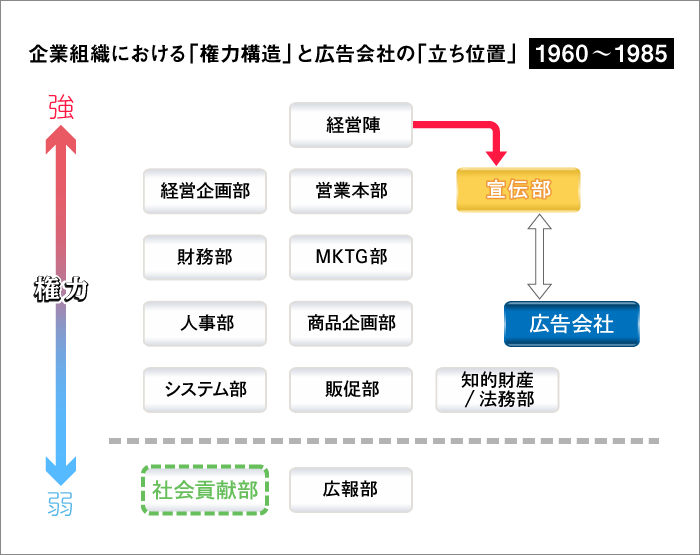
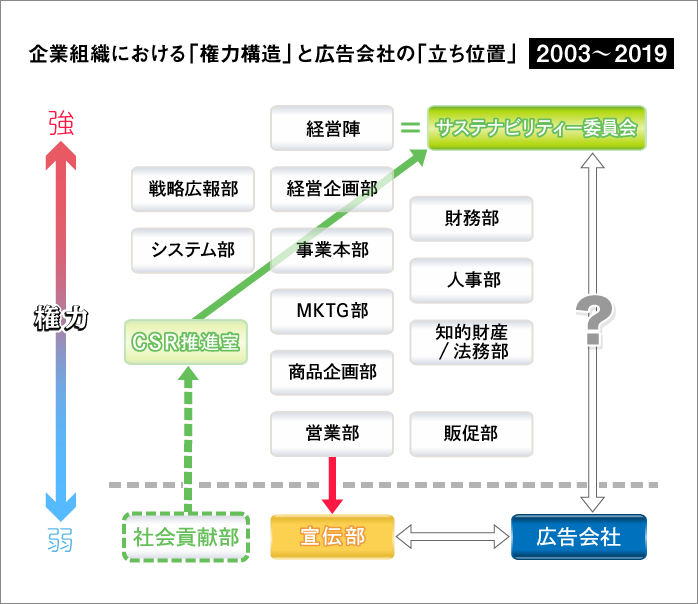
In the past, the advertising department was directly managed by management and was a department directly linked to management. Now, the top section directly managed by management might be CSR.
In short, we must discern the evolving power structures within clients—that is, the authority and processes for decision-making—and consider "to whom we should propose what."
Amateurs plan, professionals execute. That is the ideal form of creativity.
Creativity is the sum of "the ability to identify problems," "the ability to devise solutions," and "the ability to execute them." Unless you directly engage with those seeking that capability, it holds no meaning.
I'm neither an engineer nor a management expert. Frankly, I'm an amateur. While completing a specific field is naturally the role of the professionals (experts), I believe it's the amateurs—indeed, it should be the amateurs—who spark innovation within that field.
In other words, amateurs plan, and experts execute. Whether an amateur can stir the heart of an expert hinges on one crucial thing: maintaining an insatiable curiosity that surpasses anyone else's.
I'd never say "I can do it!"
In fact, I've never once responded with "I can do it!" when a client consulted me about something.
"I'd love to try! So please tell me what's troubling you! Let me think it through with you!"
That's my way.
"I can do it!" is a stock phrase used by con artists. Besides, as the data shows, only about 3% of new products become staples. "I can do it!" is not something you can casually say.
But I can responsibly say, "I'd love to try!" and "Because I have these hypotheses to back it up." The other party shows interest too.
This kind of interaction, where we stimulate each other's curiosity, is what I believe is most crucial and universal for unleashing outstanding creativity—no matter how media, technology, or society changes.
Was this article helpful?
Share this article


Newsletter registration is here
We select and publish important news every day
For inquiries about this article
Back Numbers
Author
Kenji Shirotsuchi
Thinker, Former Executive Officer at Dentsu Inc.