Note: This website was automatically translated, so some terms or nuances may not be completely accurate.
 Where Brands and Consumers Meet—The Era of Social Commerce is Here! [2/2]
Why is social commerce a concept that could revolutionize marketing?
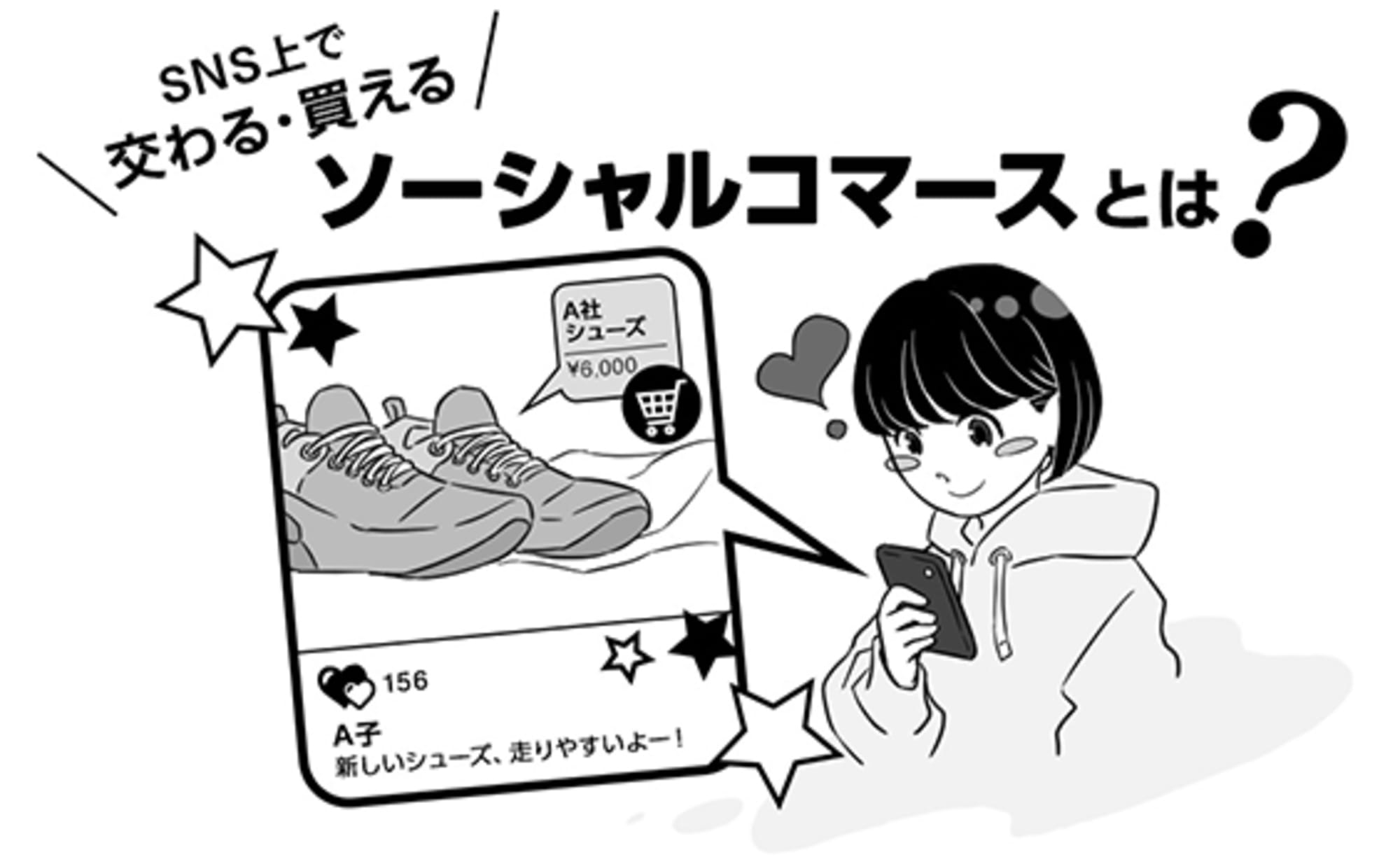
"Social commerce" is a new-era marketing approach where consumers and brands communicate on social media platforms like SNS and sell products/services directly on the spot.
Following our previous article covering basic explanations and global trends, this time we share key points Japanese companies should grasp to effectively utilize social commerce.
<Table of Contents>
▼Social Commerce is a Concept That Revolutionizes Marketing
▼1. Fully Utilize Official SNS Accounts as "Owned Media"
▼2. It's Not Just About the Storefront. User-Centric "Holistic Design" is Paramount!
▼Dentsu Inc. Launches Group-Wide "Project Team Dedicated to Social Commerce"
Social Commerce is a Concept Revolutionizing Marketing
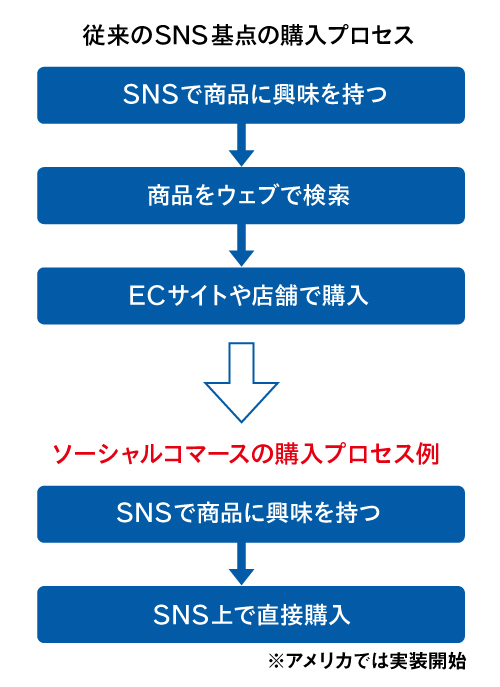
Social commerce enables a seamless shopping experience where the entire process—from awareness to purchase—occurs within SNS platforms, which were previously spaces for "information gathering" and "information exchange." Every SNS becomes a direct "sales floor" for brands.
This not only increases the potential for e-commerce purchases but also holds the potential to revolutionize traditional marketing methods and bring significant changes to relationships with consumers.
These changes include:
- One-way corporate messaging → Two-way communication between companies and consumers
- Pushing products/services → Purchases driven by empathy with the brand's worldview and story
- Business-driven commerce → Consumer-driven commerce (information sharing from consumer to consumer)
The fundamental benefit for companies utilizing social commerce lies in the ability to build and maintain positive, ongoing relationships with consumers through this new form of communication.
In the previous article, we also discussed "What needs does social commerce fulfill for companies?"
[Corporate Needs Fulfilled by Social Commerce]
- Aiming to rejuvenate the brand and strengthen relationships with younger demographics.
- Want to expand new channels without relying solely on e-commerce platforms.
- Want to start e-commerce or begin with a small-scale launch.
- Feeling that traditional digital marketing and mass marketing are becoming less effective.
For companies across all industries facing challenges like these, social commerce can be a breakthrough solution.
Furthermore, there's a unique perspective relevant to the current situation where inbound demand has declined due to the pandemic. Social commerce, deployed on global platforms, offers the potential to sell products not only domestically but, with the right approach, to consumers worldwide.
While domestic business growth may be slowing, it's also possible to develop commerce strategies with cross-border expansion in mind, leveraging digital to reach broader markets. This is another point worth keeping in mind.
Of course, simply implementing it won't guarantee results. A solid strategy is essential. Here, we'll explain key points from two main perspectives.
1. Fully leverage official SNS accounts as "owned media"
For many companies operating e-commerce, platforms hosting vast numbers of users are undoubtedly key channels. However, in social commerce, it's essential to view and utilize your company's official SNS accounts as "owned media" and enhance their quality.
When utilizing official SNS accounts as "owned media," there are three key points to keep in mind.
Deliver the most important information to consumers who perform "brand searches"
Consumers constantly browse the internet seeking desired information. Among them, those who develop interest in your brand and perform a "brand-specific search" by name represent users with high purchase potential. Owned media is the most effective place for your brand to communicate precisely what you want to convey to these users.
The fundamental premise is that you must provide a space to effectively retain people who have shown interest in your brand. This means your official account must remain consistently active, and essential information must be readily available in sections like the profile.
Communicating Your Brand Philosophy
We now live in an era where products are chosen based on "empathy." Rather than unilaterally pushing the brand's merits, it's crucial to make consumers "feel" the brand. A major factor influencing this empathy is the "brand philosophy."
A philosophy is the verbal expression of the values and mission your brand holds dear. It can also be called your corporate philosophy or brand concept. Content—whether text or images—produced based on this philosophy resonates with users, increasing purchase likelihood and contributing to the engagement-building discussed later.
Build fan engagement through continuous two-way communication
Social media, which enables two-way communication with users, is well-suited as a means to enhance fan engagement (a strong connection between the brand and its fans).
Increased fan engagement can also lead to new customer acquisition through fan-driven information sharing, i.e., UGC (User Generated Content). Furthermore, in social commerce, direct purchases from UGC can be expected.
Beyond these three points, I believe "honesty" will increasingly be demanded of brands going forward. In social commerce, where individuals freely share information that drives consumption, trust is the key connecting people to people and brands to people.
No matter how convenient a brand is, users won't choose it unless they feel secure shopping there. Pursuing transparency in information and the integrity of posts as a company will become an essential condition for social commerce success.
2. It's not just about the sales floor. User-centric "holistic design" is paramount!
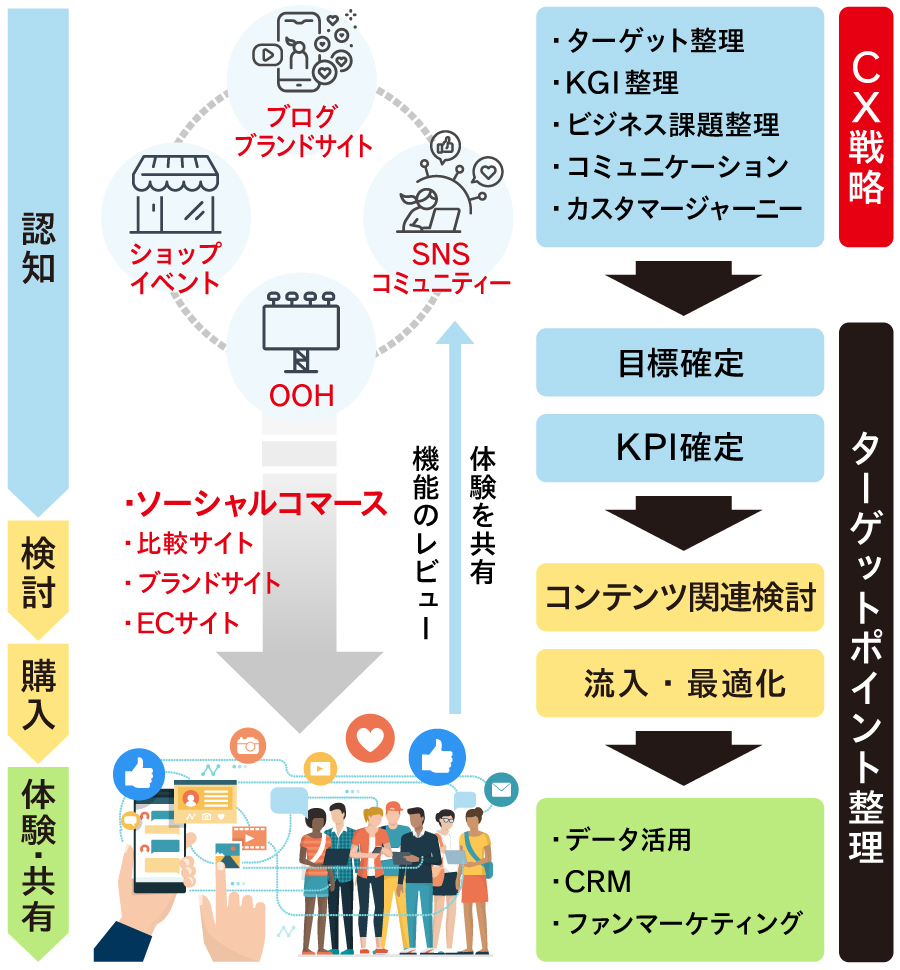
Another crucial perspective in social commerce is the "holistic design" spanning CX (Customer Experience) strategy, purchase promotion, and CRM communication.
Hearing "social" often makes people focus on micro-level aspects like "SNS management," but remember it's just one important tactic within your CX strategy. In other words, it's not something you start just because "let's try social commerce."
The first step is to organize the business challenges the company faces and clearly define the Key Goal Indicators (KGIs), target audience, and customer journey. Only after setting Key Performance Indicators (KPIs) should you begin developing social commerce content tailored to your target audience.
To reiterate, social commerce content must focus not on "selling," but on capturing consumers' emotional responses and providing experiences that make them "want to buy." As mentioned earlier, it's also crucial to incorporate strategies mindful of "UGC."
Simultaneously, to efficiently deliver content to users at the optimal timing, consider exposure across various media channels like comparison sites and ranking sites. This means optimizing the pathways leading to the company's official SNS accounts.
Furthermore, beyond just SNS and your own e-commerce site, plan in advance for CRM communication that integrates and utilizes accumulated data, as well as fan marketing initiatives to enhance loyalty.
Thus, it is crucial to develop social commerce by holistically designing a CX strategy that spans planning, content development, and integrated data marketing.
Furthermore, the "user perspective" is something that should always be kept in mind throughout the overall design process.
- Are products properly visible to users?
- Is it easy to find?
- Does the product appear appealing?
- Would they want to buy it again?
Developing strategies based on these considerations is the secret to social commerce success.
Dentsu Inc. has also launched a "project team dedicated to social commerce" across the group.
As mentioned in the previous article, social commerce encompasses a vast array of areas, despite being described in a single term. It is a deep and complex business requiring broad coverage and literacy beyond mere social media management.
Communication planning, developing high-quality content using owned media, and integrated data marketing across online and offline channels are particularly crucial.
To address these challenges, the Dentsu Commerce Room—a virtual cross-organizational unit within the domestic Dentsu Group—has newly formed a "Project Team Specializing in Social Commerce." This team brings together four companies with deep expertise in the social domain: Dentsu Inc., Dentsu Digital Inc., Dentsu Isobar, and Dentsu Digital Inc.
For more details, please see this roundtable discussion article!
The Dentsu Group in Japan has long provided solutions contributing to corporate commerce through integrated marketing spanning diverse areas, from business strategy development and data utilization to entertainment content. Social commerce, which demands comprehensive strategy and planning, is an area where the synergies of the Dentsu Group in Japan, known for delivering "integrated marketing," can be fully leveraged.
We recognize that focusing on the social commerce domain is a natural progression now that social media has become the most important communication platform, particularly among younger generations.
If you are interested in social commerce—which drives everything from brand promotion and sales growth to enhanced customer loyalty—please feel free to consult with our team.
Was this article helpful?
Share this article


Newsletter registration is here
We select and publish important news every day
For inquiries about this article
Back Numbers
Author

Kim Yong-guk
Dentsu Inc.
Business Transformation Division Global Commerce Strategy Department