Note: This website was automatically translated, so some terms or nuances may not be completely accurate.
 "Social Hunting" Captured from Social Media [2/2]
8 Approaches to Convert Social Issues into Ideas
In our previous column, we introduced the "seven frustrations" of social hunting—the practice of "capturing" signs and insights on social media that will eventually become consumer concerns.
Social hunting is a new method for discovering issues that companies and brands should address. So, once you've found an issue, how do you generate ideas for solving it? This time, we introduce eight approaches that can spark ideas.
Regarding the term "issue": While it often refers to major challenges tied to social environments or political contexts, this column continues the previous definition: "problems from the consumer's perspective that involve individual inconveniences or frustrations."
Specifically define whose awareness or behavior is involved in the issue
Before brainstorming ideas, the key is to concretely organize the issue as a combination of "phenomena occurring (or potentially occurring) in society" and "the resulting awareness or actions of consumers."
For example, focusing on "heatstroke from masks," we can refine it to: "The problem of elementary school students facing high risk of heatstroke when walking long distances while wearing masks during summer commutes." This makes it easier to consider how the phenomenon of "heatstroke during commutes" might change and whose awareness or actions should evolve.
Eight Approaches to Convert Issues into Ideas
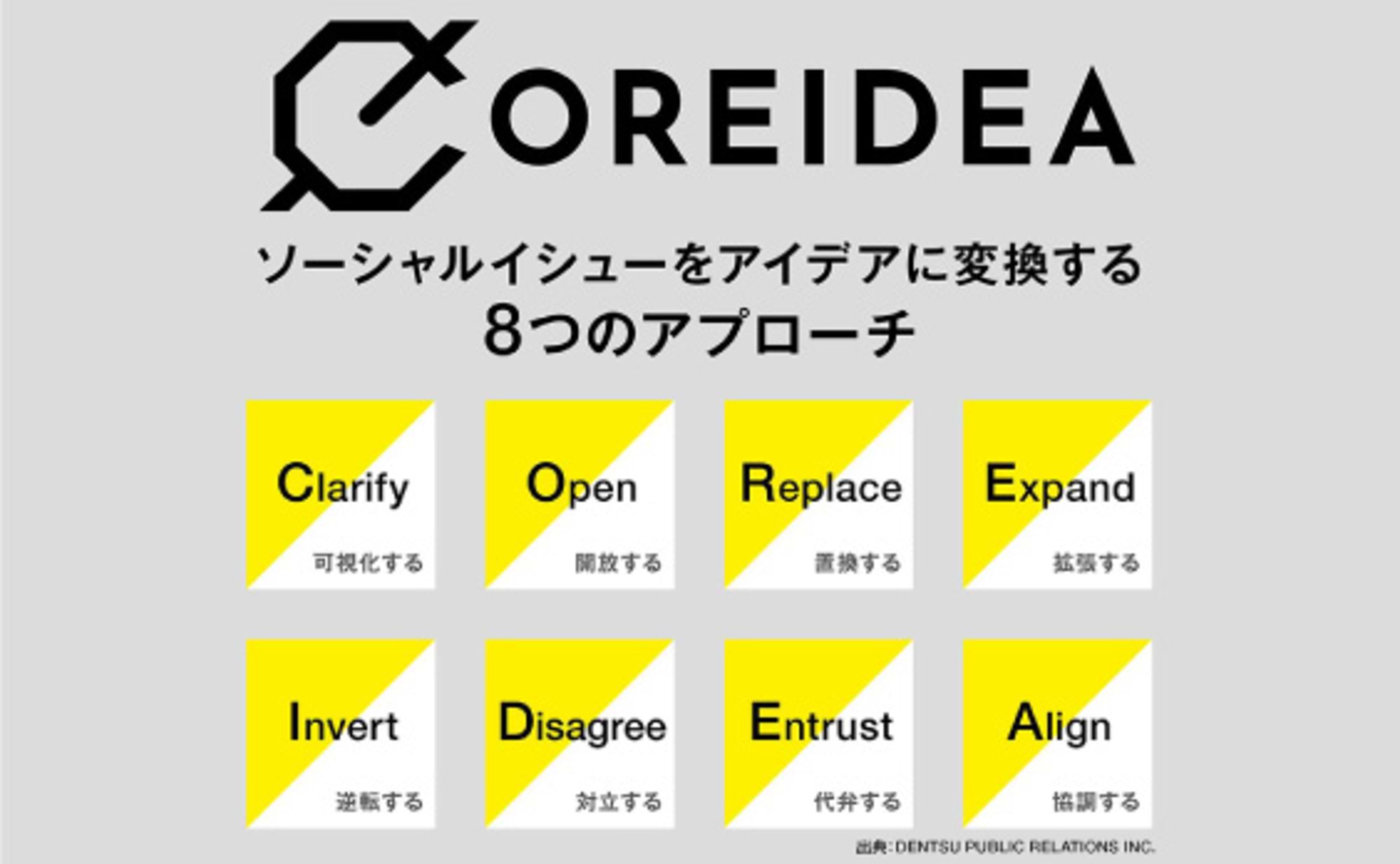
Now, let's introduce the main topic: the 8 approaches called "CORE IDEA." This term combines the initial letters of eight major approaches we've identified for issue-driven communication.
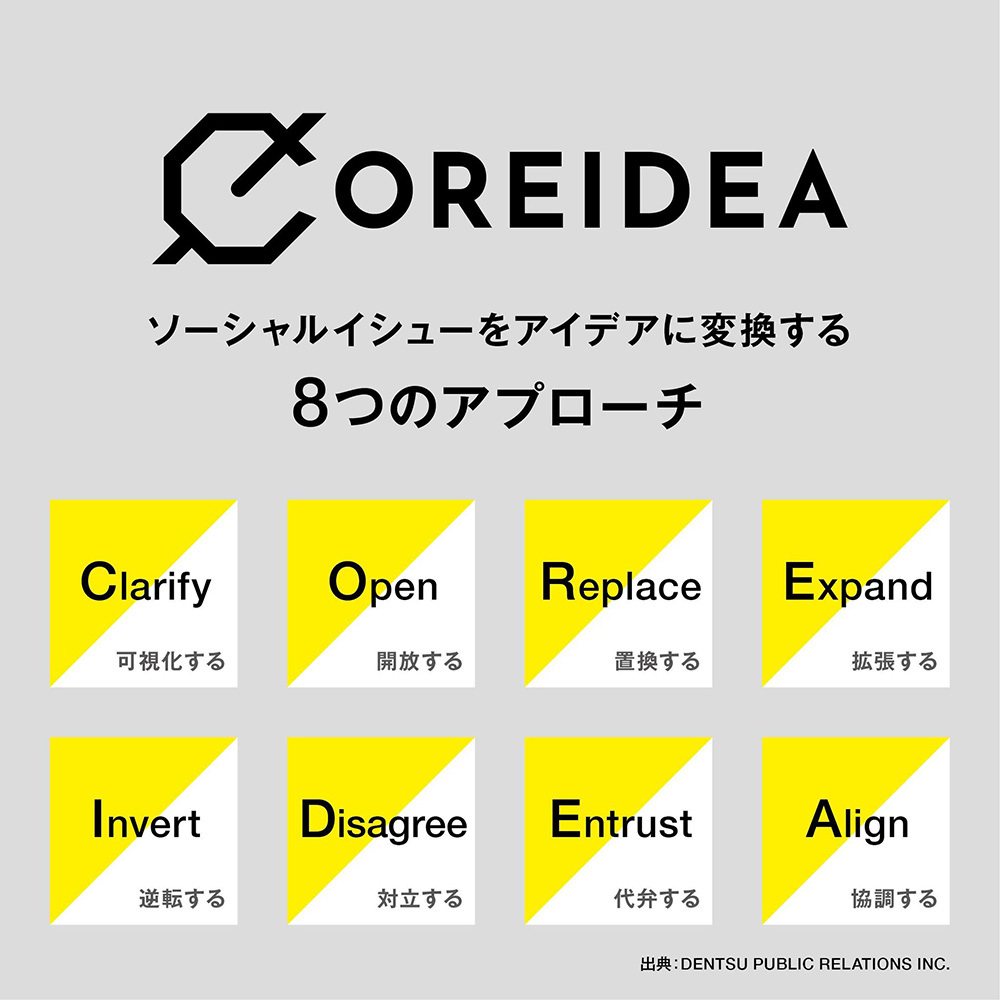
C Clarify (Make Visible)
O: Open (Open Up)
R: Replace
E Expand
I Invert (Reverse)
D Disagree
E Entrust (Advocate)
A Align
C Clarify
"Visualization" means making the invisible understandable. This involves approaches like expressing things with numbers or data, or personifying them or creating simulated experiences.
For example, craft beer company Yoho Brewing addressed the issue of "senior employees monopolizing conversations at company drinking parties by acting like 'big shots'" by uniquely raising awareness. They physically "visualized" this senior attitude as a "chair with a fan attached."
O Open (Open Up)
True to the word "open," this approach involves removing restrictions like precedents or rules to "open up," "disclosing" things brands or companies previously kept secret, or "open-sourcing" know-how.
For example, during the pandemic when people were asked to stay home, restaurants faced the issue of customers wanting to visit and try popular menu items but being unable to go out. To address this, restaurants "released" their "secret recipes" on social media so customers could recreate them at home. This resulted in a lot of positive feedback from the restaurant's fans.
R: Replace
This approach involves partially "replacing" conventional methods or "rearranging" words. When concerns arise during the planning process that an action might be "difficult to convey," shifting just one element—Who, What, When, Where, or How—can sometimes generate new perspectives.
For example, "online weddings" and "online homecomings" can be seen as approaches that "replaced" the traditional in-person experience with an online one.
E Expand
While the term is "expand," here it encompasses the opposite concept of "shrink" as well. From the perspective of changing scale, consider halving the size or length, or doubling it...
For example, the Japan Flower Promotion Council "expanded" Mother's Day in 2020 into "Mother's Month," calling for people to "express their gratitude throughout the entire month of May." This initiative addressed the issue during the COVID-19 pandemic where "florist shops were crowded with customers, and delivery services were extremely busy due to high demand for shipping gifts to mothers living far away" (refer to press release).
I Invert (Reverse)
While overlapping with the previously mentioned "Replace," this approach involves turning something inherently negative into a positive meaning, "reversing" positions, or "going against" established customs.
For example, an international marine conservation group applied to the United Nations to recognize the floating marine debris in the North Pacific as "Trash Isles," an official nation. By transforming the concept of "trash" into a "nation," they drew attention to the severity of the marine debris problem.
D Disagree
Simply put, this approach creates a "conflict structure." By doing so, it makes it easier for consumers to take a stance, sparks debate and controversy, and deliberately creates "friction" to highlight the company or brand's position.
This opposing structure doesn't necessarily mean competing against rival companies. For example, a food manufacturer pitting its own products against each other in terms of flavor or product features is also an example of this approach.
E Entrust (Advocate)
This approach involves brands or companies making statements, standing alongside people to "advocate" for their feelings, "standing up" to the powerful, or "supporting" those in need.
For instance, a company or brand might state its stance in a newspaper ad, prompting consumer agreement or sparking social media debate. A key point here is that "advocacy" must not be mere rhetoric; it must be accompanied by concrete corporate action. For issues that advocacy alone cannot resolve, consider pairing it with tangible, substantive actions.
A Align (Collaborate)
The verb form of Alliance is Align. This approach involves companies from different industries or even rivals "cooperating" or becoming "allies" to solve an issue. Recently, collaborations between competitors and cross-industry initiatives have increased.
Examples include delivery companies temporarily hiring employees from restaurants closed due to the pandemic, and rival companies jointly developing packaging to reduce environmental impact.
What approaches have been prominent lately?
Recently, the approaches of "Open," "Entrust," and "Align" seem particularly prominent. Broadly speaking, these three perspectives represent efforts by companies and brands to stand alongside consumers and work as partners toward solutions in a society where divisions are accelerating.
While we introduced eight approaches here, fitting ideas into this framework isn't the goal. Diverse approaches exist for generating ideas, and this "CORE IDEA" is just one perspective. Approaching issues from various angles is likely to lead to breakthrough ideas that overcome challenges.
Was this article helpful?
Share this article


Newsletter registration is here
We select and publish important news every day
For inquiries about this article
Author

Yusuke Matsuo
PR Consulting Dentsu Inc.
Communication Design Department
Planner