Note: This website was automatically translated, so some terms or nuances may not be completely accurate.
 "People Driven Marketing® Practical Webinar 2021" Report [1/5]
Toward the Era of Data and CX: Three Keynote Speeches to Understand Dentsu Inc.'s People Driven Marketing
People Driven Marketing(※) by Dentsu Inc.: marketing centered on people.
It undergoes annual updates and has now evolved into "PDM 5.0."
This series provides a digest report on the three-day "People Driven Marketing® Practical Webinar 2021," where Dentsu Inc. professionals and corporate guests discussed the future of marketing and data.
※Affiliations and titles reflect information at the time of the webinar.
<Table of Contents>
▼Navigating "Economic Circle Data" in the Post-Cookie Era
▼Customer Intelligence: The Strategy of Customer Imagination Driving CX Success
▼Solving the Proliferation of Customer Touchpoints: Next-Generation CRM Strategy Starting with "Customer Asset Value"
※People Driven Marketing
https://www.dentsudigital.co.jp/service/pdm/summary/
Dentsu Inc.'s proposed integrated marketing framework centered on "people" for the data & digital era. It reframes challenges from a people-centric perspective and integrates the Dentsu Group's cutting-edge marketing methodologies to support customers' sustainable growth.
Day 1: "Practical CX Data Utilization" Keynote Session
Engaging with "Economic Circle Data" in the Cookie-Free Era

The theme for Day 1 is "Practical Application of CX (Customer Experience) Data."
The keynote session featured Shun Maekawa from Dentsu Data & Technology Center and Sohei Mitani from Dentsu Digital Inc. (now part of Dentsu Inc.), who introduced the potential and application methods of "Data Clean Rooms"—a new digital marketing approach that does not rely on third-party cookies(※).
※Data Clean Room
A marketing infrastructure provided to companies by platforms and others. Within a secure cloud environment, it links and analyzes a company's first-party data with the platform's owned data, enabling actions like ad delivery.
Related articles on "Data Clean Rooms"
・Data Clean Rooms Will Transform Marketing in the "Cookie-Free Era"
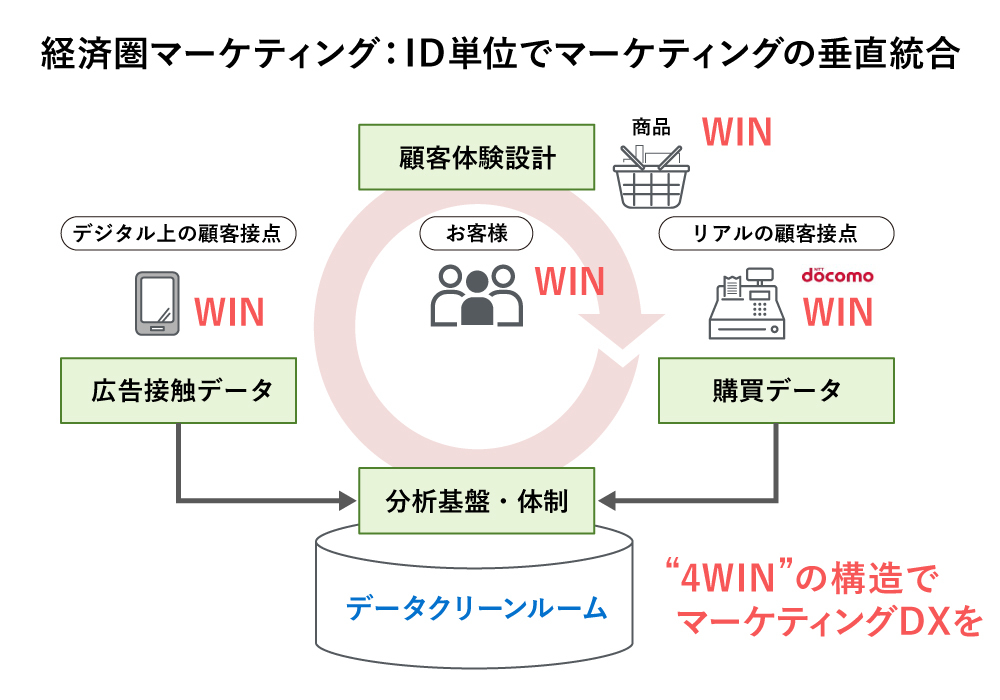
Maekawa first explained that due to the global rise in personal data protection awareness, the main battlefield of digital marketing is shifting from the cookie-based open web to "economic sphere marketing" by major platforms.
He stated that using data clean rooms within each ecosystem enables "more advanced analysis and ad delivery than ever before while protecting user privacy," attributing this to the ability to achieve "vertical integration" of marketing at the individual ID level.
"With cookies, data linked to the same ID can basically only be utilized on a campaign-by-campaign basis. However, major platforms hold vast amounts of ID data for which they have user consent, enabling long-term data utilization," stated Mr. Maekawa.
Next, Mr. Mitani of Dentsu Digital Inc. listed specific examples of leveraging same-ID data. He explained that online/offline data such as "search keywords," "offline actions linked to point services," and "POS data," as well as cross-device data like "smartphones and PCs," can be analyzed seamlessly.
"Within the data clean room, it's possible to perform analyses combining a company's first-party data, the platform's consent-based ID data, and even TV viewing data," stated Mr. Mitani.
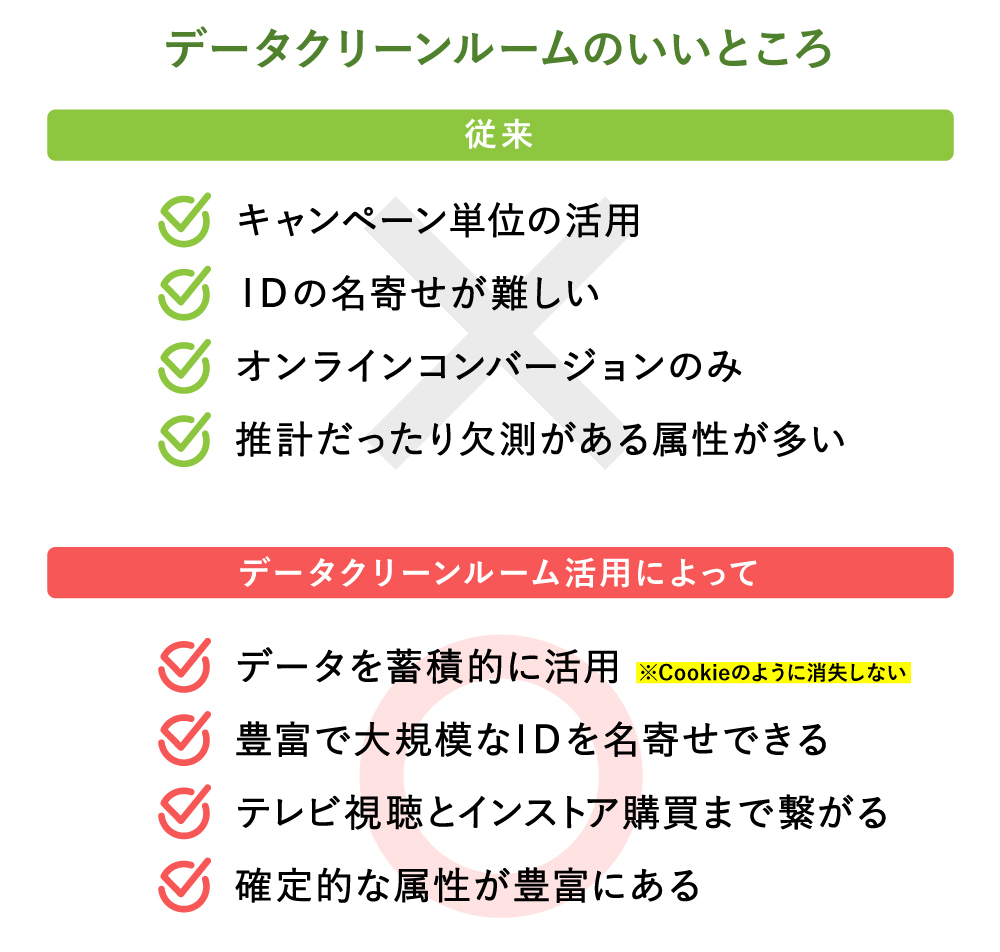
Furthermore, Dentsu Inc. has partnered with global platforms, achieving over 500 successful implementations in recent years. "We focused on data clean rooms early on, building practical knowledge and operational frameworks. We've received high praise from various platforms and are ahead of competitors in providing numerous alpha-version features," stated Mr. Maekawa.
Mr. Mitani then introduced a case study where Dentsu Inc. optimized advertising using a data clean room.
・PDCA Design Centered on Interest Attributes
To uncover new customers with latent needs, the company pre-analyzed high-potential user attributes using the economic sphere's rich data on interest and preference attributes. The target attributes defined through this analysis were then monitored continuously within the economic sphere's data clean room.
"We cluster a company's customers by interest attributes—such as gaming, travel, or automotive—then implement tailored initiatives for each cluster and run PDCA cycles," explained Mr. Mitani.
・"Single-Source Panel Analysis" enables low-cost omnichannel linkage
Omnichannel integration—where brick-and-mortar businesses unify online and offline data—requires significant development investment and operational costs.
"Therefore, we leverage the economic sphere's highly consistent, consent-based IDs as a 'massive single source with rich cross-environmental information.' This enabled us to visualize post-web-contact purchases and model purchase probability predictions while keeping costs low," said Mr. Mitani.
Next, Mr. Maekawa introduced two cases where data clean rooms were used beyond advertising for sales promotions and CRM (Customer Relationship Management).
・"Strategic Cluster Transfer" Enabling Short-Term PDCA
A food manufacturer faced slumping sales during the pandemic. Their challenge was the inability to quantitatively understand which customers were actually leaving and whether they had potential for return. While panel data provided an "overview of the entire market," it wasn't linked to the manufacturer's own customer data.
"First, we used cluster analysis on the panel data to understand customer structure and strategic targets. We then 'transferred' this cluster data into data clean rooms for each economic zone. This enabled ID-level ad delivery across various media and short-cycle PDCA," explained Mr. Maekawa.
・"Promotion Optimization" Enhancing Shopping Experiences with No-Entry Models
To lower the barrier for digital promotions, the ideal approach is to capture purchase proof within natural buying behavior and then award points or cashback. However, if it's too natural, users may not recognize it as an "offer from the brand," creating a dilemma where it's harder to build brand loyalty.
"In this case, to achieve both 'scale' and 'loyalty enhancement,' we implemented a no-entry campaign offering cashback simply for paying with PayPay. We measured campaign results in a data clean room, enabling scientific analysis of digital promotion KPIs and know-how," (Mr. Maekawa)
Finally, Mr. Maekawa addressed the audience: "The cookie-free era is not a crisis but an opportunity. By proactively adopting and mastering data clean rooms, you can reap first-mover advantages."
Day 2: "CX Planning & Development in Practice" Keynote Session
Customer Intelligence: The Strategy of Customer Imagination to Drive CX Success

The theme for Day 2 was "CX Planning and Development Practice." Masafumi Tanizawa and Chika Mitsui from Dentsu Inc. delivered the keynote session.
Mr. Tanizawa opened by stating, "The idea that 'we should implement CRM tools or utilize data to drive CX' is 'making the means the end.' Instead, we must first consider the 'essence of CX.'"
Ms. Mitsui then introduced the case of Kanebo Cosmetics' brand "KATE" as a successful example of tackling the essence of CX.
KATE champions the brand purpose "NO MORE RULES." (= Create the self you want to be), aiming to "question makeup conventions and even KATE's own past practices, encouraging not just makeup but lifestyle choices as forms of self-expression."
Building on this purpose, even as makeup opportunities decreased during the pandemic, KATE developed hit products like the "small-face mask" born from the concept "masks are makeup too" and lip products that don't transfer onto masks.
Furthermore, as in-store interactions decreased, KATE launched a bone structure analysis via its official LINE account to help customers "pursue their ideal self without being constrained by rules." It also published interviews with celebrities embodying NO MORE RULES. in its web magazine and launched an official YouTube channel where employees themselves appear to discuss unconventional products. These initiatives create CX that supports each customer's free self-expression.
Drawing from KATE's case, Tanizawa structured and introduced four key perspectives for CX transformation:
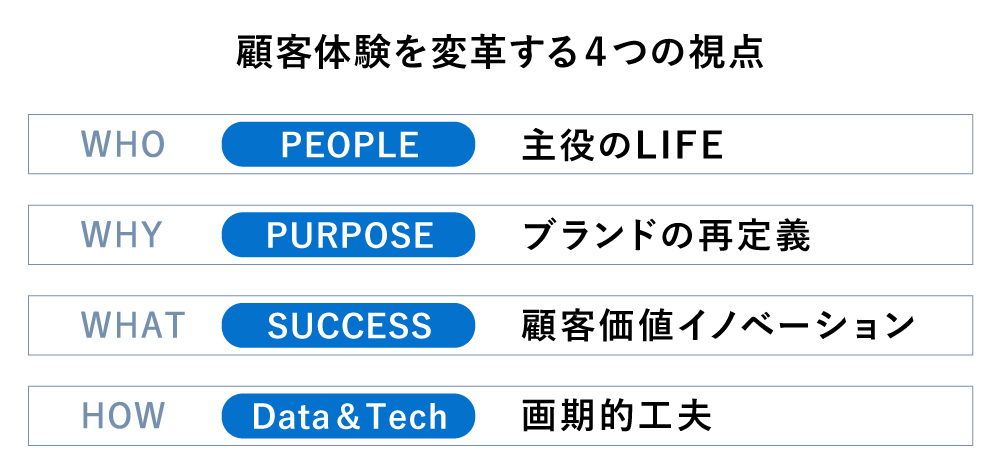
① WHO→PEOPLE: The LIFE of the Protagonist
KATE's Case: The Self-Expression Seekers
"Before being a customer, a person is an individual. The first step in CX is considering how products and services can contribute to that person's life journey and to what extent they can enrich their daily life and overall experience," (Mr. Tanizawa)
② WHY→PURPOSE: Redefining the Brand
KATE's Case: NO MORE RULES.
"Brand purpose is the ultimate goal of the brand, its very reason for existence. Clearly defining this transforms everything related to the brand into a 'means,' resolving the issue of 'means becoming the end' mentioned earlier," (Mr. Tanizawa)
③WHAT→SUCCESS: Customer Value Innovation
For KATE: Excitement (Innovative Products/Content)
"Customer success stems from the brand's desire and actions to 'make the protagonist (the customer) shine in life.' By embracing a purpose that transcends the concept of makeup, KATE provides customers with the uplifting feeling that 'they can become anything they want to be' through new products and content." (Mr. Tanizawa)
④HOW→Data & Tech: Groundbreaking Innovation
KATE's Case: Staying Connected via LINE Even During the Pandemic
How do we realize purpose and customer success? This is precisely where data and technology contribute, yet it's also where the "means becoming the end" is most likely to occur.
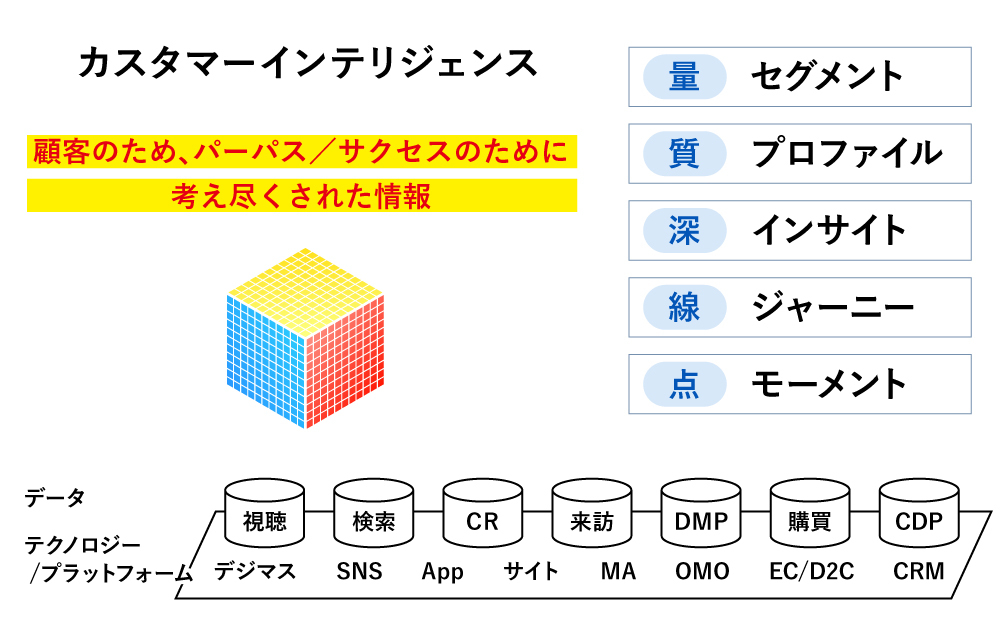
Regarding this ④HOW, Mr. Tanizawa proposed "Customer Intelligence" as a concept to link purpose with means (data & technology) and make the entire CX function.
"Customer Intelligence is information thoroughly considered for the customer, for purpose/success. We collect data from five perspectives—segment, profile, insight, journey, and moment—accumulating data insights across the entire CX. By combining these with creative, content, and ideas, we achieve stronger, more original CX transformation," stated Mr. Tanizawa.
Furthermore, when implementing CRM, the goal isn't cross-selling or upselling. For KATE, for example, the goal is "helping customers discover their true selves."
"This means the data we should collect via CRM isn't just purchase data. We also need content engagement data and 'posts where they express their true self.' Rather than purchase frequency, the key metric becomes 'how often they became the person they aspire to be?'" (Mr. Tanizawa)
Summarizing the discussion, Tanizawa revealed the essence of CX: "By thinking about and imagining the customer in pursuit of purpose/success, the truly necessary data and technologies to utilize become clear. This is where the brand's unique ideas are born, and CX transforms into something uniquely branded."
Mitsui agreed, concluding, "In this era of 100-year lifespans, when everyone is rethinking their very way of life, brands must rethink their purpose and customer success. What matters most then is customer intelligence—imagination. Imagining the brilliance of each customer's life and persistently pursuing its realization leads to brand loyalty and increased LTV."
Day 3: "Expanding PDM" Keynote Session
Next-Generation CRM Strategy Based on "Customer Asset Value" to Solve the Proliferation of Customer Touchpoints

The theme for Day 3 was "Expanding PDM." The keynote session featured Takashi Uozumi of Dentsu Digital Inc. (now part of Dentsu Consulting Inc.) presenting "Next-Generation CRM Strategy Starting with 'Customer Asset Value'."
Mr. Uozumi noted that more companies are aiming for DX that shifts from the traditional model of "selling physical products" to one where "physical products are embedded within digital services." He continued, "Currently, many companies are in a phase where physical products and digital services run parallel."
For example, an automotive company might have its traditional business selling the physical product "the car," while simultaneously commercializing "connected services" that leverage data and technology to build long-term customer relationships (CRM) and provide a comfortable car life.
Mr. Uozumi defines the former as "transactional business (activities focused on getting customers to buy more)" and the latter as "experience-based business (activities focused on getting customers to use products longer)." He points out that a challenge emerging from this transformation is the difficulty of "integrated management" due to the proliferation of customer touchpoint organizations accompanying the shift to experience-based business.
He stated that clients have consulted him with concerns such as: "Customer touchpoints are increasing, and each is becoming siloed. Without establishing company-wide KPIs, we cannot optimize investment decisions," and "The advertising organization and the CRM organization are disconnected, creating a significant gap between customer 'expectations' and 'satisfaction'." As a solution, he proposed Dentsu Inc.'s "Customer Asset Value Management."
Customer Asset Value Management is a concept centered on the "expected value" of customers who will purchase products or services in the future, while also managing the non-financial metric of "satisfaction value" post-purchase across the entire company.
For example, a certain automobile company previously managed finances centered on "business and organization." However, Customer Asset Value Management designs financial metrics centered on "the various values customers expect from the company."
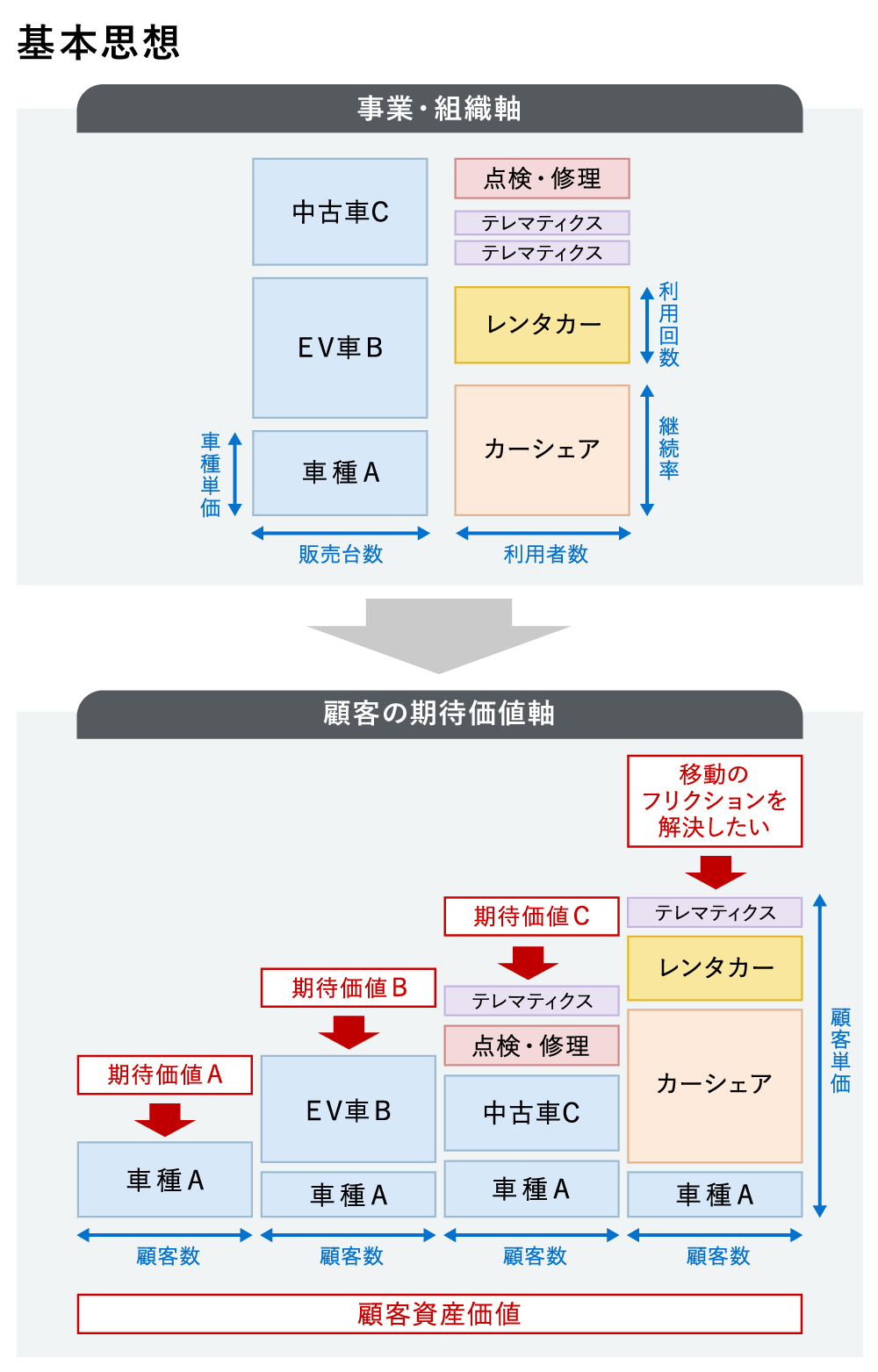
Mr. Uozumi summarized current trends into two key areas: ① Integration of customer-facing organizations and ② Establishment of a company-wide KPI structure.
① Integration of Customer-Facing Organizations
This trend involves integrating the management of "expectations" and "satisfaction" into a single organization and function to bridge the gap between customer expectations and satisfaction.
"For example, it emphasizes promoting organizational restructuring such as merging the advertising department, which handled 'expectations,' with the customer service department, which handled 'satisfaction,' or expanding the functions of the sales department, which handled 'expectations,' to include customer center functions to also cover 'satisfaction'," said Mr. Uozumi.
② Establishing a company-wide KPI structure
This trend involves structuring company-wide KPIs that drive both "expectations" and "satisfaction," leveraging them as "Customer Asset Value KPIs" for mid-to-long-term planning.
"Customer asset value KPIs are non-financial metrics, often centered on customer loyalty. For instance, one airline quantifies customers' 'emotional encounter assets.' Another health tech company measures 'how much sweat customers expended for health using their devices.' Both disclose these as management indicators to stakeholders, treating them as critically important as financial metrics," said Mr. Uozumi.
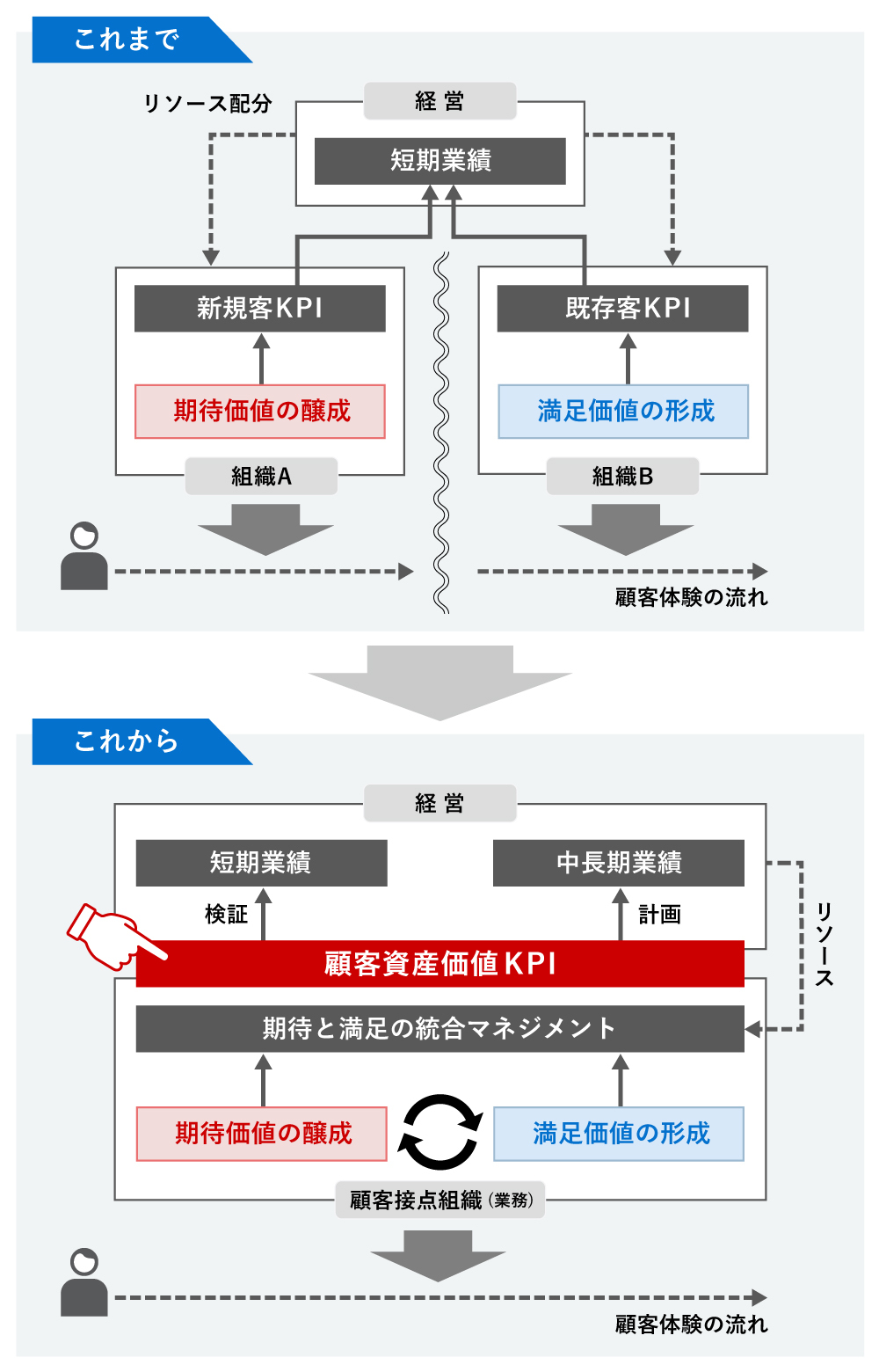
Concluding the session, Mr. Uozumi addressed the challenges of implementing customer asset value management in large organizations. He told attendees that Dentsu Inc. "can provide end-to-end support, from conceptualizing organizational integration and restructuring, to assisting with metric design, designing management frameworks and operational processes, and even talent development."
*Materials related to this webinar are available for free download.


Was this article helpful?
Share this article


Newsletter registration is here
We select and publish important news every day
For inquiries about this article
Author