Note: This website was automatically translated, so some terms or nuances may not be completely accurate.
 "People Driven Marketing® Practical Webinar 2021" Report [5/5]
Delivering New Value to Customers with People-Centric Data
Dentsu Inc.'s people-centric marketing approach, "People Driven Marketing®".
Updated annually, it has now evolved into "PDM 5.0".
This series provides a digest report on the three-day "People Driven Marketing® Practical Webinar 2021," where Dentsu Inc. professionals and corporate guests discussed the future of marketing and data.
The theme for Day 3 was "Expanding PDM" (Keynote Session here ). This time, we introduce three sessions that presented "New People-Centric Services." How can businesses transform from a customer perspective while leveraging data and digital technology? We share insights from each session that presented a vision for the future of marketing, using concrete examples.
*Affiliations and titles reflect information at the time of the webinar.
<Table of Contents>
▼Revolutionizing the Marketing Process with "Demand Forecasting"!
▼What is Seven-Eleven's Marketing Platform that Utilizes Data from Multiple Angles?
▼People-Driven TV Planning: Current Status and Future
※People Driven Marketing
https://www.dentsudigital.co.jp/service/pdm/summary/
Dentsu Inc.'s proposed integrated marketing framework centered on "people," designed for the data & digital era. It reframes challenges from a people-centric perspective, integrating the Dentsu Group's cutting-edge marketing methodologies to support customers' sustainable growth.
Revolutionize your marketing process with "Demand Forecasting"!

The first session covered the benefits and know-how of applying "demand forecasting"—which analyzes the intersection of POS and weather data—across the entire marketing process.
Satoshi Oshima of Dentsu Inc.'s First Integrated Solutions Bureau, who served as MC, stated, "It is crucial to achieve a high degree of matching between the customer's moment of thinking 'I want this product' and the company's need to provide products or services precisely when the customer requires them."
He further suggested the potential of "demand forecasting," noting it can be used "not only to increase advertising volume when significant demand is anticipated, but also for planning marketing strategies, production adjustments, in-store assortments, and shelf allocation."
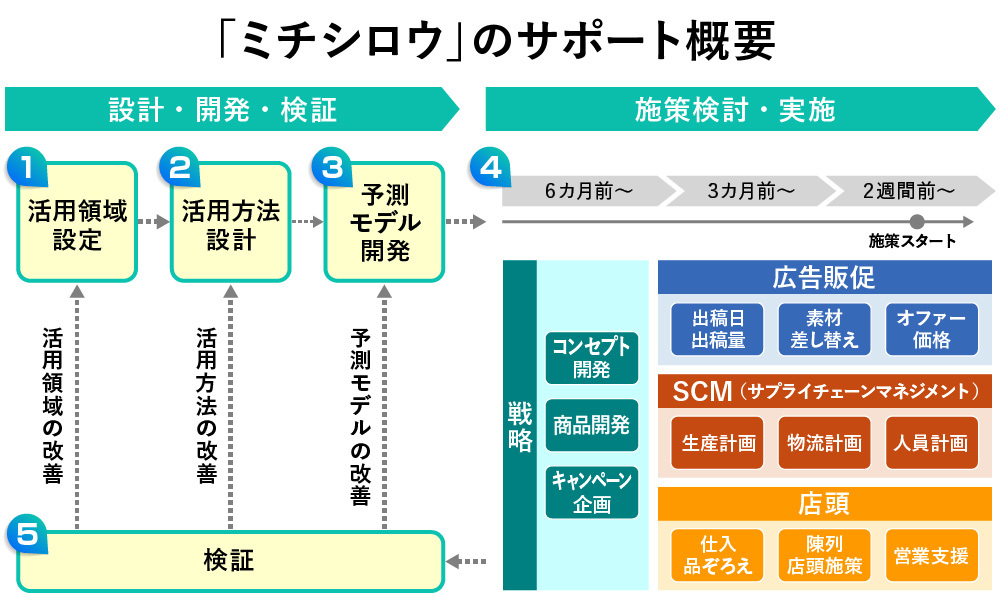
Dentsu Inc. has released "Michishiro," a consulting service that supports the entire corporate marketing process while leveraging demand forecasting ( overview here ). Oshima explained that the service proposes specific actionable measures utilizing demand forecasting across two major phases—"Design, Development, and Verification" and "Strategy Consideration and Implementation"—and provides support through to execution.
Next, Hiroyuki Sakuragi from Dentsu Data & Technology Center, Toshio Nakano and Kumi Ogoshi from the Meteorological Digital Services Section, Social & Disaster Prevention Business Division, Japan Weather Association took the stage.
Sakuragi stated that prior to Michishiro's release, the Japan Meteorological Association and Dentsu Inc. launched the "Weather Enhanced Marketing (WEM)" project in 2018 to leverage weather data and aim for higher marketing precision. Within this project, they developed the solution "Urebi Yori."
UrebiYori is a predictive model that analyzes purchase data for approximately 160 items—such as sports drinks and antiperspirants—whose demand peaks (moments) are influenced by weather factors, alongside weather data, using a proprietary methodology. It indexes changes in demand.
It continuously reflects daily updated nationwide weather forecast information (daily average temperature, sunshine duration, precipitation duration, humidity), enabling the capture of demand changes by area and product category. For daily forecasts, this can be done up to two weeks in advance (longer-term forecasts are possible for weekly or monthly data).
By predicting consumers' moments in advance, it enables efficient TV planning and digital ad delivery that never misses an opportunity, along with diverse marketing initiatives, says Mr. Sakuragi. ( Press release here ).
He added, "UrebiYori enables marketing tailored to finer nuances of demand by anticipating peak sales periods for each area and timeframe. It has been utilized across various categories including ice cream, soft drinks, and alcoholic beverages."
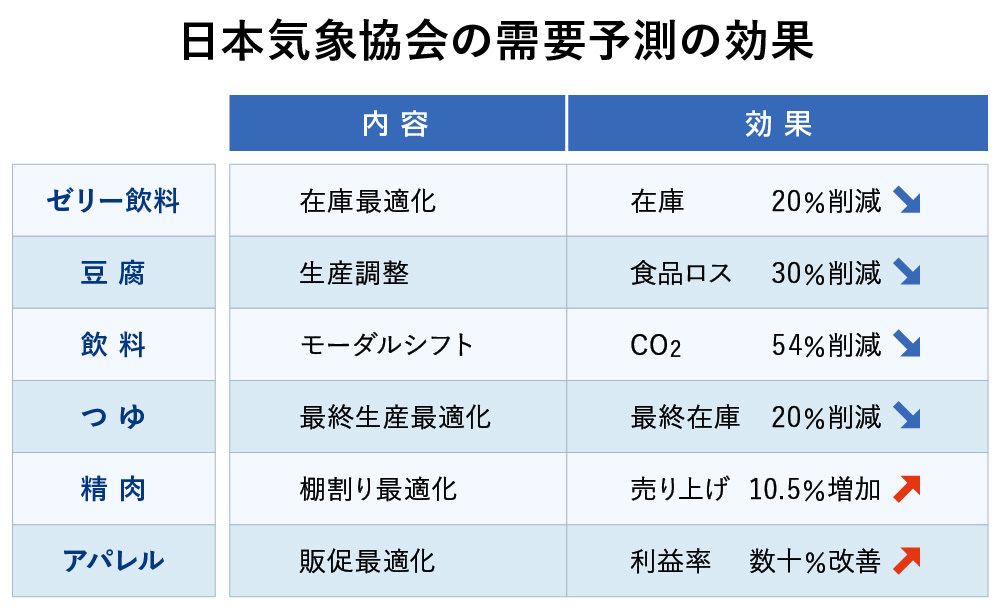
Weather data is the most critical element in "demand forecasting." Mr. Nakano stated, "One-third of all industries face some form of weather risk. And weather is the only phenomenon whose future can be physically predicted." Mr. Nakano introduced that the Japan Weather Association conducts demand forecasting using weather data and provides it to various companies. Recognized for its significant effectiveness, the Japan Weather Association received the Minister of Economy, Trade and Industry Award (Business Model Category) at the 2016 Energy Conservation Grand Prize.
Furthermore, Mr. Ogoshi explained that capturing consumers' perceived experience is crucial when applying demand forecasting to marketing.
"Even at the same temperature, the 'perceived temperature' differs by season. For example, sales of chilled Chinese noodles start when the maximum temperature exceeds 18°C, while oden sales begin when the maximum temperature drops below the 30°C range. An 18°C day in April feels very hot, while a 29°C day in August feels quite cool. While people generally consider temperatures near 30°C hot, seeing increased oden sales objectively shows that people are actually feeling cooler." (Mr. Ogoshi)
Mr. Ogoshi explains that "demand forecasting," which analyzes POS data combined with weather data, is an indicator that concretely translates consumers' perceived temperature into product demand. He states that Urebi Yori leverages this characteristic to help adjust campaign strategies and advertising volume.
Mr. Ogoshi then introduced marketing use cases for "demand forecasting." He emphasized that shared information utilization between supply chain and marketing departments is crucial for efficient profit improvement.
At the session's conclusion, the speakers discussed the value "demand forecasting" can provide to consumers and key strategies for implementing it.
"Demand forecasting effectively fosters consumers' 'discovery,' 'resolution,' and 'satisfaction' across three key areas: needs (stimulating demand), wants (stimulating purchase), and loyalty (stimulating continuity). It enables information delivery precisely when consumers need it, allowing companies to enhance marketing effectiveness," stated Mr. Sakuragi.
"Business improvements through demand forecasting also offer significant benefits to consumers. Optimizing inventory improves inventory turnover, enabling the delivery of fresher products. Optimizing shelf allocation and promotions ensures stable supply of desired products at optimal prices. This leads to reduced food waste and increased consumer satisfaction," stated Mr. Nakano.
"It's crucial to use information appropriately for each lead time. Since the granularity of forecasts varies from short-term to long-term, the key to effective operation is considering how to utilize information for each specific lead time," (Mr. Ogoshi)
Mr. Sakuragi concluded the session by outlining the future: "Demand forecasting can be applied across a broad spectrum of business areas. Beyond the traditional analysis axes of 'Who', 'What', and 'How', incorporating 'When' (timing/moment) as a new competitive axis through demand forecasting will help improve the accuracy of marketing decision-making."
What is Seven-Eleven's marketing platform that utilizes data from multiple angles?

The session titled "Integrated Marketing Solutions Based on the 7-Eleven App."
The session featured Katsuki Sugiura, Digital Sales Promotion General Manager (formerly Sales Promotion Department), and Kenji Oishi, Manager, both from Seven-Eleven Japan's Marketing Department, who introduced the newly launched "Seven-Eleven Marketing Platform (SEMP)"—a marketing solution for manufacturers leveraging various data and promotional tools connected to the Seven-Eleven App. They were joined by guest speaker Yasunori Noto from Dentsu Inc.
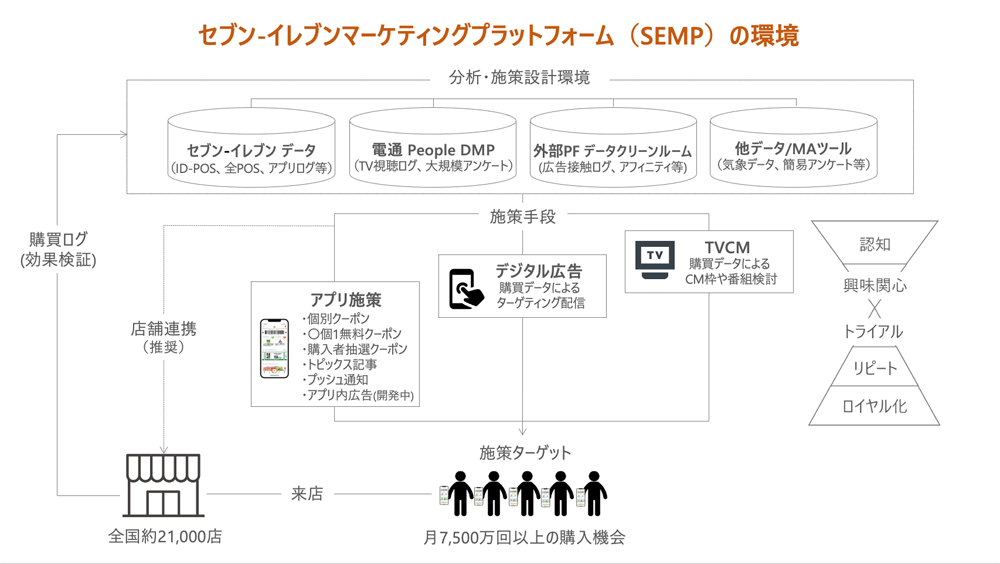
First, Mr. Sugiura explained the background for developing the platform.
As of September 2021, the Seven-Eleven app had approximately 15 million members and 7.5 million MAU (Monthly Active Users). Sugiura stated, "Previously, we communicated by sending the same information to all members at once, such as sending Seven Café coupons to members who had absolutely no interest in coffee. We felt the need to send each member the information they truly wanted at the right time."
"Therefore, we gradually advanced 1-to-1 marketing by analyzing ID-POS data linked to the Seven-Eleven app (*1). This allowed us to send not just discounts or coupons, but also information like new products, with optimal content at the optimal timing for each individual customer," said Mr. Sugiura.
*1 ID-POS data: Purchase data linked to a customer's unique ID (containing various customer information such as gender and age).
Seven-Eleven's ID-POS data is exceptionally rich, characterized by: "High data freshness due to frequent weekly visits by many customers," "Broad demographic coverage from customers of all ages and genders nationwide," and "Capturing actual purchasing behavior, not just preferences."
Using this ID-POS-centered data, we design various sales promotion strategies and execute effectiveness verification. The fundamental concept of the "Seven-Eleven Marketing Platform (SEMP)" is to open this entire PDCA cycle as a marketing platform to manufacturers. "By advancing initiatives on this platform, we aim to achieve a 'win-win-win' for manufacturers, Seven-Eleven, and our customers," stated Mr. Sugiura.
Mr. Oishi explained the difference between traditional manufacturer sponsorships and the Seven-Eleven Marketing Platform. While Seven-Eleven had previously implemented promotional campaigns for its app based on manufacturer proposals, the design and verification processes for these campaigns were not always based on detailed data analysis. He explained that the platform enables the planning of PDCA cycles together with manufacturers from the planning stage, utilizing various data centered around ID-POS.
"ID-POS data can be used not only for designing individually optimized app initiatives (such as coupon campaigns and information distribution) but also for planning awareness-building strategies using external advertising media. The data items available for designing these initiatives and verifying their effectiveness are extensive. Our analysts can customize analyses that connect to manufacturers' daily marketing activities by listening to their requests," said Mr. Oishi.
Mr. Oishi further emphasized that the greatest advantage of Seven-Eleven Japan, a business company rather than just a data holder, providing such marketing solutions is the ability to implement integrated sales promotion measures linked to the sales floor.
Next, as an example of effectively utilizing the platform, a case study was introduced where Seven-Eleven implemented the strategy for its own brand health-focused product, "Protein-Rich Roast Chicken & Spicy Chili." Regarding this case, Mr. Oishi stated, "Although we promoted it through TV commercials, we wanted more customers to repeatedly pick it up. For this initiative, we calculated repeat purchase prediction scores using machine learning applied to ID-POS data and distributed coupons accordingly. For customers perceived to have low product awareness, we simultaneously delivered web ad creatives that had shown high effectiveness in prior A/B testing. The campaign results delivered the targeted cost-effectiveness."
Yasunori Noto of Dentsu Inc., who supports the development and operation of this platform, explained the solution's strengths from the perspective of a data scientist specializing in marketing.
Noto stated that this platform combines four essential elements for FMCG marketing—an "analytical environment," "campaign tools," "store integration," and "customer attraction capabilities"—all at a high level of quality.
Regarding the "analytical environment," he explained that the platform provides virtually unrestricted access to large-scale ID-POS data and various linked datasets, enabling diverse analyses. Seamlessly integrated with this are "campaign tools"—including app-based campaigns (such as coupon promotions and information distribution) and advertising campaigns that can be designed down to the individual ID level.
"Beyond just analyzing product purchasers and market conditions, you can test manufacturers' target hypotheses, perform customer segmentation using machine learning with high-dimensional data, and develop predictive models to maximize KPIs for dual funnels. This allows you to explore optimal combinations of targets and initiatives," said Noto. Furthermore, the ability to validate this through RCTs (randomized controlled trials) and causal inference methods using statistical models represents the highest level achievable in a marketing PDCA environment," stated Mr. Noto.
Furthermore, for daily consumer goods where offline purchases account for about 90% of sales, "store integration" is particularly crucial for maximizing the effectiveness of various initiatives. Considering its "customer attraction power"—the ability to market to over 75 million monthly purchase opportunities just among current app users—it is believed to be unparalleled as an offline marketing solution. "Specifically, the Seven-Eleven app is frequently used before visiting the store or while in-store—moments when purchase intent is high. Therefore, we believe it is a highly effective measure for encouraging the purchase of specific products," stated Mr. Noto.
Mr. Noto then introduced actual case studies with manufacturers, explaining that this marketing platform can address a wide range of marketing challenges and that its value for manufacturers is maximized through medium- to long-term utilization.
Finally, Mr. Sugiura explained the conditions for using SEMP and expressed enthusiasm, stating, "Taking into account requests from manufacturers and marketing trends, we will continue to update this marketing platform." With that, the session concluded.
People-Centric TV Planning: Current State and Future

The session titled "The Present State of TV and the Future Realized Through Data Innovation" covered new solutions and the latest information in the field of TV planning.
Presenters were Yusuke Ashiki and Tae-Hee Park from Dentsu Inc.'s Radio,TV Business Produce Division. First, Mr. Park discussed the current state of television and its future, interspersed with key topics.
Lifestyles surrounding television are changing, with individualized viewing within households and the emergence of younger generations without televisions. Reflecting this trend, there is a movement to simultaneously stream terrestrial broadcasts online. Furthermore, the proliferation of connected TVs (televisions connected to the internet) is accelerating the shift toward television becoming a device primarily for watching video content.
A 2021 Dentsu Inc. survey found that for video streaming services like YouTube and Netflix, viewing frequency and duration tend to be higher on connected TVs than on PCs or smartphones," said Mr. Park.
Mr. Park stated that the impact of going cookie-free is a deeply relevant issue for television and video streaming, adding, "Video streaming platforms will inevitably have to advance OneID systems to maintain competitiveness in the data domain." OneID refers to the consolidation of user IDs around a single person.
"For example, registering an email address would allow access to various services from different companies using just that single ID. Television broadcasting will inevitably follow this trend. We expect peripheral services will also pursue OneID integration going forward, working to consolidate viewer data," said Park.
Park continued that as OneID adoption advances, viewing log data from internet-connected TVs will become increasingly vital for marketing. "However, TV data remains isolated from the digital DMP (Data Management Platform) world. Solutions like Dentsu Inc.'s STADIA (※2) bridge this gap. Technological innovation will likely drive future integration of TV, PC, and smartphone data," he projected.
※2 STADIA: An on-off integration solution that unifies data from "offline" media like TV with "online" media data from smartphones and PCs to enable more effective marketing. As of February 2022, it holds viewing log data from approximately 9.3 million TVs, alongside audience data comprising about 10 million mobile advertising IDs and roughly 148 million cookie IDs.
So, how can we gather various TV-related data and leverage it for marketing? Mr. Ashiki explained Dentsu Inc.'s two solutions developed to respond to TV's new future and maximize advertising value: "RICH FLOW" and "CONNECTED VIEW."
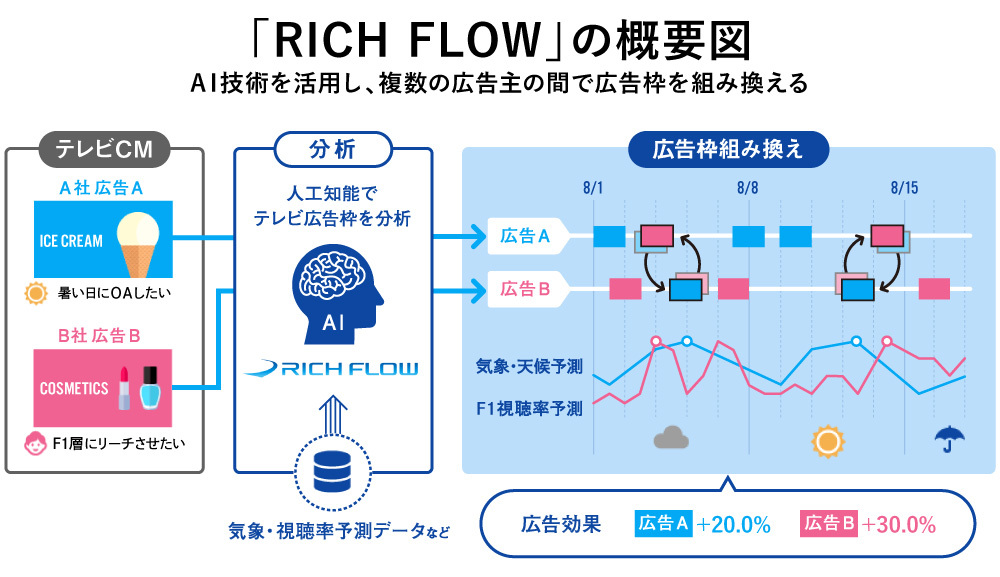
" RICH FLOW (beta), released in 2020, is a system that leverages AI technology to enhance commercial effectiveness. It enables the reallocation (optimization) of advertising slots among multiple advertisers.
For example, suppose Advertiser A wants to run an ice cream commercial on hot days, while Advertiser B aims to reach the F1 demographic (women aged 20-34). They have completely different KPIs. RICH FLOW analyzes the optimal ad slots for both companies using AI. If it predicts that both companies' advertising effectiveness will increase, it rearranges the ad slots."
Mr. Ashiki then explained " CONNECTED VIEW ": "This solution addresses the need to 'pay advertising fees based on the target audience reached.' It's a next-generation buying menu that executes orders based on actual viewing log data."
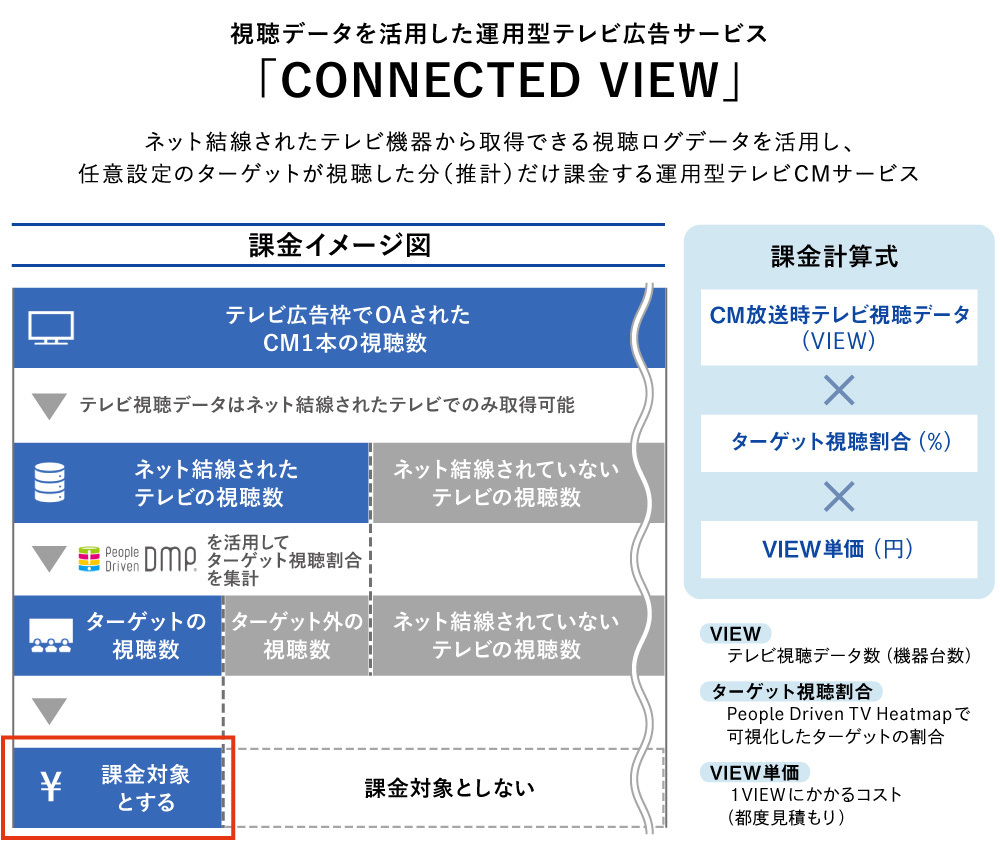
While TV broadcasts reach many people, the key point of "CONNECTED VIEW" is that it charges per unit based on the actual measured view log count (VIEW count) against the target viewership, as shown in the diagram above.
Mr. Park then addressed three challenges for leveraging television from a "person-centric" perspective and discussed future prospects for each.
Challenge 1: Discrepancies with PM ratings (*3), Kanto bias, and lack of local data
The first priority is solving the need for "PM-compliant big actual data" that combines nationwide actual numbers capable of local analysis, ensures representativeness close to PM ratings, and enables individual-level behavior analysis.
※3 PM (People Meter): A measurement device used by ratings research companies for individual viewer ratings surveys.
Challenge 2: Achieving integrated evaluation across data clean rooms
The challenge lies in being able to view multiple data clean rooms but not being able to correctly compare their respective results. Developing a solution to properly compare analysis results is necessary.
Challenge 3: Community Marketing Centered on Content
As "person"-based data becomes established, greater focus will shift to content enhancement. Therefore, it is necessary to build a system that contributes to the dual funnel using "content ID" as the key and to engage in marketing support.
Finally, regarding the future of broadcast waves, Mr. Park pointed out their weakness: "They cannot be targeted." However, he concluded the session by stating, "Through various data applications, we are also discovering the 'marketing effect on the target's peripheral audience' that broadcast waves possess. Activating this peripheral audience has been shown to positively influence various purchasing behaviors and contribute to sales. Please keep an eye on Dentsu Inc.'s research findings regarding this point going forward."
*Materials related to this webinar are available for free download.

Was this article helpful?
Share this article


Newsletter registration is here
We select and publish important news every day
For inquiries about this article
Back Numbers
Author