Note: This website was automatically translated, so some terms or nuances may not be completely accurate.
 "People Driven Marketing® Practical Webinar 2021" Report [4/5]
The Power of Digital and Data Essential for Achieving Customer Success
Dentsu Inc.'s people-centric marketing approach, "People Driven Marketing®".
It undergoes annual updates and has now evolved into "PDM 5.0."
This series provides a digest report on the three-day "People Driven Marketing® Practical Webinar 2021" (October 13-15, 2021), where Dentsu Inc. professionals and corporate guests discussed the future of marketing and data.
The theme for Day 3 was "Expanding PDM" ( Keynote Session here ). This installment introduces three sessions focusing on topics related to the practice of "People-Driven Digital Transformation."
*Affiliations and titles reflect information at the time of the webinar.
<Table of Contents>
▼Accelerating Major Transformation Through Cumulative Small Successes
▼Three Key Points for Digital Marketing Success Revealed by "Digital Marketing Diagnostics" Across Over 2,000 Companies
▼What Human and Organizational Challenges Emerged During Rapid DX Transformation?
※People Driven Marketing
https://www.dentsudigital.co.jp/service/pdm/summary/
Dentsu Inc.'s proposed integrated marketing framework centered on "people" for the data & digital era. It reframes challenges from a people-centric perspective and integrates the Dentsu Group's cutting-edge marketing methodologies to support customers' sustainable growth.
Accumulating small successes to reliably advance major transformation

In the session titled "Non-Selling Marketing: 'Customer Success' - Unraveling the Latest CRM with Data," Yosuke Shigehara of Treasure Data and Satoshi Abe of Dentsu Digital Inc. took the stage. They introduced methods for practicing customer success, incorporating the approach of Treasure Data, a data platform provider.
Today, society is shifting from consuming goods to consuming experiences. Companies are now required not only to efficiently produce goods but also to transform how they ensure continuous use. Within this trend, "Customer Success" is gaining significant attention. It refers to the concept of fostering ongoing, effective use of products or services after purchase or contract, building trust with customers, and ultimately driving business growth.
Mr. Abe described the transformation brought by customer success: "It begins with a 'communication transformation'—changing how we communicate with and support customers. Beyond that lies a 'service/product transformation' that creates new value propositions, ultimately leading to a 'business transformation.'" He further emphasizes that "delivering a consistent customer experience, rather than fragmented value," is essential for practicing customer success. To achieve this, effectively utilizing "data" to deepen customer understanding is crucial.
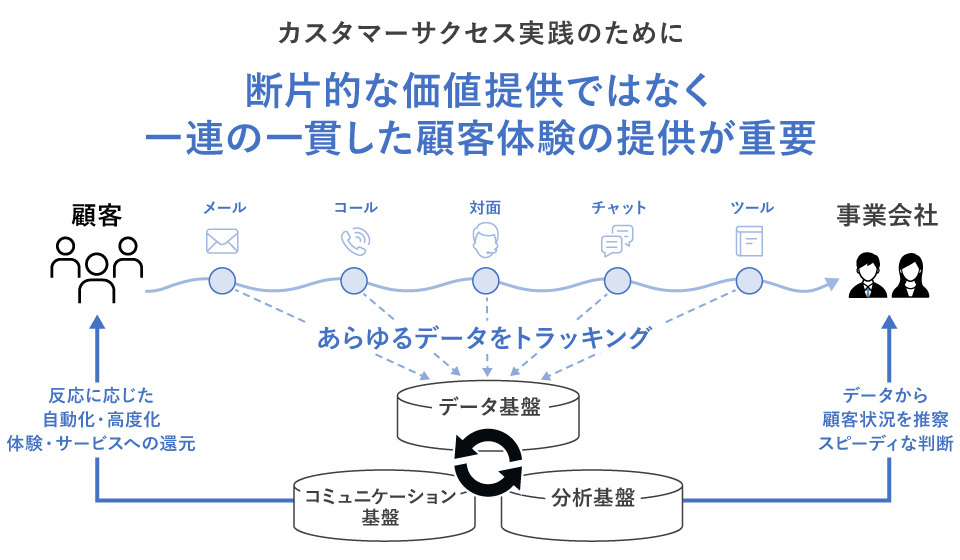
So, what specific actions should be taken to translate customer success into concrete initiatives and leverage data to drive results?
The session introduced two key points: "Customer Success-Minded Personnel and Organizations" and "High-Speed Proof-of-Concept PDCA."
① Customer Success-Minded Personnel and Organizations
In recent years, companies have focused on hiring IT talent like IT architects and engineers to drive DX. Practicing customer success requires not only these IT skills but also marketing skills, service design skills, a data-driven mindset to communicate effectively with IT talent, an agile mindset to rapidly cycle outputs and verification, and above all, a mindset for transformation.
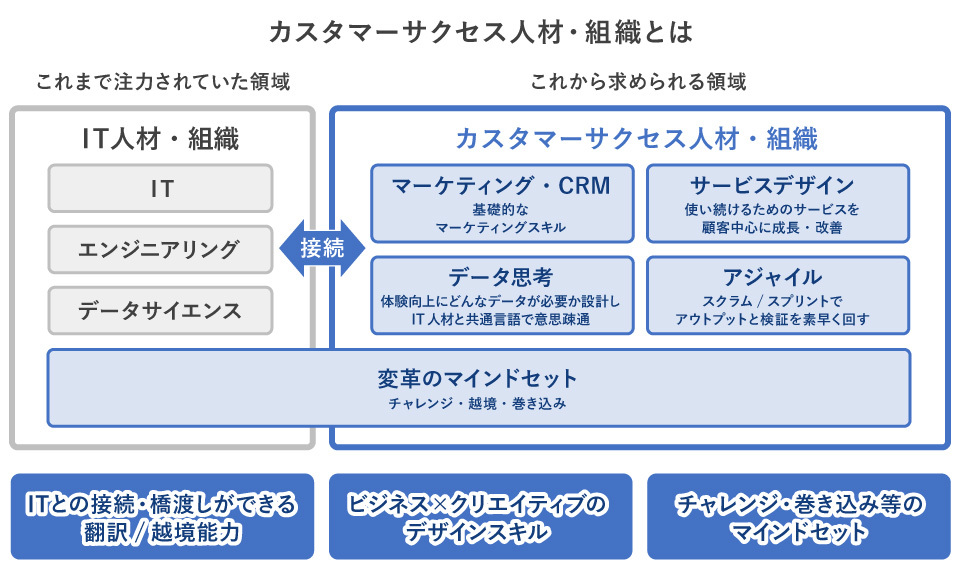
Mr. Abe explained that building a talent organization possessing these skills and mindsets enables the company to fulfill three key roles: "Customer Success Design" (defining customer success and integrating it into organizational mission and strategy), "Initiative Execution and Promotion" (data analysis/utilization and concrete planning for this purpose), and "IT/Business Improvement" (optimizing and standardizing operations).
② Rapid Proof-of-Concept PDCA
In customer success design, we must explore the value that truly contributes to customer success. For example, in a property search service, while providing a convenient search experience is essential, we can also consider various other values to deliver a "rich life experience." These include recommending suitable properties, supporting relocation procedures, introducing facilities and shops at the new location, and providing comprehensive support for food, clothing, and housing.
However, Shigehara noted, "In reality, cross-organizational/departmental and digital/physical initiatives often face conflicts due to differing departmental missions. Therefore, it's crucial to accumulate small successes and gradually scale initiatives."
The approach both companies advocate for creating these small successes is "Customer Success Prototyping." This method involves using prototyping to quickly demonstrate results and then scale the transformation. Shigehara explained, "For example, a business with a 10,000-member base might first offer a new customer experience service to 500 monitors. They then demonstrate changes in loyalty or purchase frequency, gradually scaling it into a larger transformation. That's the idea."
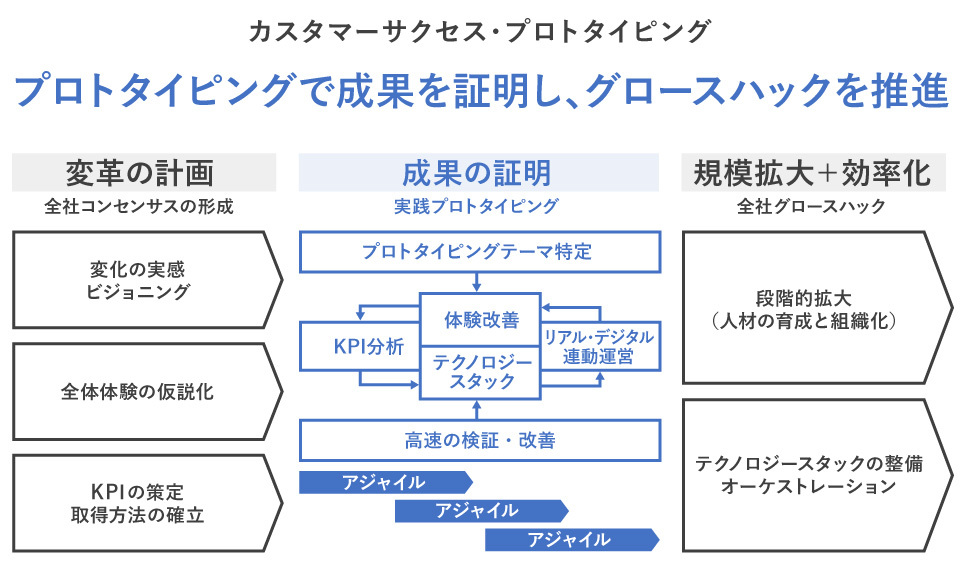
Treasure Data and Dentsu Digital Inc. are collaborating with three other companies to provide implementation support for Customer Success Prototyping.
Mr. Abe stated, "We aim to support you across various aspects—from designing hypotheses for customer experience and success, to planning specific initiatives and metrics, and then executing those initiatives through the PDCA cycle."
Related articles
The DX Engine Driven by Treasure Data and Dentsu Inc.
Three Key Points for Digital Marketing Success Revealed by "Digima Diagnosis" of Over 2,000 Companies

Next up is the session titled "The Reality at the Digital Marketing Frontline: Three Major Challenges and Success Stories Revealed by Dentsu Inc.'s Original 'Digital Marketing Diagnostic Tool'". Speakers Juichi Ichiyanagi from Dentsu Digital Inc. and Wataru Nagatomi from Dentsu Inc. introduced challenges occurring at the forefront of digital marketing and their solutions.
As digital marketing permeates society and new marketing technologies and tools emerge continuously, three key developments are occurring at the forefront of digital marketing.
① Expansion of Responsibilities
The evolution of marketing technology has broadened the scope of what can be handled digitally, ultimately expanding the scope of work for each individual.
② Expansion of Marketing Technology Functions and Increase in Related Departments
As functionality increases, the departments responsible also expand, leading to more projects requiring cross-departmental collaboration.
③ Increasing Complexity of Required Expertise
Due to factors ① and ②, the specialized knowledge required of marketers is also broadening and becoming more sophisticated.
Mr. Ichiyanagi states, "These factors have made the barriers to digital marketing higher and more complex than before."
Furthermore, he identifies the following four pitfalls in digital marketing:
- Failure to take stock of existing tools and data
- Failure to organize and prioritize challenges
- Failure to organize operations for implementing initiatives
- Tool implementation becoming an end in itself
As a result, real-world problems emerge: "The system stopped being used because operations became too burdensome," "Licensing and development costs doubled, driving up expenses!", and "We started digital marketing before competitors, yet now they're overtaking us...!?".
To avoid these pitfalls, the Dentsu Group recommends creating a blueprint centered on "workflows, talent, and data." We provide a unique framework to support the development of a digital marketing strategy that "avoids the four common pitfalls."
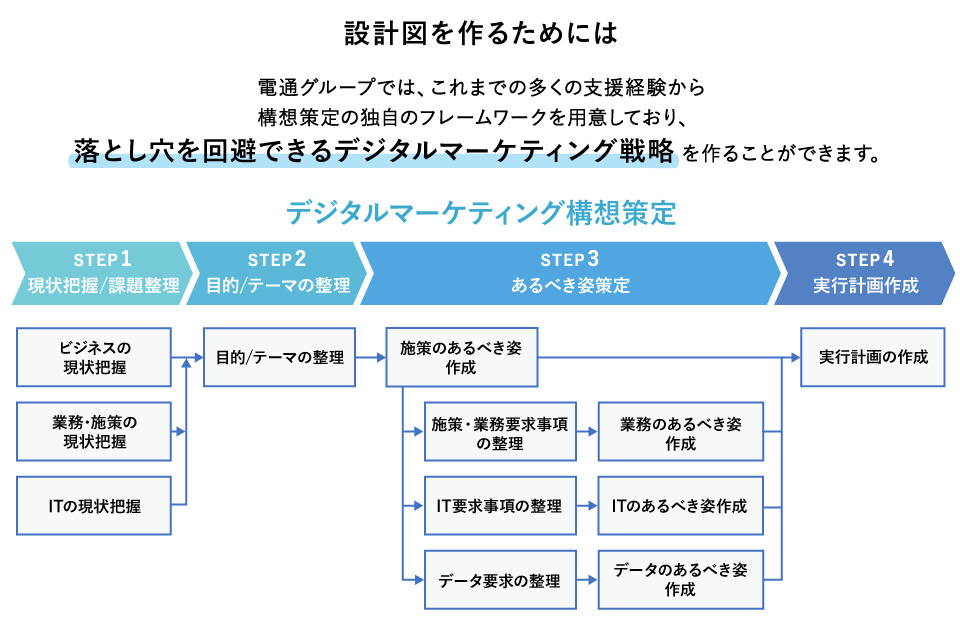
"For example, even if a car looks cool on the surface, it won't move without an engine or fuel. In digital marketing, the engine is 'business processes and talent,' and the fuel is 'data.' Without these in place, the desired state cannot be achieved," explains Mr. Ichiyanagi, highlighting the significance of the "blueprint centered on business processes, talent, and data."
However, he notes many express concerns like, "We're already overwhelmed just implementing immediate measures," or "Explaining the need for strategic planning to the company seems incredibly difficult." To address this, the Dentsu Group developed the "Digital Marketing Diagnostic Tool." This tool allows for easy assessment of the essential elements needed to build a digital marketing environment and also suggests future strategic directions.
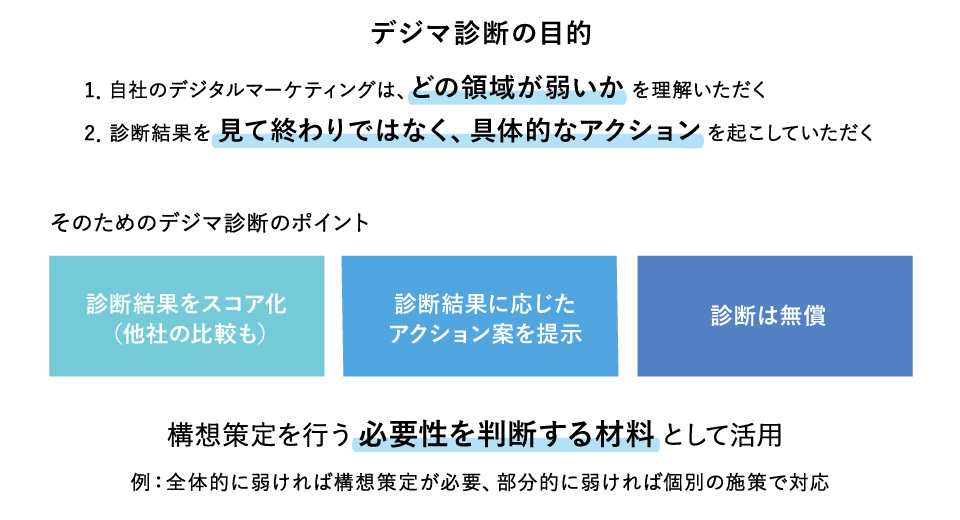
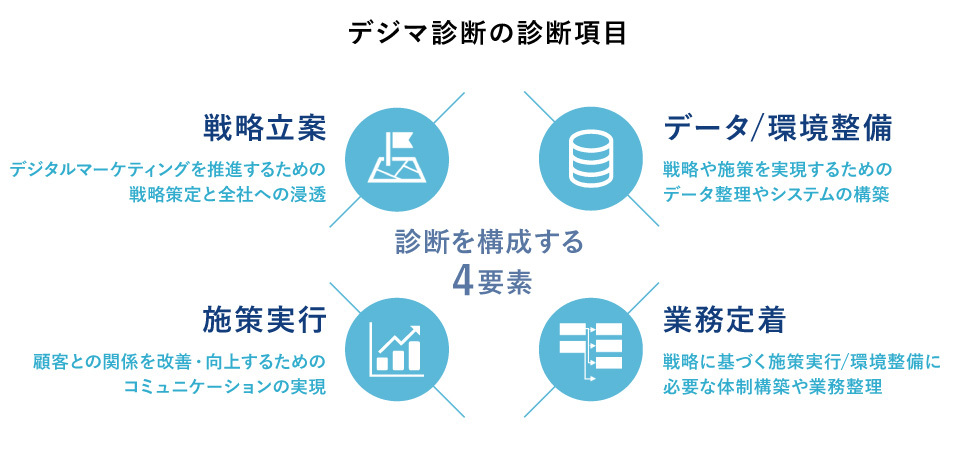
The "Digital Marketing Diagnosis" evaluates a company's digital marketing status across four areas—"Strategy Planning," "Initiative Execution," "Data/Environment Preparation," and "Process Implementation"—based on diagnostic results from over 2,000 companies already scored by industry. It provides actionable recommendations based on the results and serves as material to determine the necessity of formulating a vision.
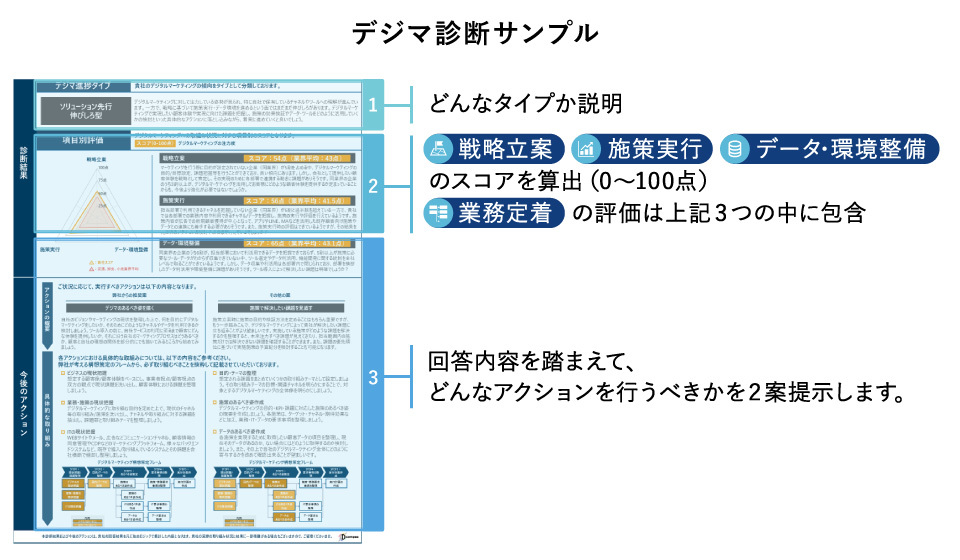
"Scores provide an objective view of your company's digital marketing progress. Comparing these scores to industry averages reveals your company's standing. If scores are generally low across all categories, it indicates significant challenges. Rather than addressing individual issues, it becomes clear that developing a strategic blueprint—creating a roadmap for your company's digital marketing—is the better approach. By conducting the DigiMa Diagnosis, you can determine whether to focus on strategic planning or address specific improvements. This also aids in formulating policy and sharing awareness of challenges within the company," explained Mr. Nagatomi, outlining the benefits of using the DigiMa Diagnosis.
Furthermore, the session highlighted three major challenges identified from diagnostic results of over 2,000 companies: "Lack of conviction in KGI/KPI setting," "Inability to share knowledge company-wide," and "Limited understanding of implemented tool functionalities." Solutions for each were proposed.
① Lack of buy-in for KGI/KPI setting
→ Solution: Define the exit point
Thoroughly consider the purpose of your current digital marketing efforts and what metrics must be tracked to measure progress toward that goal. By creating KGI/KPIs you find convincing and considering how to collect the corresponding data, you can identify what should be set as KGI/KPIs at your current stage.
② Knowledge isn't being shared company-wide
→ Solution: Establish a system for information sharing
The key to success lies in effectively leveraging your company's culture. Determine whether text-based knowledge sharing on the web is best, or if video works better. Should managers compile information before disseminating it? Explore every method to pinpoint which aligns with your company culture and is most likely to drive engagement. Improved information sharing eliminates the need for each team to repeat the same verification processes, streamlining efforts and accelerating digital marketing initiatives.
③ Not fully understanding the features of the implemented tools
→ Solution: Develop a manual
Create original manuals that compile the tasks necessary to advance your company's digital marketing, rather than relying solely on vendors' operation manuals. Start by creating operational manuals that help planners understand the workflows. Clearly state where to inquire for detailed feature information to encourage broader adoption.
Results from the digital marketing diagnosis revealed that companies answering "We have created manuals" scored approximately 2.5 times higher than those without manuals. Companies answering "We have a system for information sharing that can be referenced anytime" scored approximately 3 times higher than those without such systems.
Mr. Ichiyanagi summarized the session by stating that "Digi-Ma"—setting "Deguchi" (exits), creating "Jijo" (information sharing mechanisms), and formulating "Manuals"—are the three key points for digital marketing success. "To differentiate from competitors, prioritizing 'Maji' (Ma→Ji order) leads to results," he emphasized.
*As of March 2022, the "Digital Marketing Diagnostic Tool" is provided under the name "D-compas". "compas" stands for Check Of Marketing Platforms And Strategies, embodying our commitment to broadly identifying digital marketing challenges and guiding solutions.
What Human and Organizational Challenges Emerged from Rapid DX Transformation?

The final session introduced was "Creating Customer Smiles: Toyota Finance's Challenge in Digital Communication Transformation." Katsuyuki Takano of Toyota Finance and Daisuke Kobayashi of Dentsu Digital Inc., serving as facilitator, took the stage. They introduced the essentials of digital communication transformation based on Toyota Finance's DX case study.
Toyota Motor Corporation sells vehicles globally while also providing financial services in each country. Toyota Finance handles domestic sales financing. With the mission "Creating the future of mobility society and customer smiles through financial services that exceed expectations," it offers a wide range of financial services, including auto loans, credit cards, and the smartphone payment app "TOYOTA Wallet."
In its 2021 business strategy "VISION2025," the company declared its commitment to "create customer smiles" by expanding beyond its traditional "car-related services" into "lifestyle services" such as mobility service payments, life and non-life insurance, travel, and e-commerce services. This expansion aims to provide value tailored to each customer's individual needs.
The CX Division is tasked with driving this mission of "creating customer smiles." It aims to maximize customer success through digitalization, data-driven approaches, and smart contact. To achieve this, it has clearly defined member action guidelines, such as "thinking thoroughly from the customer's perspective based on the customer journey" and "always treating data as fact."
Mr. Takano stated, "The key is shifting analog customer touchpoints like paperwork and phone reception to digital ones. Beyond the traditional 'CRM approach,' we must now leverage data utilization to deliver personalized value to each customer through a 'customer success' digital approach."
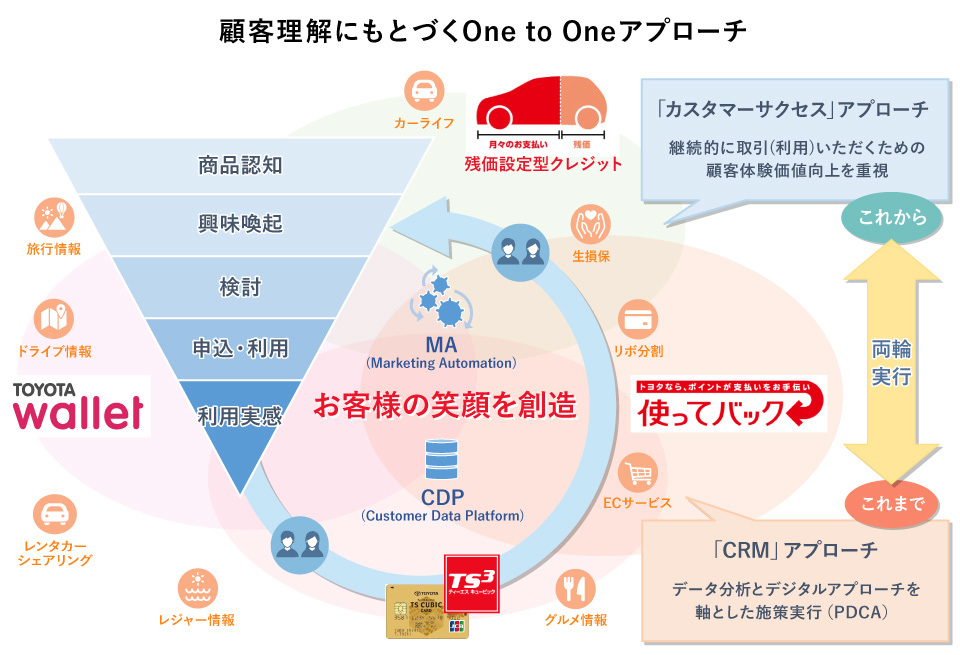
He then introduced specific DX initiatives. In 2018, the CX Division formulated a "Digital Communication Strategy" and optimized the customer journey across the entire business. Within about two years, they rapidly built the digital marketing tools and data infrastructure essential for DX. As a company-wide initiative, the "Business Concept Reform Project" launched in 2019, progressively expanding into new businesses beyond traditional auto loans and credit cards. Concurrently, to enhance CX, they expanded the range of services available for 24/7 online inquiries and procedures, updated FAQs, introduced chatbots, and renewed smartphone apps and websites.
"We are currently working on expanding web features for auto loan contract holders and integrating member sites," explained Mr. Takano, highlighting the ongoing commitment to further CX improvement.
While the CX Headquarters has driven Toyota Finance's DX transformation in a short timeframe, challenges emerged for the first time during project execution.
First, regarding the introduction of platforms and tools, there were few in-house experts knowledgeable about tools and data, making it difficult to gain understanding for the implementations themselves. Furthermore, the rapid pace of tool implementation and organizational expansion led to digitalization becoming an end in itself, creating the challenge that fostering a DX mindset and a CX (customer experience) perspective has not yet kept pace. "Additionally, I believe skills in effectively using the tools and analyzing data are still lacking," said Takano.
To address these challenges, the company is now refocusing on its original goal of "customer success" and working to correct course. "We still have many analog touchpoints, so first we need to firmly establish digital touchpoints with customers, acquire data, and effectively utilize that data. Building on that, we want to spread the ability to think from the customer's perspective and the skill to effectively use data throughout the entire organization," he shared his outlook.
Mr. Kobayashi concluded, "I felt that developing people and building the organization are indeed the most challenging points and will be the key to DX success."
※ Materials related to this webinar are available for free download.


Was this article helpful?
Share this article


Newsletter registration is here
We select and publish important news every day
For inquiries about this article
Back Numbers

Author