Note: This website was automatically translated, so some terms or nuances may not be completely accurate.
 "People Driven Marketing® Practical Webinar 2021" Report [3/5]
Customer experience design: essential for future brand development
Dentsu Inc.'s "People Driven Marketing®" (PDM®) is a human-centric marketing approach.
It undergoes annual updates and has now evolved into "PDM 5.0."
This series provides a digest report on the three-day "People Driven Marketing® Practical Webinar 2021" (October 13-15, 2021), where Dentsu Inc. professionals and corporate guests discussed the future of marketing and data.
Day 2's theme was "CX Planning & Development Practice" ( Keynote session here ). This installment introduces three sessions focusing on customer experience design case studies in D2C Inc. (Direct to Consumer), social commerce, and advanced tech.
*Affiliations and titles reflect information at the time of the webinar.
<Table of Contents>
▼ Purpose-Driven Brand Development to Thrive in the Era of "Meaningful" Consumption
▼ Achieving One-to-One Communication Through Social Commerce
▼ What is the Optimal Solution for Next-Generation CX Using New Technologies?
※People Driven Marketing
https://www.dentsudigital.co.jp/service/pdm/summary/
Dentsu Inc.'s proposed integrated marketing framework centered on "people," designed for the data & digital era. It reframes challenges from a people-centric perspective and integrates the Dentsu Group's cutting-edge marketing methodologies to support customers' sustainable growth.
Purpose-Driven Brand Development to Thrive in the Era of "Meaningful" Consumption

The session titled "D2C Practice Report: Two Barriers to Overcome in Purpose-Driven Brand Building" featured Shota Hisashi and Akiko Shiratori from NEW STANDARD, which operates the web media "TABI LABO" and runs its own D2C Inc. (Direct to Consumer) business, alongside Kazuki Takahashi from Dentsu Digital Inc. They introduced methods for building brands that deliver the customer experience (CX) needed in an era where purpose drives decision-making.
Mr. Hisashi, CEO of NEW STANDARD, pointed out that consumer behavior has shifted from "thing" consumption to "experience" consumption, and has now entered the era of "meaning" consumption. "Whether users can empathize with the 'meaning' of a product or service—its purpose—greatly influences their decision-making. Every brand must refine the 'new meaning and value' that only they can deliver through dialogue with users, and build customer experiences around that," he stated.
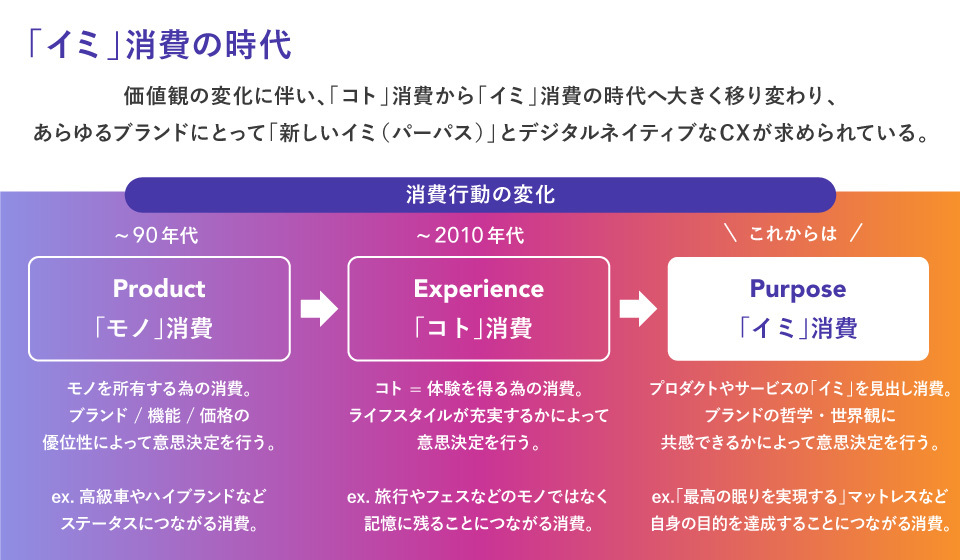
Against this backdrop, "D2C Inc." has gained significant attention in recent years. D2C Inc. refers to a business model where companies plan and manufacture products themselves, then sell them directly to users through their own sales channels. Simultaneously, it involves developing products and designing customer experiences centered on the user, prioritizing digital communication from the initial stages to grow the product and brand alongside fans. In this sense, it can be seen as a marketing trend suited to the 'meaning' consumption era, transcending the boundaries of a simple business model.
Mr. Takahashi highlights "user-dialogue-based prototyping" as an indispensable perspective for D2C Inc. business success. This method involves updating the customer experience by incorporating user feedback and insights at every stage: brand planning and design, construction and launch, and growth. "Through user-dialogue-based prototyping, maintaining a shared user perspective within the team enables the creation of a consistent customer experience," Mr. Takahashi explained the benefits of this approach.
Mr. Shiratori then stated, "Conducting user interviews based on traditional values rarely uncovers truly essential insights. Therefore, collecting and utilizing the reactions, behaviors, and insights of Millennials and Gen Z—the generations driving the values of the 'Meaning' consumption era—becomes a key clue for building D2C Inc. brands."
Furthermore, traditional brand strategies often involve separate functions like manufacturing, marketing, monetization/sales each developing their own strategies, leading to inconsistent customer experiences. As a solution, Mr. Hisashi emphasized, "It's crucial to design and develop the customer experience collaboratively, with all functions working together under a unified strategy centered on a purpose-driven brand identity."
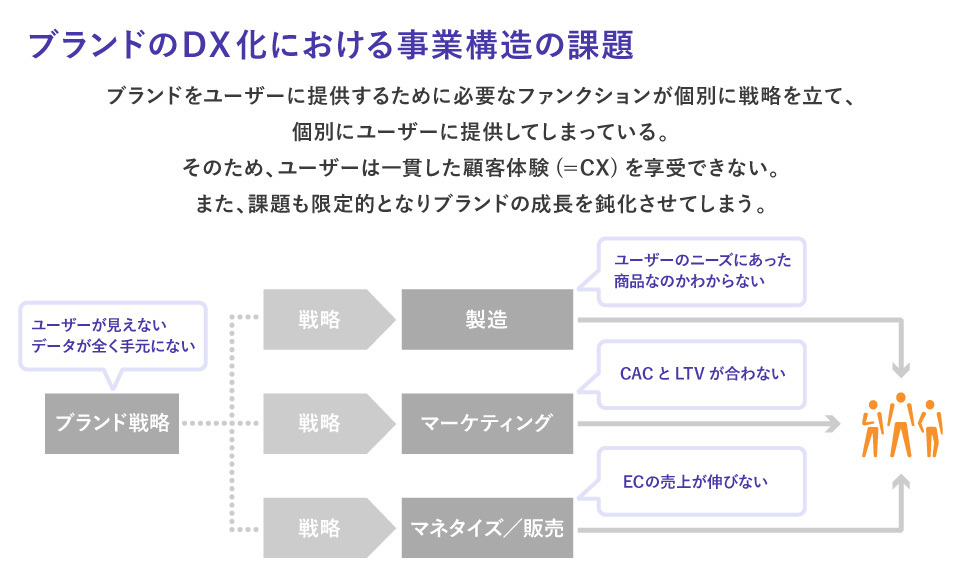
To address these challenges, Dentsu Digital Inc. and NEW STANDARD launched the service "BRAND DIGITAL TRANSFORMATION" (BDX). BDX provides a one-stop solution for launching new brands or reimagining existing ones, embodying purpose-driven customer experiences that capture insights from Millennials and Gen Z. By combining NEW STANDARD's research methodologies and extensive data on Millennials and Gen Z with the Dentsu Group's consumer insights and communication assets, BDX provides end-to-end support—from user-centric brand identity development and customer design to product development, marketing, and growth.
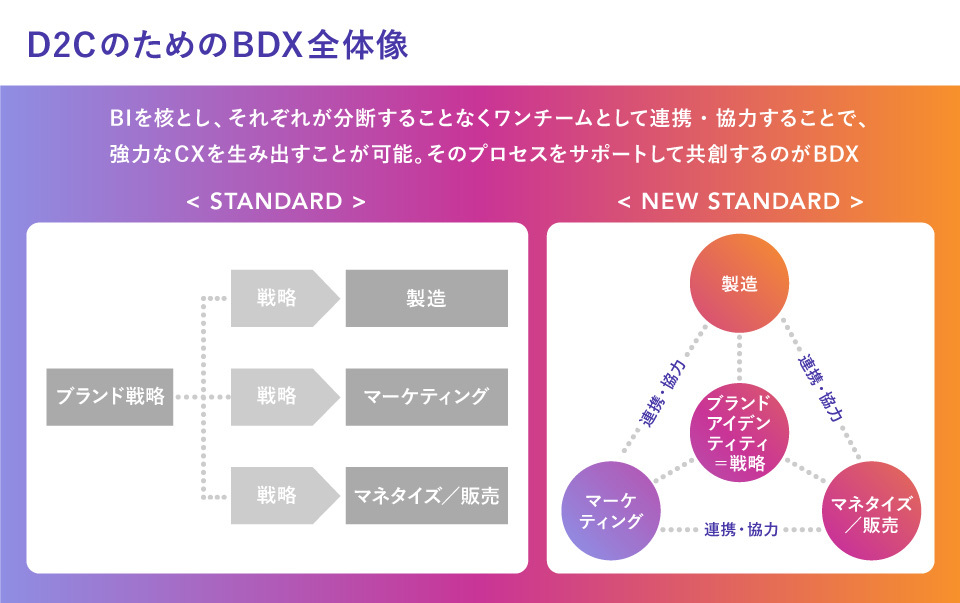
"We will help overcome the two barriers facing traditional brands – 'failing to redefine brand meaning in line with the times' and 'tending to focus solely on products, failing to translate into experiences that elevate quality' – and support product creation suited to the era of meaning-driven consumption," Mr. Takahashi stated, concluding with determination.
Related articles on "BDX"
Startups × Dentsu Inc.: Challenging New Value Creation
One-to-One Communication Realized Through Social Commerce

The next session introduced was "New Customer Experiences Enabled by Social Commerce and DX Advancement: Daikokuya's Sales Floor Transformation." Kohei Ogawa, President and CEO of Daikokuya Holdings, along with Dentsu Inc.'s Misa Ueda and Dentsu Digital Inc.'s Ryohei Mitsuhashi, presented on transforming sales floors from a commerce perspective in an era where companies and customers connect directly, based on initiatives by Daikokuya and Dentsu Inc.
Daikokuya is a leading company in the reuse industry, specializing in the purchase and sale of brand-name goods. While leveraging its strengths—expert appraisal skills and a proven track record in purchasing cultivated over its 70-year history—the company faced challenges such as acquiring new customers, particularly younger demographics, and the decline in inbound tourism during the COVID-19 pandemic.
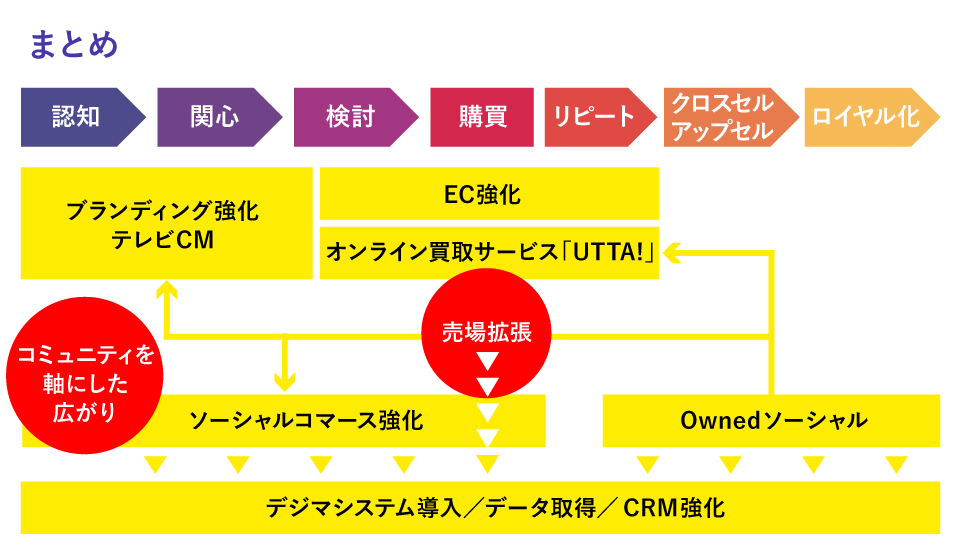
To address this, the company pursued reforms along two axes: "Awareness Expansion & Branding" and "Customer Touchpoint & Sales Floor Enhancement." For the former, it revised its logo and produced TV commercials. For the latter, it launched an online purchasing service, improved the UI/UX of its e-commerce site, and enhanced its CRM (Customer Relationship Management). Among these reforms, the strengthening of social commerce is particularly noteworthy.
Regarding the rationale for strengthening social commerce, Mr. Ogawa explained: "The items we handle vary greatly in customer needs depending on the brand and product category. While each store has accumulated expertise in personalized customer service tailored to individual shoppers, the fragmentation of this information across stores was a major challenge. We aimed to transform social commerce to visualize this 'analog knowledge' and enable optimal information delivery and communication with individual customers via e-commerce and social platforms."
To address these client challenges, the Dentsu Group supports social commerce renewal under the theme of "in-house development and self-sufficiency." Specifically, they introduced a new dashboard to visualize overall sales performance across social initiatives and store-specific sales performance. "We support clients in identifying challenges for the whole organization and individual stores in real time, enabling swift and appropriate decision-making," said Mr. Mitsuhashi. Ueda also highlighted the dashboard's benefits: "Seeing traffic and purchase numbers in real time boosts the daily motivation of those managing SNS operations."
Centered around the dashboard, accurately grasping target needs and personas while strengthening individualized communication has not only expanded sales for Daikokuya's own "LIVE SHOPPING" feature but also contributed to maintaining sales and improving inventory turnover rates. Additionally, they created manuals and tone-of-voice guidelines for creative and photography, providing support for the marketing team to operate independently. "Building on this foundation, we aim to strengthen sales targeting China, where live commerce is deeply entrenched, and further advance the digitization of Daikokuya's core strength: its appraisal expertise," Ogawa shared regarding future prospects.
Reflecting on the project, Ueda commented, "By extending the one-to-one communication we've practiced in stores to social platforms, we realized the immense potential of social commerce in directly driving purchases." Mitsuhashi stated, "The major achievement here was not only expanding our sales channels through enhanced social commerce, but also establishing a system where customer feedback and data gathered there can be leveraged to generate further sales."
Related articles on "Social Commerce"
・Beyond Merging Stores and E-Commerce: The Future of Shopping Experiences
・Why Social Commerce is a Concept Revolutionizing Marketing?
What is the optimal solution for next-generation CX utilizing new technologies?

The next session featured panelists Rintaro Ogawa and Kenichi Kawamura from Dentsu Digital Inc., with moderator Fumihiko Taira from Dentsu Digital Inc. Under the theme "How to Create Next-Generation Services: Aiming for Next-Generation CX with Advanced Tech × Creative," they discussed key points in CX design for product and service development utilizing advanced technologies (such as VR and AR).
At the outset, Mr. Taira introduced a common scenario frequently discussed with clients:
- Clients want to use new technologies like VUI (Voice User Interface), VR, and AR to improve CX, but they question the effectiveness.
- They have no experience creating services or products using advanced tech and are unsure how to proceed.
- They want to try new technologies eventually, but feel it can wait.
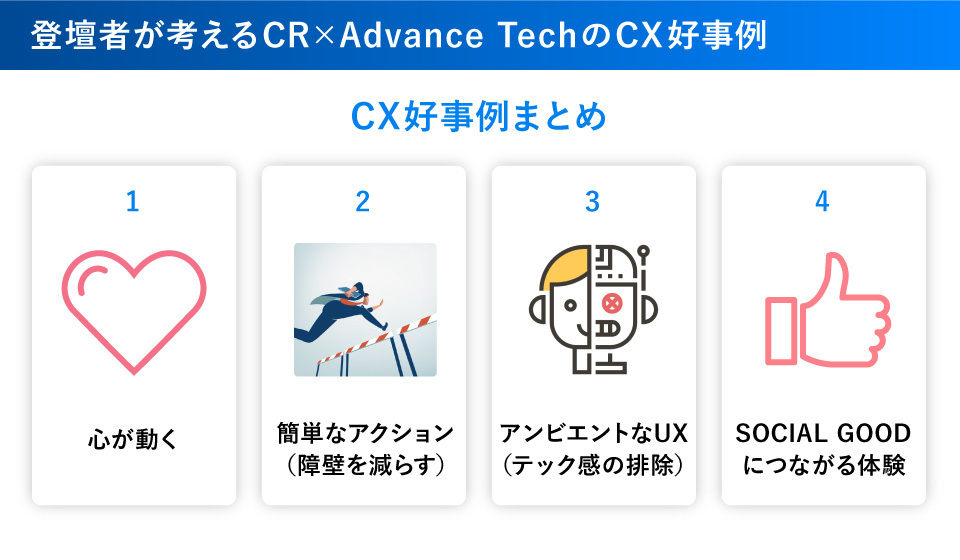
Mr. Ogawa and Mr. Kawamura then examined "real-world examples of CX success using advanced tech" and identified the following key points.
So, what specific initiatives is Dentsu Inc. undertaking? As one example, Mr. Ogawa introduced NTT Docomo's "my daiz." "my daiz" is a platform designed to deliver content users seek to customers. It features voice assistance like Siri, alongside communication functions via text chat and touch UI.
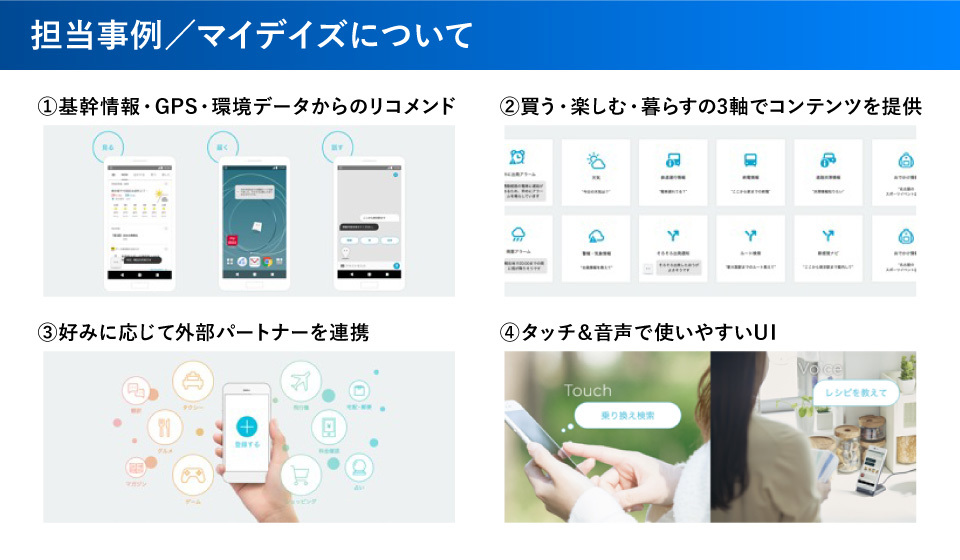
Ogawa's primary responsibility was character personality design—defining how the AI agent, positioned between the company/service and the customer, should exist and interact. "Since voice dialogue via VUI (Voice User Interface) was possible, we thoroughly researched and utilized Siri, Alexa, and Google Home," Ogawa recalls.
He also discussed the character design process. "We made the character square and tofu-like because we discovered that in the Japanese market, people tend not to naturally talk to non-human entities as if talking to themselves," he explained. "User testing revealed that as long as there's a clearly defined entity to interact with, Japanese users start talking to it immediately."
To clarify this tangible presence, they adopted the "Design Sprint" methodology. This agile process involves a small team rapidly iterating through idea generation, prototyping, and validation over a short period.
Another key point he highlighted was implementing various communication functions beyond just voice, such as text chat. "With voice dialogue, users might sometimes get a 'I don't understand' response to their questions. So, we aimed for a stress-free, comfortable experience by providing multiple operation methods for users to choose from and preparing the correct scenario for each," said Mr. Ogawa.
Next, Mr. Kawamura explained the challenges and key points of utilizing Advanced Tech.
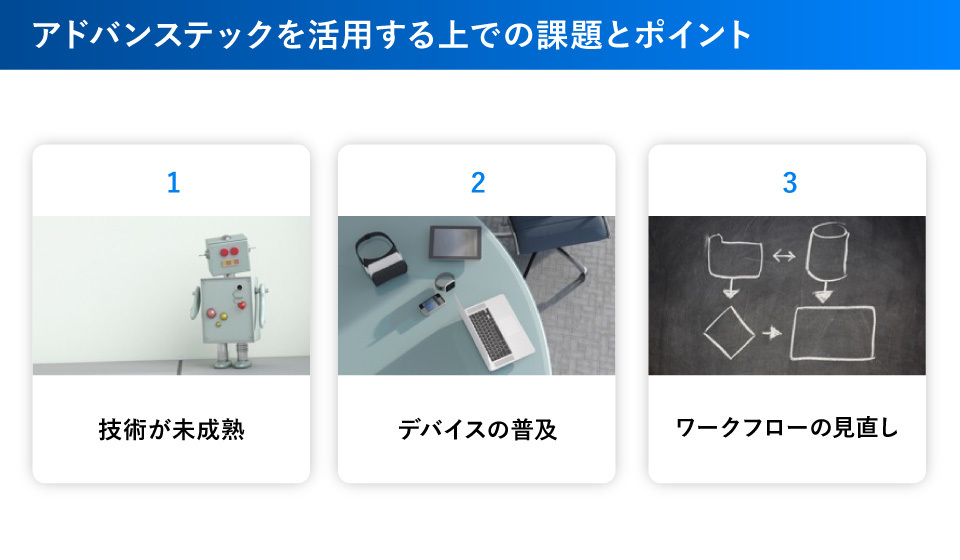
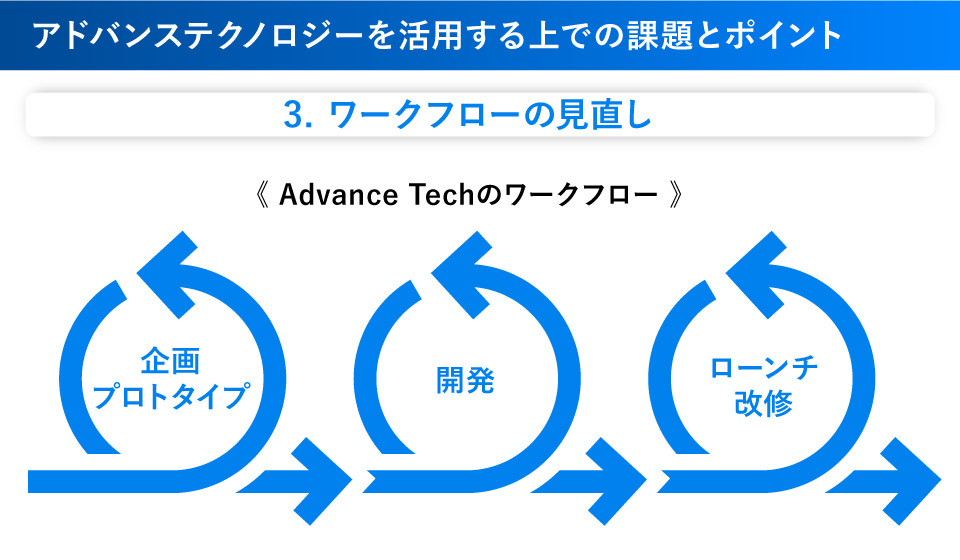
"For things like commercials, graphics, websites, and apps, where it's easy to imagine the finished product, a waterfall-type workflow is generally used, progressing from planning and prototyping to development to launch and refinement. On the other hand, for projects utilizing advanced technology, an agile workflow is effective. This is because the goal is unclear at the planning stage, so it is necessary to use an agile approach to explore the experience, share images with stakeholders, and ensure feasibility through prototyping. We often see cases where advanced tech is viewed merely as a tool to be introduced, and the result of proceeding with the conventional waterfall-type flow is a gap between what was imagined and what can be realized, leading to plans that are impossible to implement. We believe that when working with advanced tech, it is necessary to review the workflow itself," said Mr. Kawamura.
Finally, Mr. Taira summarized this theme by raising the following points.
- By actively incorporating advanced technology, it is possible to achieve a level of CX that was previously unattainable.
- It is important to develop in an agile manner, as new technologies may not deliver the expected performance.
- Aim for ambient experiences where technology is barely noticeable and experiences that contribute to social good.
Learn more
※ Materials related to this webinar are available for free download.


Was this article helpful?
Share this article


Newsletter registration is here
We select and publish important news every day
For inquiries about this article
Back Numbers
Author