Note: This website was automatically translated, so some terms or nuances may not be completely accurate.
 "People Driven Marketing® Practical Webinar 2021" Report [2/5]
What is the true value of Economic Zone Data × Data Clean Rooms? Introducing domestic implementation cases.
Dentsu Inc.'s "People Driven Marketing®" (PDM®) is a human-centric marketing approach.
It undergoes annual updates and has now evolved to "PDM 5.0."
This series provides a digest report on the three-day "People Driven Marketing® Practical Webinar 2021," where Dentsu Inc. professionals and corporate guests discussed the future of marketing and data.
Day 1's theme was "Practical CX Data Utilization" ( Keynote session here ). This time, we introduce three sessions focusing on next-generation digital marketing case studies utilizing "Data Clean Rooms" and "Economic Zone Data".
*Affiliations and titles reflect information at the time of the webinar.
<Table of Contents>
▼What is "X-Stack Connect," the new measurement platform for cookie-free environments?
▼Combining proprietary data with platform provider data in the cloud! How to leverage Data Clean Rooms
▼Leveraging data from 50 million users! The strengths and benefits of "HAKONIWA," developed in collaboration with Yahoo!
※People Driven Marketing
https://www.dentsudigital.co.jp/service/pdm/summary/
Dentsu Inc.'s proposed integrated marketing framework centered on "people" for the data & digital era. It reframes challenges from a people-centric perspective and integrates the Dentsu Group's cutting-edge marketing methodologies to support customers' sustainable growth.
What is "X-Stack Connect," the new measurement platform for cookie-free environments?

One strength of traditional digital marketing using third-party cookies was the ability to measure marketing data effectiveness and drive PDCA cycles based on that data. However, prioritizing user privacy protection makes it increasingly difficult to rely solely on cookies going forward. How should we measure and evaluate marketing data in this new landscape?
In this session, Chiharu Koyama of Dentsu Digital Inc. introduced "X-Stack Connect," a new measurement platform for marketing data in the "cookie-free era."
Cookies are a browser-dependent mechanism, stored on the visitor's browser. They enable tracking user movements across sites, allowing measurement of user conversions (CV) after ad exposure and automated ad bidding based on this cookie data. However, considering user privacy protection, cross-site measurement relying on cookies without proper user consent will likely become difficult going forward.
"This is where the concept of 'server-side measurement' becomes essential. A system that maximizes the use of first-party data—such as access logs and form information—and cross-references it with data held by each advertising platform to drive marketing will likely become the mainstream approach going forward," stated Mr. Koyama.
Mr. Koyama also pointed out that the currently widely used countermeasure technique of "adding parameters to the end of links for redirection (1st-party cookies)" is ultimately still a browser-dependent method and could eventually become subject to regulation. He warned that continuing to rely solely on browser-dependent countermeasures without user consent, thereby directly facing the impact of regulations,
- User-level tracking will become nearly impossible
• High-precision automated bidding will become impossible due to hindered optimization learning
・Retargeting will become impossible
These issues were explained.
As a solution to these challenges, Dentsu Digital Inc. introduced its new server-side layer data measurement platform, "X-Stack Connect" (details here ).
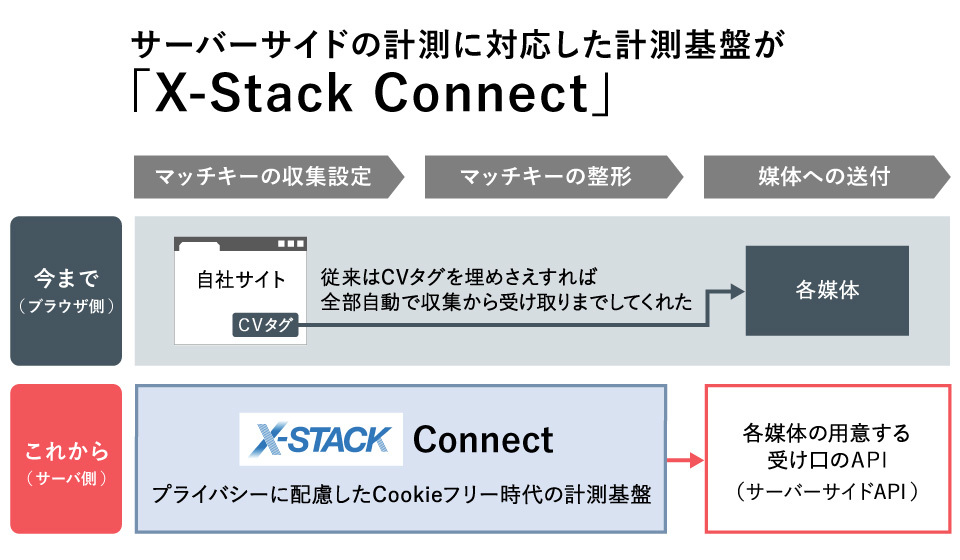
Server-side measurement presents significant challenges: implementers must handle data collection and formatting to identify converting users, making it highly complex. Additionally, individually adapting to each advertising platform incurs enormous costs and man-hours.
"However, 'match keys'—such as user IDs in access logs or form input information like email addresses, names, and addresses—remain largely consistent across platforms. Therefore, once the foundation is established, it can be easily and robustly repurposed for any advertising platform. In this regard, 'X-Stack Connect' is precisely such a foundation: it allows for a solid, reusable, and robust measurement infrastructure. It enables universal utilization after a single implementation, while also allowing for cost-effective, highly sustainable measurement," said Mr. Koyama.
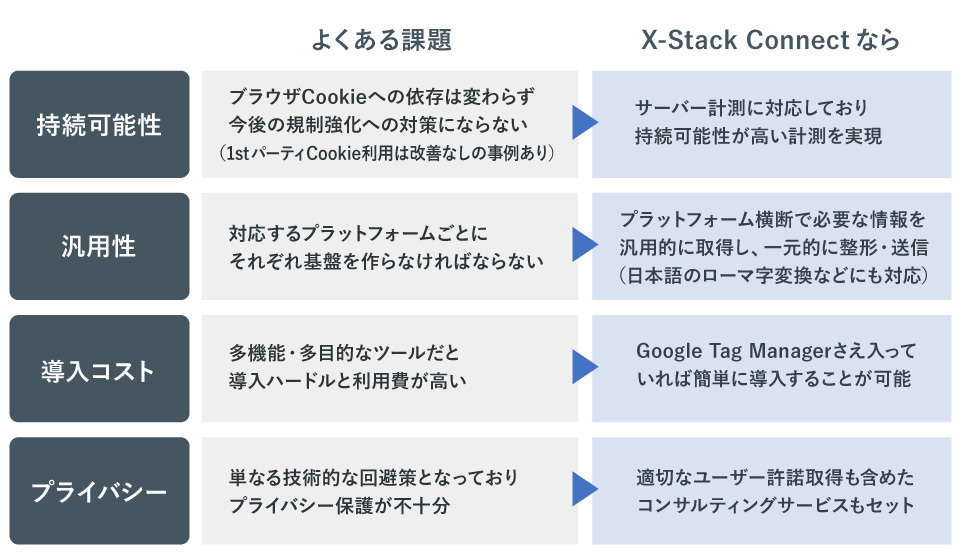
X-Stack Connect has proven compatibility with APIs provided by advertising platforms, such as Google's Enhanced Conversion API and Facebook's Conversion API.
When X-Stack Connect was implemented with Facebook, leveraging access logs reportedly increased trackable conversions by approximately 18%. Furthermore, correlating access logs with form data boosted trackable conversions by about 30%.
Koyama continues, "X-Stack Connect isn't just defensive; it also has an offensive aspect." By integrating X-Stack Connect with a data clean room, it holds the potential to analyze not only web conversions like "member registration," but also subsequent actions like "whether it led to an in-store purchase or contract."
In other words, by covering everything from "ad exposure" to "site visits" and "store visits/purchases," it enables end-to-end analysis of more fundamental "data that drives business growth." Koyama emphasized that this makes X-Stack Connect not just "a tool for cookie-free compliance," but a "solution that supports business growth" for long-term use.
, stating it is "a solution with potential to expand coverage when combined with other solutions and ideas," and concluded by urging, "Please consider utilizing it for the future."
Combining Your Own Data with Platformer Data in the Cloud! How to Utilize Data Clean Rooms

In the session titled "Ready to Use Tomorrow! Practical Examples of Integrated Marketing Using Data Clean Rooms," Aoi Inoue and Akane Furuike from Dentsu Inc.'s Data & Technology Center took the stage.
They first discussed the importance of "data" in future marketing and the concept of "turning consumers into fans."
Ms. Furuike explained the background: "With Japan's population declining and contact points shifting, particularly among millennials, companies must make each individual consumer a fan to maintain sales levels."
She also noted that amid growing trends like cookie-free environments and personal data protection, future data marketing requires a mindset of "entrusting data to us" from consumers.
Mr. Furuike stated, "In this environment, for companies to utilize valuable data, it is crucial to provide services that offer benefits to consumers—such as 'loyalty programs' or 'user-friendly, convenient payment methods'—and to make consumers want to maintain a connection with the company."
He also noted that "data clean rooms" offered by major platform providers are gaining attention as a solution capable of addressing this situation.
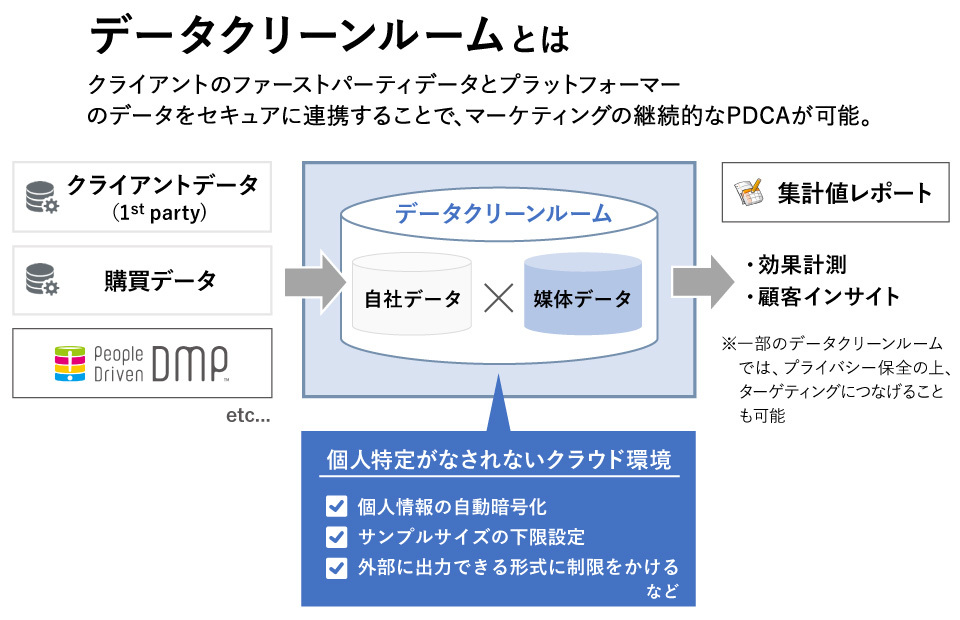
A data clean room is an environment that securely links a client's first-party data with the platform provider's owned data in the cloud. It becomes a data infrastructure that balances "privacy protection" with "corporate marketing needs," enabling the continuous PDCA cycle of marketing.
"Platform operators offering services that make customers feel 'I want to stay connected' and 'this is valuable' already possess data on a scale of tens of millions. By effectively utilizing the data clean rooms provided by these platform operators, marketers can leverage data more quickly and efficiently," said Mr. Furuike.
Related articles on "Data Clean Rooms"
・Data Clean Rooms Will Transform Marketing in the "Cookie-Free Era"
Here, Mr. Furuike once again explained the benefits of utilizing data clean rooms, illustrating them with three examples.
① Enables linking diverse data sets centered around the individual
Previously, a company's own "purchase data," the various data held by platform providers, and the various data held by advertising agencies were all managed separately. Both policy and technical constraints made linking them difficult, limiting data integration and utilization. However, using a data clean room enables the integration of these data sources, allowing for higher-resolution analysis and more accurate measurement of effectiveness.
② Enables "backcast-type" analysis based on purchases, making sales contribution clear
Traditionally, analysis and effectiveness measurement focused primarily on mass media like television, following a "top-down" approach: awareness → consideration → interest → purchase. Utilizing the data clean room enables analysis such as "Which consumers were influenced by the advertising?" and "What characteristics do consumers who considered but did not purchase have?" To get consumers to buy products, we believe it is necessary to transform to backcast-type marketing, starting from the ultimate marketing goal: "purchase."
③ Enables PDCA cycles using stored data, from acquiring new customers to nurturing them
Companies possessing a CDP (Customer Data Platform) can likely run PDCA cycles for initiatives within their own environment. However, when advertising is delivered via external platforms, the inability to link data prevents effectiveness verification, leading to the frustration of initiatives becoming one-off efforts. By utilizing data clean rooms to integrate and accumulate data, we can move beyond single-use, disposable advertising communication to a stock-based data marketing approach. This enables continuous PDCA cycles from acquiring new customers to nurturing them.
Mr. Inoue then detailed specific examples of platformer data utilization. He mentioned a daily goods manufacturer that, by using a data clean room, gained the ability to measure using actual purchase data, confirming whether ad recall truly led to purchases. He also cited a beverage manufacturer's promotional case study, noting that it became possible to visualize whether participants in a promotional campaign continued purchasing afterward. Another beverage manufacturer case study highlighted how the data clean room was used to deepen customer understanding through platform demographic data, which then informed subsequent marketing strategies.
In summary, he stated: "By utilizing data clean rooms, promotions that were previously based on 'gut feeling and sincerity' can now be made scientific by adding purchase data. Through deep customer understanding, you can achieve both scale and personalization. Turning cookie-free from a crisis into an opportunity—that is the power of data clean rooms."
Leveraging Data from 50 Million Users! The Strengths and Benefits of "HAKONIWA" in Collaboration with Yahoo

The final session was titled "Implementing Marketing Mechanisms that Drive Business Growth with HAKONIWA, a Collaboration with Yahoo."
Naoshi Shigayama from Yahoo, Taku Arakawa from Dentsu Digital Inc., and Rui Egashira from Dentsu Inc. took the stage to discuss the features and appeal of "HAKONIWA," a service provided by Yahoo and Dentsu Inc.
At the outset, Dentsu Inc.'s Egashira described HAKONIWA's defining characteristics as follows:
"HAKONIWA isn't just about inputting first-party data, matching it with platformer IDs, and outputting aggregated values. After matching IDs, it incorporates Dentsu Inc.'s mass advertising data to perform broad measurement, accumulation, and analysis. It enables data modeling, segment creation, and profile creation. The key point is its ability to facilitate deeper, more fundamental marketing utilization of data." (Egashira)
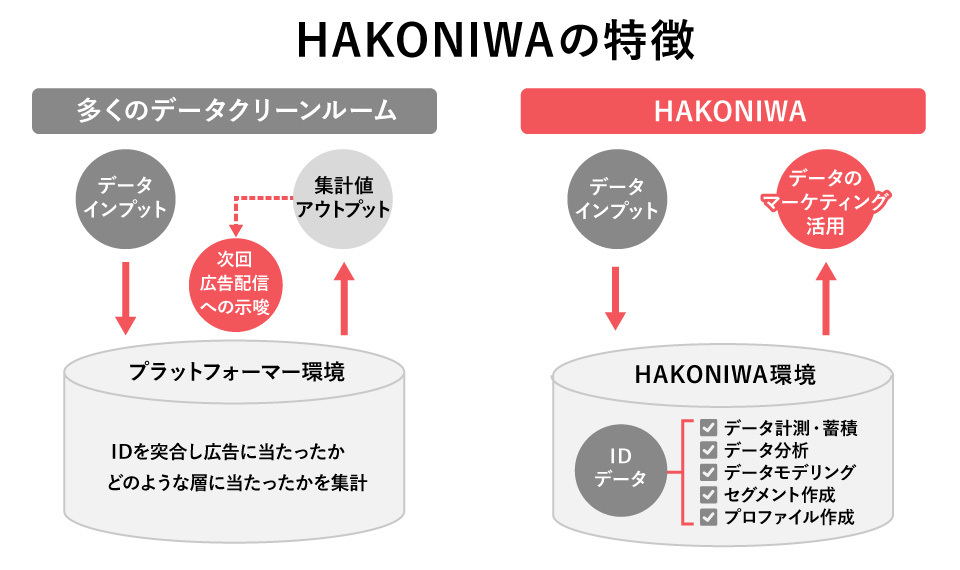
In response, Mr. Shigeyama of Yahoo introduced HAKONIWA's strengths. "HAKONIWA's strength lies in its data environment linked to over 100 services, including Yahoo! Shopping, PayPay Mall, and T-POINT. Furthermore, it accumulates data on full-funnel audiences engaged in diverse consumer behaviors," stated Mr. Shigeyama.
Yahoo stores data from over 50 million monthly users, ranging from "searches" to "online and offline purchase data." Furthermore, the management integration with LINE is expected to expand this scale even further.
Shigayama also highlights other strengths: "Most of the data is transactional, allowing users to be interpreted over time," and "It's diverse data aggregated around Yahoo! JAPAN IDs (individuals), not cookies, enabling seamless end-to-end execution from planning (strategy) to execution (measures) to measurement (analysis)."
He further explained the advantage of using IDs that do not disappear like cookies: "Data within the Yahoo! HAKONIWA economic sphere is continuously stored in a form consolidated under Yahoo! JAPAN IDs. This ID-based foundation, unaffected by 'cookie loss,' enables us to continuously enhance the precision of subsequent initiatives."
Next, Mr. Arakawa from Dentsu Digital Inc. introduced specific use cases for HAKONIWA. He highlighted cases where HAKONIWA was used not only to predict "people likely to buy our products" for planning purposes but also for actual ad moment delivery. He also introduced a case where Yahoo data was combined with Dentsu Inc.'s TV viewing data to verify the effectiveness of the overlap between the two. This demonstrated how HAKONIWA is actually utilized in each phase: "Planning," "Execution," and "Measurement."
Mr. Egashira concluded the session with a strong statement: "HAKONIWA is a solution that helps you understand customer movements not only within your own company but also externally. It's a mechanism that becomes your best partner when you want to supplement data on purchases, media exposure, and interests."
*Materials from this webinar are available for free download.


Was this article helpful?
Share this article


Newsletter registration is here
We select and publish important news every day
For inquiries about this article
Author