Note: This website was automatically translated, so some terms or nuances may not be completely accurate.
 The Dentsu Inc. Healthcare Team's Perspective on Consumers' True Feelings [1/3]
Are those in their 70s enthusiastic about health tech!? The reality of health awareness revealed by the 10,000-person survey
"This product targets people with lower health awareness," or "Ms. ●● has high health (beauty) awareness"—both professionally and personally, we often express the degree to which someone prioritizes their health and beauty. While this is very useful for getting a rough idea of someone's profile, when it comes to formulating specific business or communication strategies, we often want a more detailed understanding of exactly how high or low their health awareness is.
To capture these nuances in health consciousness, the Dentsu Inc. Healthcare Team regularly conducts the large-scale quantitative survey "Wellness 10,000 Survey" ( survey overview here ). The latest 2025 survey expanded its scope for the first time to include 10,000 respondents, encompassing those in their 70s. This time, we'd like to introduce the "subtle differences in 'high' or 'low' health consciousness" from the perspective of age groups, which became clearer by broadening the target.
The 70s: Highest Health Investment; The 20s: Eager to Adopt Latest Health Tech
When broadly told someone has "high health consciousness," what kind of person comes to mind? Perhaps older adults seem more health-conscious than younger people, or someone diligently exercising at the gym?
Looking at it by age group, the general awareness of health—the desire to "pay attention to one's body and health, and live carefully"—is indeed highest among those in their 70s (76.9%), with a gap of 24.8 percentage points compared to those in their 20s (52.1%), who have the lowest rate.
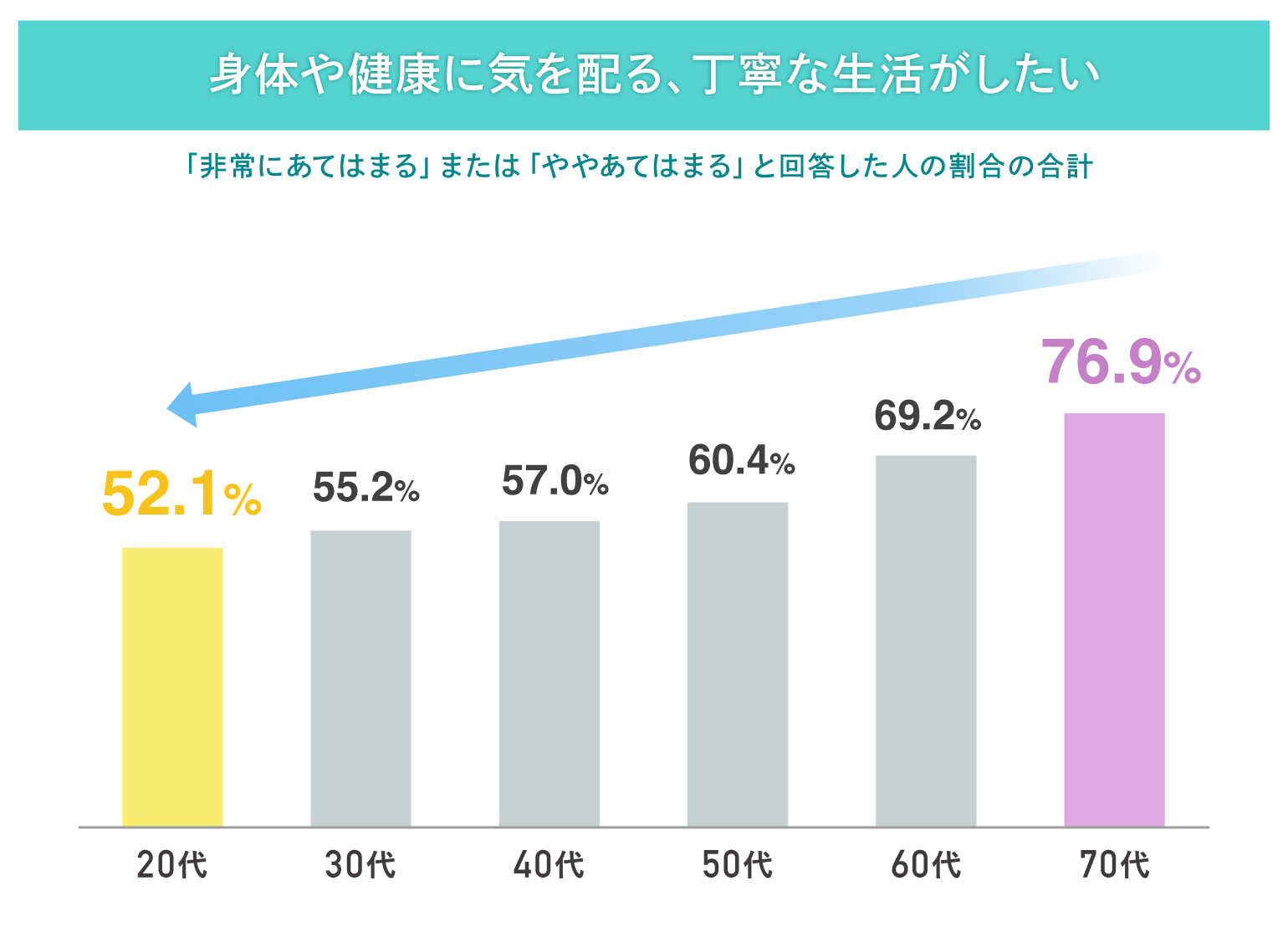
The amount spent monthly on health also peaks among those in their 70s (¥2,434), with a ¥1,240 difference compared to those in their 20s (¥1,194). This result, suggesting older people generally have higher health consciousness, might feel intuitively plausible. So, conversely, do those in their 20s have higher "health consciousness"?
For example, the results show that people in their 20s have the strongest desire to "work on their health together with others who share the same health concerns."
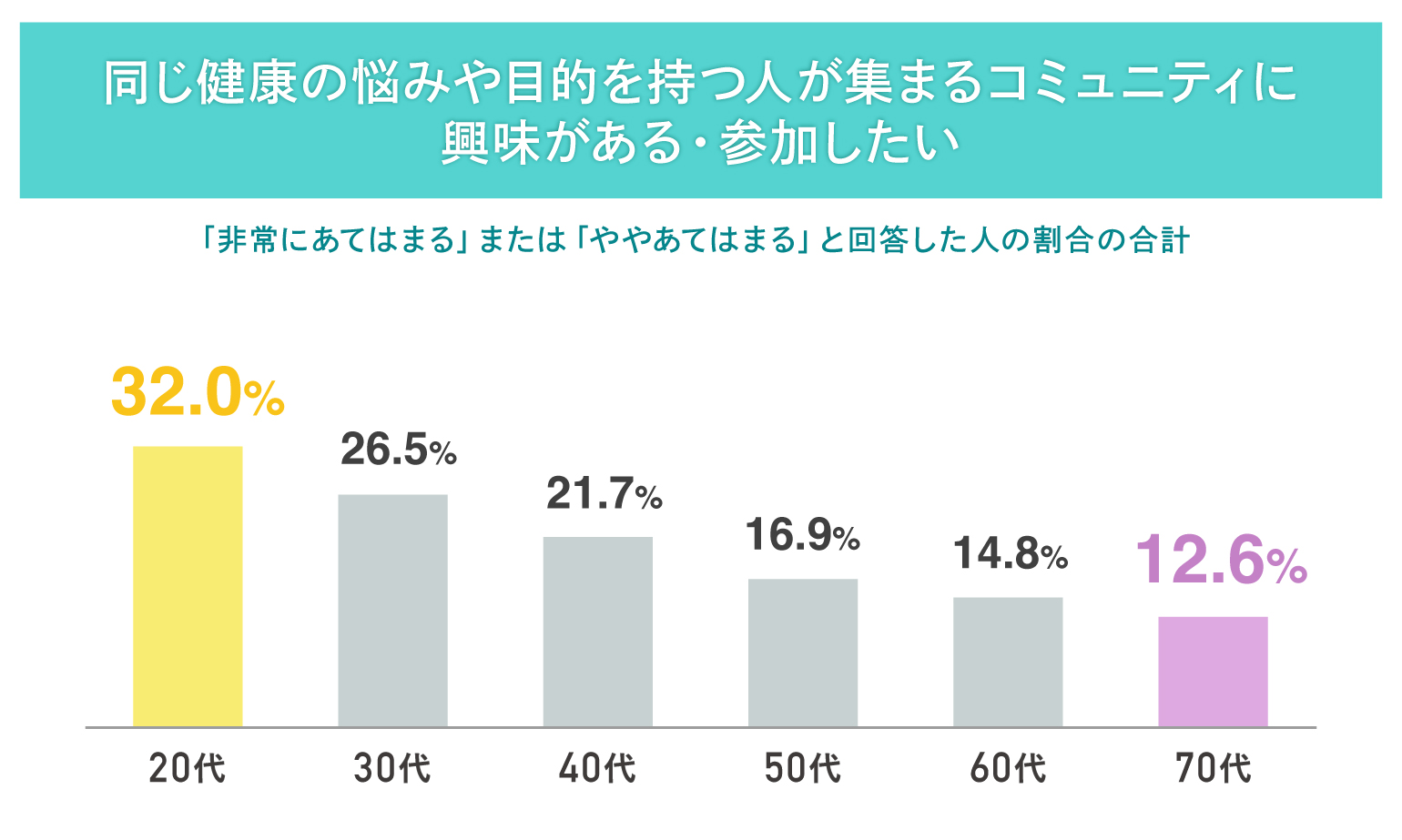
This may reflect generational traits: younger generations place greater value on and are more accustomed to "building relationships and mutual growth with those around them," not just in health but broadly. Furthermore, recent technological advancements have made virtual connections easier. For instance, using apps to share or compete over running distance and frequency—leveraging social elements to enhance enjoyment—has become common among young people.
From a technology utilization perspective, the desire to "use products and services incorporating the latest research and technology to address health" was also highest among those in their 20s (36.0%), decreasing towards those in their 60s (21.0%) and 70s (22.0%).
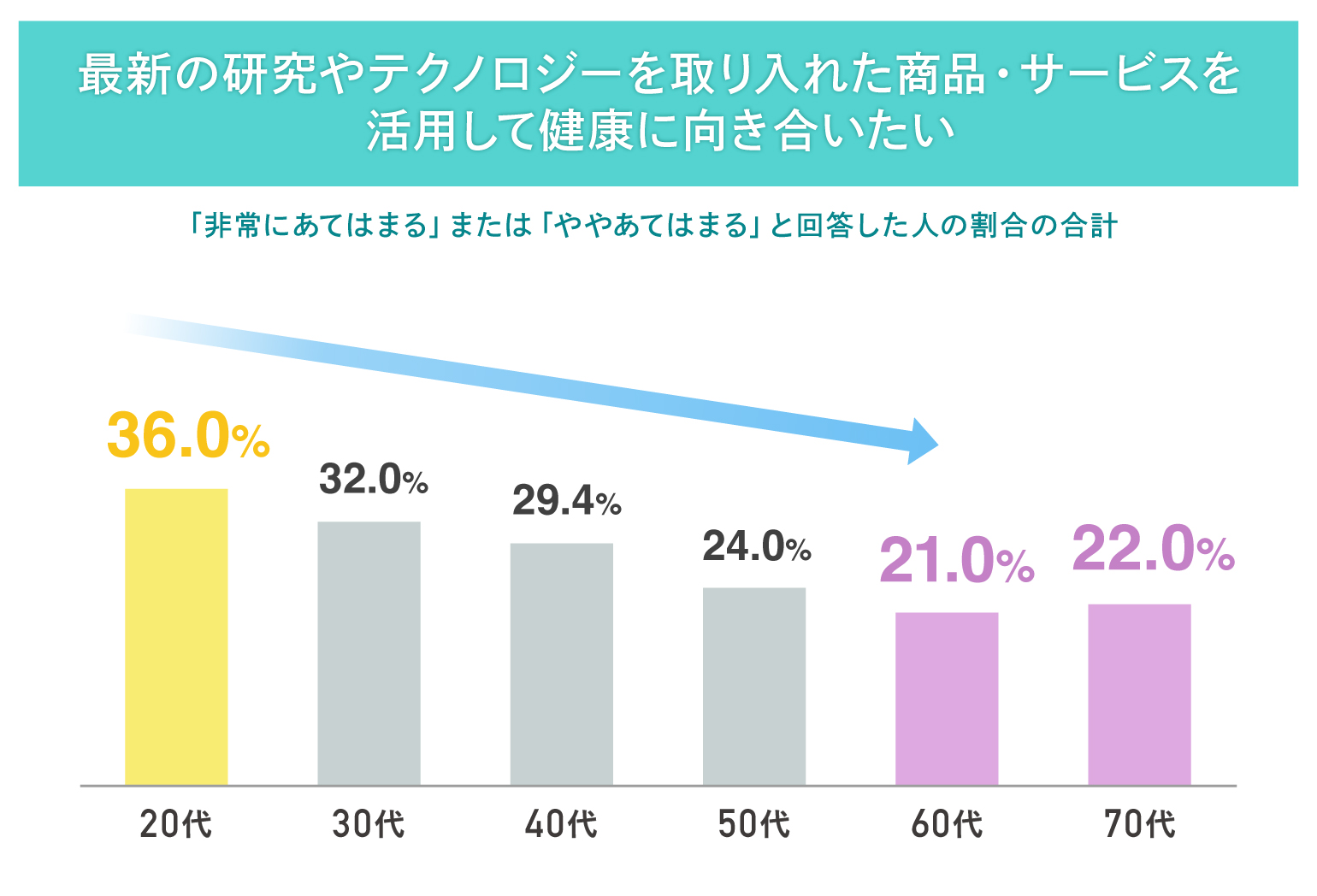
This result also makes sense considering that younger people are generally quicker to incorporate "latest technology" into their lives.
Smartwatch users are in their 20s and 70s!? A gap between awareness and reality
Summarizing the awareness trends discussed so far, we could broadly express it as: "Older people tend to have higher general health awareness, but younger people have higher awareness of trend-driven health practices utilizing technology."
However, examining the actual usage and intent for specific tech-based products reveals a different trend.
For example, the current usage rate of so-called smartwatches – "wristwatch-style or ring-type devices that can measure heart rate, step count, sleep quality, etc." – is highest among men in their 20s (17.6%), but the next highest is among men in their 70s (15.2%).Future usage intentions, as shown in the graph below, are also not declining; after those in their 20s (33.1%), those in their 70s (31.9%) show the next highest intention.
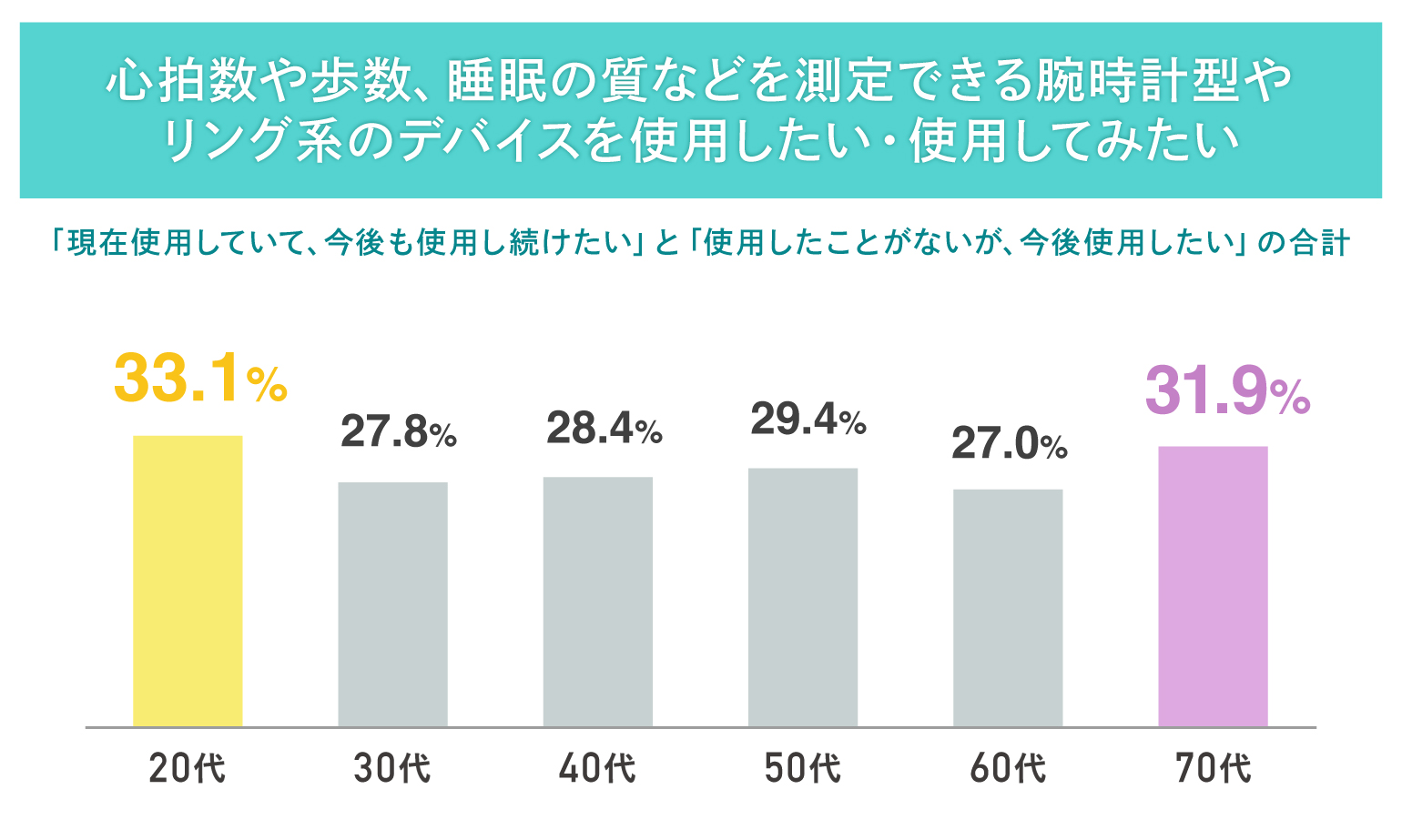
A similar trend is seen for the intention to use "recovery wear," a recent topic of discussion. While interest dips slightly among those in their 60s and 70s, over 20% of them still answered "I'd like to try it." The gap with other age groups isn't as large as the "awareness" gap regarding the latest technology mentioned earlier.
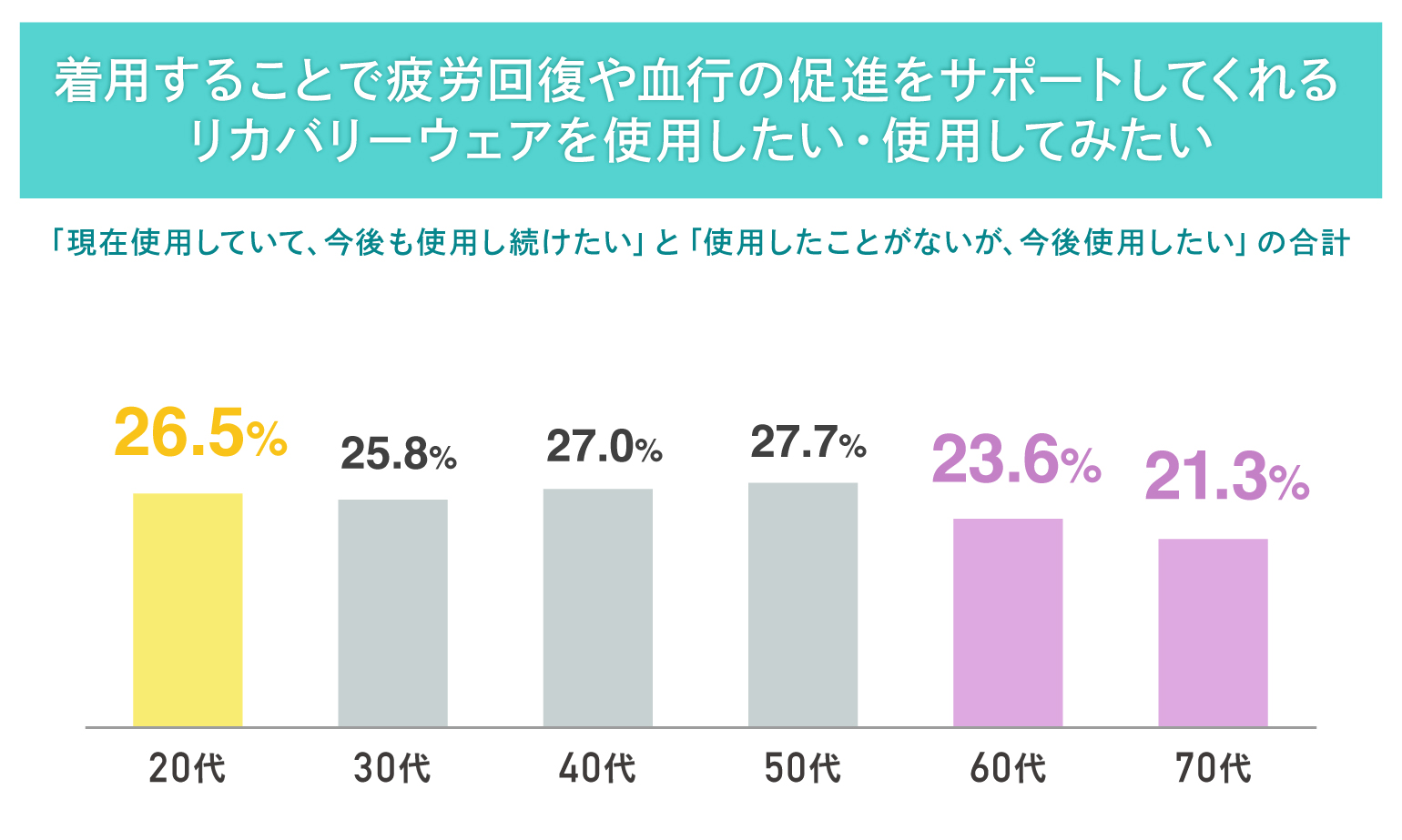
This may indicate that relevant products and services are naturally integrating into people's awareness and daily lives without individuals consciously thinking "I'm using the latest research and technology!" or trying to keep up. Looking at the actual situation, it's not necessarily true that "the latest health tech starts with young people, and getting older adults to use it is a high hurdle."
This article took the opportunity of redesigning the survey to include those in their 70s to delve deeper by age group. While it's convenient to broadly categorize people as having "high" or "low" health awareness to establish hypotheses and strategies, the question of what exactly defines "high" or "low" is both fascinating and complex. I hope this article has offered a glimpse into that complexity.
Adopting analytical perspectives beyond just age and gender might reveal even more intriguing and complex trends. With that in mind, next time we'll introduce the latest trends in health awareness and behavior based on the newly defined "Eight Healthcare Clusters" derived from our latest survey results.
[Survey Overview]
Survey Name: "The 19th Wellness 10,000 Survey 2025"
Conducted: June 2025
Survey Method: Internet survey
Survey Participants: Men and women aged 20-70 nationwide (10,000 samples)
Research Company: Dentsu Macromill Insight, Inc.
The information published at this time is as follows.
Was this article helpful?
Share this article


Newsletter registration is here
We select and publish important news every day
For inquiries about this article
Author
Takizawa Naho
Dentsu Inc.
6th Marketing Bureau, Marketing Consulting Division 1
Planner/Consultant
Exploring the Wellness Survey of 10,000 PeopleHealthcare Keywords Revealed by the Wellness 10,000-Person SurveyHow Should Japanese Companies Advance DX in China, a DX Leader?Latest Healthcare Insights from the Wellness 10,000-Person SurveyHealthcare Trend Forecasts for a Healthy and Happy FuturePR-Driven Marketing "MARKETING+PRUS"The Dentsu Inc. Healthcare Team's Perspective on Consumers' True Feelings