
Note: This website was automatically translated, so some terms or nuances may not be completely accurate.
 App Reference Book [7/7]
The 7 Principles of Good Apps ⑦: Visually Convey the Worldview You Want to Share

Masashi Yamasaki
Fuller Co., Ltd.
As many companies pursue digital transformation, the shift toward mobile as the primary customer touchpoint is accelerating. In this series, we interview Fuller Inc., which collaborates with Dentsu Inc. on app development. We asked Fuller's President Yamasaki, who has been tracking apps since the dawn of the iPhone era, to discuss the "Seven Principles of Good Apps" ( see the previous article here ).
This time, we explain "The 7 Principles of Good Apps ⑦: Visually Conveying the Desired Worldview."
(Planning: Dentsu Inc. 8MK Bureau, Makoto Sasagawa, Yosuke Otsubo, Yuki Sugiyama, Takuya Sotohebo)
Fuller Inc.
Flur provides business support in the digital domain, with app design and development as one of its core services. They meticulously analyze apps and their markets, handling everything from strategy building to product development and growth. Their creative team, comprising engineers, designers, data scientists, and directors, creates outstanding apps for various companies. Since 2021, they have had a business partnership with Dentsu Inc., which evolved into a capital and business alliance in 2024, forming a powerful team dedicated to app development.
Good usability alone won't make users fall in love with an app
In the first installment of this series, we introduced Jakob Nielsen's "Ten Usability Principles."
Reference: The 10 Usability Heuristics (Fagerlund)
- Visually convey the service's status in real time
- Communicate information using familiar terms and meanings
- Allow users to undo mistakes and operate freely
- Design should be consistent and common
- Preventing user errors
- Can be understood without relying on memory
- Usable by beginners and advanced users alike
- Minimalist and aesthetically pleasing design
- Assists users in recognizing and recovering from errors
- Provides help and manuals
Faithfully adhering to these 10 principles will certainly result in a stress-free, easy-to-use app. The apps that come to mind as exemplifying these principles at the highest level are the iOS and Android "Settings" apps. They are designed so that even first-time users can navigate them without confusion, and they are exceptionally effective at achieving their purpose.
However, does that alone make you feel affection for the app? I doubt it. You probably don't think, "I love the Settings app so much I want to look at it every day," or recommend it to friends saying, "The Settings app's worldview is the best."
Functional excellence and moving users to feel affection are entirely different dimensions. The 10 principles are fundamentally about "turning negatives into neutrals." To build on that and make users feel "I love this app," I believe the company or service's worldview must be visually reflected. That's why I added "Visually Conveys the Desired Worldview" as the seventh principle of a good app.
Google-Approved Playful Worldview: Waze
An intriguing case study illustrates the "value beyond functionality" that a worldview can hold. Consider the Israeli social navigation app "Waze." Developed in 2008, it was acquired by Google in 2013.While still operated under Google's umbrella, Waze continues to thrive as an independent brand, loved by over 150 million users worldwide—despite its parent company owning the powerful navigation app Google Maps.
Differences from Google Maps include features like its focus on car travel and its emphasis on gathering information through user communication. However, the biggest difference lies in its thoroughly consistent worldview. While Google Maps aims for a sleek, almost blandly impartial app, Waze features a playful world filled with cute characters resembling ghosts with wheels. All icons are unified in a pop design with white outlines.Even reporting traffic jams is presented as a fun "community experience" of users helping each other.
If Waze had focused solely on efficiency to meet the 10 principles, it might have been absorbed by Google Maps, losing its unique identity. Its visual appeal—the desire to enjoy travel within this charming world—is the decisive differentiator against its massive competitor.
Moleskine recreates the tactile feel of its notebooks in its app
Another standout in world-building is the app series offered by Italian notebook brand Moleskine.Moleskine, an Italian stationery manufacturer founded in 1997 (a more recent start than you might think!), is renowned for its paper diaries and notebooks. However, it is now actively expanding into the digital realm, offering a diverse range of apps including the journaling app "Moleskine Journal" and the task management app "Moleskine Planner."Particularly noteworthy is "Moleskine Planner," a revamped version of the app formerly known as "Balance," which underwent a major update at the end of 2024. This demonstrates how long-standing apps continue to be refined and improved.
Moleskine aims to eliminate the boundary between analog and digital, seamlessly connecting the two. It skillfully translates the essence cultivated through its paper products into the digital realm. From the app's color palette to its subtle animations, Moleskine's long-established brand worldview of a "free and creative lifestyle" is consistently reflected.While a digital tool, it visually reconstructs the tactile experience of holding a Moleskine notebook. Users develop deep affection for the app not merely because it's convenient, but by feeling they are part of the Moleskine world, embracing its identity.
The "F1" app that recreates the circuit with just one font
Worldview resides even in details like fonts.The official app for Formula 1, the world's premier motor racing series, exemplifies this. Upon opening the app, users first encounter a unique, original font that evokes a sense of "speed" and "motorsport tradition." Merely viewing the numbers and text within the app allows users to unconsciously conjure the streamlined form and velocity of machines racing around the circuit, the shape of courses with successive corners, and the distinctive atmosphere inherent to the F1 brand.
This visual dedication transcends mere "decoration." It plays a crucial role in imprinting the brand's personality on users every time they open the app, elevating it into a memorable experience.
A Worldview That Fosters Affection
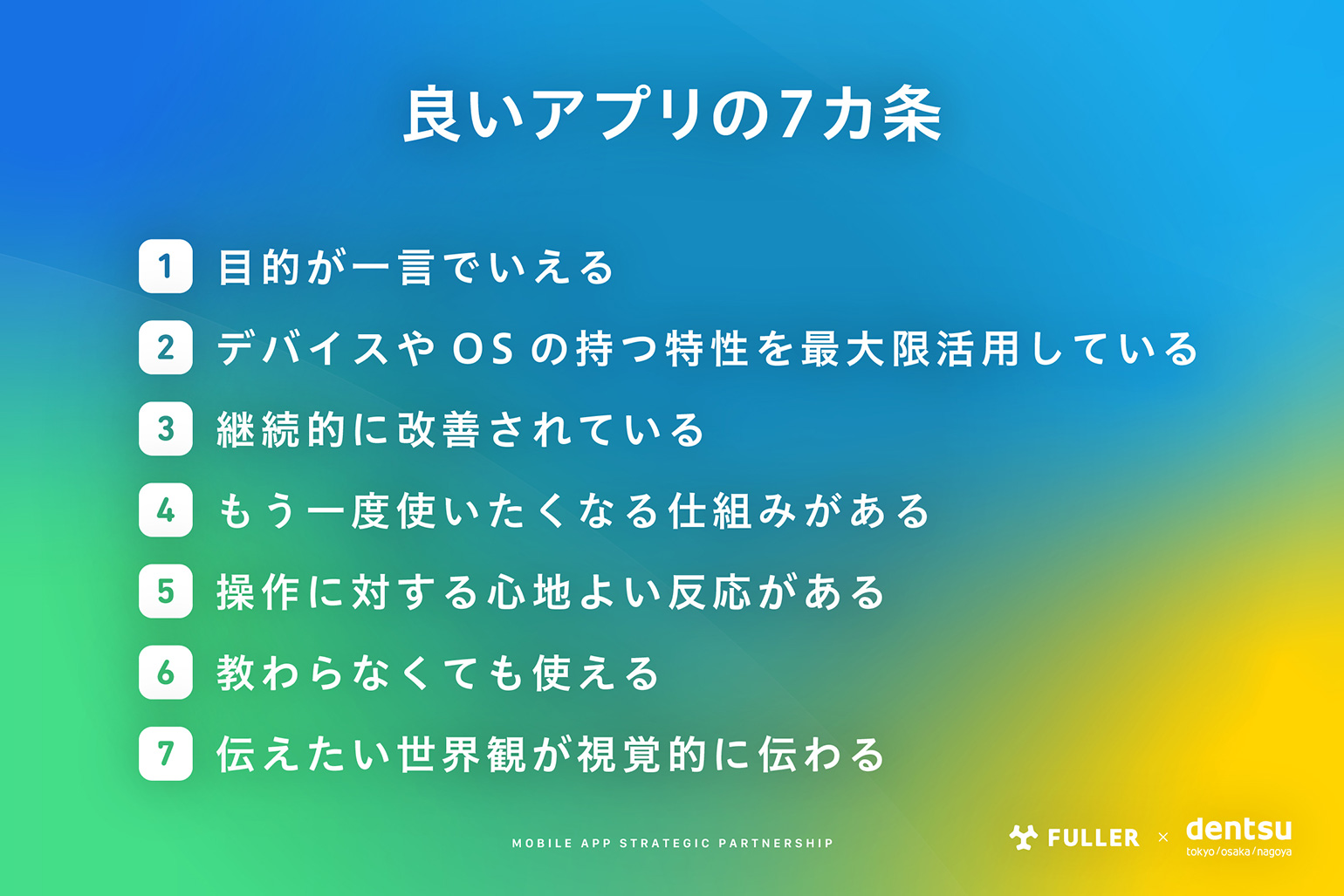
Over the past seven installments, we've explained the following "Seven Principles":
①The purpose can be stated in one sentence
②Maximizes device and OS capabilities
③It undergoes continuous improvement
④It has mechanisms that make you want to use it again
⑤It provides pleasant feedback for actions
⑥ Can be used without instruction
⑦ Visually conveys the desired worldview (this article)
Embedding corporate philosophy into apps so users instantly sense their "authenticity" upon interaction. That's when affection blossoms within users. Beyond convenience lies affection, and at the root of that affection lies each company's desired worldview.
"Ease of use" is a prerequisite. We believe that apps embodying a company's philosophy—beyond mere utility—become not just tools, but also the most intimate medium for conveying that worldview to users in the most beautiful way.
What we value most is ensuring apps don't end as mere "convenient tools." Of course, each app naturally serves purposes like collecting data as a customer touchpoint or functioning as a marketing tool to leverage acquired data. But those purposes are irrelevant to the user. Our final commitment is to let users sense the company or brand's vision through their daily app usage. We encapsulated this in the term "worldview," making it the seventh and final principle. It represents the form of a "beloved app" that app creators should strive for.
This concludes the seven-part series, "The Seven Principles of Good Apps." Nothing would make us happier than if these insights inspire you to create apps that bring happiness to your customers and make society just a little bit better.
Was this article helpful?
Share this article


Newsletter registration is here
We select and publish important news every day
For inquiries about this article
Back Numbers


Author
Masashi Yamasaki
Fuller Co., Ltd.
President and CEO