Category
Theme

Note: This website was automatically translated, so some terms or nuances may not be completely accurate.

Expanding Space Industry Players. JAXA's Evolving Role

Kako Dateki

Kako Dateki

Japan Aerospace Exploration Agency (JAXA)

Hiroyuki Suzuki

Hiroyuki Suzuki

Dentsu Inc.

At Dentsu Inc.'s Solution Creation Center, which spearheads the development of new solutions, we are working on solution development utilizing the space domain.

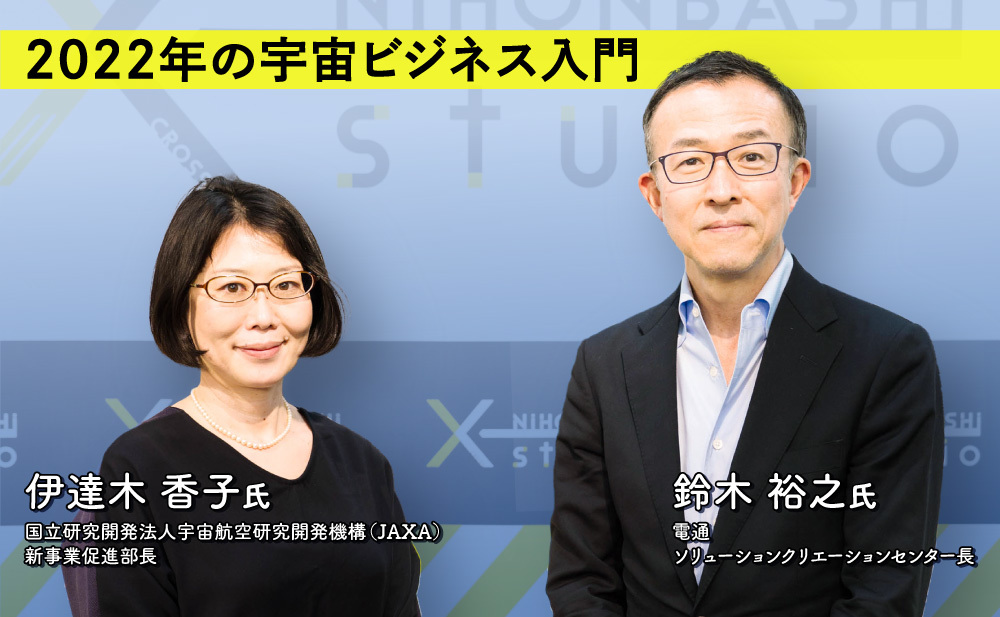
This time, Hiroyuki Suzuki, Head of the same department, interviewed Ms. Kayoko Dataki, Director of the New Business Promotion Department at the Japan Aerospace Exploration Agency (JAXA). We heard about the current state of the space business and its future potential.

オープン画像

<Table of Contents>

▼Overview of Recent Space Development

▼"THINK SPACE LIFE": Improving Life on Earth by Addressing Space Living Challenges

▼Progress in Four Space Business Categories

▼Five Space Business Categories: What Are Japan's Strengths?


Overview of Recent Space Development

Suzuki: At Dentsu Inc., we promote our company-wide stance as an "Integrated Growth Partner," providing integrated solutions to address challenges faced by our clients and society as a whole.

Our department creates new solutions, and space is an area we should focus on. Dentsu Inc. as a whole has a track record of utilizing space for advertising dating back about 20 years, and we are currently developing solutions.

It's been a year and a half since Mr. Dataki assumed the role of Director of New Business Promotion at JAXA. During this time, various companies have become involved in the space domain, and new businesses have emerged. Today, I'd first like to ask how you perceive the current business landscape surrounding space.

Date: Space development accelerated from the US-Soviet space race of the 1950s and 60s. Back then, the focus was on how nations could establish space programs, staking their national prestige on it. In Japan, several aerospace research institutions were established, including the former NASDA (National Space Development Agency).

Development of rockets and space stations progressed actively, but the companies involved were primarily large corporations in Japan.

Later, three Japanese aerospace R&D institutions merged to form JAXA in 2003.

Meanwhile, starting in the 2000s, space ventures rapidly emerged in the United States, sparking a second and third space boom. ( Details here )

After 2010, this trend reached Japan. Numerous space ventures emerged domestically, and companies previously unconnected to space began entering the space business one after another. This significant increase in players represents a major shift.

Currently, companies possessing diverse technologies, ideas, and business approaches are entering the field, accelerating space utilization and space-based ventures. We are increasingly seeing space businesses that impact not only space itself but also our everyday lives.

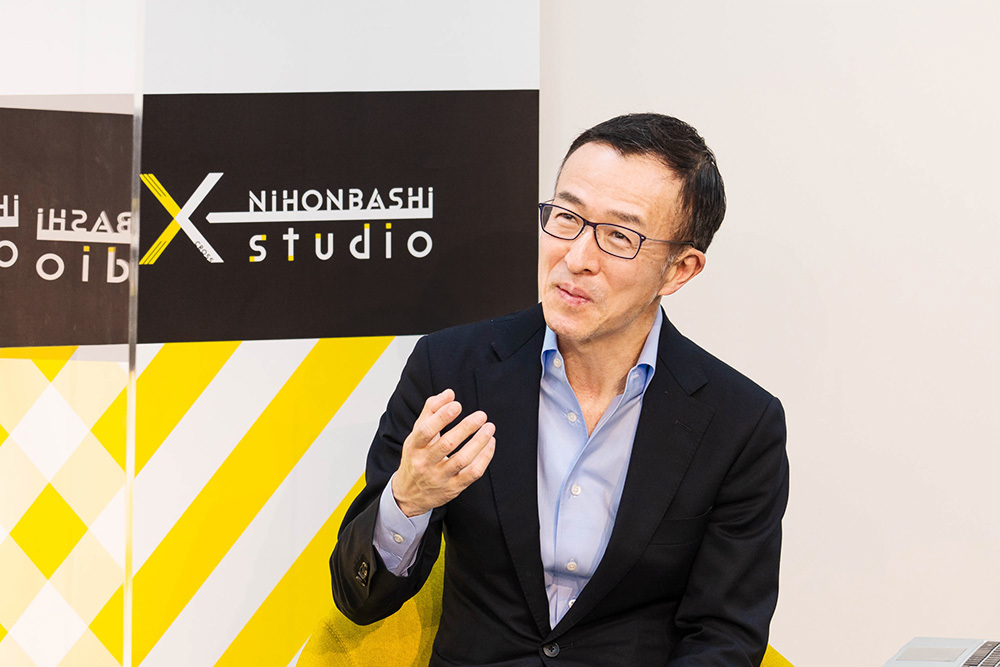
伊達木氏
Suzuki: As more companies enter the field and space businesses proliferate, how has JAXA engaged with these changes in the business environment?

Dataki: JAXA has just under 2,000 employees. We handle fundamental research and development, and we also engage in the process of transferring developed technologies to companies for joint development. It's more about collaboration than just support. Centered around my New Business Promotion Department, we place emphasis on co-development, sharing development outcomes with companies, and playing a role in driving new business initiatives.

Suzuki: So JAXA is currently positioned to promote private sector ventures.

Dataki: When advancing projects with private companies, we first consider how to get them to utilize JAXA's technology. A key point our New Business Promotion Department values is whether the collaboration shows potential for broader impact – such as "whether JAXA can further enhance its technology and R&D capabilities through this partnership" or "whether the new insights gained together can be fed back into JAXA's space development."

Suzuki: So there's a significant shift happening where technologies and insights born from JAXA's projects can be used together with the private sector. Could you tell us about a specific initiative, J-SPARC (※)?

※J-SPARC (JAXA Space Innovation Partnership)
A co-creation R&D program aiming to create innovative space-related businesses through collaboration between private entities and JAXA


Datamiki: The New Business Promotion Department launched J-SPARC (Space Innovation Partnership) activities in 2018, and it's now been four years. We've handled 36 projects so far. After sorting out those that have already ended or changed phases, we currently have 19 projects active (as of August 2022). Among these, four have been commercialized as products or services.

It's difficult to judge whether four in four years is a lot or a little, but these four projects emerged within the context of space business, where development takes time and often requires a long-term commitment before solutions become truly usable in society.

J-SPARC Official YouTube

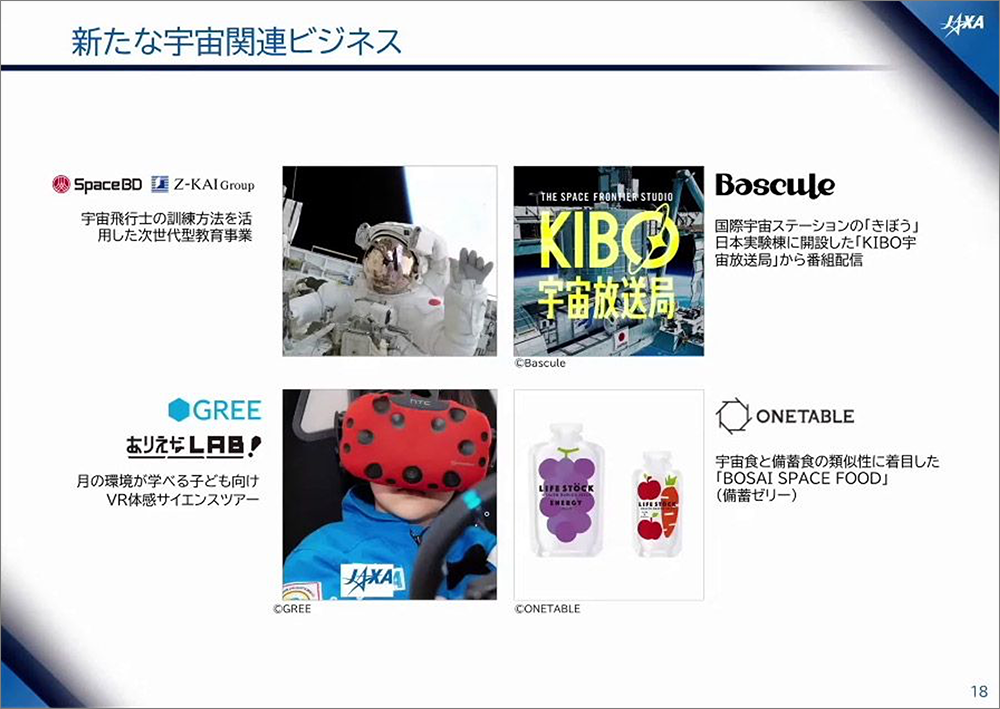
J-SPARC共創活動発のビジネス化案件事例(出典:JAXA)
Examples of Business Cases Originating from J-SPARC Co-creation Activities (Source: JAXA)

Suzuki: So, J-SPARC aims to function as a hub, a business platform, leveraging private sector capabilities?

Dataki: Yes, that's correct. The ideal is for JAXA to connect with private companies in various ways.

"THINK SPACE LIFE": Improving life on Earth by tackling challenges of space living

「THINK SPACE LIFE」HP

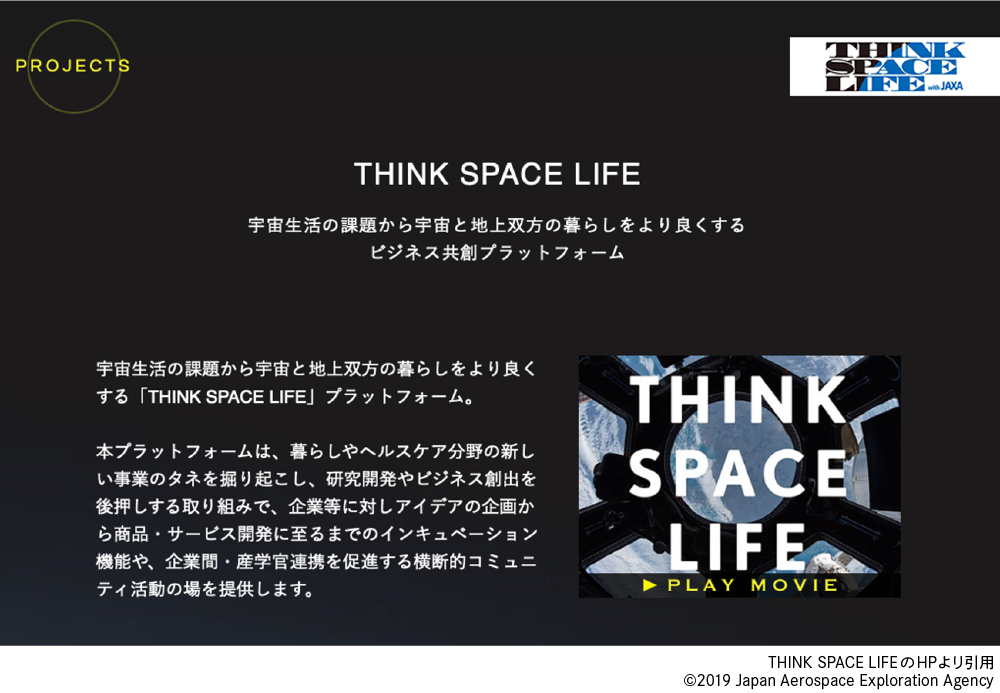
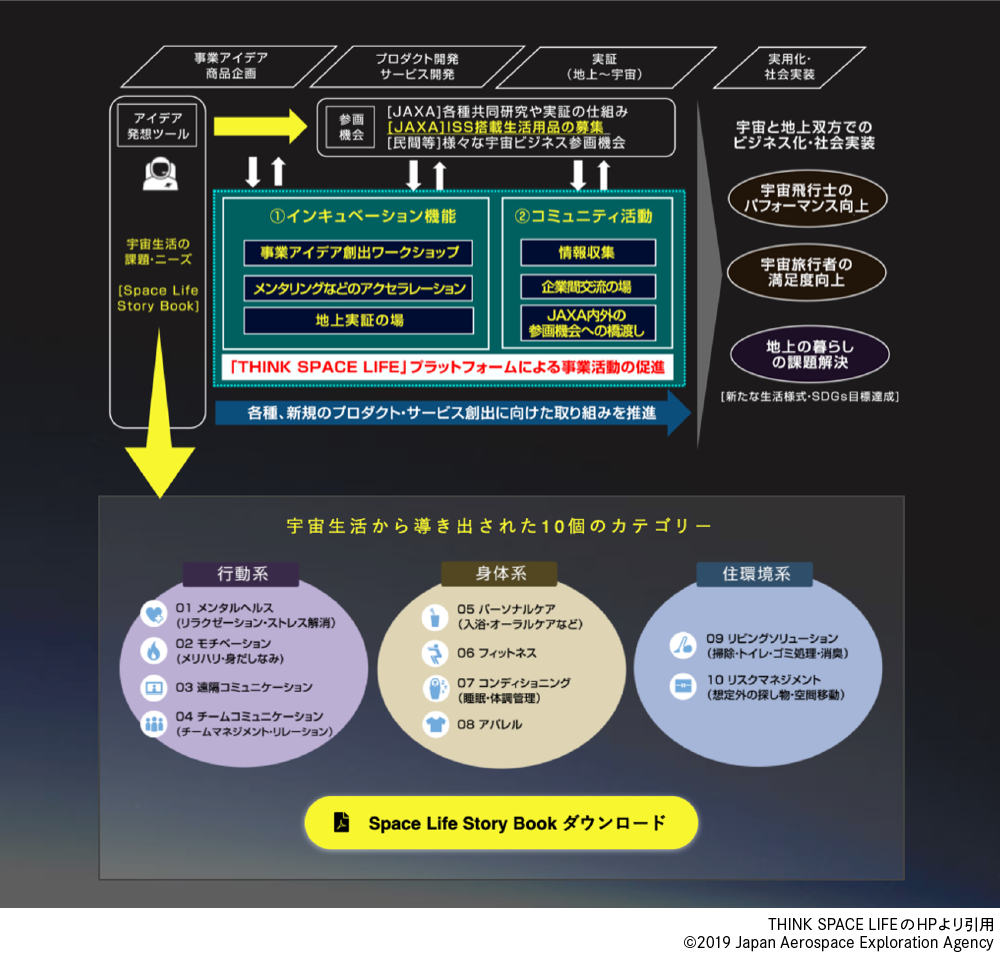
Suzuki: Could you also tell us about THINK SPACE LIFE, one of J-SPARC's projects? I understand this initiative focuses less on space itself and more on exploring business opportunities for both space and Earth by addressing life challenges in space with private companies. How is it progressing?

Dataki: THINK SPACE LIFE launched in July 2020 and has attracted participation from over 200 companies to date. In 2021, we also started an acceleration program with six companies, enabling even more businesses to join.

We're collaborating with companies that previously thought, "Space has nothing to do with us" or "We don't know how to get involved," to explore how to bring Earth-based technologies into space.

We discuss what can be achieved in space using terrestrial products, brainstorm ideas together, and develop products. This process also enhances the value of those products on Earth. This is how our activities are recognized.

Suzuki: So it's about drawing out the potential of companies and their people, and exploring whether the various seeds of opportunity (business seeds) offered by space can be brought into terrestrial business.

Date: Yes. When we think of space, companies and products tend to be limited, but basing it on Earth allows for greater expansion. This expansion takes the form of preparing for use in space, enabling more people to participate through .

Progress in the Four Space Business Categories

Suzuki: We've also been involved in various space businesses. For example, ispace's business ( details here ). From its dawn period until now, we've been helping, in our own small way, by applying methods for securing sponsors to space business, figuring out how to nurture the business.

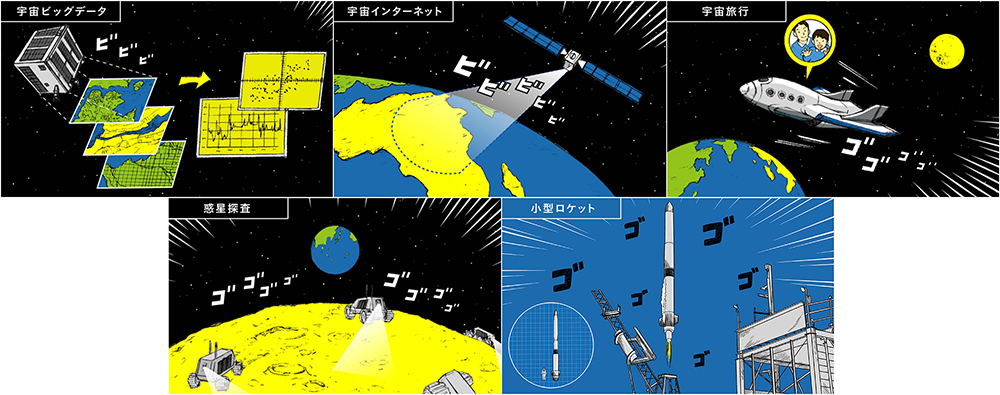
ispace falls under "Lunar and Planetary Exploration." Beyond that, there's "Space Tourism" in the human spaceflight sector, which gained significant attention with Yusaku Maezawa's stay on the International Space Station in late 2021. Then there's "Utilizing Big Data Obtained from Space via Small Satellites," and additionally , "Internet Services for Regions Lacking Infrastructure." We broadly categorized these into four main areas. ( Details here )

Adding "small rockets" like those from Interstellar Technologies, founded by Takafumi Horie, to these four, we see a 4+1 (rockets or space transportation) framework. Considering this, could you share your thoughts on the progress of space business as of 2022, Mr. Dataki?

宇宙ビジネスイラスト

Dateki: I believe the area showing significant recent progress is space big data. This involves utilizing data and information captured from space, primarily via satellites, for activities on Earth. Satellite imagery is being actively used even within the current international situation. Furthermore, satellite data can be leveraged for decision-making in agriculture and economic activities, or to understand disaster situations and environmental conditions.

Suzuki: How is JAXA involved in the big data field?

Dataki: Private companies consider not only satellite capabilities but also how people on Earth can utilize the data from those satellites within society. Conversely, they think about what kind of information would make the business viable.

JAXA provides advice to identify technical development paths, based on our accumulated space knowledge and development experience, to determine what kind of information should be obtained from space to meet those corporate objectives. We also offer technical cooperation regarding data processing and refinement.

衛星のイメージ

Suzuki: So you actively provide expertise to private companies, offering quite specific consulting services.

Dataki: Yes. Of course, the companies themselves possess technology, and how our technology can be useful varies. For JAXA, this presents an excellent opportunity to make our accumulated development experience and expertise available to companies more quickly.

Suzuki: The boom in space big data has seen developments unimaginable back in 2016 ( details here ), when we last covered this in Web Dentsu Inc. Compared to six years ago, what has evolved to make this possible?

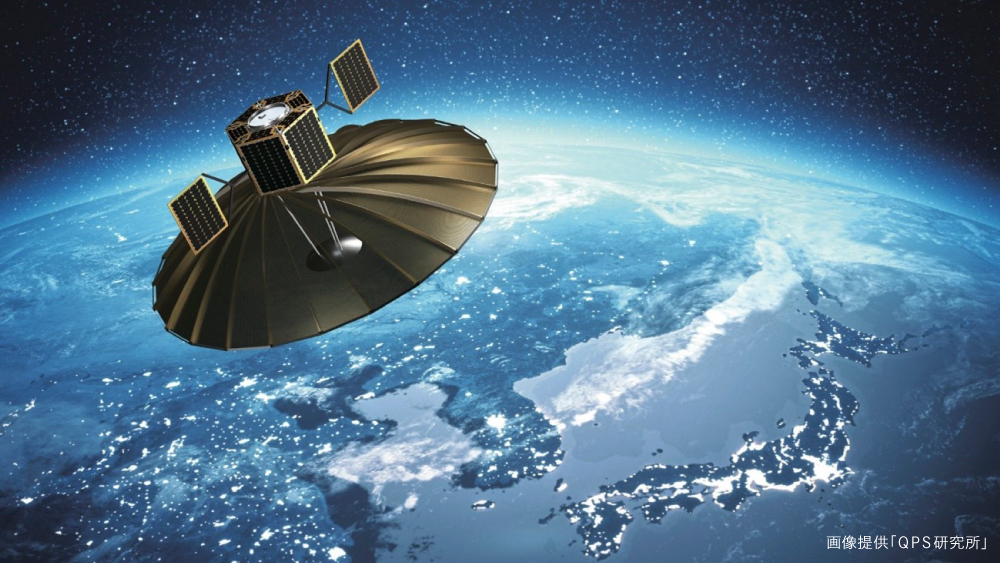
Dateki: Looking specifically at these past six years, I think the significant advancement has been the development of small satellites aimed at forming constellations (operating multiple satellites as an integrated system). The data business and data solutions we discussed earlier involve launching these small satellites in constellations to capture images and gather data.

In this field, many players have emerged in Japan too, and it's rapidly becoming commercialized. Everyone is successfully launching satellites and acquiring image data, and we've now reached the stage of analyzing that data and figuring out how to use it. The fact that we now have satellites that can be used practically is a major step forward.

Private companies—not just one, but multiple firms—are leveraging their respective strengths to launch and operate satellites.

Space Business 5 Categories. What are Japan's areas of strength?

Suzuki: We've heard about achievements in the space big data field. From your perspective, Mr. Dataki, which of these five areas do you think Japan excels in?

鈴木氏

Dataki: Well, I'd say satellite data-related fields for now. How we use the acquired data to create and monetize products is where Japan's technology and business acumen truly shine.

For example, Japan experiences many natural disasters, so we excel at anticipating risks and understanding what information is needed. This ability translates into creating valuable products.

Planetary exploration is an emerging field where Japan is also making its mark. While both the US and Europe are investing heavily, Japan possesses world-class technology, as exemplified by JAXA's renowned Hayabusa mission. This is an area where Japan should definitely aim to lead development.

Space tourism might currently see the US taking the lead in some areas. However, I believe Japan will advance its own unique development path. Promising fields going forward include space tourism and lunar exploration missions, like those being pursued by ispace.

Communications, often referred to as "space internet," are currently led by overseas companies, and Japan's approach is still to be determined. Nevertheless, Japan possesses numerous world-class technologies, such as its communications expertise. By combining these with space, I believe new businesses will emerge.

Suzuki: The company we're working with, ispace, is focused precisely on lunar exploration. The launch is finally approaching in 2022.

Dataki: This year is packed with challenges to the Moon.

Suzuki: Through today's discussion, I understand that JAXA itself has undergone significant change. It's no longer just about JAXA as the subject; space is now being approached as something we all do together.

Dataki: Thank you. As the momentum to utilize space grows, JAXA aims to leverage our accumulated technology and expertise together with everyone. We want this to be utilized globally and become a strength for Japan.

Suzuki: As those of us working closely with clients' challenges, we would like to actively leverage JAXA's strength, which has led this field. We look forward to your continued support.

Dataki: Thank you.

Suzuki: Finally, is there anything you'd like to share with everyone?

Dataki: Our J-SPARC catchphrase includes the phrase "Let's co-create." Historically, "kyousou" (競創) often implied competition, but today I truly feel the emphasis is on "co-creation" – creating together. Rather than competing, we aim for greater heights and better outcomes by creating together. I firmly believe there are still many ways we can transform society using space-derived technologies. I look forward to advancing together with everyone toward this new world.

Suzuki: Thank you. We will do our utmost, however small our contribution may be, to enable co-creation with many clients.

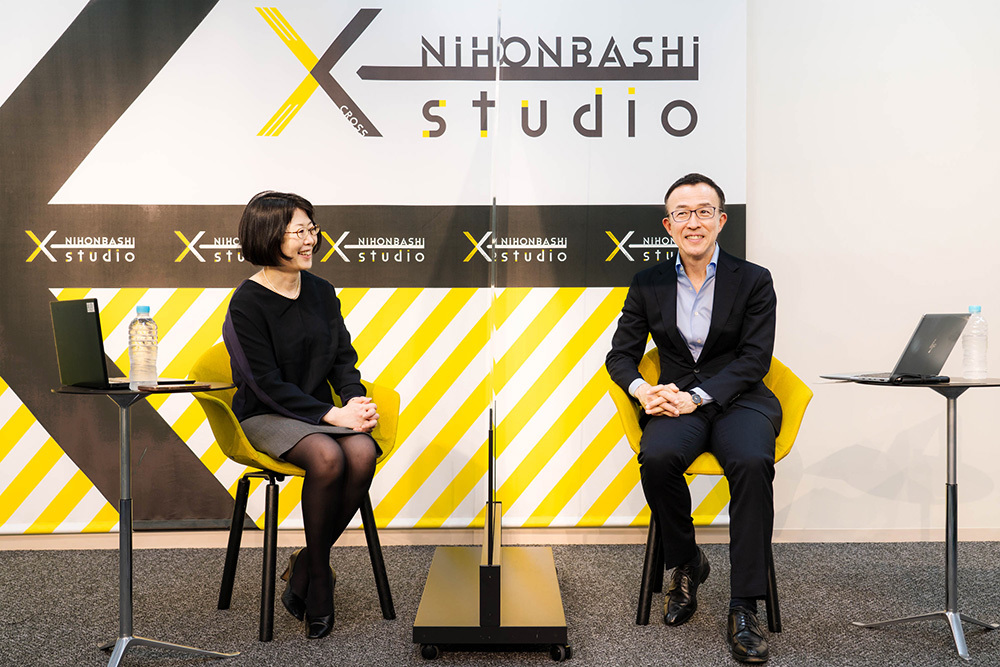
ツーショット画像

twitter

Was this article helpful?

Share this article

Author

Kako Dateki

Kako Dateki

Japan Aerospace Exploration Agency (JAXA)

Director of New Business Development

Graduated from the Faculty of Law and joined the former National Space Development Agency in 1997. After handling contract law for overseas contracts and satellite development projects, gained experience in legal coordination with domestic and international organizations regarding the private utilization system for the International Space Station "Kibo (JEM)" and the "Kounotori (HTV)" program. Obtained an MBA through overseas study. After working in the Human Resources Department and the Legal & Compliance Section of the General Affairs Department, he served as Head of the Project Procurement Office in the Procurement Department (2018-2020) before assuming his current position.

Hiroyuki Suzuki

Hiroyuki Suzuki

Dentsu Inc.

Director of the Solution Creation Center

After working at a bank, joined Dentsu Inc. Primarily worked in marketing-related departments, responsible for developing strategies and planning initiatives for clients' businesses, brands, marketing, and communications. In 2016, seconded as a founding member of Dentsu Digital Inc. and served as an Executive Officer there. Since 2019, Head of the Solution Development Center (now the Solution Creation Center).

Also read