Note: This website was automatically translated, so some terms or nuances may not be completely accurate.
 Sporulation [15/15]
Beyond the Tokyo Olympics: What "Spozium," a platform for sharing sports business success stories, envisions.

Tetsuhei Morita
Limlet Co., Ltd.

Noguchi Yoshikazu
Dentsu Inc.
The SPOLUTION team is a solution unit that attempts to create new business opportunities by viewing sports content not just as media content, but also as a solution. Team members will introduce upcoming sports-related business opportunities from their respective perspectives in a relay column format.
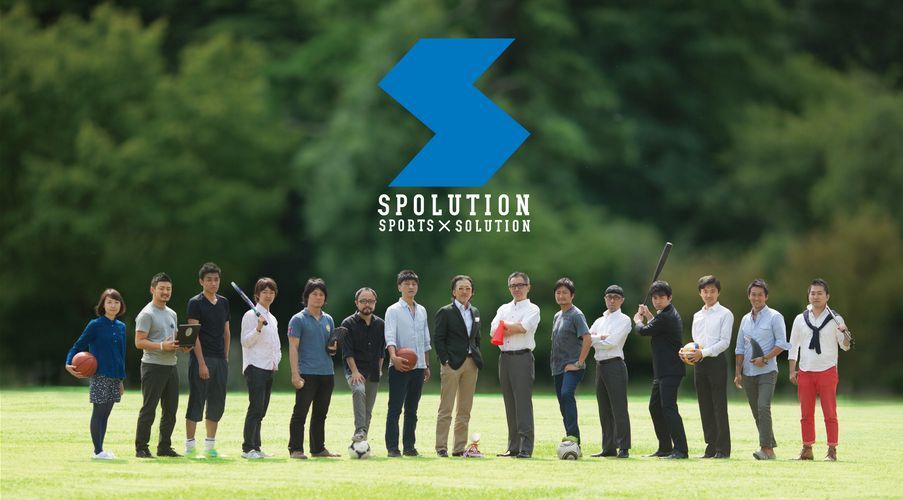
My name is Yoshikazu Noguchi from the SPOLUTION team.
For this column, we welcome Mr. Tetsuhei Morita, Editor-in-Chief of the sports media platform "SPOZIUM," operated by our SPOLUTION team partner, Limlet Inc.
Mr. Morita was actually an employee of Dentsu Inc. until recently and was a member of the SPOLUTION team. However, seeing great potential in the sports business leading up to 2020 and beyond, he left Dentsu Inc. and is now working in a new environment.
We'd like to hear about the background and passion behind launching this unprecedented sports media platform, as well as the challenges and opportunities facing the sports business industry.
Noguchi: First off, what kind of media is "Spozium"?
Morita: It's a specialized media platform for all stakeholders aiming to promote business through sports. This site covers activities (activation) designed to expand the sports industry. We envision Spodium as a symposium space for discussing the development of the sports industry, where knowledge and success stories from these activations spark further ideas.

Noguchi: So that's why it's called "Spozium." By the way, with the Olympics approaching, there's this sports bubble-like atmosphere, but when asked specifically about the potential opportunities, many people are vague. How do you feel about the "potential of sports," Morita-san?
Morita: During my time at Dentsu Inc. working in the sports industry, I identified three key pillars for growth. First are the "content holders" – teams, leagues, and athletes. Second are the "sponsors" who support them. Finally, there are "other stakeholders" like governments and broadcasters.
Noguchi: I see. Could we start by discussing the potential held by the content holders?
Morita: As various business magazines have already covered, the baseball world is undergoing significant change. Particularly the Pacific League, facing reduced exposure on free terrestrial TV, has been proactive in digital strategy. They launched online streaming services like " Pacific League TV " at an early stage.
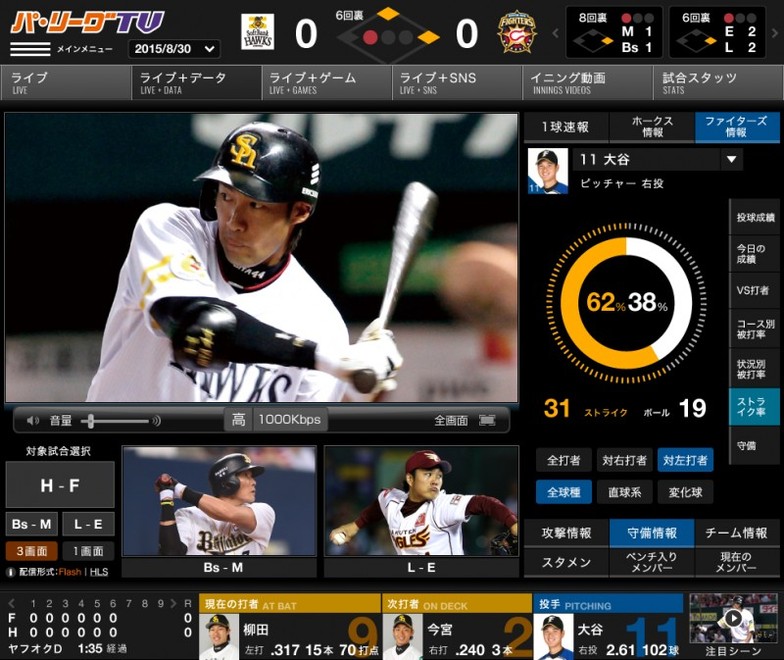
The entire league is undertaking various activities to grow its fanbase, and you can sense the content holders themselves are committed to changing.
Also, the J.League, which we recently covered on Sporium. With the goal of "growing together with Asian nations," they've begun initiatives to expand their Asian strategy, such as providing the know-how cultivated within the J.League to other Asian countries.
Noguchi: One aspect involves enhancing the digital dimension—making content more data-rich through internet streaming, conducting more detailed video analysis, and so on. The other is pursuing global expansion, like the J.League's Asian strategy. So, what potential do corporate "sponsors" see in sports?
Morita: From what I've observed, the focus used to be heavily on "how much exposure the company's logo or name gets on uniforms and bibs." While many companies still prioritize brand name visibility, a growing number of clients now realize that, given the significant shift in communication methods, brand exposure alone isn't necessarily the only goal.
Within this shift, companies are beginning to realize that sports can be leveraged not only for enhancing brand value and boosting product sales, but also for addressing corporate challenges beyond advertising, such as improving employee motivation and investor relations (IR). This trend is likely to become a major wave in the future.

Noguchi: Recently, a major life insurance company announced its sponsorship of the J.League, generating significant buzz. You can sense their desire to foster customer communities through sports.
For instance, I've heard that one reason the life insurance company became a J.League title partner is because it allows sales agents and customers to enjoy matches together. With heightened security, agents now find it harder to visit companies for sales calls as they did before. When they needed to create new connections unlike anything before, sports proved to be the perfect solution.
I've also heard many companies participate not only in spectator sports like the J.League but also in DO sports events like marathons. Broadly speaking, the communities cultivated through sports are becoming increasingly important for corporate marketing.
Morita: I feel many companies overseas are considering the use of sports—or activation—from an overall marketing perspective, including how to mobilize communities and connect them to their own business. It would be great if we could actively import that knowledge.
Particularly, seeing what activations Brazil implements as it hosts the Olympics next year could serve as a benchmark. I think it will offer hints for how companies will engage with sports moving forward, especially as we approach the Tokyo Olympics.
Noguchi: Then, for the third axis, "Stakeholders," please tell us about the potential of sports, especially within the media.
Morita: In Japan, mass media outlets like broadcasters and newspapers remain crucial players. The evolution of internet infrastructure and smartphone penetration are transforming the broadcasting business model. It's said that high school girls spend about seven hours a day on their smartphones, and working adults are constantly watching videos on their phones during commutes or work breaks. In this environment, figuring out how to increase the points of contact between sports and consumers is incredibly important. I sense broadcasters are starting to recognize this significance too.
For example, in the " Virtual High School Baseball" project, where Rimlet is assisting with strategy planning and development alongside Asahi Shimbun and Asahi Broadcasting, game footage is simultaneously streamed online. Beyond the multi-angle feature allowing users to freely choose between pitcher, batter, and stadium-wide camera views, it offers a uniquely internet-based service called the "Highlight Generator." This lets individual users clip their favorite scenes and upload them to social media. We believe this sparks actions like, "Hmm, maybe I'll check out this scene my friend recommended," even among people who normally have zero interest in sports, potentially leading to gaining new fans.
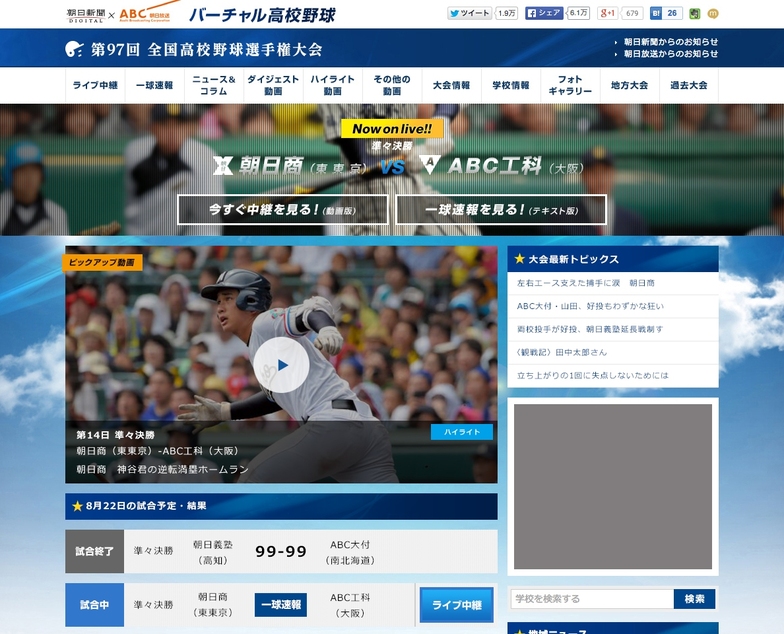
Noguchi: I think this is quite significant. While social media like Facebook is fundamentally comment-based, users want to see video highlights. The fact that these highlights become news and spread on social media is a new phenomenon. It has tremendous media potential. The NBA and MLB are doing similar things, right?
Morita: They are. What's even more impressive is the synergy with data. MLB's " Statcast " visualizes data by displaying the ball's trajectory on screen, quantifying and showing not just a pitcher's ball speed but also an outfielder's throw speed, running speed, the distance a runner leaves the base during a steal, and their top speed.
In Japan, the J.League also uses its " LIVE Tracking " data system to convert player movement into data, instantly showing who ran how many kilometers. By creating unprecedented visual experiences and integrating them with data, the effort to make it entertaining and engaging while incorporating fun elements is also seen as a way to attract new fans.
This fusion of sports and the internet aligns closely with what "Sporolution" envisions as " Augmented Sports," doesn't it?
Noguchi: "Augmented Sports" is a term coined by Hotta from the Sporolution team. In Japanese, it would be something like "expanded sports."
Since both "spectator sports" and "participatory sports" can be expanded through "visual-based" and "data-based" approaches, there are four directions in a matrix. The Solution Team aims to combine these with "entertainment."
For example, "visual expansion" for spectator sports could mean watching games through virtual reality or holography. It would also be exciting if, like in the Matrix, you could see a player's slide from any 360-degree angle.
For "data-based expansion" in spectator sports, imagine watching high school baseball and seeing not just batting averages but also player profiles like their hobbies displayed on screen. Access to even highly localized details could deepen emotional engagement and enjoyment.
Other intriguing technologies include displaying players' movements captured by wearable devices as numerical data or motion trajectories. Beyond entertainment potential, accumulating this information could effectively support player training.

For DO Sports' "visual extensions," we created an app that shows where force is applied on footage of weightlifting. It's pretty silly stuff, like adding a "BOOM" animation when the barbell lifts (laugh). But this visualizes the athlete's force during competition, something previously invisible. Knowing where they're exerting force and the exact moment of lift lets you cheer along with them.
DO Sports' "Data-Based Augmentation" could involve using wearable devices to track heart rate or measure distance traveled. If utilized effectively, this could lead to city-wide health promotion, potentially creating business opportunities like regional revitalization.
Morita: I find Augmented Sports incredibly interesting. If we can successfully engage content holders, I believe the pace of its expansion will accelerate.
Noguchi: The benefit for content holders is that technology now makes it possible to visualize previously unseen value in sports. If animations, videos, and data can convey the incredible power and speed, it could unlock the appeal of minor sports and potentially propel them into mainstream popularity.
Finally, a word about your thoughts on the future of sports.

Morita: Taking 2020 as a starting point, I want to improve the environment for watching and enjoying sports in Japan. I believe Japan's sports market will naturally grow until the Olympics. While stakeholders engage with various sports in different ways, there's concern that unless everyone's satisfaction is high, people might lose interest in sports afterward. The key is creating an environment that can sustainably develop beyond 2020. I hope "Spozium" serves as a place where all stakeholders can come together to think about and discuss methods to achieve this. What about you, Noguchi?
Noguchi: Through "Augmented Sports," I want Dentsu Inc. to discover new business opportunities. Even if Japan doesn't experience economic growth going forward, I believe it's possible to find happiness through sports.
I believe that using technology to create new perspectives on sports and fostering new social media-like expansions can contribute to building a happier country. In that process, we want to identify business opportunities in the new things that emerge and, as Dentsu Inc., effectively accelerate that momentum.

★What is the "Sporolution" team?
It's an internal Dentsu Inc. unit that approaches sports content not just as "media assets," but as "solutions" to solve business challenges and project issues, and plans accordingly.
The team brings together diverse talents including strategic planners, promotion planners, copywriters, art directors, technologists, consultants, and producers, all with extensive experience in sports planning. Through our Solution Director system, we provide not just "ideas for expression," but also "ideas for solutions" in a one-stop service.
Was this article helpful?
Share this article


Newsletter registration is here
We select and publish important news every day
For inquiries about this article
Back Numbers
Author
Tetsuhei Morita
Limlet Co., Ltd.
Manager
Noguchi Yoshikazu
Dentsu Inc.
Corporate Office