Note: This website was automatically translated, so some terms or nuances may not be completely accurate.
 The Advertising Industry Moves Amid the AI Revolution's "Great Divergence" ~ Next-Generation Agents That Move People [6/6]
After digitalization, aim for real-world engagement! Could Japan become a global model?
This series, which rewrites and introduces the content of the paper that won the Gold Prize in the Japan Advertising Association (JAAA) 45th Prize-Winning Paper Contest, has finally reached its conclusion. What exactly is this "Next-Generation Agent" that we wanted to convey in this paper? We will also explain the "Cyber-Physical System (CPS)" mentioned in Part 2, considered a core technology (GPT) of the Fourth Industrial Revolution. You can view the JAAA Prize-Winning Papers, including this one, here. We encourage you to refer to them.
Opportunities for the Advertising Industry: Providing User Experiences from Input to Output
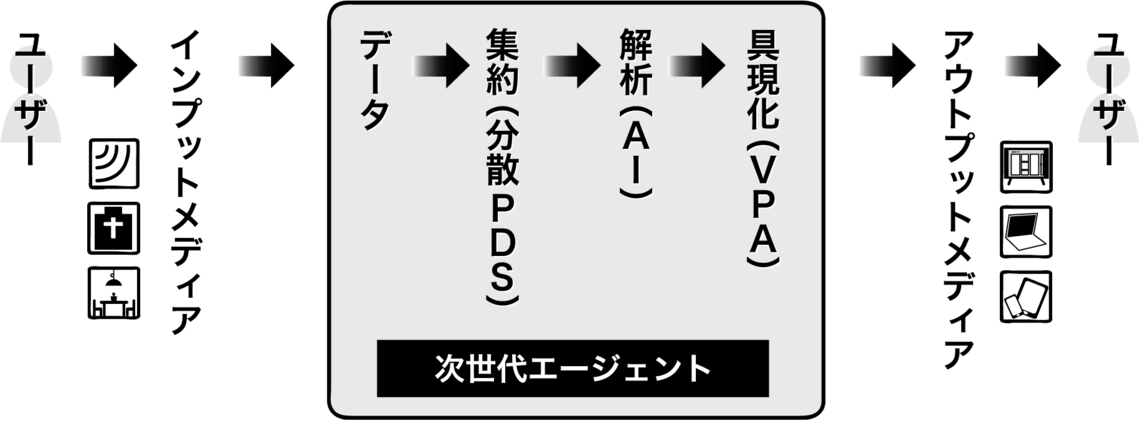
While integrating personal information across distributed PDS by users themselves offers many benefits, even if the environment to actually implement this is ready, the setup is likely to be complex for an individual to handle alone. Services that consistently support or act on behalf of users from input to output are still needed, and this is where the opportunity for the advertising industry lies. In other words, the "Next-Generation Agent" is a service that safely integrates and operates multiple services virtually, independent of specific devices, OS, or apps. It becomes smarter automatically through AI technology the more personal sensor data and life logs it accumulates. This intelligent agent (such as a VPA) maximizes user convenience while appealing to user emotions to generate new desires (demand). Furthermore, this agent service will likely become a mechanism usable not only by individuals but also by corporations, just as current cloud services serve both individuals and businesses. Furthermore, if security is inherently guaranteed through a distributed PDS, individual authentication and authorization for each device or service may become unnecessary, potentially enabling automatic default connections (think of it as an evolution of authenticated Wi-Fi). This would lead to a society where technology connecting to cyberspace is completely integrated into the environment, allowing people to go about their daily lives without consciously thinking about the agents operating in the background.
Toward the Fourth Industrial Revolution:What isa Cyber-Physical System (CPS)?
Amidst this, one keyword that will increasingly draw attention is CPS (Cyber-Physical System). While terms describing mechanisms linking the real and cyber spaces have long existed—such as ubiquitous computing, click-and-mortar, O2O, and IoT—CPS stands out as encompassing both the AI and IoT concepts discussed throughout this article.
More specifically, CPS represents a system enabled by IoT advancements where sensor networks permeate the physical world, allowing the virtual space (Cyber) to control the physical space (Physical). Furthermore, it includes a mechanism that feeds feedback from the physical space back into the virtual space, creating a loop of interaction. While CPS shares the same fundamental concept as IoT, IoT is considered one element of CPS. The entire cyclical system—where artificial intelligence (AI) analyzes the big data generated by the digitization and networking of things via IoT—is called CPS [Figure].
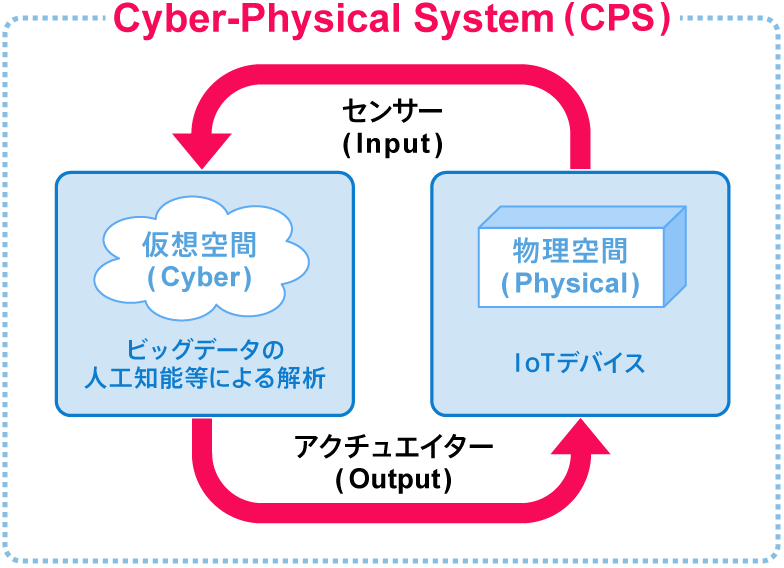
[Figure] Conceptual Diagram of a Cyber-Physical System (Author's creation)
It has been about 20 years since Nicholas Negroponte famously stated, "From atoms to bits." While "atoms" can be rephrased as physical or real, and "bits" as cyber or digital, the manufacturing sector is already seeing the emergence of technologies like 3D printers, leading to talk of "from bits (information) to atoms (material)." Following this, marketing is also entering an era of feedback from "bits" to "atoms" through CPS. Marketing, which has long pursued digitization, will now likely compete to achieve real-world implementation (※11).
Summary: The Advertising Industry as Japan's Model, Japan as the World's Model
Finally, you might think, "You're being optimistic, but if AI eliminates the need for standardized labor in service industries, won't the advertising industry itself shrink?" The answer to this question is quite simple: the solution lies entirely in shifting the business domain as much as possible from "routine tasks" to "non-routine tasks." For example, while autonomous driving may eliminate many drivers, developing that technology, implementing it in society, devising business models, and reaping its benefits—all these tasks are performed by "humans." Even if "labor" becomes unnecessary, "humans" will not. "Non-routine tasks" include things like research and development or business development. Google's "20% time" policy (allowing employees to dedicate 20% of their work hours to personal projects) can be seen as already institutionalizing this shift towards non-routine work. Furthermore, increased productivity directly translates to shorter working hours. In Japan's advertising industry, where compliance with the 36-hour agreement is required, there appears to be no downside to fully implementing AI. If the advertising industry can boost productivity through AI adoption, it could become a role model for Japan, facing labor shortages due to its aging and shrinking population. Should this success spread across Japan, wouldn't Japan itself become a global role model?
It is my hope that this paper contributes to the Japanese advertising industry "moving" towards the next technology (AI). That the advertising industry leverages its strengths to "move" people's actions and emotions through next-generation agents. That this creates societal demand. And that, in turn, enriches Japan and the world while enabling the advertising industry's growth.
※11: Fumio Nitta, "Basic Knowledge of Modern Advertising Business Terms: CPS (Cyber-Physical System)," JAAA REPORTS (April 2016 Issue) (Japan Advertising Agents Association, 2016), pp. 11.
Was this article helpful?
Share this article


Newsletter registration is here
We select and publish important news every day
For inquiries about this article
Back Numbers

Author
Nitō Fumi
Dentsu Inc.
Business Development & Activation Division