Note: This website was automatically translated, so some terms or nuances may not be completely accurate.
 How Business Designers Create Breakthroughs [5/5]
Designing the future of business with a dual approach of "ideas" and "logic"
Dentsu Inc. has established 'Dentsu Business Design Square,' an organization within the company dedicated to creating innovation for client companies. In this series, members share "What Dentsu Inc. Considers Business Design to Be." In Part 5, Business Designer Atsuo Nabe discusses ideas and logic.
【Table of Contents】
▼Ideas are the driving force behind creating value
▼Logic Creates the Reason to Act
▼ "Simple and easy to understand," "Don't rely too much on words," "Don't depend on the speaker"
▼Visualizing Business Opportunities in an Uncertain Future
▼ "Ideas" and "Logic" Should Not Be Considered Separately
Ideas are the driving force for creating value
I'm Nambe from Dentsu Inc. Business Design Square. It's been three years since I last wrote for Dentsu News, and since this is my first time writing about my work, I'm a bit nervous. This time, under the theme "Designing the Future of Business with the Dual Approach of 'Ideas' and 'Logic'," I'll primarily discuss "Logic" while explaining how we approach our daily work.
"Dual-wielding ideas and logic" might sound abstract—something you think you understand but don't quite grasp. Yet, I believe it's the most crucial concept for Dentsu Inc. as we seriously engage with business design.
The reason becomes clear when we compare business design with the communication design Dentsu Inc. has pursued until now.
First, a commonality between the two is that "ideas" form their core. Whether it's communication design or business design, what clients seek from us is "giving shape to value that doesn't yet exist in the world." Ideas are indispensable for this, and they serve as the driving force for us to create value within the business design domain as well.
So, what is different? It is that while Dentsu Inc. is the expert in communication design, the client is the expert in business design.
In communication design, since we ourselves create the final output, we make proposals with the conviction and responsibility of professionals. In business design, however, no matter how innovative or groundbreaking the business ideas we propose, it is ultimately our clients who bring them to life and make them a reality.
↑Back to Table of Contents
Creating reasons to act is logic
When I was in Dentsu Inc.'s Corporate Planning Division, I found myself on the receiving end of proposals. When pitching ideas to business owners, there are three questions you absolutely must prepare answers for.
・Why pursue this idea?
・Is there a better idea?
・How will this idea change the company?
From my personal experience, answering these questions with just an idea is extremely difficult. Especially, the more novel and innovative the idea, the more it sparks debate across the company. I've seen countless ideas vanish without ever being implemented, overwhelmed by an endless flood of "reasons not to do it."
I'm not proposing ideas irresponsibly, but sometimes it creates an unfortunate situation for both sides where the recipient perceives it as "just talking without follow-through."
This is where logic plays a crucial role. Clients approach us at Dentsu Inc. Business Design Square with the expectation that we will bring them something new – a fresh perspective they don't have internally.
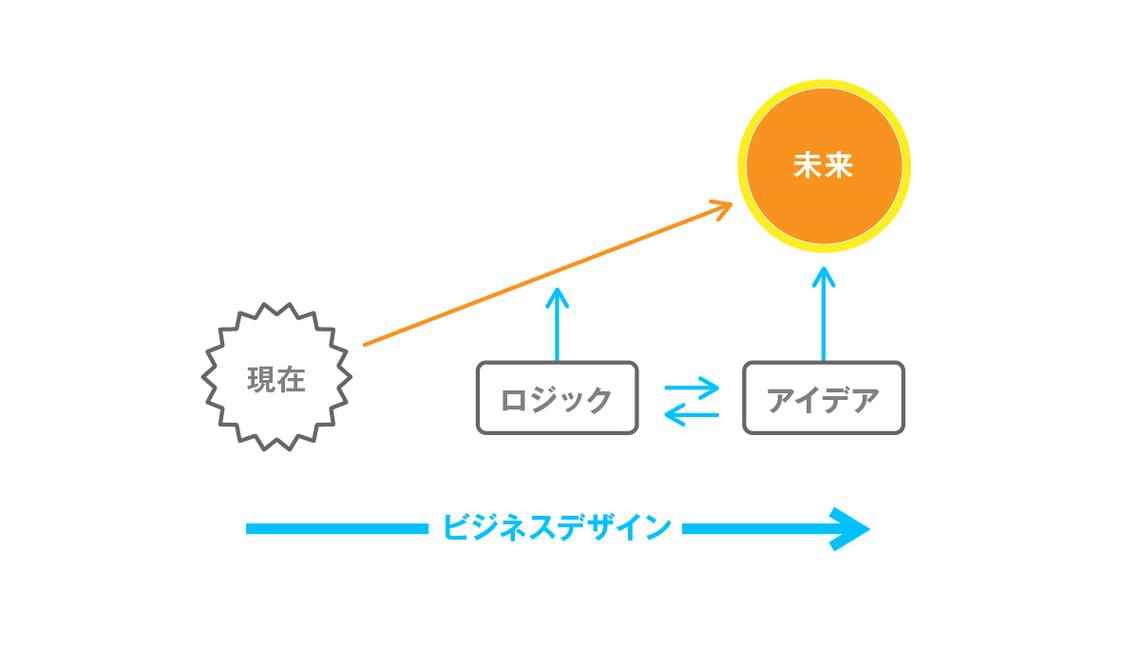
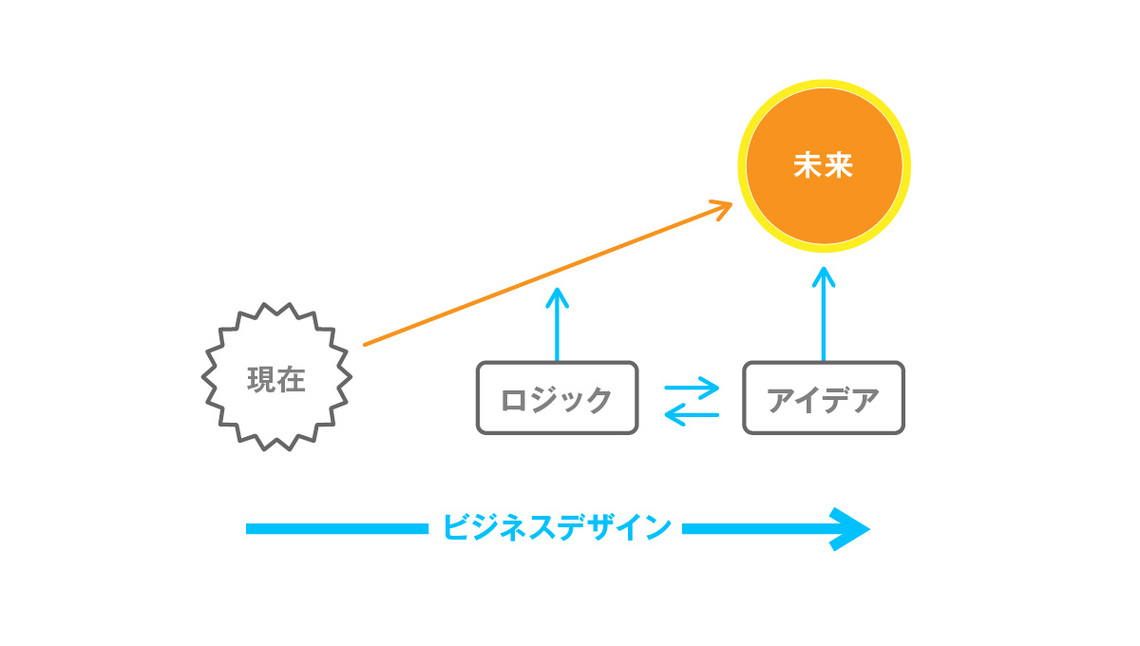
To meet that expectation, we must use logic to create a two-way arrow—one that fosters mutual understanding and leads to meaningful discussion—rather than a one-way arrow of idea proposal and approval.
Put another way, if an idea is "giving shape to what should be done," then logic is "creating the reason why it should be done." By fusing ideas and logic at a high level, we at Dentsu Inc. Business Design Square strive daily to deliver not just "proposals that are left unsaid," but "proposals that enable equal discussion as partners."
↑Back to Table of Contents
"Simple and easy to understand," "Doesn't rely too much on words," "Doesn't depend on the speaker"
So, what kind of logic is required in business design?
I believe the following three elements are crucial:
① Simple and easy to understand
Hearing the word "logic" might conjure images of something complex and rigid for some. However, logic in business design is about explaining "something that doesn't yet exist in the world." If it becomes even slightly complex, it turns into something like a spell that only the person who conceived it can understand. No matter how deeply and meticulously you think things through, I believe the final output should be simple and beautiful—something anyone can understand at first glance.
② Not overly reliant on words
In the field of business design, you'll interact with a vast number of stakeholders. Beyond the diversity of roles like corporate planning, business units, and R&D, the mix of cultures and nationalities—domestic and international—means relying solely on verbal communication inevitably leads to misunderstandings. In fact, even the word "idea," which appears frequently in this article, is likely interpreted differently by each person. To avoid such misunderstandings, using visually understandable charts and numbers is crucial in business design logic.
③ Independent of the Speaker
Working with many stakeholders also means you won't always be the one explaining things every time. In other words, even if a project starts moving forward due to the speaker's strong personality, it's not uncommon for questions like "Why was this considered good again?" to arise later in the long process of business realization, when things cool down. To avoid such situations, it's crucial to design materials at the creation stage so they can be communicated clearly and without misunderstanding, regardless of who presents them. In actual business practice, we increasingly assist clients in creating materials needed to gain internal approvals.
↑Back to Table of Contents
Visualizing Business Opportunities in an Uncertain Future
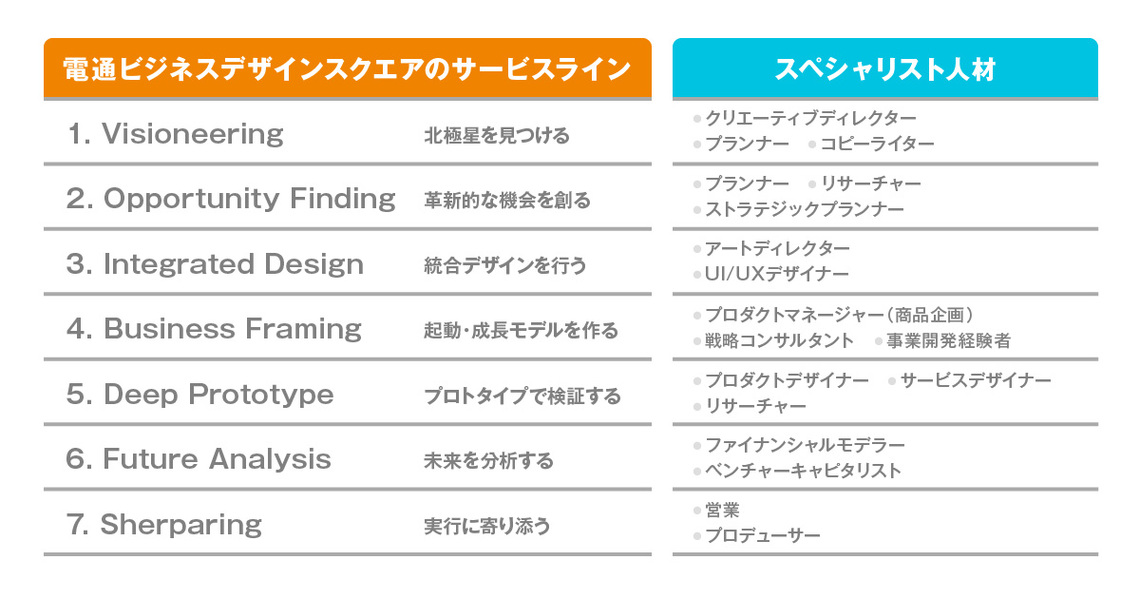
The roles fulfilling these functions are the four services introduced by Akihito Kunimi in the first installment of this series, " Business Design for Creating a Future Worth Loving," from Dentsu Inc. Business Design Square's seven service lines: ④ Business Framing (Creating Launch and Growth Models), ⑤ Deep Prototype (Verifying with Prototypes), and ⑥ Future Analysis (Analyzing the Future). This time, we briefly outline Future Analysis.
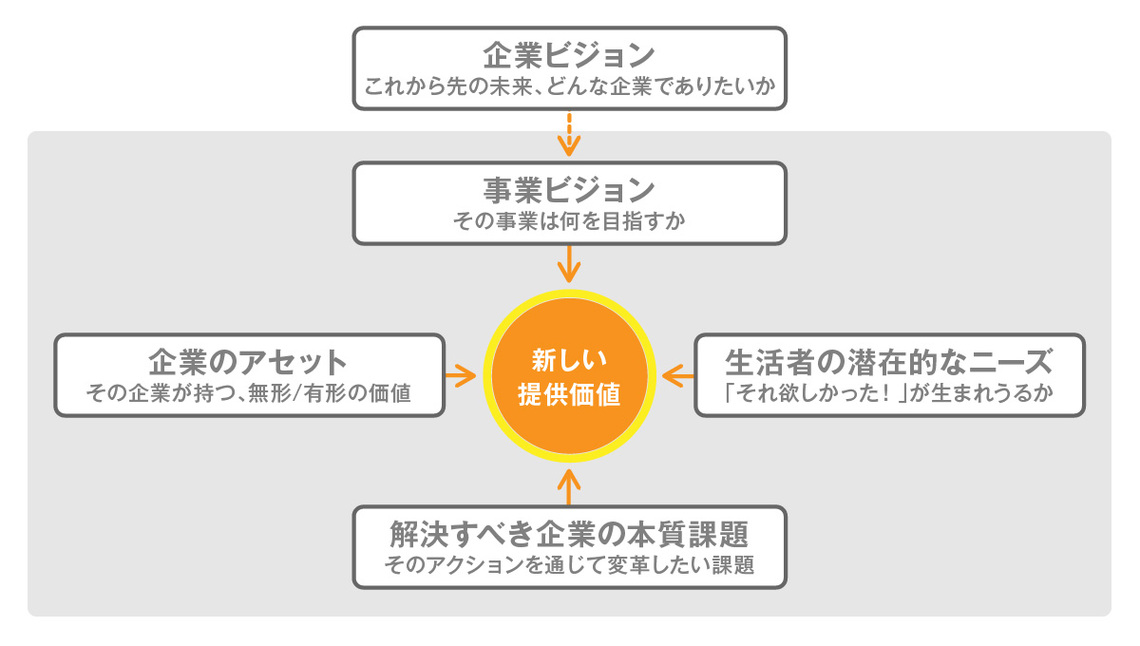
Future Analysis is based on the concept of Decision Management, proposed by Stanford University in the 1960s. Its purpose is to support high-quality decision-making by visualizing business opportunities in an uncertain future through numbers (NPV = Net Present Value). Because it predicts the future using numbers, it is a methodology that integrates various concepts beyond traditional finance, including statistics like probability and psychology applied in facilitation.
One specific characteristic is its premise that "all input must come from the client, who knows the business better than anyone." Therefore, at the project's outset, we secure time with the client's responsible personnel and conduct thorough, repeated interviews.
This process not only deepens our own understanding of the client's business but also prompts the client to re-examine their own operations, fostering a shared understanding among all stakeholders. Through this iterative process, the ideal vision and its business feasibility become logically connected, revealing the answer to "what should be decided."
The final conclusion is remarkably simple and clear to anyone who sees it. However, reaching that conclusion demands diverse expertise, making it an intensely focused project. At Dentsu Inc. Business Design Square, we establish specialized teams to continuously hone our skills, striving daily for high-quality output.
↑Back to Table of Contents
"Ideas" and "Logic" are not meant to be considered separately
So far, we've explained "logic" in business design. Finally, I want to emphasize that "ideas" and "logic" are never separate concepts; they constantly coexist within an individual's mind or within a team.
It is precisely because there are new and innovative "ideas" that "logic" can become simpler and more elegant. Conversely, by leveraging the power of "logic," "ideas" become sharper and more refined.
As mentioned in the previous article, at Dentsu Inc. Business Design Square, members with diverse expertise and values work together as one.
We are delighted when the outputs generated from this collaboration become catalysts for our clients' businesses to evolve and grow further, and as a result, contribute to the continuous creation of new value in the world. Personally, I look forward to taking on new challenges in this space.
↑Back to Table of Contents
Was this article helpful?
Share this article


Newsletter registration is here
We select and publish important news every day
For inquiries about this article
Back Numbers
Author

Atsuo Nambe
Dentsu Inc.
Dentsu Inc. Business Design Square