
Note: This website was automatically translated, so some terms or nuances may not be completely accurate.
 Influencer Marketing 2.0 [1/4]
Which product categories benefit most from influencer recommendations?

Akira Amano
Against the backdrop of influencers' ever-growing presence and business potential in consumer purchasing behavior and corporate brand building, Dentsu Inc. conducted a survey on consumer receptivity toward influencers. This series will introduce the research findings in four parts, presented by the respective researchers.
While influencer-based promotional methods are gaining traction as advanced initiatives, we feel they have yet to reach a level of adoption commensurate with their potential. We hope this series will deepen understanding of the effectiveness of these marketing strategies.
Part 1 takes a bird's-eye view, discussing societal understanding surrounding influencers and the effectiveness of general communication.
<Table of Contents>
▼On the Communication Effects of "Influencers"
▼Differences in Influence Between YouTubers and Instagrammers
▼Purchase Contribution Rates by Product Category
▼Influencers and Brands Have Distinct Roles
On the Communication Effectiveness of "Influencers"
With the proliferation of smartphones, everyone has become capable of sharing content, leading to the emergence of numerous influential communicators leveraging photos and videos. YouTubers and Instagrammers, who have gained significant attention in recent years, are prime examples. These individuals wielding influence online are collectively referred to as "influencers."
While it should be noted that the subjects of this survey (summary at the end) are people with high engagement with influencers, the key point is that influencers hold strong influence across the 10s to 40s age groups.
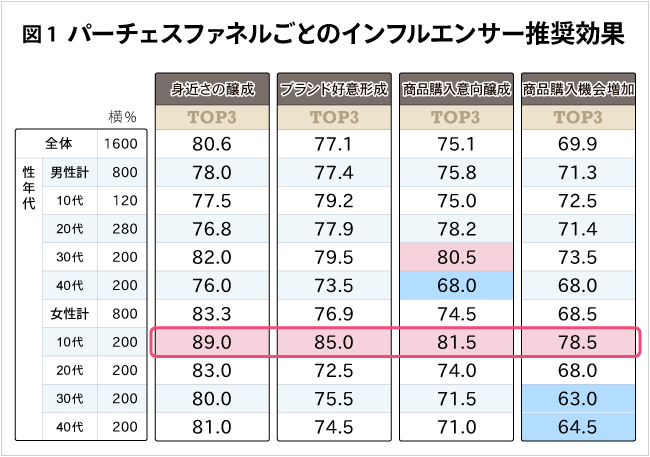
※Intentions were gauged using the following questions (from left):
Fostering Familiarity: "Do you feel more familiar with products or brands introduced by influencers than you did before they were introduced?"
Brand Favorability Formation: "Do you think positively about the 'brand or manufacturer' of products posted by influencers?"
Fostering Purchase Intent: "When you see an influencer's post, does it make you want to buy the 'product' featured?"
Increased Purchase Opportunities: "Do you think you will have more opportunities to buy the 'products' that influencers post about or introduce in the future?"
Furthermore, generational differences were clearly evident, with the influence tending to be greater among younger age groups. Figure 1 summarizes the percentage of respondents who selected the top three responses (Strongly Agree, Agree, Somewhat Agree) when asked the above questions on a 7-point scale. Blue markings indicate responses 5 points or more below the overall average, while red markings indicate responses 5 points or more above the overall average.
Looking at the response patterns of teenage women, who scored highest, it appears that around 80% are significantly influenced by influencers at every stage of the purchase funnel—from "building familiarity" to "product purchase"—regarding items introduced by influencers.
For men overall, the figures are: 78.0% for building familiarity, 77.4% for forming brand favorability, 75.8% for fostering purchase intent, and 71.3% for increasing purchase opportunities. Overall, the lowest scores were among men in their 40s, at 76.0%, 73.5%, 68.0%, and 68.0% respectively. A noticeable decline was observed from purchase intent formation to purchase opportunity.
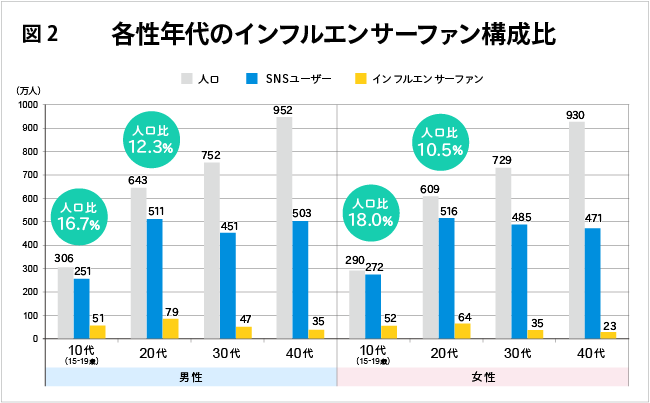
Converting the volume of influencer fans (those favorable toward influencers) to population ratios yields the results shown in Figure 2. It is evident that the proportion relative to the population of each generation is larger among younger age groups.
Differences in Influence Between YouTubers and Instagrammers
This survey compared the influence of TV personalities, YouTubers, and Instagrammers on consumers by gender and age group to assess the impact of currently prominent YouTubers and Instagrammers. Figure 3 summarizes these results.
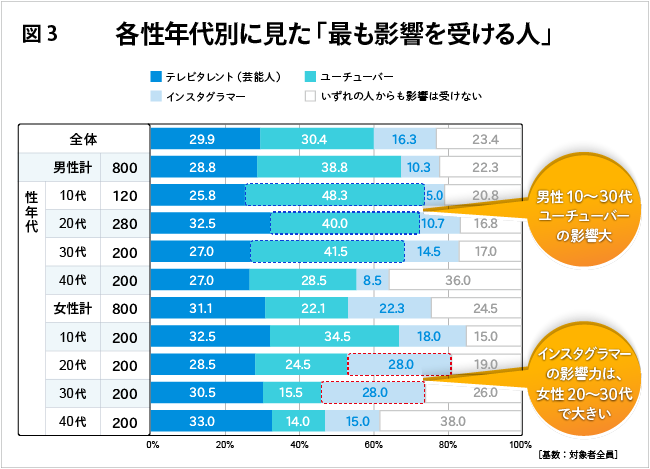
Overall, the ranking was: 1st place: YouTubers (30.4%), 2nd place: TV personalities (29.9%), 3rd place: Instagrammers (16.3%). This indicates YouTubers ≥ TV personalities > Instagrammers.
A notable characteristic here is that men tend to be more influenced by YouTubers, while women are more influenced by Instagrammers. Instagrammers are a particularly strong influence source for women in their 20s and 30s.
It should be noted that these scores do not strictly indicate the relative popularity of each category (YouTubers over TV personalities!), but rather represent the momentum of the term in society and its strength as a social symbol.
Purchase Contribution Rate by Product Category
We previously discussed how influencers' content goes beyond simply showcasing their lifestyles or spreading trends; it now directly influences people's purchasing behavior. So, for which types of products are such influencer recommendations most effective?
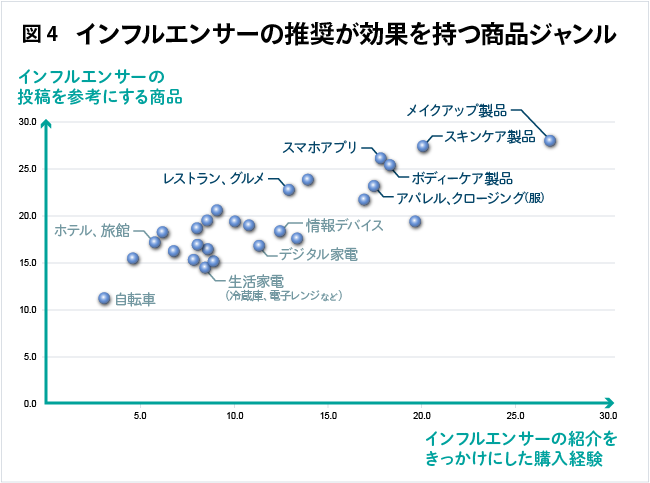
Figure 4's vertical axis represents the "Percentage of Products Referenced in Influencer Posts," while the horizontal axis shows the "Percentage of Purchase Experience with Products Introduced by Influencers." This illustrates where each product category maps onto the graph. The higher and further to the right a category is, the more likely influencer posts are referenced for that product category and the more likely those references lead to actual purchases.
The results show that categories popular with women, such as makeup, skincare, and body care, dominate the top positions. Products popular with younger demographics, like smartphone apps, are also prominent, followed by apparel, restaurants, and gourmet food. This likely correlates with Instagram's inherent strengths in fashion, beauty, and food content.
Conversely, high-priced items and products requiring careful consideration before purchase represent categories where careful strategy is needed when collaborating with influencers. It will be important to monitor various environmental changes and trial initiatives in this area going forward.
Influencers and Brands Have "Niche Segmentation"
As shown in the previous Figure 4, influencer recommendations tend to be most effective in the following areas:
Products where "influencer recommendations" are highly influential
1st Place: Makeup Products (28%)
2nd Place: Skincare Products (28%)
3rd Place: Smartphone Apps (26%)
4th Place: Body Care Products (26%)
5th Place: Hair Care Products (24%)
※Total of TOP2 responses On the other hand, there are categories where consumers reference information released by companies/brands, suggesting specifications generally play a significant role in selection decisions.
Categories where "Brand Official Websites/Accounts" are heavily referenced
1st Place: Automobiles (36%)
2nd Place: Home Appliances (34%)
3rd Place: Digital Home Appliances (32%)
4th Place: Information Devices (31%)
5th Place: Hotels & Ryokans (29%)
*Total of TOP2 responses
Looking at the individual categories and comparing influencer and brand communication, we find the following results:
・Trust influencer posts: 37% (total)
・Can't say either way: 29%
・Trust manufacturer/brand posts: 35% (total)
※Respondents were asked about their level of trust in posts about the same product/service when made by influencers versus when made by manufacturers/brands
※Totals may exceed 100% due to rounding to the nearest whole number.
These evenly split results indicate that while we recognize the importance of influencer marketing as a solution, we must not view it as a panacea that solves everything (this applies to all communication strategies, of course).
In today's sophisticated and complex communication environment, integrated communication planning is essential. Therefore, relying solely on influencers is insufficient; combining it with traditional brand-driven information dissemination remains crucial. What is required in the modern communication landscape is not a simple choice between A or B, but rather engaging with multi-layered variations of A and B.
[Survey Overview]
Survey Period: December 2017 - February 2018
Research Firm: Dentsu Macromill Insight, Inc.
Survey Method: Internet Quantitative Survey (conducted December 2017)
Sample Composition: 1,600 men and women aged 15–49 nationwide
Was this article helpful?
Share this article


Newsletter registration is here
We select and publish important news every day
For inquiries about this article
Author