
Note: This website was automatically translated, so some terms or nuances may not be completely accurate.
 The Present and Future of Design and Innovation by frog [21/49]
Now is the time to reclaim the true essence of the open office.
frog
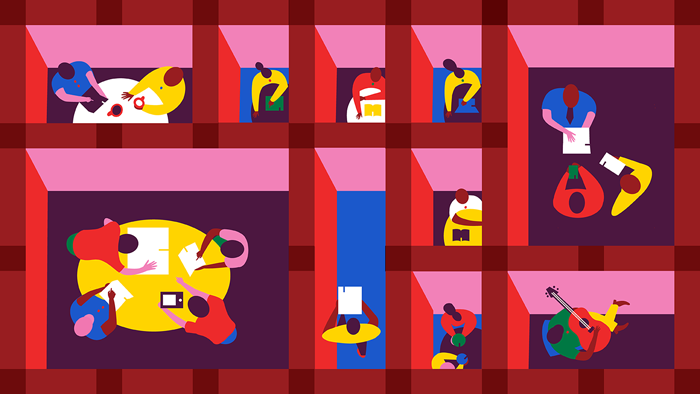
User-centered workspace design begins not with space, but with mindset
Overly logical thinking led to the failure of open offices
The concept of the "open office" (free-address office), where workers can freely choose their workspace, was born from a utopian vision. However, in reality, open offices often feature distractions like fish tanks or theater corners. Furthermore, depending on desk layout, staff turnover can reduce work efficiency, resulting in increased stress.
Yet many designers, including frog, continue to create open offices. This is because, despite being difficult to implement, open offices still hold potential for economic benefits and easier collaboration.
This past June, Norwegian energy company Equinor held an opening event for its open-office innovation lab. This was a proud moment for frog's spatial design efforts. It marked the culmination of months of serious consideration on how to succeed in a field rife with failed attempts.
The design team at frog faced spatial constraints no different from the frustrations encountered in traditional cube farms (conventional office floors with partitioned cubicles). They needed to fit the workspaces for three R&D teams into a limited area of just under 200 square meters.
The greatest concern was whether the space constraints would limit the design team's thinking. The 1950s movement known as Bürolandschaft (office landscape), the prototype of the open office concept, sought to eliminate rigid partitions and hierarchies in office spaces, embracing organic layouts and furnishings focused on the individual. However, by the 1970s, it had devolved into bland cube farms due to cost-driven optimization. We feared the same fate might befall us.
What Canadian novelist Douglas Coupland called "calf-fattening barns," these cubicle farms merely borrowed the physical form of open-plan layouts without incorporating any of the original open office concept's appeal to human emotion and motivation.
The call for adaptable workspaces only gained traction with the digital age, as diverse workstyles began replacing the 40-hour desk job. That's when we wondered: Could we reinterpret the spirit of that "office landscape"?
Isn't that a bit naive? Isn't this just another example of designers getting carried away with ideas detached from reality? Some might think so. But we disagree. By listening to people who actually work in offices, we discovered that an organic, flexible office environment is precisely what this era demands.
After examining various aspects of technical research within Equinor, we arrived at the concept of a multi-layered office environment. Rather than demanding employees conform to the space design, the space itself adapts to the employees and their work.
This kind of multi-layered design, leveraging expertise across broad fields, is becoming increasingly common as the digital and physical worlds merge. At Equinor's Innovation Lab, we brought together knowledge of architecture, visual/interaction design, technology, business processes, and user research to create a truly organized environment.
What we undertook was a form of speculative design, using various design methodologies to build the future.
*A design methodology that generates seeds of ideas while posing questions by translating visions of "what could be" into designs with high precision that people can easily understand.
Every company has multiple possible futures—some future that are considerate of employees, others that are not. We began with thorough design research to empathize deeply with employees, gathering individual needs and clarifying workflows. Based on this, we determined technical requirements and then, through a multi-layered approach, built spaces that will meet these needs for years to come.
User-centered design in physical spaces begins not with the space itself, but with awareness. A key goal of our design research was to clarify what "innovation" meant for Equinor. For them, it meant rapidly assembling global, cross-disciplinary teams to solve complex problems. This meant everyone could contribute directly to projects using their own field's tools and methods, leveraging their expertise.
Put another way, the workplace is a stage where innovation happens on the spot, adapting to each individual participant. Such a workplace requires spaces for interacting with nearby people, for teamwork, for focused individual work, for experimentation, and for hosting events. Finding the right balance of these spaces was central to this design.
The ratio of various activities differs by organization, demanding unique spatial allocations. Achieving the right balance allows users to choose the environment best suited to their work. Given Equinor's limited floor space and the dynamic nature of its innovation lab, the design needed to provide all the above spaces as needed.
Since adaptable environments cannot be built solely through technology, we had to rethink how to design interior spaces that allow for easy adjustments to layout and atmosphere. We systematically designed each component to enable reconfiguring the space without requiring large investments or disrupting team workflows.
In this Equinor case, teams can reconfigure the space in just minutes. Office furniture is modular and on casters, allowing smooth movement to new configurations or storage areas. Technology equipment (screens, cameras, power sources, etc.) is strategically placed for use across various spatial configurations. The few static design spaces are primarily for individual focused work and are positioned along the periphery of the room.
Furthermore, in environments where multiple teams work within a single room, controlling the acoustic environment is key. To maintain the space's functionality and provide an environment where each team can concentrate, the ability to counteract noise is essential. We solved this problem by selecting materials and office furniture, and by adopting sound masking technology.
Renovation or new construction costs represent a significant investment for any organization. As designers, we have a responsibility to build environments that function effectively for the organization, evolve with it, and adapt to change.
The original Action Office partitioned office system designed by Robert Propst for office furniture manufacturer Hermann Miller, and its improved version, Action Office II, emphasized customizability. They allowed for flexible partition placement, personalization of individual workspaces, and easy layout changes, fulfilling all requirements for an adaptable office in the 1960s.
However, the mistake companies have made is adopting only the form of such systems without embracing their spirit. They implemented them top-down and uniformly across the entire company solely to maximize the single metric of space utilization, failing to determine how the supporting space should be used based on the company's actual work—or "action."
Now is the perfect opportunity to shift our behavioral standards and refocus on the people who live and work in the spaces we create.
Was this article helpful?
Share this article


Newsletter registration is here
We select and publish important news every day
For inquiries about this article
Back Numbers

Author