Note: This website was automatically translated, so some terms or nuances may not be completely accurate.
 Women's Audience Insights Special Feature [1/4]
Words they find interesting, words they feel close to
Amidst the rapidly changing information media environment, the words we use continue to evolve like living organisms. In November 2019, Dentsu Media Innovation Lab surveyed women regarding their level of interest and familiarity with recent words. Additionally, it examined women's digital device usage patterns and the values representing characteristics of each generation.
Part 1 explains the results of analyzing the percentage of people showing interest and familiarity, broken down by decade, to examine the relationship between recent words and women by generation. Correspondence analysis and hierarchical cluster analysis were performed to visualize the relationships between items.
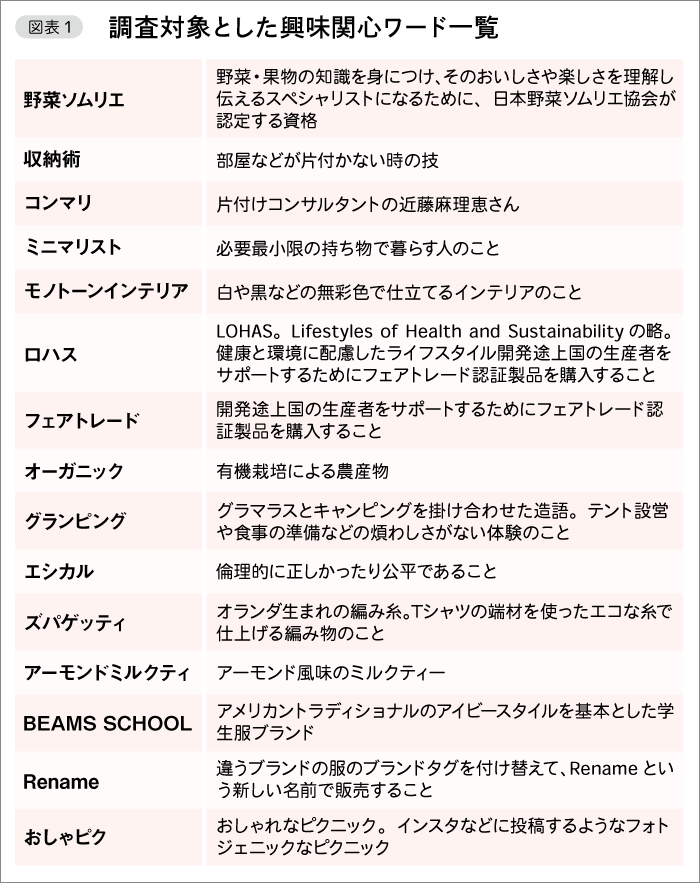
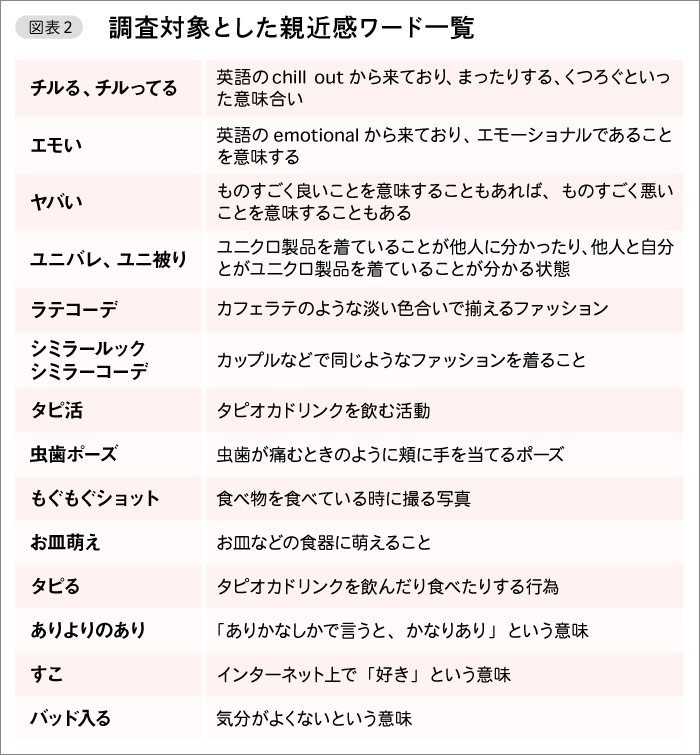
What words interest women?
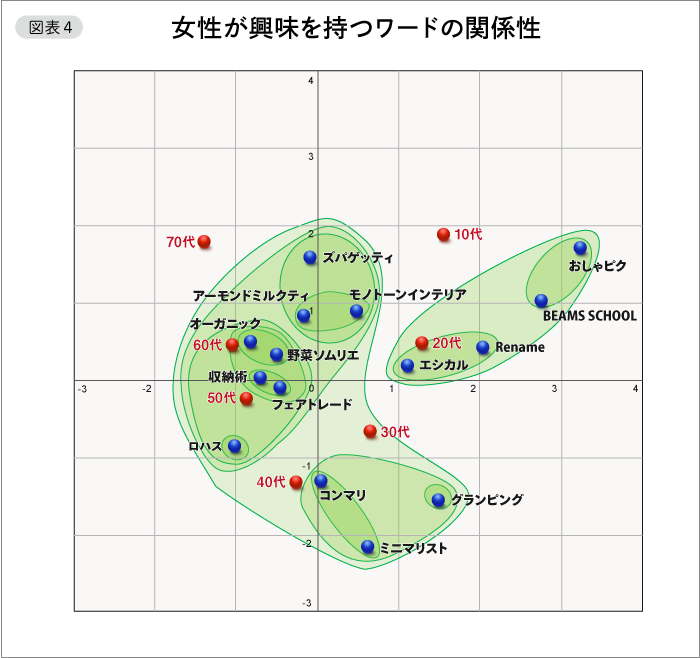
Among the items surveyed , <Storage Techniques> topped the list, exceeding 50% across all age groups. The motivation to organize overflowing possessions appears to be a major concern for women. Next was <Organic>. While slightly lower among teens, it remained high across all age groups. This reflects the recent rise in beauty awareness and health consciousness, particularly the trend of "rethinking from food."
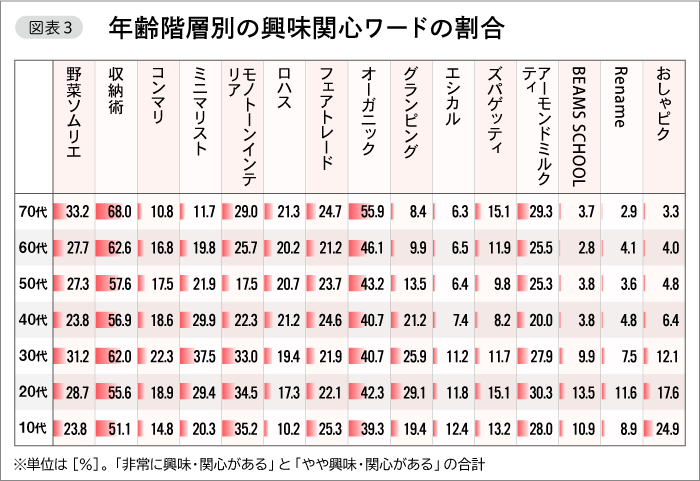
Performing correspondence analysis on this data allows us to list relationships (proximity) between items not visible in summary tables like Figure 3. Here, blue dots represent word items, red dots represent age group items, and green boxes enclose words belonging to the same cluster identified by hierarchical cluster analysis.
Within the distribution map in Figure 4, the close distance between <Vegetable Sommelier> and <Organic> indicates a strong relationship. This suggests these items reflect underlying female consciousness: "desiring a healthy lifestyle" and "maintaining a focus on beauty even as one ages."
Please note that for convenience, the distribution maps of different dimensions—age groups and words—are overlaid. Therefore, even if a specific age group and word appear close on the diagram, this does not necessarily indicate a correlation between them.
What words do women feel a sense of familiarity with?
Next, regarding words that evoke familiarity, we primarily collected terms used among younger generations in recent years. The results showed that scores were predictably higher among teens and those in their 20s, indicating a strong tendency to feel familiarity with words likely used in daily communication like actual conversations and social media.
However, the word "yabai" scored relatively high even among older age groups. "Yabai" is used both positively and negatively, and while it's commonly used by men, its versatility means it's a word that even people in their 70s feel a sense of familiarity with.
While there are various theories, the origin of this word is said to be a secret code used in Edo-period prisons to warn fellow inmates that a guard was approaching. In the sense that it expresses a feeling of unease or agitation caused by some factor or stimulus, its meaning may be the same now as it was then.
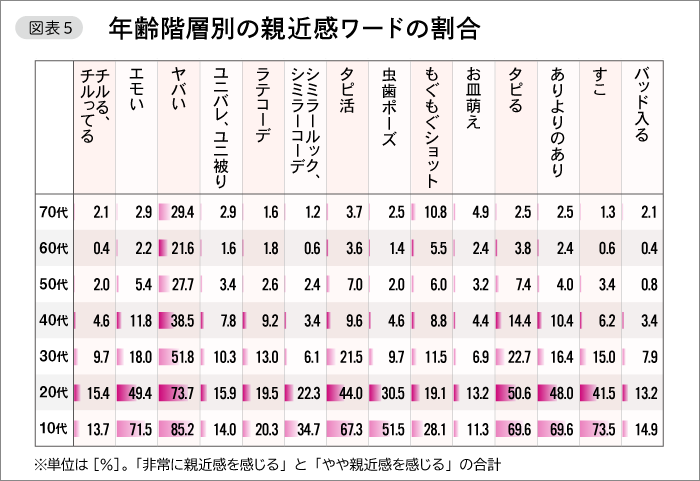
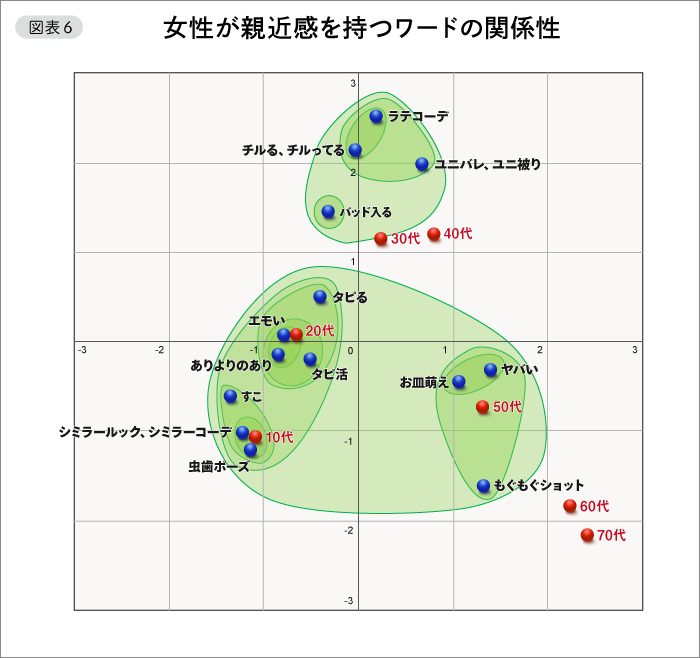
Correspondence analysis results for relatable words show that <Cavity Pose>,<Similar Look,Similar Outfit>, and <Suko> are closely related. This reflects the high relatability scores for each term among younger demographics.
<Cavity Pose> spread particularly among women because placing a hand on the cheek makes the face appear smaller. <Similar look, similar coordinate> reflects the desire to express intimacy by wearing the same fashion or coordinating outfits with one's boyfriend. <Suko> originated as a typo on NicoNico Douga, evolving from the word "suki" (like), and spread particularly among younger generations. Such linguistic expansion exists in every era, leading to the emergence of "sukosuko no suko" – meaning "especially like" among things one likes.
The driving force behind trending words remains young women
As seen above, examining women's mentality through their interest in and affinity for language reveals that young women play a significant role in the birth and disappearance of new words. While new words are useful in communication among younger demographics, they may not convey intended messages accurately to older age groups. Therefore, some differentiation in usage is necessary depending on the intended audience.
While new words are often created by younger generations, these same young people also serve as the driving force spreading them through platforms like social media. As they become the core of society, they may continue using the same words characteristic of their generation, or the words they use could evolve with the times and their own aging. In this sense, this generational analysis approach will likely remain a noteworthy methodology.
Next time, we will explain the usage patterns of digital services among women.
[Survey Overview]
● Survey Name: Survey of 12 Age Groups of Women
● Target Areas: Kanto (Tokyo/Kanagawa/Saitama/Chiba), Chubu (Aichi/Gifu/Mie), Kansai (Osaka/Kyoto/Hyogo/Nara)
● Target Criteria: Women aged 15–74
●Sample Size: 3,000 respondents
●Survey Method: Internet survey
●Survey Period: November 1–5, 2019
●Research Organization: Video Research Ltd.
Was this article helpful?
Share this article


Newsletter registration is here
We select and publish important news every day
For inquiries about this article
Author

Manabu Tachiki
Dentsu Inc.
Future Business Research Institute
Insight MemoOmni-Viewing of Accelerating VideosShiodome Media Researcher CommentaryDigest of the Opening Feature: 'Information Media White Paper 2016'Women's Audience Insights Special FeatureExploring Pathways from the "Quality of Society Survey" to a "Society" Where People Find Meaning in LifeCurrent State of Public Awareness and Values as Seen in the "Quality of Society Annual Survey 2021"DENTSU DESIRE DESIGN's Approach to Marketing Reconstruction Based on "Theory of Desire"Building the future begins with visualizing the will of the future.