Released in February 2025, the Dentsu Inc. Future Mandala 2025 examines 72 trend themes across four categories: "Population & Households," "Society & Economy," "Science & Technology," and "Cities & Nature."
This time, a roundtable discussion was held with the co-editors of Dentsu Inc. Future Mandala 2025: Kentaro Yoshida and Takuya Kagata from Dentsu Inc., Akemi Takahashi from Dentsu Digital Inc., and Hajime Yamamoto from Dentsu Consulting Inc. Based on Dentsu Inc. Future Mandala 2025, they discussed the present and future of four themes: "Body," "Learning," "Connection," and "Abundance."We explore how the Dentsu Inc. Future Mandala can be utilized when considering the future!
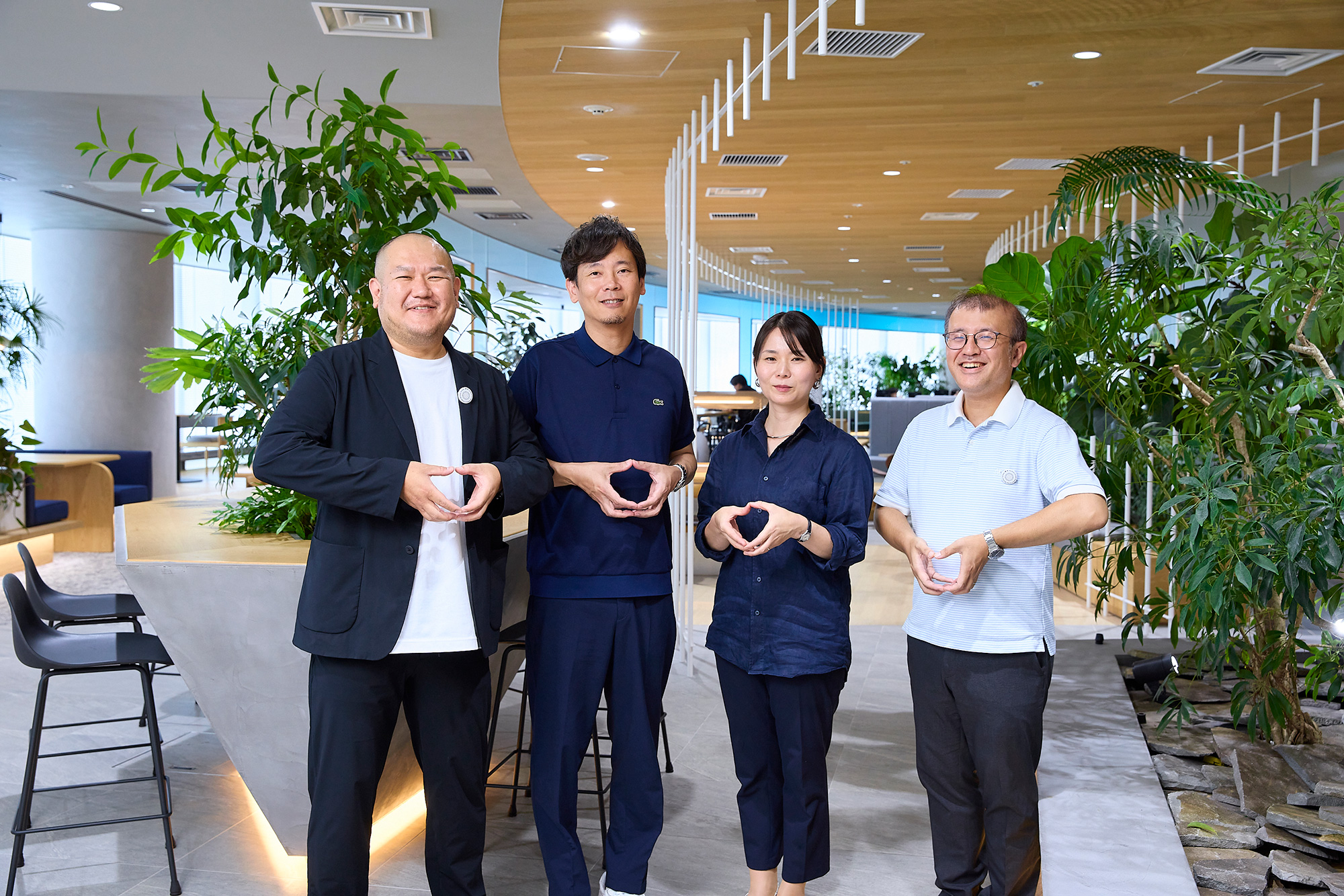
Photographed in the Mandala pose. (From left) Dentsu Inc.: Takuya Kagata, Kentaro Yoshida; Dentsu Digital Inc.: Akemi Takahashi; Dentsu Consulting Inc.: Hajime Yamamoto
The 'Dentsu Future Mandala' – A Gathering of Wisdom from Six Dentsu Group Companies
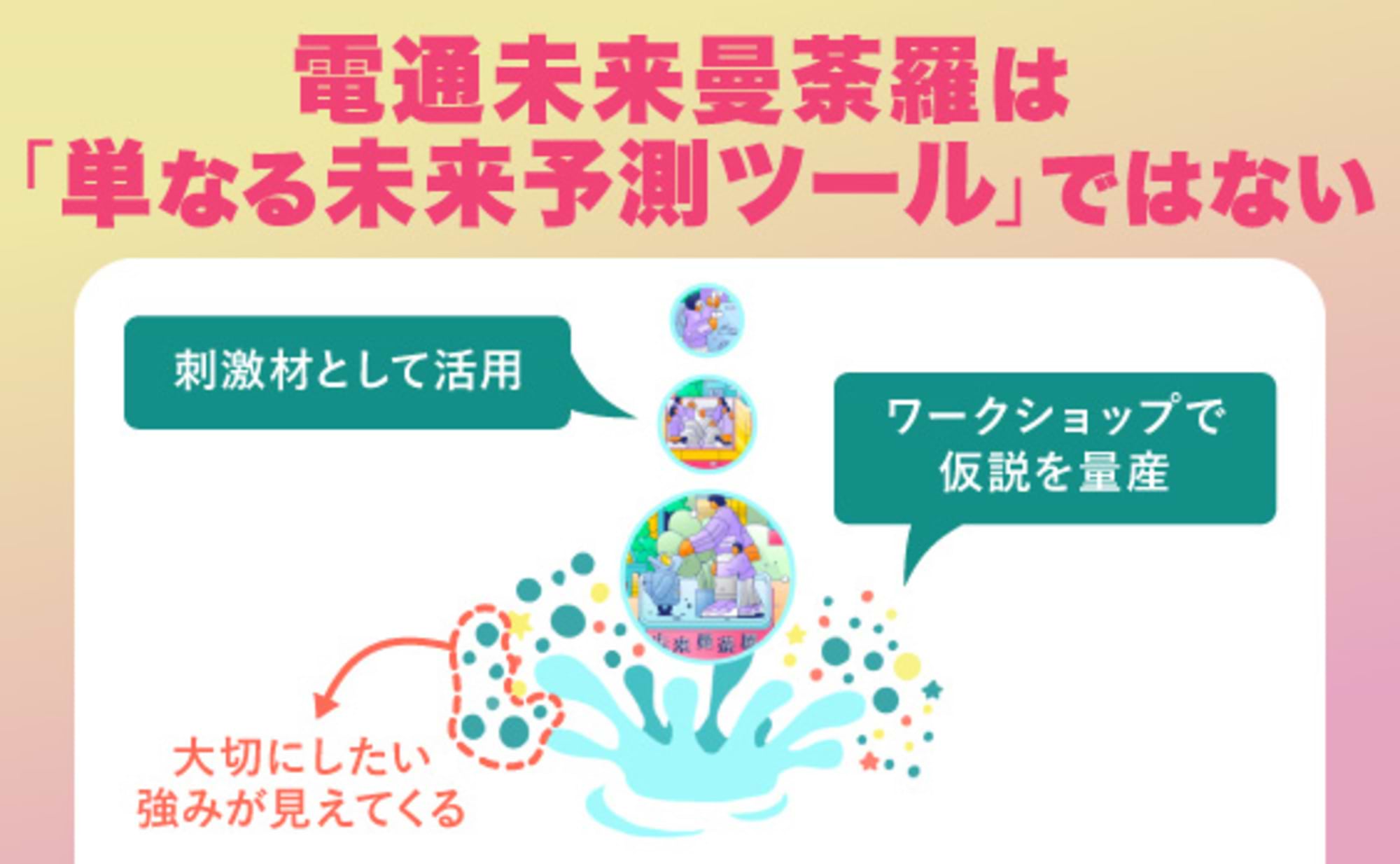
Yamamoto: The "Dentsu Future Mandala" is a "co-creation hypothesis mass production tool" launched by the domestic Dentsu Group in 2010. The editorial team comprises over 30 members from six Dentsu Group companies (Dentsu, Dentsu Digital, DENTSU SOKEN INC., Dentsu East Japan Inc., Dentsu Macromill Insight, Inc., and Dentsu Consulting Inc.).Today, four members have gathered. First, I'd like to hear about your backgrounds and what you value most when thinking about the future.
I'll start. I began my career in the marketing department of a beverage manufacturer. After that, I worked in the marketing departments of IT companies and other consulting firms, but I've been with Dentsu Consulting Inc. longer than any of those other companies. During my time at the manufacturer, I focused on "what insights our customers would have going forward." In consulting, I worked on "how to shape the next growth strategy and new business models." I believe both roles share the common thread of creating value while looking toward the future.
My fundamental belief is that "the future is something we create." While we sometimes receive requests to "predict the future," I place greater importance on collaborating with clients not just to forecast, but to think together about "how to realize the future they desire."
Takahashi: My career has been in digital marketing, and I'm now in my ninth year at Dentsu Digital Inc. As a project manager, I've gained broad experience spanning market research, requirement definition, and product development.
What I value most when thinking about the future is "looking at both the past and the future to grasp the essence." My experiences as a student influenced this.I majored in film at art university, a field that tends to focus on learning from the past, somewhat detached from broader societal trends. However, in my early twenties, I witnessed firsthand how rapid advances in film technology completely transformed the industry structure. This experience made me strongly realize that "while technology changes certain values, other things endure." Since then, I've made it a practice to consider "what changes and what remains" from both past and future perspectives.
Kagata: Since joining Dentsu Inc., I've supported product and service development for companies across various industries. Starting this year, I've also been involved in supporting Japanese companies' overseas expansion and projects for foreign companies, providing development support from a global perspective. Personally, I have a strong interest in "regions and towns." I've revisited studying urban engineering and have also worked as a local government official.
When thinking about the future, I place great importance on the presence of people in frontier areas. My experience has shown me that new products and services emerging 7-8 years later often originate from their mindset and way of life. By regularly observing and conversing with people living in these regions and towns, I seek hints for shaping the future.
Yoshida: I've loved digital technology and gadgets since childhood, and after graduating from university, I joined a telecommunications company. There, I often felt that digital was treated primarily as a tool for streamlining and efficiency, not necessarily linked to value creation. Wanting to "create digital value that impacts society as a whole," I moved to Dentsu Inc.
After joining, I worked in the telecommunications field, conducting consumer research to observe long-term how people's behaviors change in response to shifts in technology and the environment. However, in recent years, I've witnessed a shift toward people proactively choosing technology. Seeing this change firsthand made me realize we need a different approach to value creation than before.
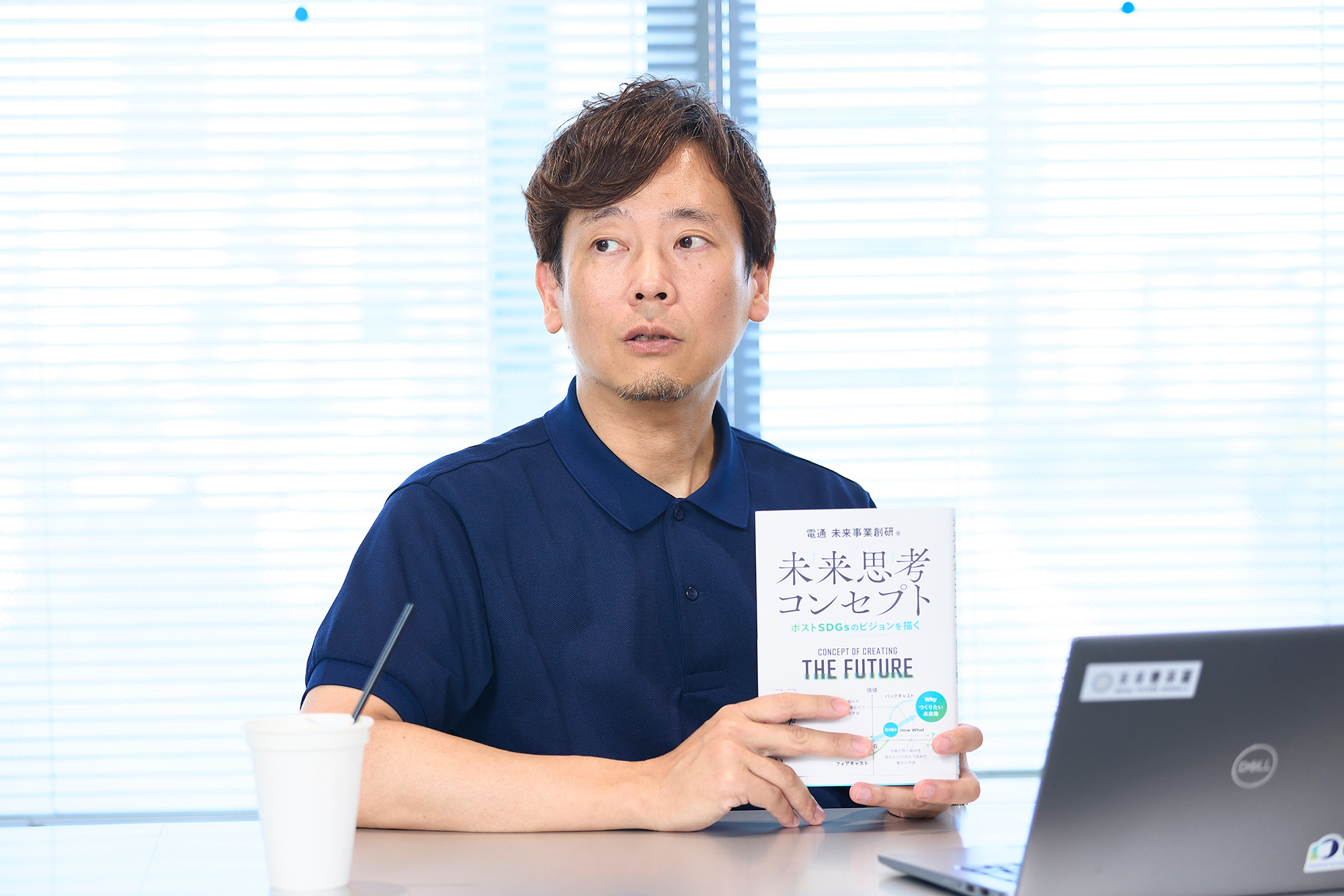
Like Mr. Yamamoto, I believe "the future is not something to be predicted, but something to be created." Guided by this belief, I established Dentsu Inc.'s Future Business Creation Research Team and published the book "Future Thinking Concepts: Envisioning a Post-SDGs Vision."
Yamamoto: Thank you. Just hearing everyone's backgrounds shows how many different angles there are to approaching the future, right? I believe this is precisely the defining feature of Dentsu Inc.'s Future Mandala.
For example, Dentsu Inc., where Mr. Yoshida and Mr. Kagata belong, excels at creative thinking. It has the power to expand the future not just by stacking facts, but sometimes by adding unconventional ideas. Dentsu Digital Inc., where Mr. Takahashi belongs, looks ahead to what value will be required in the next society from a digital perspective.Meanwhile, we at Dentsu Consulting Inc. excel not only at envisioning concepts but also at identifying fact-based pathways to realize them. The remaining three companies within the Dentsu Group each possess their own strengths as well. People with diverse backgrounds and strengths come together to envision the future grounded in facts. Since its launch in 2010, the Dentsu Future Mandala has been built through repeated discussions, like adding secret broth to a simmering pot.
How will perceptions of aging and death change?
Yamamoto: From here, we'd like to hold a free-flowing discussion based on the "Dentsu Inc. Future Mandala 2025." What we aim to achieve through the Dentsu Inc. Future Mandala is to generate hypotheses about the future through discussions with our clients. We hope you can sense that vision through our discussion among the four of us.Today, each of us brought one theme from Dentsu Inc. Future Mandala 2025 that we find intriguing. Who would like to start?
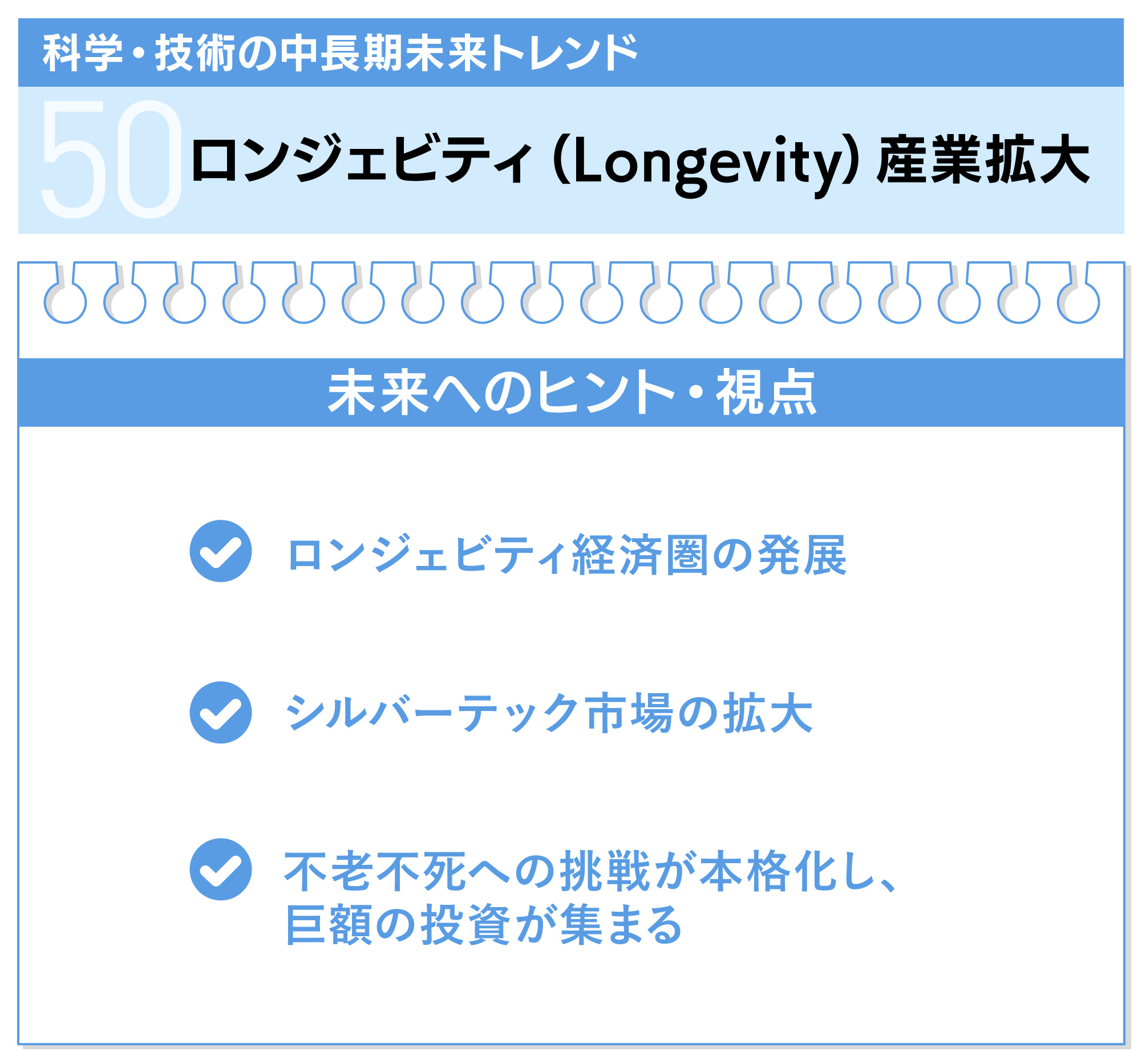
Takahashi: Alright, I'll be the spark. The theme I chose is "The Body." I believe our approach to concepts related to the body—such as health, beauty, and death—will undergo significant change. The rise of the longevity industry, as seen in item 50 of Dentsu Inc. Future Mandala 2025, and supplements claimed to slow aging, show that technological and research advancements are making the pursuit of immortality increasingly realistic.
Excerpt from Dentsu Inc. Future Mandala 2025
When the era arrives where the wealthy invest heavily to buy youth and health, what exactly will aging mean for humanity...? Perhaps it's because of our line of work, but I feel that when "intelligence" and "thinking" – values traditionally held in high regard – become streamlined and replaceable by AI, "physical strength and youth" will emerge as the new competitive axis.
Yamamoto: Approaches to the body seem to broadly fall into two categories, right? Those that control decline from within, like using supplements, and those that augment or extend physical capabilities from the outside, like powered suits. The latter direction, in particular, raises the question: "Where does the human body end?" If the definition of the body expands, our concept of death will likely change too.
Yoshida: If we enter an era where "death becomes a choice," the way we live will fundamentally change. While extending lifespan might be an option, if death itself becomes a "choice," we'll start designing our lives backwards. This isn't about endorsing suicide; rather, as our approach to physical limitations and aging evolves, discussions about death will likely intensify.
Yamamoto: Discussions about euthanasia are emerging overseas, right?
Takahashi: While there's a trend where cutting-edge medicine guarantees youth and health, we also see news about younger generations being highly conscious of end-of-life planning and building assets for retirement. As choices around health and life/death increase, more people might plan "how to end things on their own terms."
Kagata: Lately, I feel more people are clearly articulating "what they want to leave behind in their lifetime" and including it in their social media profiles. Someone once said, "If I share my knowledge and expertise publicly, it will live on as a 'meme' even after I die."
Now, with AI capable of analyzing social media and text, the possibility of recreating a person's essence after death is becoming realistic. If more people start pragmatically thinking, "Perhaps physical death is just one chapter ending," wouldn't this change how companies market their services? The old approach—selling insurance or homes with the pitch, "You don't know what will happen in 20 years, so buy peace of mind"—might no longer work.
Yamamoto: As the democratization of "leaving something behind" advances, an era may come where even those without children can pass on their ideas and personality to the next generation. This could make the declining birthrate even harder to stop. While our approach to death becomes more planned, we simultaneously invest in immortality and continue confronting the fear of death. Listening to this, I felt the gap between these conflicting feelings seems destined to widen.
"Learning" enters an era valuing education
Yamamoto: Next, I'd like to discuss Mr. Yoshida's theme of "Learning."
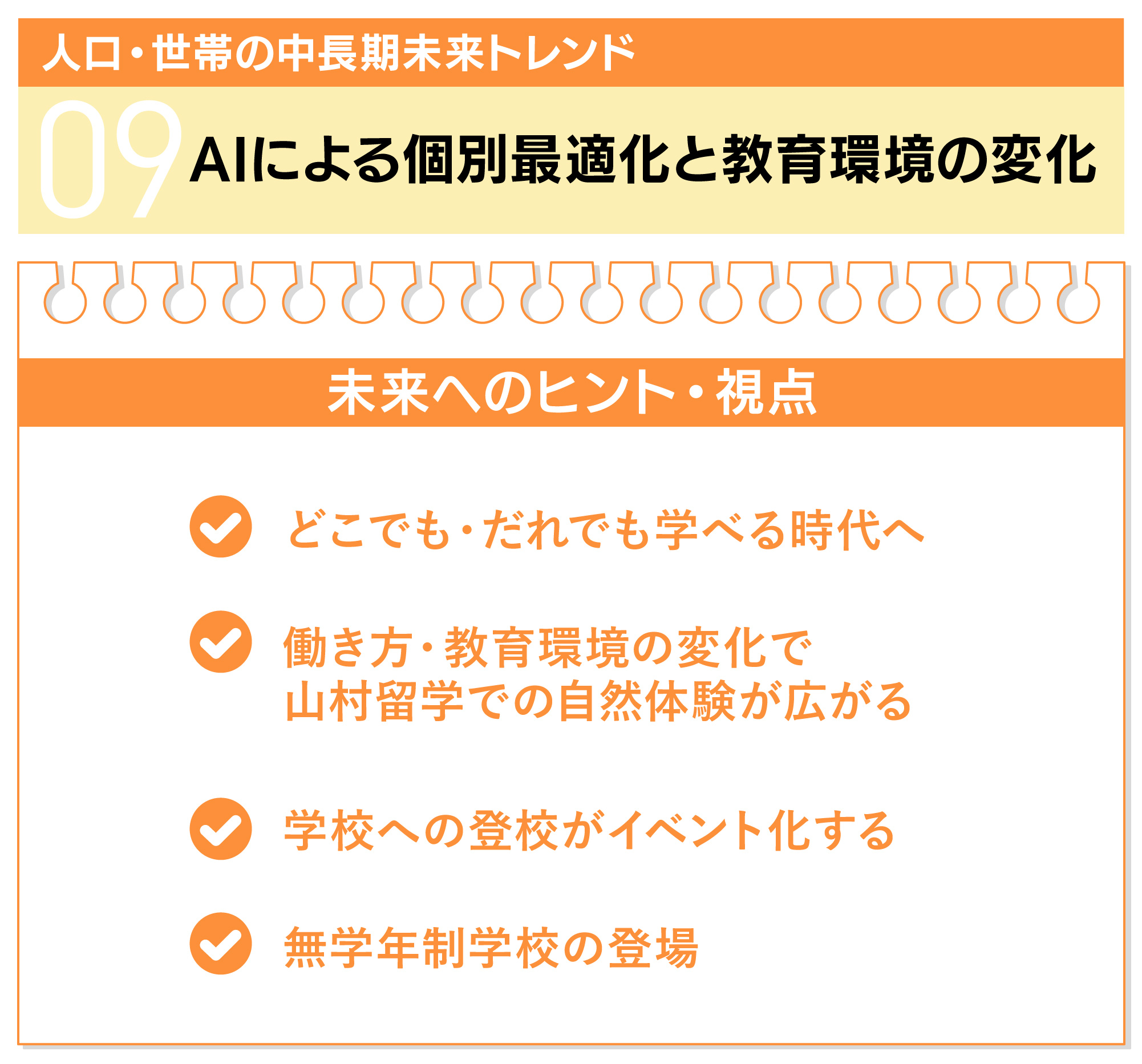
Yoshida: Point 9 of the Dentsu Inc. Future Mandala 2025 states "AI-driven individual optimization and changes in the educational environment." I believe learning will be significantly impacted by the spread of AI. Recently, a conversation with a university professor resonated deeply when they said, "The value will shift from education to liberal arts." What sustains today's academic meritocracy is the deviation score based on knowledge-centered study, but in reality, about half of it is actually "liberal arts proficiency."
Excerpt from Dentsu Inc. Future Mandala 2025
It's not just about memorization; it's about having enough cultural literacy to understand societal structures and the meaning of words. That's what enables truly human communication and productive communities. I believe "cultural literacy scores" will become crucial going forward. As AI takes over the knowledge-based aspects, I expect we'll see a huge increase in discussions about what humans should learn and how we can remain distinctly human.
Takahashi: I truly agree. Trying to provide children with all-around early childhood education—sports, arts, STEAM, English, programming—it's endless. Some even say the ultimate strength to withstand the AI era is grit. On the other hand, the obsession with standardized test scores remains deeply ingrained, and as a parent, the future of learning is nothing but anxiety and confusion (laughs).
Yoshida: That's precisely why I believe in a well-rounded education. I think the essence of learning going forward will be things like "Be a kind person" and "Do things that benefit others in the world."
Yamamoto: It does seem like that's where we're headed. My child is right in the thick of middle school entrance exams, and at school information sessions, I hear more and more about how they start having students think about their careers as early as high school.
But with technology evolving this rapidly, how much meaning will a career plan made in high school actually hold in the future...? I think what's more important is the desire to "do something that benefits others" and the attitude of deeply exploring something. How we cultivate that foundation will be the real value going forward. I increasingly feel that schools that properly teach ethics and morality will be the ones that pay off in the long run.
Kagata: I recently completed a rigorous four-month leadership program at Minerva University. In Japan, we tend to think leadership comes from being class president or being academically gifted, right? But that's not it. The lectures were extremely logical, focusing on leadership through coaching and storytelling – essentially, breaking down why people want to follow someone.
Listening to everyone's perspectives, I believe the future will increasingly value not just knowledge, but the ability to move hearts and guide people. However, Japanese education hasn't reached that level yet, and even in America, only a limited few can learn these skills. Ultimately, this seems likely to create a significant gap.
Yamamoto: If liberal arts education gains prominence, the gap in experiential opportunities will likely become an even bigger problem, won't it?
Kagata: Exactly. It feels like we're entering an era of increasing unfairness.
Yoshida: That's precisely why we need to shift learning from a take-based model to a give-based one. Until now, the culture was about not sharing knowledge without receiving compensation. But going forward, we need to give first, then build business around what we gain afterward. People with leadership and a well-rounded education sharing their knowledge and experiences. I believe this will bridge the gap and lead to an era where more human-centered learning flourishes.
Yamamoto: In the latter half, we'll discuss "connection" and "abundance."
Solution Creation Center / Future Business Creation Research Founder
Chief Director, Marketing Division 4
Engaged in market analysis, strategic planning, and consulting primarily focused on the mobile business and smartphone app sector. As Dentsu Inc.'s Mobile Project Leader, attended CES/MWC annually since 2011 to grasp tech trends. Established the Dentsu Group cross-organizational "Future Business Creation Lab" in 2021. Specializes in business development through backcasting from visualizing future lifestyles. Fellow of the Consumer Affairs Agency's New Future Vision Forum; Master of Business Administration (MBA).
Supports corporate business design at Dentsu Marketing Division ~ Dentsu Digital Inc. ~ Dentsu Consulting Inc., including an insurance company's 2050 vision, an automaker's smart city concept, and a food company's new ventures. Currently involved in business planning and service design in Japan, India, ASEAN, China, and Taiwan. Specializes in consulting with an urban engineering background and facilitation that breaks down silos. Captain of the Dentsu Sumo Club. Right-handed. Signature move: Ushiro Nage (back throw).
After joining Dentsu Inc. e-marketing One (now Dentsu Digital Inc.), he began his career in creative direction. He has consistently worked on projects driving business from the customer perspective, serving as a UI/UX consultant and service designer. Since 2022, he has been involved in promoting the Future Mandala initiative and serves as its co-editor-in-chief.
After working in the marketing department of a major beverage manufacturer, joined Dentsu Consulting Inc. in July 2010. Returned to the company and assumed current position in January 2023. Has been involved in numerous projects, primarily in the consumer goods, media, and entertainment sectors, focusing on corporate vision formulation and mid-term management planning. Recently also engaged in disseminating insights on thinking methodologies, including a short-term series in Nikkei Cross Trend.

 Dentsu Group's 72 Visions of the Future: "Future Mandala" [2/3]