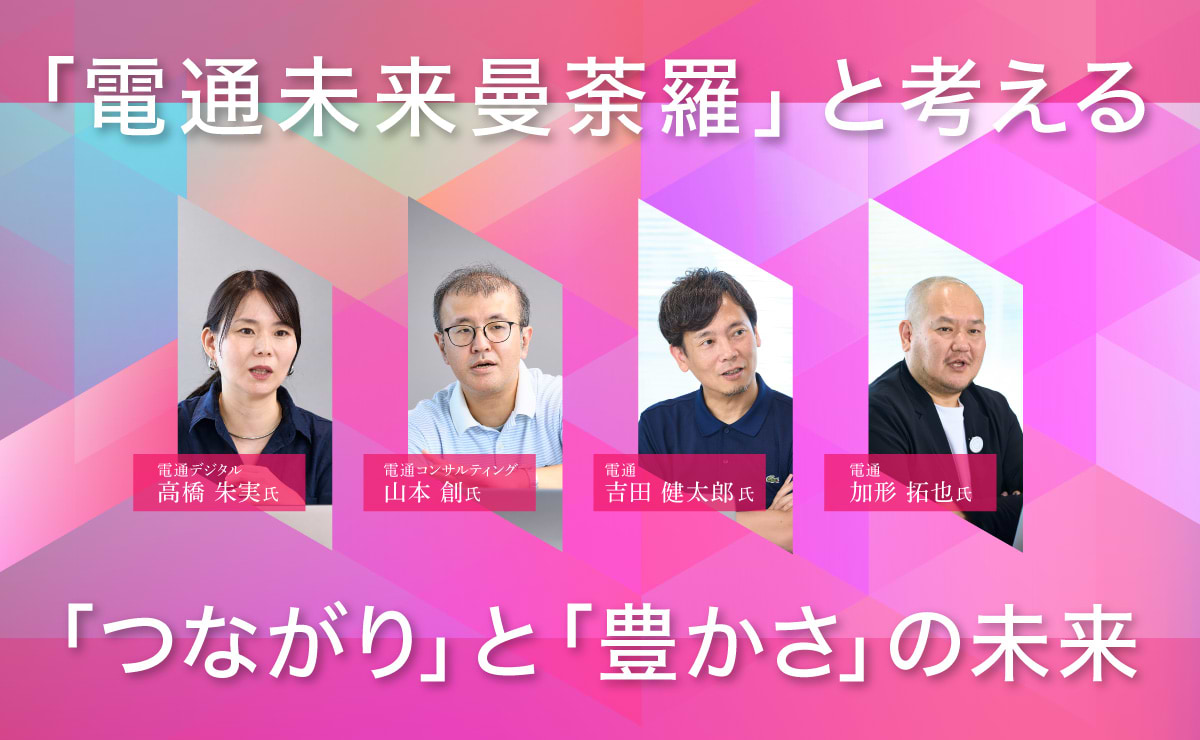
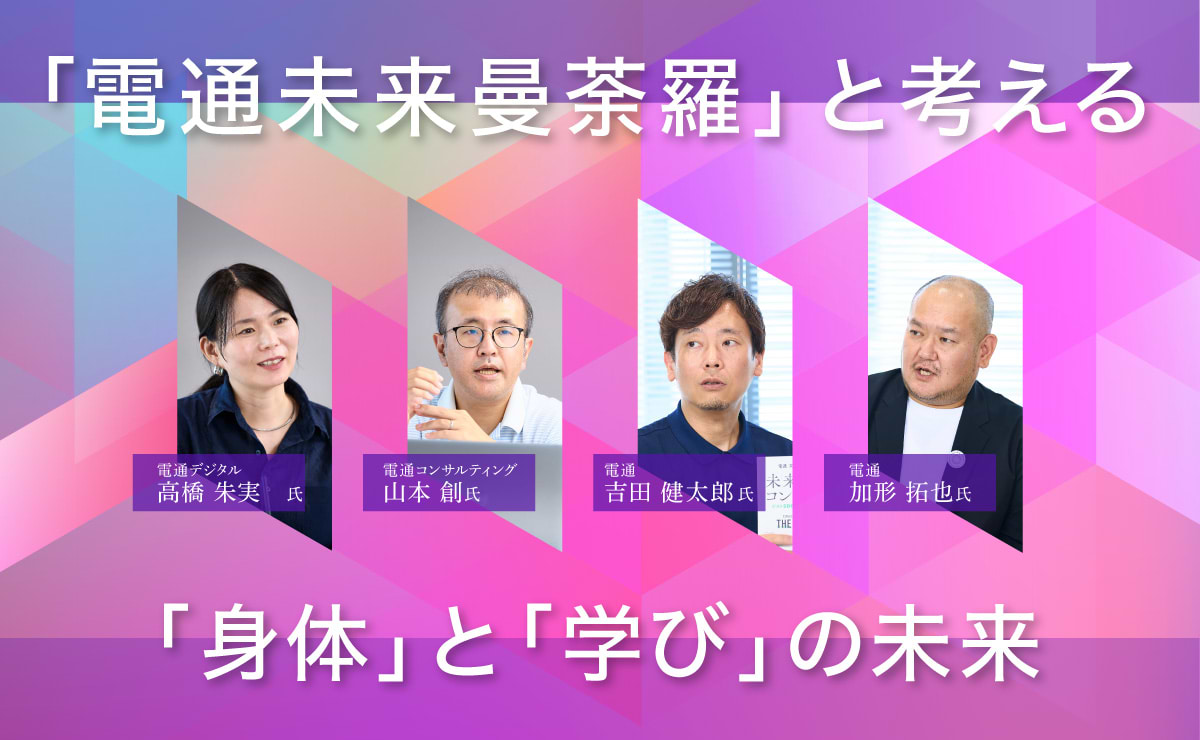
Deepening discussions about the future through 'Dentsu Inc. Future Mandala 2025.' What kind of future will be woven by the diversifying concepts of 'connection' and 'abundance'?
Released in February 2025, the Dentsu Inc. Future Mandala 2025 is a "collaborative hypothesis generation tool" covering 72 trend themes across four categories: "Population & Households," "Society & Economy," "Science & Technology," and "Cities & Nature."
This time, a roundtable discussion was held with Kentaro Yoshida and Takuya Kagata of Dentsu, who serve as co-editors of the Dentsu Future Mandala 2025, along with Akemi Takahashi of Dentsu Digital Inc. and Hajime Yamamoto of Dentsu Consulting Inc. Based on the Dentsu Future Mandala 2025, they discussed the present and future of four themes: "Body," "Learning," "Connection," and "Abundance."The first part covers "Body" and "Learning," while the second part discusses "Connection" and "Abundance."
How will people connect with each other amid the development of AI and SNS?
Yamamoto: Within this year's "Dentsu Inc. Future Mandala 2025," the theme that particularly captured my interest is "connection." It ties into the discussions about "the body" and "learning" we covered in the first part. As the declining birthrate and rise in unmarried individuals continue, we'll likely see an increase in single-person households. Furthermore, with frequent news about regional depopulation and shrinking populations, society seems to be fragmenting, leading me to believe more people will experience loneliness.
On the other hand, social media enables connections across various domains. This duality in "human connections" is a theme I find deeply compelling. During the pandemic, there was a temporary sense that "real connections could be replaced online," exemplified by remote drinking parties. However, the sentiment that "we really need to gather in person" has now resurfaced. Considering these dynamics, I want to explore the nature of connection moving forward.
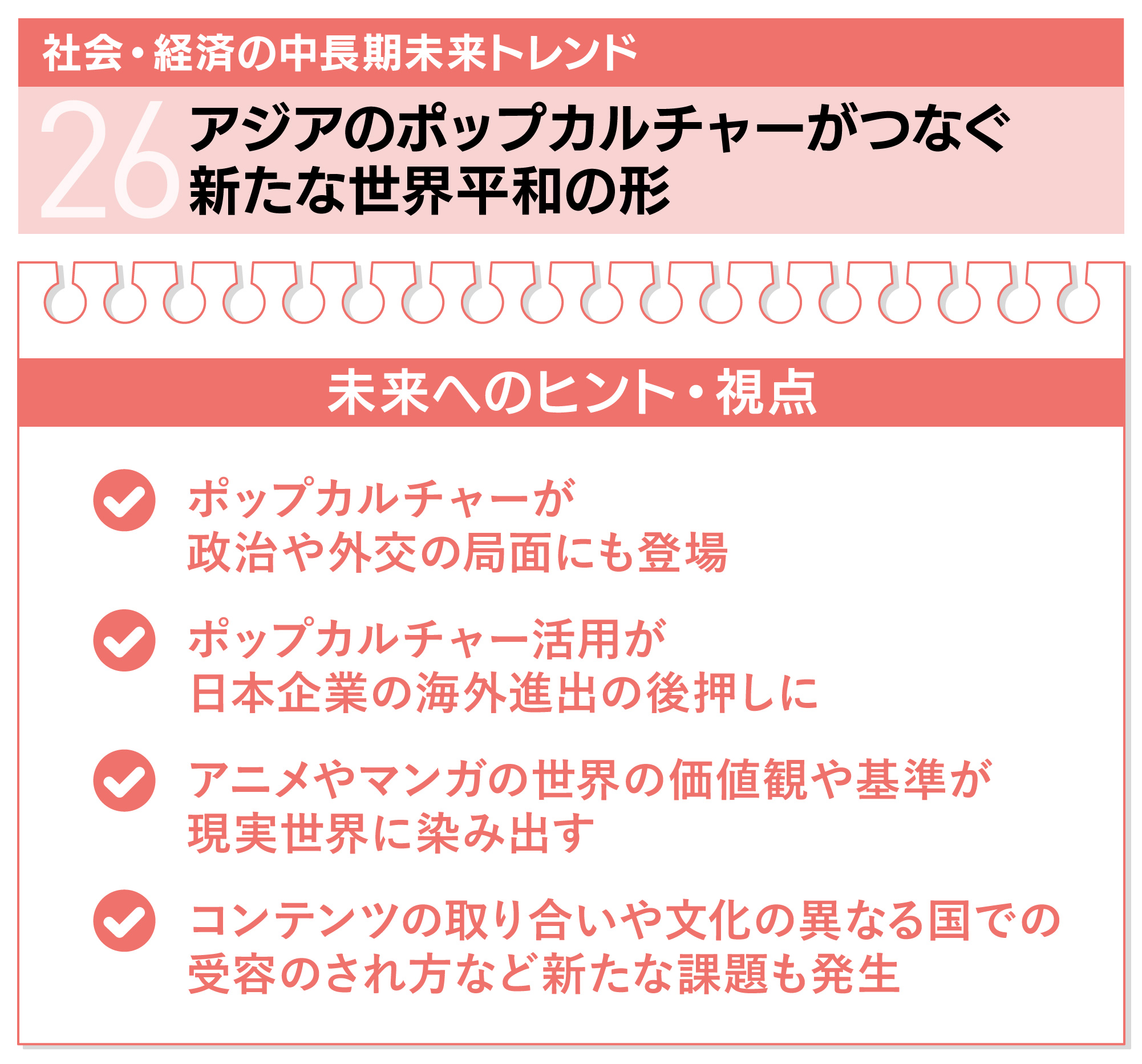
Dentsu Inc. Future Mandala 2025 highlights "Asian Pop Culture" in its 26th entry. For example, there's talk of building a Dragon Ball theme park in the Middle East. This makes me wonder if popular Japanese manga holds the potential to connect people worldwide through shared enjoyment. If Japan's content industry takes on this "role of connecting people," I believe it could create new competitive axes in the business realm as well.
Excerpt from Dentsu Inc. Future Mandala 2025
Yoshida: They say loneliness shortens your lifespan, right? It's even said to be as bad for your health as smoking a pack of cigarettes a day. So, connections are incredibly important, not just for physical health but also for mental wellness.
I believe that in the coming era, the ways people find their place will become increasingly diverse. A place to belong is something you feel when others recognize you and say, "You belong here," separate from your personal space.In the past, having a desk at work and a role within a department proved this. But now, with remote work and open-plan offices, it can be harder to feel that sense of belonging. On the other hand, we're also entering an era where interactions with AI—where an AI, not a person, acknowledges you—can provide that sense of belonging and connection. With platforms like social media and the metaverse, you might not even know if the other person is real. I think this is an area where all kinds of possibilities are expanding.
Yamamoto: Recently, overseas, there was buzz about people saying "The old version was better. Give me back my ChatGPT" during its update. This story serves as proof that people can feel connected even if the entity giving them a response that understands them isn't a real human. As AI becomes more widespread, the question of "connection" seems likely to deepen further.
Takahashi: American students often view sharing personal concerns like romantic issues with friends as "disrespectful because it takes up their time," so they seek counselors within their budget. However, more are now turning to AI for relationship advice, using AI for lighter concerns and reserving counselors for truly overwhelming problems. When I shared this with a Japanese woman in her twenties, she said,she said, "Exactly. I don't talk to friends about love—I talk to AI (my smartphone)." I was surprised to learn that even in Japan, people are already turning to AI for advice.
Yoshida: It seems the idea is that talking to friends makes them feel like they have to be considerate about things.
Takahashi: Exactly. Another interesting point was how they use social media. According to her, SNS is a place to share things you like and connect.Today's youth connect based not on values, but on "units of favorite things" like characters or idols. So the more favorite things someone has, the more "connection points" they gain, ultimately expanding their social circles. Hearing this made me realize that marketing based on values is outdated; we need a lighter, "favorite things"-based perspective going forward.
Kagata: I feel that while division and loneliness are increasing, we'll see more services stepping into that space. In the future, even connections made through SNS or idol fandom might be underpinned by AI that understands people, using recommendations to connect them with others it deems "safe to be around." This could facilitate real-life meetings for travel or events, definitely increasing the total volume of connections.
Yoshida: AI involvement might change how distances between people shrink. For example, Kansai-style "tsukkomi" humor could be perceived as "harsh" by people from Kanto. But if AI could soften it, translating it so the other person responds with a smile, it might build trust that was previously difficult to establish. We might even be able to connect with people we couldn't reach before, thanks to AI.
Noblesse Oblige and Post-Lookism: The Future of Prosperity
Yamamoto: Finally, I'd like to discuss the theme of "affluence."
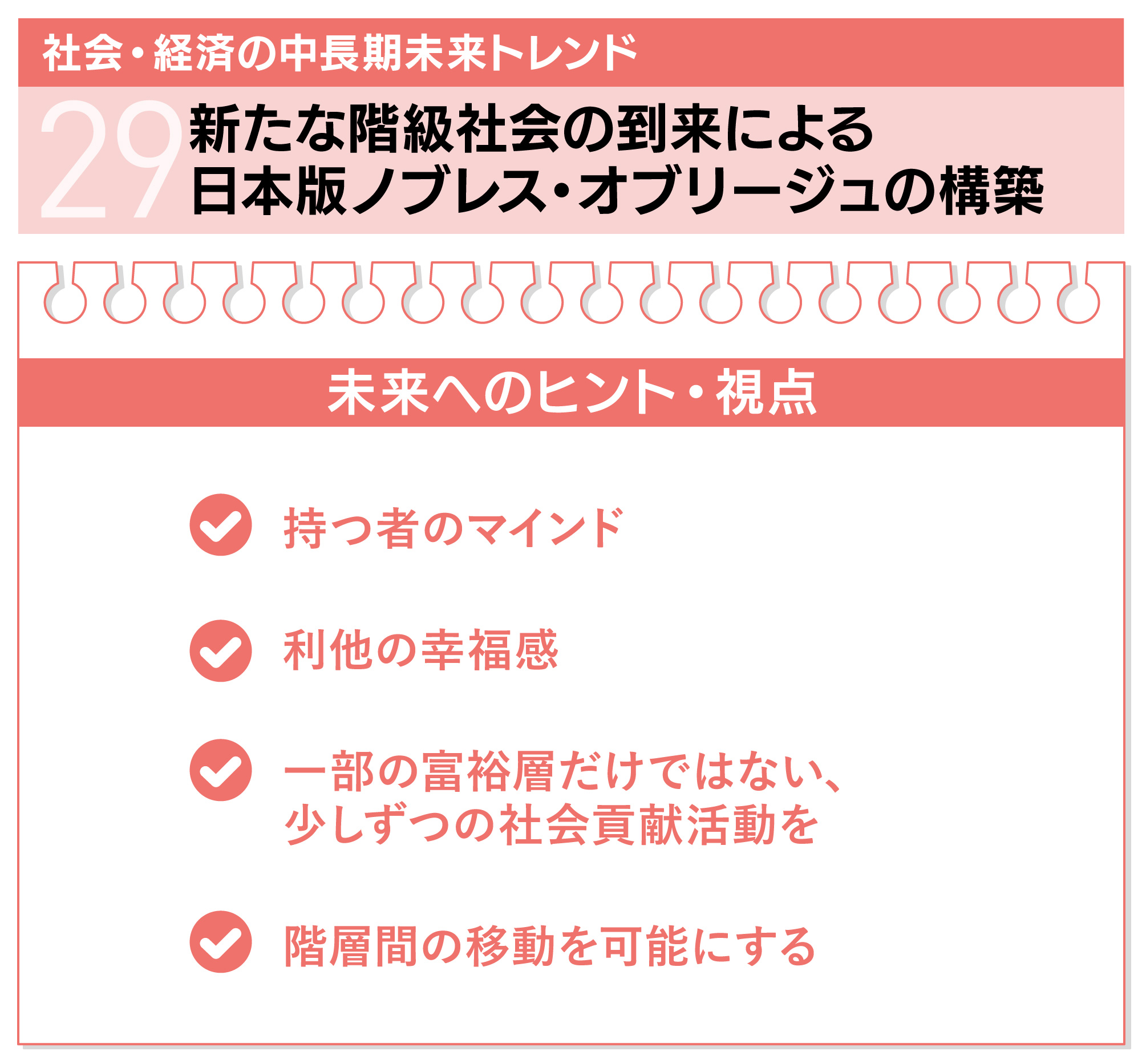
Kagata: I'd like to introduce Dentsu Inc. Future Mandala, specifically number 29: "What is the New Class Society?" It's the Japanese version of noblesse oblige. The idea is that those in a privileged position should naturally contribute to society.
Excerpt from Dentsu Inc. Future Mandala 2025
Yoshida: That's exactly the spirit of giving we discussed under the "Learning" theme.
Kagata: In Japan, there used to be a culture of hiding wealth, right? Like, "My family isn't anything special." That's changing now. A cycle is emerging where the next generation of angel investors fund ventures to improve society, and their children, having achieved further success, then invest in the next generation.
Watching smart people, you really see how money circulates throughout the world. If you have an excellent idea and the ability to execute it, investors will inevitably appear. Furthermore, as mechanisms for large corporations to collaborate with great ideas become more widespread, I think we'll see more exciting challenges that drive society forward.
Yamamoto: If we reduce this discussion of noblesse oblige to just individual ethics or awareness, it tends to become a moral debate like, "We should do something good, right?" But as Mr. Kagata mentioned, when this mindset is integrated into investment structures and corporate ecosystems, it becomes achievable not just as awareness, but as a business method.
That could naturally change people's behavior. Money is important, of course, but I think more people are starting to feel that valuing "money above all else" is excessive.
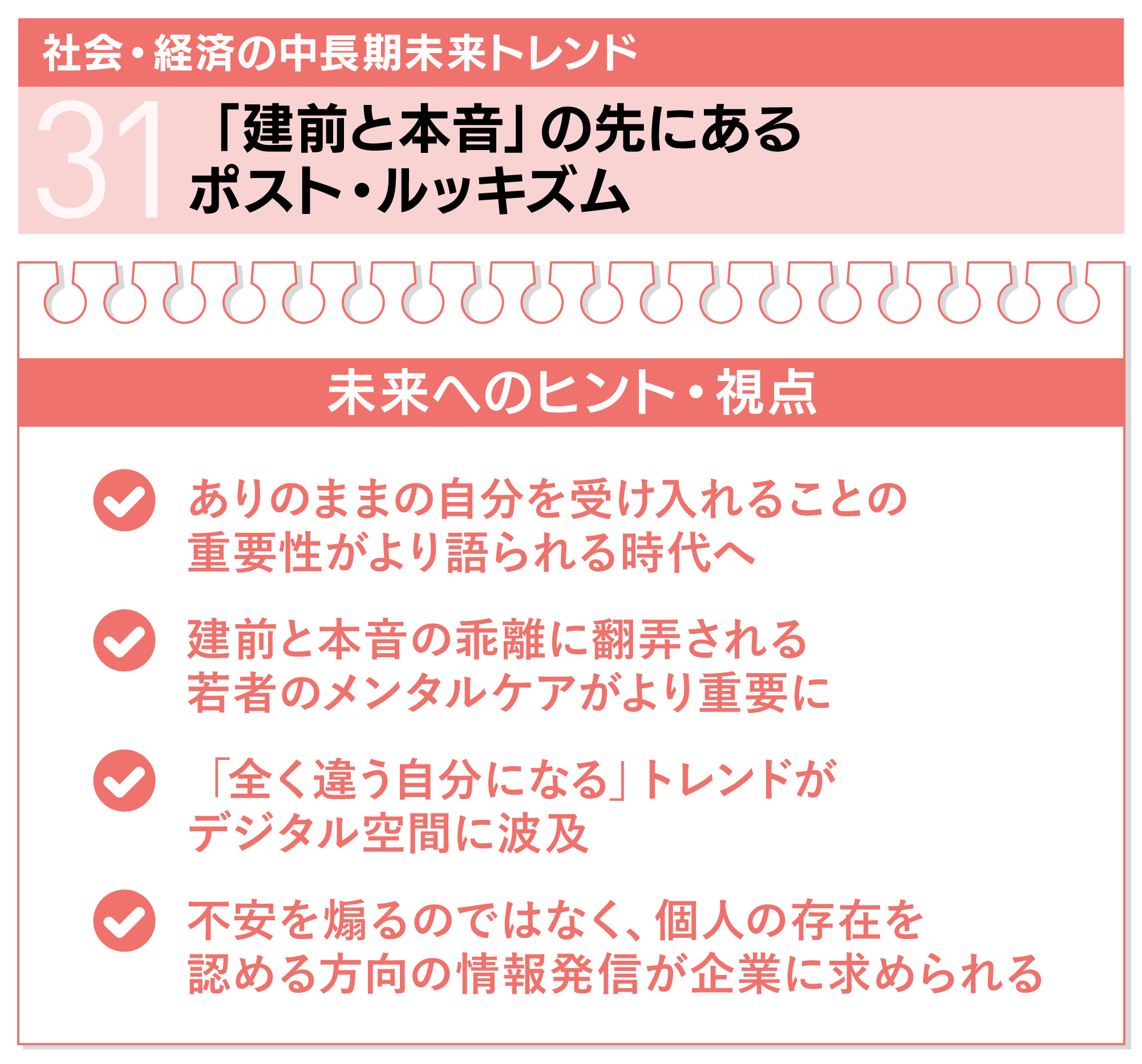
Kagata: Another point: everyone here understands that richness isn't just about material aspects; the spiritual side is also important. Dentsu Inc.'s Future Mandala, item 31, discusses "Post-Looksism." It means that not just appearance, but one's way of life and efforts will increasingly be recognized as beauty.
Excerpt from Dentsu Inc. Future Mandala 2025
Yamamoto: This shift in beauty standards seems likely to change men's values too. It might free them from the fixed notion of needing to be the kind of man young women find attractive.
Yoshida: Hearing this, I realize that ultimately, a sense of spiritual richness is deeply tied to the feeling that "someone truly recognizes me."Thinking about it that way, the evolution of digital and information technology becomes incredibly important. Information we wouldn't normally have access to is now reaching us, and the means to convey it have become more sophisticated. For example, hearing about an idol's lifestyle or their efforts might make some people think "Hmm," while others feel "That's cool." However, I also sensed that as we enter an era where it's okay not to be acknowledged by the masses, it's becoming easier for each individual to live and to recognize their own richness.
Kagata: While GDW (Gross Domestic Well-being) is gaining attention as a new metric for measuring national well-being, I also feel the standards of affluence themselves are shifting. It's about having something you genuinely find beautiful or wonderful, free from peer pressure. And having people who understand and accept that version of yourself – that's what leads to true affluence.
Yoshida: Another point, which I think connects to spiritual richness, is that the nature of human relationships seems to be shifting slightly. Recently, likely influenced by dating reality shows, I feel the ideal way to date has become overly visualized. This seems to be accepted as the correct way, narrowing the acceptable range within relationships.
Kagata: I also feel like the future might offer even more personalized dating processes. It might go beyond just love at first sight, developing processes where you gradually come to appreciate someone's qualities.
Yoshida: That seems plausible. I think feelings, timing, and serendipity are crucial in romance and relationships. An era where AI orchestrates those three elements seems likely.
Kagata: Apparently, services that create serendipitous events already exist in China. They're said to facilitate positive happenings not just in romance, but in various situations like work and childcare. Some might question whether people would actually spend money on that.
Yoshida: That's interesting. Perhaps true affluence isn't just something we sense—it becomes more understandable when visualized in tangible, relatable ways. In a convenient society where everything becomes routine, it's harder to consciously appreciate genuine richness. That's precisely why the idea of creating systems that let people truly feel affluence is so compelling.
Let's use the Dentsu Inc. Future Mandala as an opportunity to create a brighter future together!
Yamamoto: We've concluded discussions on the four themes, and many hypotheses emerged. To wrap up, I'd like to ask how you envision utilizing the Dentsu Inc. Future Mandala moving forward.
Takahashi: In the digital industry, there's a tendency to prioritize rationality and efficiency when promoting the adoption of tools and products. But when you consider whether introducing truly new digital tools can actually enrich people or make them feel happier... I think it's a bit different.Just like the story of unexpected events in richness, there could be algorithms that, while seemingly inefficient, reliably make people happy. I hope we can collaborate with companies that share this perspective, discussing together and shaping the future side by side.
Kagata: The Dentsu Inc. Future Mandala includes about four perspectives per theme that offer hints for the future. It's not about finding one final answer; there are various angles, and even if they seem contradictory, that's perfectly fine. What matters is having the discussion.
Personally, observing AI's evolution and the global political landscape often left me feeling gloomy, wondering, "Can we really leave a bright future for our children?" But today's discussion made me realize that persistent dialogue inevitably reveals brighter aspects. I'd be thrilled if we could co-create those moments of inspiration – where we leverage each company's unique technologies and assets to think, "Couldn't we create a future like this?"
Yoshida: As Mr. Kagata mentioned, the Dentsu Inc. Future Mandala gathers hypotheses from diverse perspectives and incorporates mechanisms to broaden the discussion. Conversations about the future tend to lean negative, but that's precisely why we want to envision and create an exciting future.What's needed when thinking about the future is creativity that generates new value itself. This is absolutely not something Dentsu Inc. can create alone; building it together with our business partners is essential. That co-creation is the key to shaping the future. Let's create an exciting future together, everyone. That, I believe, is the essential value of the Dentsu Inc. Future Mandala.
Yamamoto: Thank you. There is no single correct answer for any of the topics we discussed today—be it "the body," "learning," "connections," or "abundance." However, engaging in these open-ended discussions together reveals what companies truly value and what they want to pursue next. That's precisely why it's so interesting to delve deeper into words that might otherwise be taken for granted. I hope to continue discussing the future with those who can appreciate that kind of fascination.
Solution Creation Center / Future Business Creation Research Founder
Chief Director, Marketing Division 4
Engaged in market analysis, strategic planning, and consulting primarily focused on the mobile business and smartphone app sector. As Dentsu Inc.'s Mobile Project Leader, attended CES/MWC annually since 2011 to grasp tech trends. Established the Dentsu Group cross-organizational "Future Business Creation Lab" in 2021. Specializes in business development through backcasting from visualizing future lifestyles. Fellow of the Consumer Affairs Agency's New Future Vision Forum; Master of Business Administration (MBA).
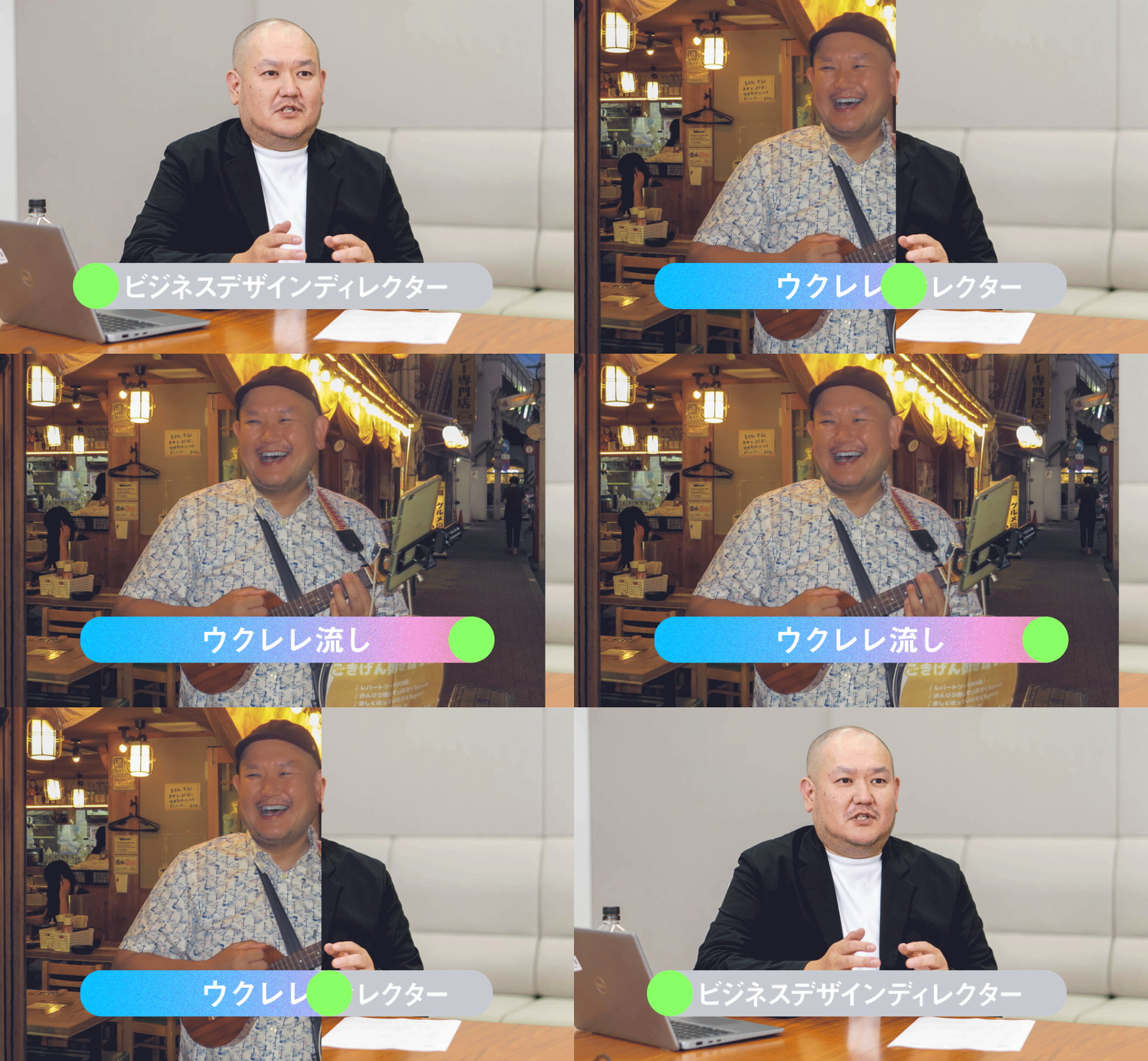
Supports corporate business design at Dentsu Marketing Division ~ Dentsu Digital Inc. ~ Dentsu Consulting Inc., including an insurance company's 2050 vision, an automaker's smart city concept, and a food company's new ventures. Currently involved in business planning and service design in Japan, India, ASEAN, China, and Taiwan. Specializes in consulting with an urban engineering background and facilitation that breaks down silos. Captain of the Dentsu Sumo Club. Right-handed. Signature move: Ushiro Nage (back throw).
After joining Dentsu Inc. e-marketing One (now Dentsu Digital Inc.), he began his career in creative direction. He has consistently worked on projects driving business from the customer perspective, serving as a UI/UX consultant and service designer. Since 2022, he has been involved in promoting the Future Mandala initiative and serves as its co-editor-in-chief.
After working in the marketing department of a major beverage manufacturer, joined Dentsu Consulting Inc. in July 2010. Returned to the company and assumed current position in January 2023. Has been involved in numerous projects, primarily in the consumer goods, media, and entertainment sectors, focusing on corporate vision formulation and mid-term management planning. Recently also engaged in disseminating insights on thinking methodologies, including a short-term series in Nikkei Cross Trend.
Deepening discussions about the future through 'Dentsu Inc. Future Mandala 2025.' What kind of future will be woven by the diversifying concepts of 'connection' and 'abundance'?

 Dentsu Group's 72 Visions of the Future: "Future Mandala" [3/3]