
Note: This website was automatically translated, so some terms or nuances may not be completely accurate.
 Active Learning: How About This? Research Institute ~ 10th Anniversary Relay Column [7/9]
A Paradigm Shift in Education in the AI Era
The Power of “Active Learning” in Tackling Questions with No Single Correct Answer
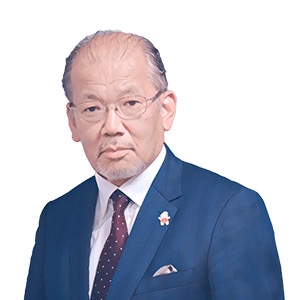
Masashi Okuma
東京都小金井市教育委員会
Combining education and creativity to make Japan’s unique educational system more engaging.
The "Active Learning: What About This? Research Institute" was established within Dentsu Inc. by a group of copywriters, art directors, creative directors, marketers, and others. To commemorate its 10th anniversary, we will present a series of relay columns in which each member shares their discoveries and the changes they have observed through their involvement in education.
This installment is written by Masashi Okuma, a co-researcher at the institute and Superintendent of the Koganei City Board of Education in Tokyo.

<Table of Contents>
▼The Emergence of AI as a New Sail
▼Redefining Schools — From “Knowledge Supply Stations” to “Workshops for Sharpening Willpower”
▼The Core of Learning—The “Physicality” and “Sense of Responsibility” That AI Cannot Possess
▼Becoming a Companion to Inquiry —Bringing a Creative Perspective to the Classroom
▼“Unconventional Homework” Sparks Innovation—The Power to Uncover “Mysteries” AI Cannot Solve
▼Emergent Innovation Born of Friction—A Space Where Diverse Cognitive Traits Resonate
▼To the Children Who Will Navigate the Wilderness of the Future with Their Own Compass
On the Emergence of AI as a New Sail
The field of education is now approaching a historic turning point. This is because, driven by the dramatic evolution of generative AI, schools are shifting from places focused on “how much knowledge to accumulate” to practical settings centered on “how to apply acquired knowledge and what kind of values to hold.”
Looking ahead to around 2040, when the children learning in schools today will have become adults and taken center stage in society, we will likely enter an era where AI takes over much of the accumulation of knowledge and routine logical processing. Even in such an era, we must bring about a paradigm shift in modern education so that all children can acquire the “power to live authentically.”
In fact, the education I received myself, as well as most of the early education I have practiced, focused—and continues to focus—on accumulating knowledge and efficiently deriving “correct answers.”I do not believe that “education as it has been” was wrong. This is because the knowledge I have acquired throughout my life serves as the very foundation that allows me to understand this world and navigate life as I do today. When you think about it, from the dawn of humanity to the present day, the fundamental structure of passing on the experiences of those who came before to the younger generation has remained unchanged.
However, relying solely on this approach is no longer sustainable in the modern world for the following two reasons. The first is the rapid advancement of ICT in recent years. It is no exaggeration to say that the information surrounding us has surged like a massive wave, increasing 500 or even 1,000 times compared to a decade ago.The second reason is the current reality that we face a mountain of challenges—such as global warming and an aging population with a low birth rate—that cannot be solved by past experience and knowledge alone. These factors are precisely why our society is described as “difficult to predict and uncertain about the future.” In such an era, modern education is entrusted with the task of nurturing the ability for everyone to live authentically, without leaving a single person behind.
Amid this situation, AI—which can be described as an even more massive wave—has emerged. Is this a blessing, or a threat? I choose to view it as a “new sail” for navigating uncharted waters.
Amid the recent explosion of information, it has become impossible for any single person to accurately gather information on their own. However, with the advent of AI, while we must still verify its accuracy, we can now collect all manner of information. Based on this, it has become possible to “choose our path forward.” Of course, there are still many uncertainties at present, but I believe that AI has the potential to become a “new sail” for those navigating these uncharted waters.
Redefining School — From a “Knowledge Supply Station” to a “Workshop for Sharpening the Will”
AI instantly generates “answers” the moment a prompt is entered.In terms of immediacy and efficiency, humans can no longer compete with AI. I believe this situation will fundamentally transform the way classes have been conducted up to now. This is because, even if teachers present children with unfamiliar problems and try to get them to think about them—as in traditional classes—the children will likely use the computers right in front of them to get instant answers from AI. Would it really solve the problem if the teacher simply said, “Close the computer and think for yourself”?
When they return home, children will naturally turn to AI for answers. Therefore, it is difficult to prevent them from asking questions of computers. In other words, children of the future will lose their curiosity about the act of “acquiring knowledge” itself, and we have entered an era where AI provides all the standard answers found in textbooks.
Consequently, teachers must have AI supplement the traditional task of “conveying accurate information,” while shifting their own role from “deliverers of correct answers” to “facilitators of inquiry.” Therefore, schools must undergo a fundamental transformation from being mere “knowledge supply stations” to becoming “workshops for refining one’s will”—places where each child cultivates the ability to engage in repeated self-reflection and deep exploration, while also developing their character through dialogue with others.
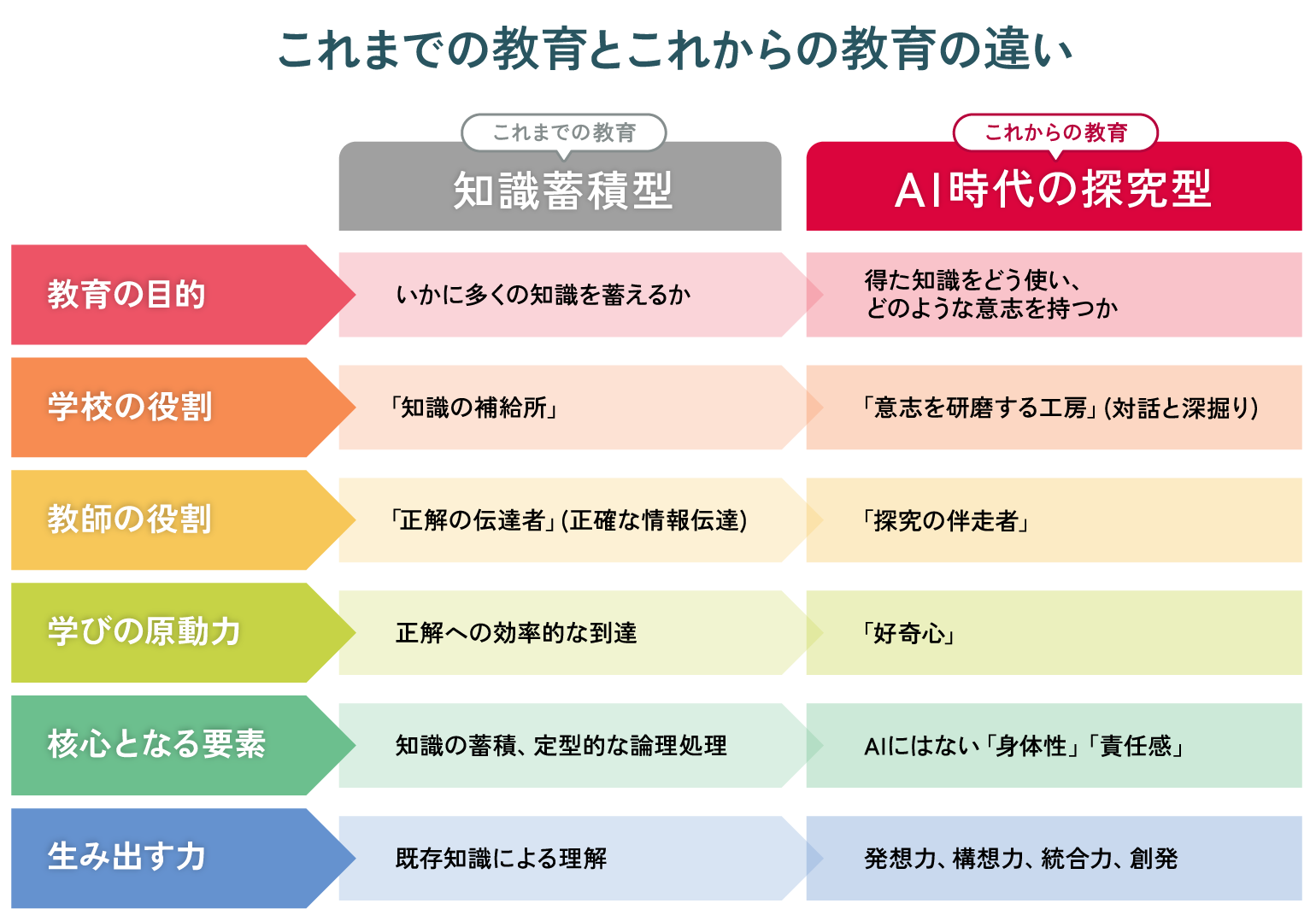
The Core of Learning—The “Physicality” and “Sense of Responsibility” That AI Cannot Possess
That said, can we entrust all “teaching” to AI? I assert that we cannot. The decisive difference between AI and humans lies in “physicality” and the presence or absence of the “sense of reality” that arises from it.
For learning to take root, it is essential that the desire to learn wells up from within the body. Even if knowledge pours down like water, without the will to “acquire” it, nothing can be grasped. To strengthen that will, we must go beyond the confines of the classroom and survey the world using our five senses.
Through physical experiences—such as the heat of the sun stinging your skin, the tremor in someone’s voice, or the oppressive atmosphere at a scene—it is vital to internalize the world’s challenges not as mere “information,” but as your own pain. No matter how advanced AI becomes, it will never be able to experience this “discomfort” or “unease.” This is precisely what only humans can perceive, and it serves as the driving force that compels us to take action.
Furthermore, AI has a major problem: it cannot take “responsibility” for the social and ethical consequences of the results it produces.To simply accept an AI’s answer at face value is tantamount to abandoning one’s own will. We must continually question the proposed solution—“Is that really true?” and “What lies ahead?”—and go out to verify it ourselves. It is precisely because we arrive at a conclusion through this grueling process that we, as humans, can accept it as “our own judgment” and be prepared to take responsibility for it.
I believe that when we seek to utilize AI, we must keep these two points at the very center of our thinking. Otherwise, there is even a risk that AI will swallow us whole. So, how can we go about acquiring this kind of ability?
To the Companions of Inquiry—Bringing a Creative Perspective to the Classroom
As a co-researcher at the “Active Learning: What About This? Research Institute” established within Dentsu Inc., I have been exploring new approaches to learning. The institute was founded in 2015 to cultivate the ability to forge one’s own future as we entered an era without clear answers.
Prior to this, I had been involved in creating educational materials for the “Advertising Elementary School” as part of an industry-academia collaboration between Dentsu Inc. and Tokyo Gakugei University. I still vividly remember the moment I received a phone call from Mr. Kuranari, a key member of that project.
“Professor Okuma, isn’t the ‘active learning’ mentioned in the current curriculum guidelines interesting? Doesn’t it connect with what we’ve been doing?” “I’d like to explore that further.”
I still clearly remember the shock I felt at those words—it was as if countless fireworks had gone off in my head. At the time, the new curriculum guidelines emphasized the importance of “active learning,” but in the classroom, we were still at the stage of simply saying, “Let’s think carefully,” “Let’s discuss and decide for ourselves,” and “Hands-on activities are the most important.” As a result, both teachers and children were confused about what to do.
At the same time, everyone was anxious that the current methods wouldn’t lead to “true life skills.” It was during this period that I received that call from Mr. Kurashina. “So, what schools hadn’t even begun to tackle was already being practiced in the creative world,” I thought, and it felt as if a fog had suddenly lifted.
It suddenly clicked: the skills for “framing questions” and “thinking” that are practiced daily in advertising creative development, along with the concrete know-how for refining ideas, were indispensable for active learning. I became convinced that by applying the methods used by creative professionals to education, proposing “what about this approach?” to educational institutions nationwide, we could create a uniquely Japanese educational system.
"Weird Homework" Sparks the Fire—The Power to Uncover "Mysteries" AI Can’t Solve
Among the various approaches proposed by the Active Learning “How About This?” Research Institute, a representative project that fosters the “sustained curiosity” humans need in the AI era is “Weird Homework.” This is an activity where students are given homework with no correct answer—such as “If a week were extended to eight days, what would you do with that extra day?”—and are asked to come up with diverse ideas in response.
Why do we deliberately pose “strange” problems? It is because “curiosity” is the greatest driving force behind human growth. Strange challenges instantly amplify children’s curiosity and spark a desire to “think for themselves.”
And most importantly, this homework has “no set answer.” While AI can instantly generate a “plausible answer,” “Weird Homework” has no end. AI can instantly produce an “80-point answer,” but humans are not satisfied with that; they can keep asking, “Is there a better answer?” and continue to dig deeper. They then present the results of that deep exploration to everyone and receive recognition.We believe that receiving “likes” fosters motivation—making students feel, “I’m glad I dug deeper,” “I want to dig deeper again,” and “Thinking about various things is interesting.”
In fact, I believe that through these “detours” and “processes of trial and error,” we can independently cultivate comprehensive abilities—such as creativity, conceptualization, and integration—that cannot be replaced by AI. I am reminded once again that the leap in thinking embodied by our institute’s guiding principle—“No answer? No, everything is an answer!”—represents the form of learning necessary for the coming era.
Emergent Innovation Born of Friction—A Space Where Diverse Cognitive Traits Resonate
Another key skill for navigating the future in the AI era is “collaboration with diverse others.” Every human possesses unique, innate “cognitive characteristics.” For example, some are “visually dominant,” remembering people by their faces or demeanor upon first meeting; others are “linguistically dominant,” understanding through text on business cards; and still others are “auditory dominant,” grasping information through the sound or tone of a name. Even when observing the same world, each person’s way of perceiving and expressing information is distinct.
While AI excels at providing individually optimized learning, I believe the experience needed in the world of tomorrow lies in the process where people with different characteristics and values gather in the same space, clash, and collaborate.
During group work, disagreements can arise and lead to conflict. However, this “gritty” process does not exist for AI, which is designed to maximize efficiency. The experience of “emergence”—where individuals with different traits and criteria align their perspectives to create something new that no one could have imagined alone—is, I believe, the key to solving the complex challenges we face in society, and it represents the human dignity that AI cannot replicate.
To the children who will walk the wilderness of the future guided by their own compass
Looking back, I am convinced that the “creative education without a single correct answer” we have pursued alongside our research institute members will truly shine in the coming era of widespread AI adoption.
Precisely because the black box of AI is permeating society, everyone must have the right to sense something amiss with their own five senses, put it into words, and continue to think critically. Not every child needs to become a professional explorer, but I strongly believe we must ensure that every child possesses “the ability to navigate using their own compass.”
To empower every single person to navigate the rough seas of the future under their own steam, without handing over the helm of their lives entirely to AI—that is the very essence of the “education that leaves no one behind” we strive for. In contrast to AI, which maximizes efficiency, we seek a spirit of inquiry that embraces “persistence”—the willingness to take detours, make repeated mistakes, and imprint that process deeply into one’s being. This is the strength that will serve children well when they encounter obstacles in the future.We are now facing the rough seas of AI and about to embark on a new voyage. In the midst of this transformation, we intend to continue asking, “What about this?” as we grapple with these challenges alongside the children, persevering in our role as companions on their journey of discovery.
Active Learning "What About This?" Research Institute Website
https://www.konnano-dodaro.jp/
Related Series:Active Learning "How About This?" Report
Was this article helpful?
Share this article


Newsletter registration is here
We select and publish important news every day
For inquiries about this article
Back Numbers
Author
Masashi Okuma
東京都小金井市教育委員会
教育長