Note: This website was automatically translated, so some terms or nuances may not be completely accurate.
 Active Learning: How About This? Research Institute ~ 10th Anniversary Relay Column [8/9]
Participant Report: “The ‘How About This?’ Style New Employee Training Method”
Combining education and creativity to make Japan’s unique educational system more engaging.
The “Active Learning: What About This? Research Institute” was established within Dentsu Inc. by a group of copywriters, art directors, creative directors, marketers, and others. To commemorate its 10th anniversary, we’ll be sharing the discoveries and changes each member has experienced through their involvement in education in a relay column format.
Hello. I’m Tomochika Hida, the youngest member of the institute. While I usually work as a planner, coming up with all sorts of advertising ideas, at the institute I also create and implement educational content—such as “Classes on Presentations Without Substance”—that draws on my expertise in the advertising industry.
I joined the Institute when I was a new hire. That said, it wasn’t because I was recruited for some special talent—it was simply because a senior colleague who mentored me in education ( Mr. Oyama from PLAY FIRST, my spiritual mentor) was a member of the Institute. I just tagged along—it was a lucky break.
The Institute is an organization made up of members who have strong opinions on education—people who researched it during their student days, created educational content, or simply have a lot to say on the subject. Joining such a group out of the blue as a new hire meant I was completely useless as a contributor (for the record, I was a stiff-as-a-board science guy who’d studied shape-memory alloys in grad school and had never even given education a second thought).
Even though I was someone with absolutely no background in education, they managed to nurture me to the point where I could contribute to the team. Looking back now, I realize that the training I received might have been extremely active learning-oriented.
Today, I’d like to reflect on that experience from 10 years ago and summarize those methods. I’m not sure if this will be helpful to you all, though…
“Hey, want to take this on?” It All Started with an Out-of-the-Blue Request
It was right after I joined the research institute, during a planning meeting for a class program scheduled to be held at a certain university. I’d been told, “Just give it a try for now. You can figure it out as you go,” and since it was practically my first time in a meeting like this, I was taking minutes while thinking things like, “Oh, so this is what a planning meeting is like,” and “We’re going to present one by one? I’m so nervous!” But then, a senior colleague who was explaining his own proposal suddenly pointed at me and said:
“So, how about you give this a try?”
Huh…? You mean I’m supposed to do this?
The lesson plan that senior colleague came up with? No way!
“Ah! I’ll do it! Sure!”
Despite my confusion, I reacted on autopilot. I was the kind of new hire whose only real asset was my enthusiasm—the type who, when asked, “Want to do it?” would always reply, “I’ll do it!” However, since it was a plan the senior employee had devised, I figured they wouldn’t let me just snatch it away like that. Well, it must be a joke. Yeah, yeah, just a corporate inside joke. Just as I was thinking that,
“Okay. Well then, I’ll leave it to you. Good luck!”
And just like that, the project was handed over to me without a second thought.
What am I going to do?
I’m pretty sure there was less than a month left until the class at that point. Of course, I had to ensure the quality of the class, so from then on, my senior mentor gave me one-on-one lessons on the project’s intent and key points, and watched me do mock lessons over and over in preparation. But the more I worked on it, “If I mess this up, I’ll be ruining my senior’s project, right…?”“Since this is a paid job, money is involved, right…? Can I really make this lesson worth the money…?” I became incredibly anxious. I’m just a nervous person. Every time I felt that way, I’d receive words of encouragement like, “You’ve prepared this much, so you’ll be fine,” or “Just go all out—you’re a newbie, after all.” Clinging to those words, I somehow managed to get through the lesson. Here’s a photo from back then.
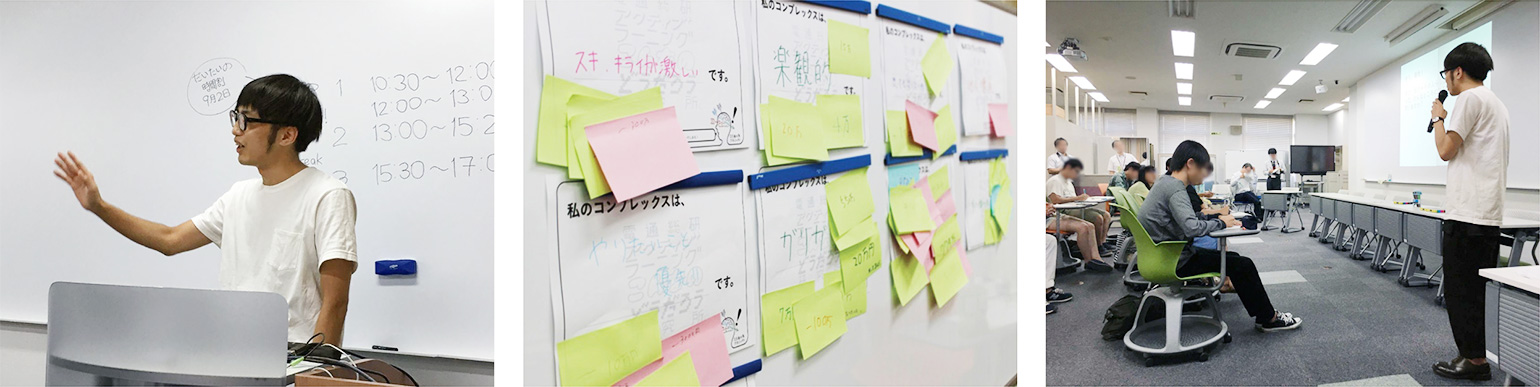
I was so nervous that I don’t remember much, but I vividly recall how, after the class, several students came up to me with a sparkle in their eyes and gave me enthusiastic feedback, saying, “This was my first class like this—it was so interesting.” Even though I was just following the outline my senior had prepared, I had a rare epiphany: “Oh, so a class can actually resonate with people. That’s amazing—this might actually be fun.” It’s something I never would have realized if I hadn’t been given the chance to stand on that stage.
“Why don’t you start creating your own lessons?” My next challenge was handed to me
Some time after my first class was a huge success (※my personal opinion, of course), people started saying, “Isn’t it about time you created a class, Tobita?” At the time, the research institute was in the educational content development phase, where each staff member was leveraging their diverse expertise to create and test new programs one after another, essentially asking, “How about this?” Amidst all that, my turn at bat finally came.
A class…
I was stumped. You see, the institute’s approach was to “leverage know-how from the advertising industry” to develop programs that could be applied in the education sector. As a newcomer, I didn’t even have the foundational “advertising industry know-how” to begin with—or rather, I was still in the midst of absorbing it. What should I do…? Maybe I’m just not ready yet… Just as I was starting to lose heart, my senior colleagues chimed in.
“Creating a class means
© means creating Tobita’s own content.”
“Wouldn’t it be amazing
wouldn’t that be amazing if you could do it right now?”
“There probably aren’t
so give it a shot."
……Somehow, this feels amazing!!
© I want my own content!
Feeling inspired and seeing the task at hand as a huge challenge, I grunted in agreement and finished creating a class called “Presentation Class Without Content,” which focuses specifically on the “how-to” of giving presentations.
By the way, even though I said “I finished it” in a rather cocky way, I actually received a lot of support. When I mentioned I wanted to teach a presentation class, someone gave me materials, saying, “I have a summary of presentation techniques I put together for work before—feel free to use it,” and others patiently sat through my mock classes over and over. But what really mattered was that I had a strong sense of ownership—the feeling that “this is my project.” Looking back now, I realize that’s what ignited my motivation from the very beginning.
“How did it go?” Reflect while the experience is still fresh
Through all of this, I was given the opportunity to work on various projects, and there was always one thing the director would say without fail after I finished each one.
“How did it go?”
He’d ask this almost immediately after finishing, staring intently into my eyes, so I couldn’t just brush it off with a quick one-liner.Still buzzing with relief at having finished successfully—and with a lingering sense of tension—I’d have to rack my brain to come up with an answer. “I managed to pull that off, but I messed up on this,” “Here’s what I want to try next,” “I thought it would be like this, but when I actually did it, it turned out completely different”—I’d just blurt out raw, candid thoughts like that… And the director’s response was, once again, just one word.
“Yeah, I’m glad you made some discoveries.”
I used to think feedback from bosses or seniors meant getting praised, scolded, or given advice, but “That’s good.”Sometimes it really is just one word. However, since I’m putting my thoughts into words—or rather, being made to put them into words—right after it’s over, with no time to sugarcoat anything, it ends up being useful later on. Sometimes, as I’m speaking, I realize, “Oh, that’s what I was thinking.” Another great thing is that because I’m discovering it on my own, I can honestly think, “I’ll put this to use next time!” I suspect that combo—starting with “How did it go?” and ending with “That’s great”—is a deliberate method designed to encourage self-discovery.
Is the “5-Centimeter Distance Theory” the Root of It All?
One of the educational methods I heard about from Mr. Masashi Okuma (nicknamed Kuma G), Superintendent of the Koganei City Board of Education in Tokyo—who also participates in our research institute—is the “5-Centimeter Let-Go Theory.”
When a child starts doing something, you don’t pull their hand to guide them. You let go 5 centimeters—just enough to keep them from falling, yet close enough to support them immediately if needed—and watch over them. By doing this, the child’s sense of autonomy grows…
Looking back, the training I received as a new employee might have been a practical application of this very theory. First, putting them on stage. Igniting their motivation and observing how they do. Supporting them from just the right distance. Helping them discover a sense of accomplishment and fulfillment. Giving them challenges that push them just a little beyond their comfort zone. Writing it all down, it’s exactly the practical application of this theory.
Or maybe it wasn’t so much “practice” as an “experiment”? It was a research institute, after all. Which means I was the test subject. I see—so that’s how it was.
……That sums up the “let’s see how this goes” style of new employee training I received. If you’re in charge of training new hires this year, why not give it a try? I can’t take responsibility for how they turn out, though—you’ll have to do it at your own risk…
Actually, I was taught a lot more—like the “Let’s Work Our Way Worth the Pay” edition and the “Your Rival Is Sitting at the Counter of a High-End Restaurant” edition—but I’ll save those for another time.
Active Learning “How About This?” Research Institute Website
https://www.konnano-dodaro.jp/
Related series: “Active Learning: How About This?” Reports
Was this article helpful?
Share this article


Newsletter registration is here
We select and publish important news every day
For inquiries about this article
Back Numbers
Author

Tomochika Tobita
株式会社電通
5CR Planning Bureau
CMプランナー