Note: This website was automatically translated, so some terms or nuances may not be completely accurate.
 Active Learning: How About This? Research Institute ~ 10th Anniversary Relay Column [9/9]
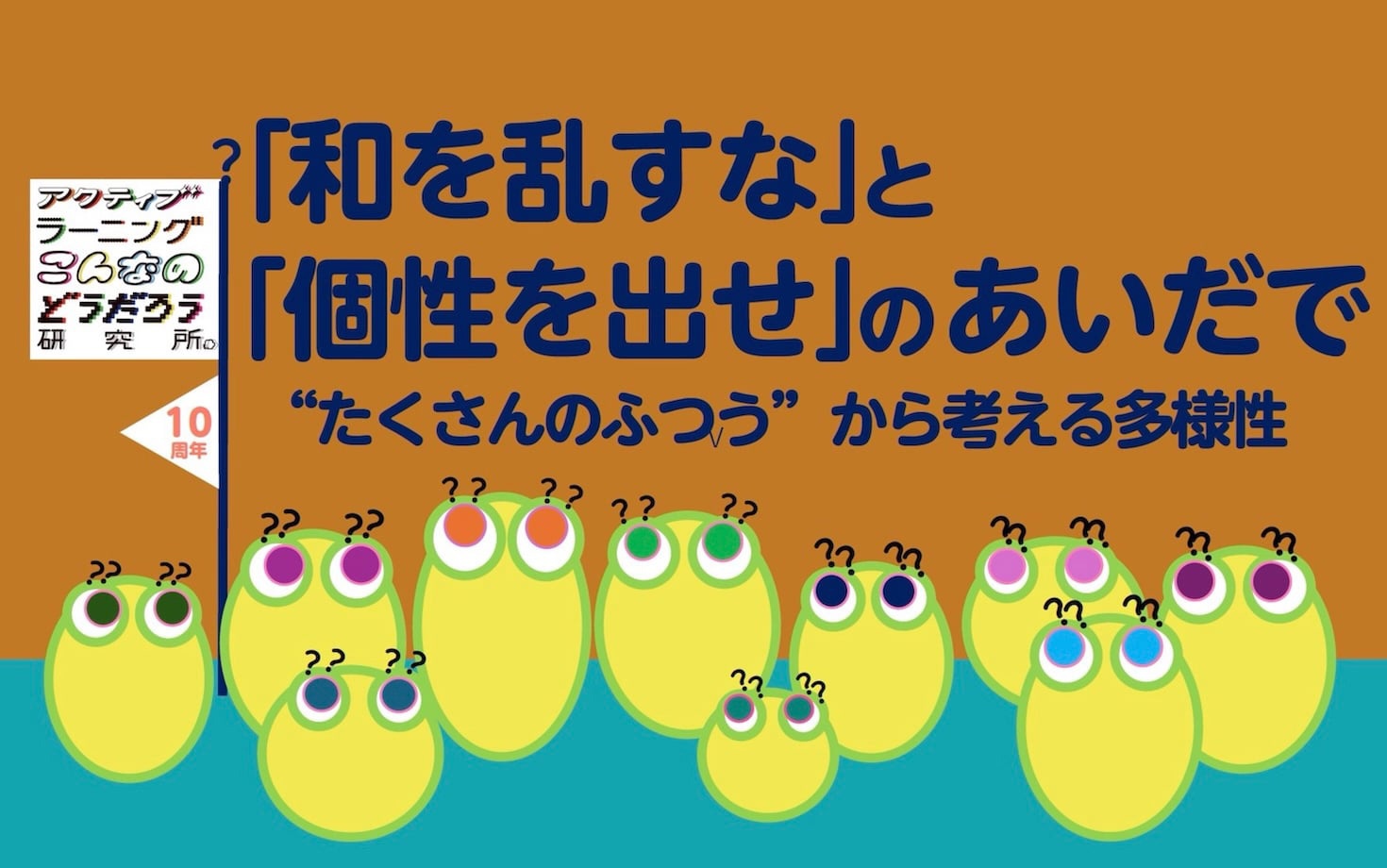
Between “Don’t Disrupt the Harmony” and “Express Your Individuality”
Combining education and creativity to make Japan’s unique educational system more engaging.
The “Active Learning: What About This? Research Institute” was established within Dentsu Inc. by a group of copywriters, art directors, creative directors, marketers, and others. To commemorate its 10th anniversary, we’ll be presenting a series of relay columns in which each member shares their discoveries and the changes they’ve observed through their involvement in education.
<Table of Contents>
▼ Thinking About Diversity Through“ManyNorms”
▼ The Day I Stopped Hating the Things I Disliked AboutMyself
▼At School, We’re Told “Don’t Disrupt Harmony”; In Society, We’re Told “Express Your Individuality”
▼There Are No Role Models. That’s Why We End Up Thinking, “I Can’t Do This”
▼Individuality Flourishes in a Society of “Many Norms”
Diversity Through the Lens of “Many Kinds of Normal”
Over the past decade, the term “diversity” has become much more familiar to us. However, what I’ve come to realize through my work on the ground is that diversity isn’t just about some special person. It’s something much closer to home—and much more personal. It exists within families, within schools, and within communities. And, of course, it exists within ourselves. Today, I’d like to share three incidents that occurred at different schools—events that sparked my reflection on these very ideas.
Before I knew it, the “Active Learning: How About This?” Research Institute has reached its 10th anniversary. Ten years ago, I wrote a column for Dentsu-ho comparing the schools I attended in six different countries from various perspectives.
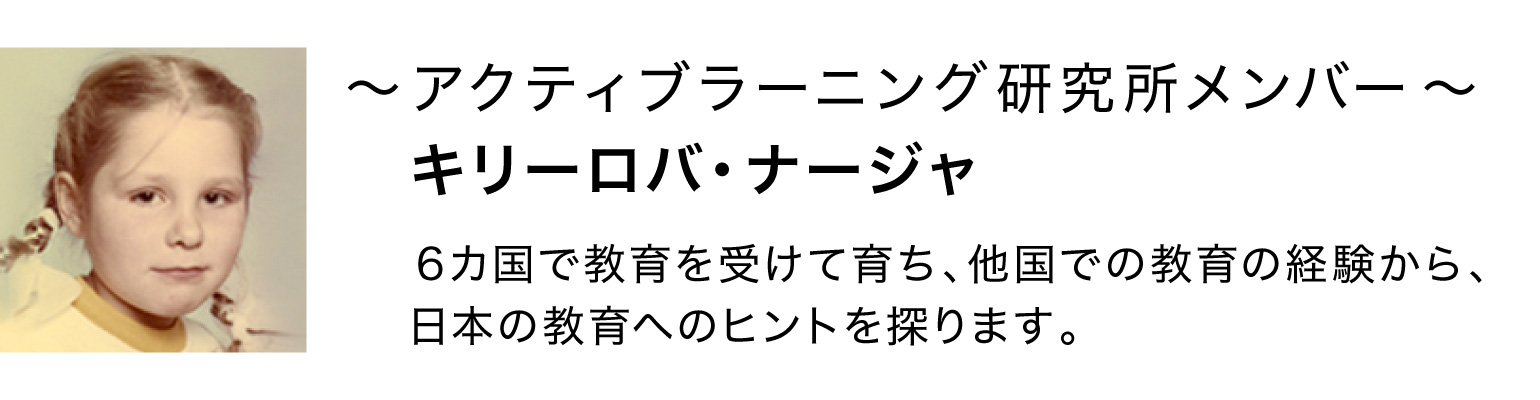
The series was decided on suddenly, and I was given free rein over the content. So, I wrote by reminiscing about various experiences I’d had at schools during my childhood. Different countries mean different schools. The rules are different, and so is the dynamic between teachers and students. The values they prioritize are different, too. When viewed from a bird’s-eye perspective, there is always a philosophy behind those differences. That’s why there is no single “right answer” when it comes to schools or education.Even if asked, “Which is the best?” the answer depends on who you’re asking. I’ve been saying this consistently in my lectures and interviews.
Over the past decade, as I’ve spoken with children, teachers, parents, and other adults in various settings—including schools, local governments, and academic conferences—I’ve encountered the same question time and again: “How should I accept the fact that I’m different from others?” How should I live as someone who isn’t “normal”? And what does it really mean that, while schools tell us not to “disrupt the harmony,” society tells us to “express our individuality” once we enter the workforce?
The Day I Stopped Hating the Things I Disliked About Myself
At a small elementary school, I had the opportunity to speak to the children about my experiences as a transfer student who had lived in six different countries and about “diversity.” The children listened to me with their eyes truly sparkling. Drawing on my experience of attending schools in various countries, I told them, “Even just looking at schools, there are so many different kinds. That’s why there isn’t just one right answer. All of them are right.” I also told them, “You all should cherish your own individuality and, someday, turn it into a strength.”
A few days later, I received this feedback from the children:
“My individuality is unique to me. That means I don’t have to compare myself to others.”
“Since all answers are correct, I realized it’s okay to be different from others.”
“There are things about myself that I don’t like, but I realized that those are also important parts of who I am.”
“I used to lack confidence in the ways I’m different from others and hid them, but from now on, I want to be proud of them and show them off.”
To be honest, I was quite surprised. The children might be thinking about their differences more than I realized.
Later, when I spoke with the teachers, they told me that the school is a very comfortable place for the children. However, when they move on to middle school or high school, what’s considered “normal” there might change. That’s why I felt they wanted the children to know—while they’re still young—that there isn’t just one definition of “normal.”
Those words from the teachers have stayed with me ever since.
We’re all a little different from our families and friends. If you go to the next town over, there’s a different “normal.” If you go to the next prefecture, there’s yet another “normal.” I think this has always existed within Japan, just as there are differences among schools around the world. For children not to deny their own individuality, they first need to know that there are “many kinds of normal.” At that school, I was reminded once again of this simple yet important truth.
At school, we’re told, “Don’t disrupt the harmony”; in society, we’re told, “Express your individuality.”
On another occasion, I had the chance to speak at a high school. The students there came from a wide variety of backgrounds. As I shared my own strategies for getting by, I encouraged the students to look for the unique qualities in their classmates. Some students discovered aspects of themselves they hadn’t noticed before, while others were surprised to realize, “Maybe there’s no such thing as ‘normal’ to begin with.”
During the Q&A session, one student asked the following question:
“At school, we’re told not to disrupt the harmony, but once we enter society, we’re told to ‘express our individuality.’ What are we supposed to do?”
I thought it was a truly poignant question that hit the nail on the head.
I felt that this single statement encapsulated the difficulties facing today’s children.
From the teachers’ remarks and the discussions that took place, I sensed that quite a few students are afraid to “express their individuality.” Japanese schools have a culture of acting with consideration for others. That in itself is important. However, some children now feel that if they deviate even slightly from what’s considered “normal,” they’ll be attacked on social media and lose their sense of belonging.
Intellectually, they know they need to discover their own strengths and talents. They also know that individuality will be valued once they enter the workforce. But in reality, getting by without causing any trouble has become the safest way to survive high school. In this environment, it’s hard for them to even find the right moment to “discover their individuality,” let alone “express it.”
I feel that this is where a major contradiction in today’s Japan lies.
Isn’t the key to avoid pitting “individuality” against “harmony”? In a society of diverse people, how can we harmonize our individuality with others? I believe this perspective is particularly important in Japan.
Individuality does not mean being self-centered.
On the contrary, I firmly believe that individuality—when transformed into a strength—contributes to harmony and, as a result, becomes a force that propels everyone forward.
There are no role models. That’s why students end up thinking, “I can’t do this.”
At another high school, I also heard comments like this. From my perspective, there are students who are exceptionally skilled at moderating discussions, and others with amazing talents. There are also many students with such deep knowledge that once they start talking about what they love, they can’t stop. Yet, they all seem to lack confidence in some way.
As I listened to their stories, I realized this is how “successful people” appeared in the students’ eyes: people who have dreams, work hard toward them, and move forward without failing. Such people have role models, but the students feel they don’t. That’s why they seem to have convinced themselves that they can’t do it.
But is that really true?
In reality, the more successful a person is, the more failures and hardships they’ve experienced. There isn’t just one starting point. Even people who seem to have it all together face doubts and detours behind the scenes.
Standing before the students in the gym—who tended to look down a bit—I said this:
“I’m actually quite shy and reserved.”
At that, I noticed a few students lift their heads slightly. Furthermore, when I explained that what they thought of as “flaws” could actually become strengths if viewed from a different perspective, I felt their expressions change a bit more.
“Maybe I can do it, too.”
Perhaps a small glimmer of hope had just shone through.
As the world continues to change and become more diverse, it’s getting harder to find a role model who perfectly matches who you are. In fact, these days, it might be “normal” not to have a role model at all.
You don’t need just one role model. You can simply take little bits and pieces that resonate with you from a variety of people. There’s no need to become like anyone else. I think it’s perfectly fine to be your own unique self.
Individuality flourishes in a society with “many kinds of normal”
Over the past decade, I’ve visited many schools and met countless children, teachers, and adults. What I’ve come to realize is that while the question of “how to approach things without clear answers” remains the same, the nature of that question may have shifted slightly.
I believe the question being asked now is: Amid so many forms of “normal,” how do we discover and nurture our own individuality, and how do we harmonize it with others?
I’ve been writing about schools so far, but this isn’t just about schools. I give the same talk at companies, and the concerns I hear there are surprisingly similar. Whether in organizations, communities, or businesses—anywhere people gather—there is always a “norm,” and within that context, both “individuality” and “harmony” are called into question.
What may become increasingly important in Japan going forward is how to reconcile “individuality” and “harmony.”
It is because of “harmony” that individuality can flourish with peace of mind.
And because of “individuality,” harmony becomes even richer.
If this cycle continues to grow little by little, perhaps in ten years we’ll be closer to a society where we can more freely turn our differences into strengths than we can today.
I believe the starting point for that change begins, surprisingly enough, with noticing the differences in the “ordinary” things around us.
Now that we’ve reached our 10th anniversary, I’m looking forward to the next decade.

Active Learning: “How About This?” Research Institute Website
https://www.konnano-dodaro.jp/
Related Series:Active Learning “How About This?” Reports
Was this article helpful?
Share this article


Newsletter registration is here
We select and publish important news every day
For inquiries about this article
Back Numbers
Author

Kirillova Nadezhda
Dentsu Inc.
第7マーケティング局
Creative Director
Born in Leningrad, Soviet Union (at the time). Raised in six countries. After joining Dentsu Inc., he worked as a creative professional across various fields, overseeing a wide range of domestic and international projects. He has received numerous awards. Member of the “Active Learning: What About This?” Research Institute.