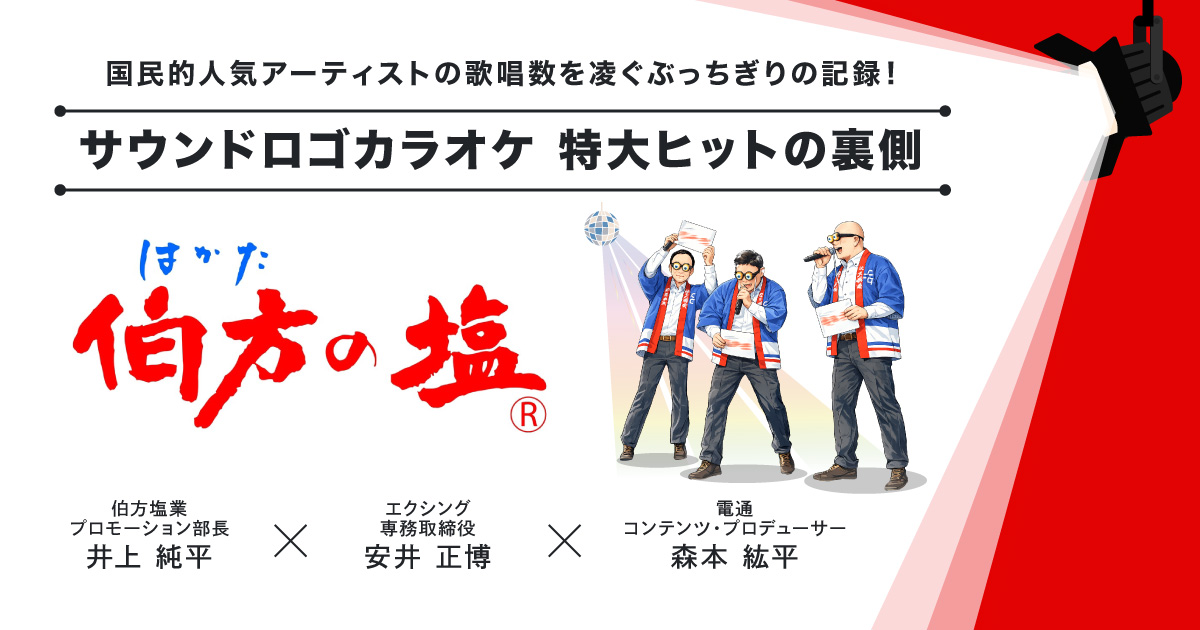
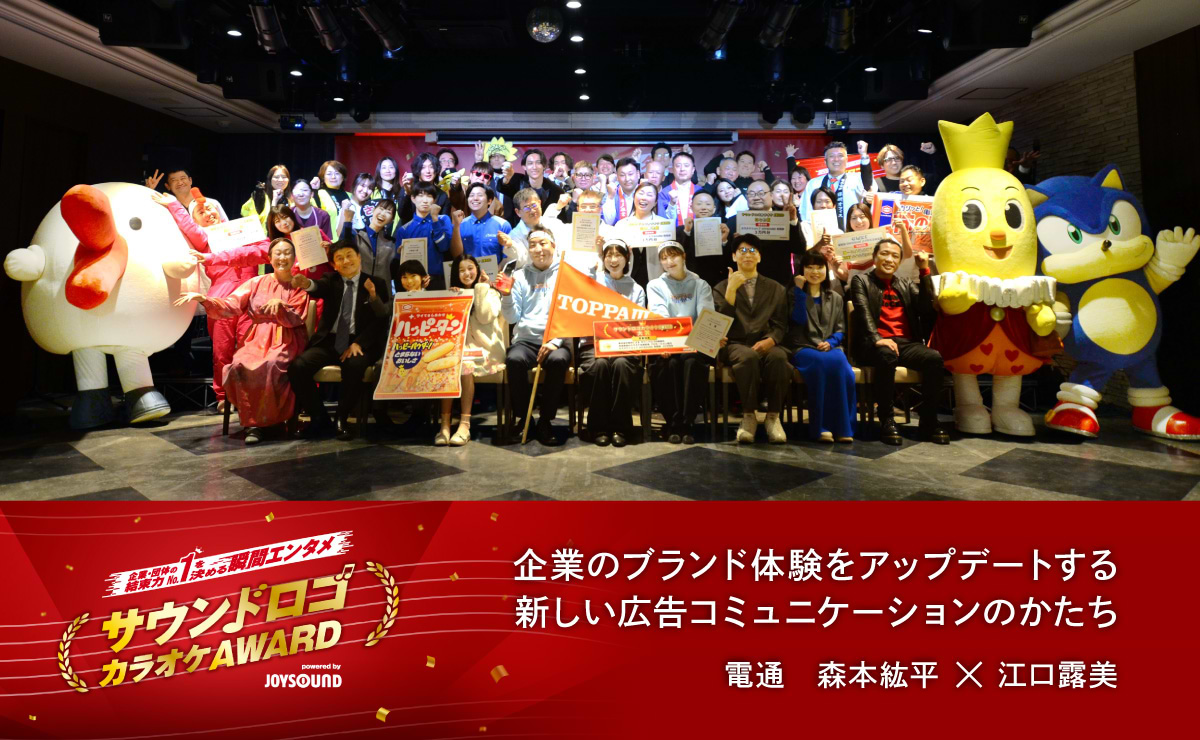
A sound logo just a few seconds long that everyone has heard at least once. Thanks to the “Sound Logo Karaoke AWARD ” held in February 2026, that phrase became something people actually “sing” at karaoke, sparking a huge buzz.
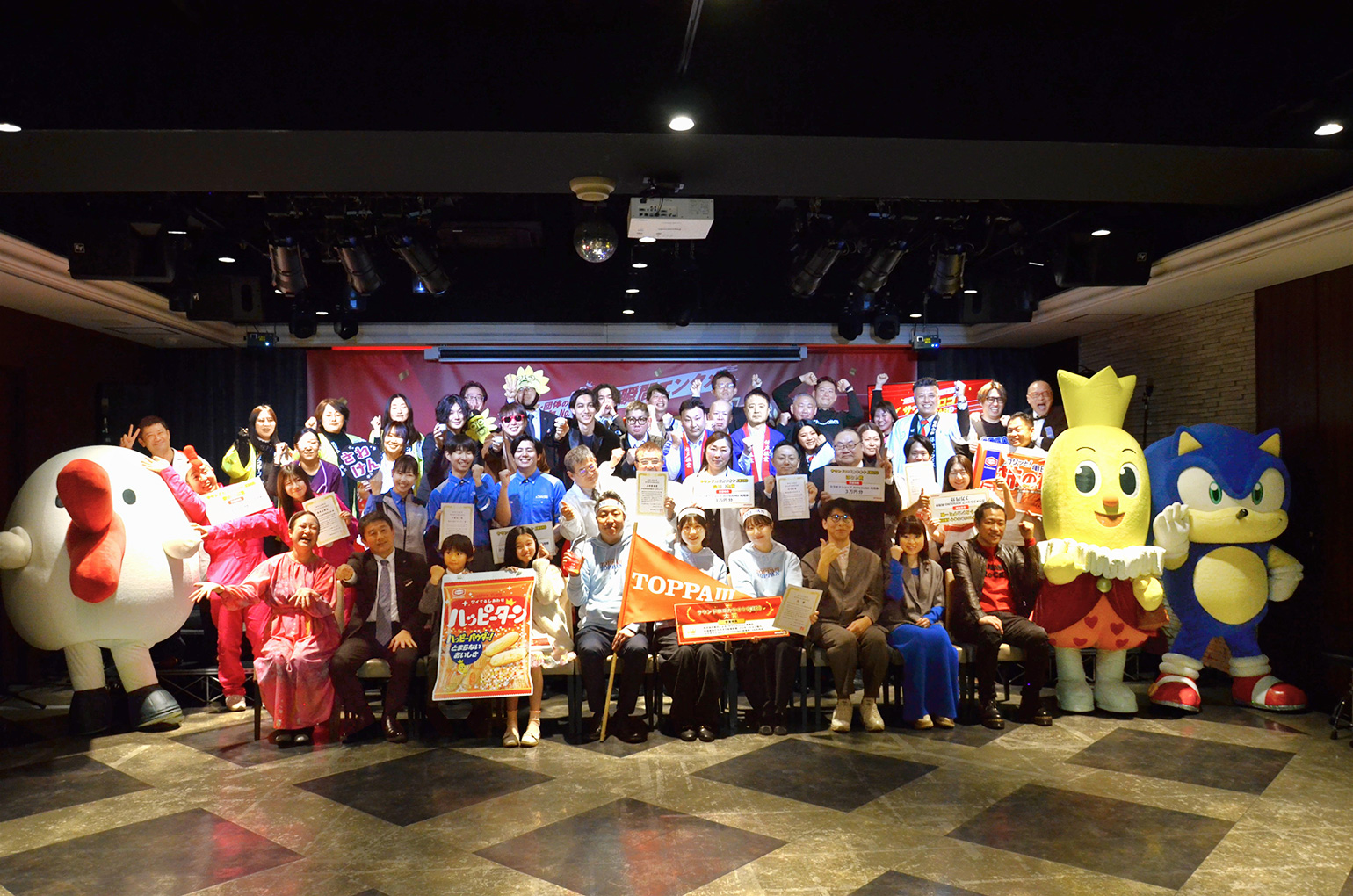
The “Sound Logo Karaoke AWARD” is a competition that streams sound logos from companies and organizations on JOYSOUND, determining Japan’s top sound logo karaoke entry based on the number of times it is sung in stores and performances during the final round.
Among them, Hakata Salt Industry’s “Hakata no Shio” garnered the most attention. Posts showing karaoke history screens flooded with “Hakata no Shio” went viral on social media, and the phenomenon was featured extensively on TV programs and other media.
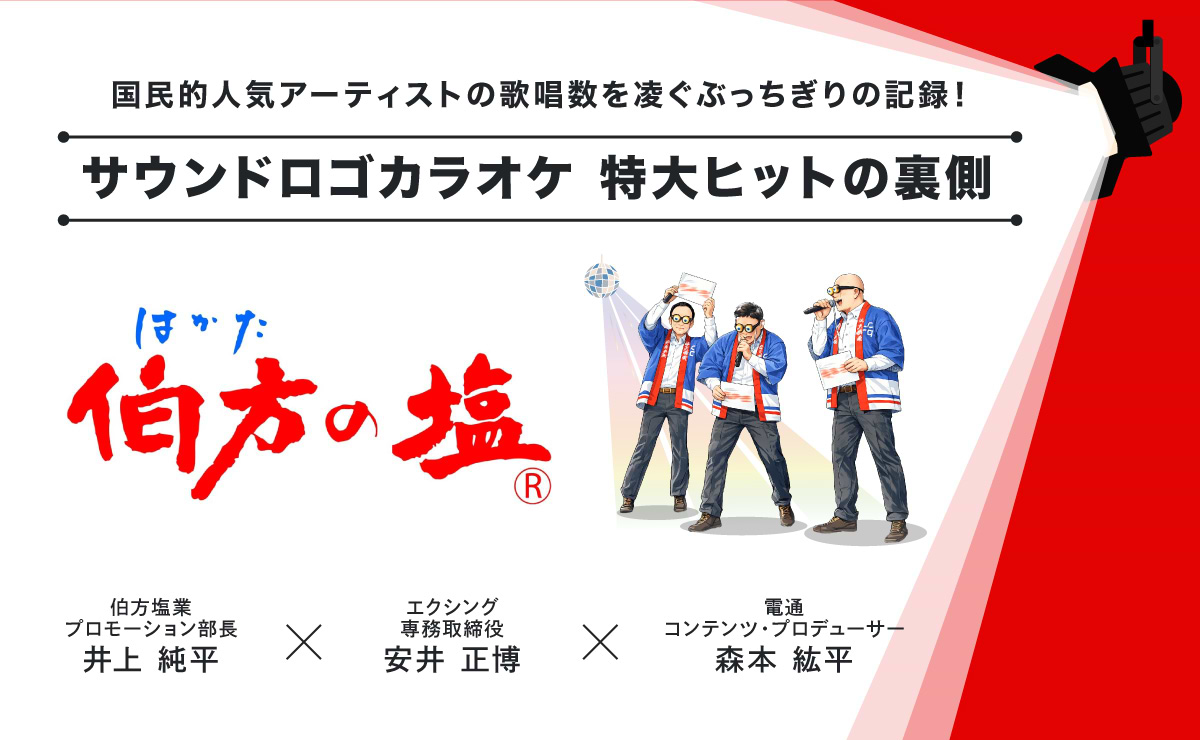
Why did this corporate sound logo generate such a frenzy? Through a roundtable discussion featuring Masahiro Yasui, Senior Managing Director of XING; Junpei Inoue, General Manager of the Promotion Department at Hakata Salt Industry; and Kohei Morimoto of Dentsu Inc. (the event’s secretariat), we explore the behind-the-scenes story of the “Sound Logo Karaoke AWARD” and the new possibilities for collaborations between businesses and music.
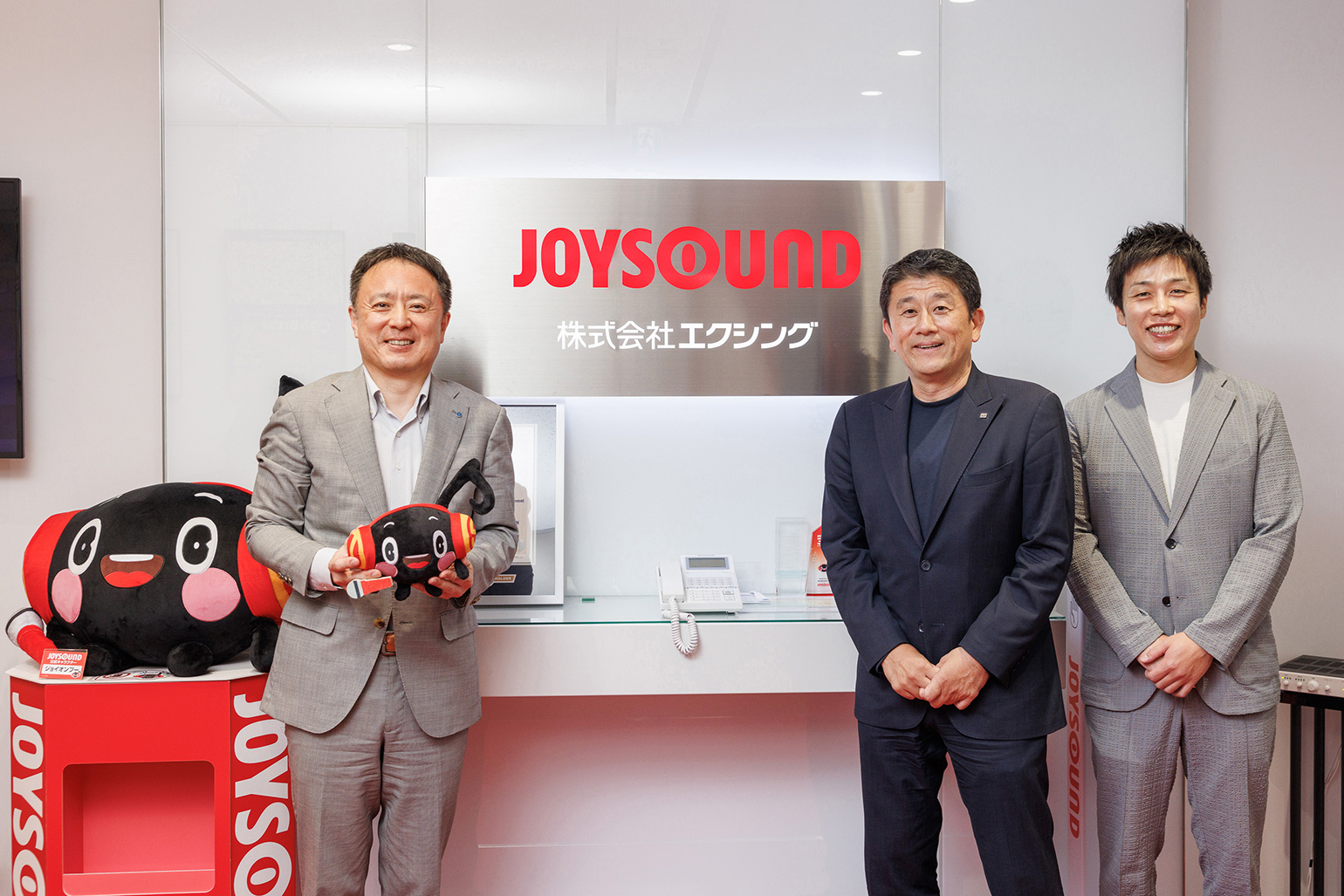
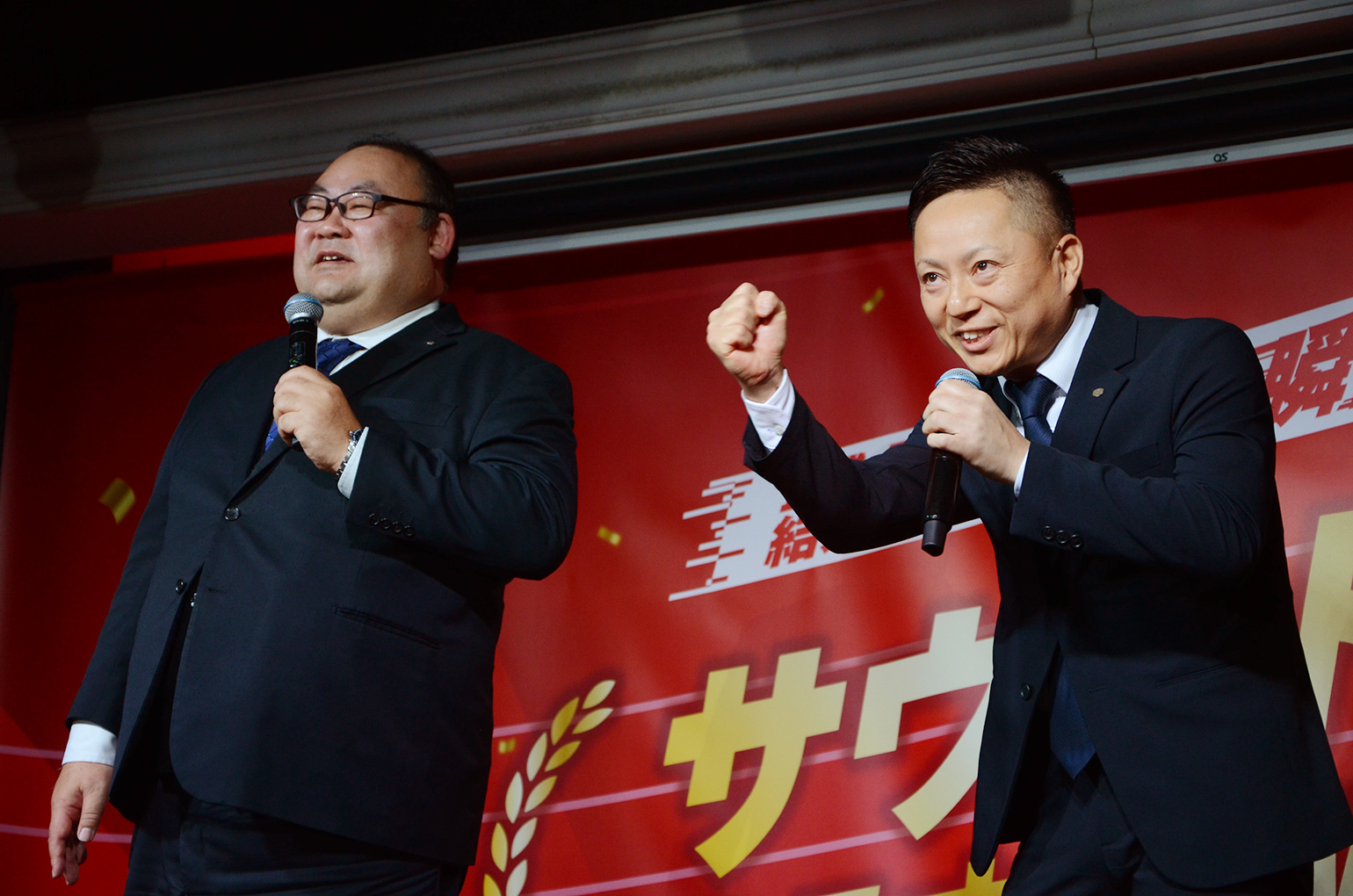
(From left) Junpei Inoue of Hakata Salt Industry, Masahiro Yasui of XING, and Kohei Morimoto of Dentsu Inc.
This unprecedented “instant entertainment” was extraordinary even by the karaoke industry’s standards
Morimoto: The finals of the “Sound Logo Karaoke AWARD” took place in February 2026, but even now, several months later, it continues to receive TV coverage and generate buzz on social media.
Considering how it went viral on social media and was covered by the media, I feel this is the first time corporate sound logos have generated this level of enthusiasm. From the perspective of JOYSOUND, a karaoke manufacturer, was this surge in excitement a unique phenomenon?
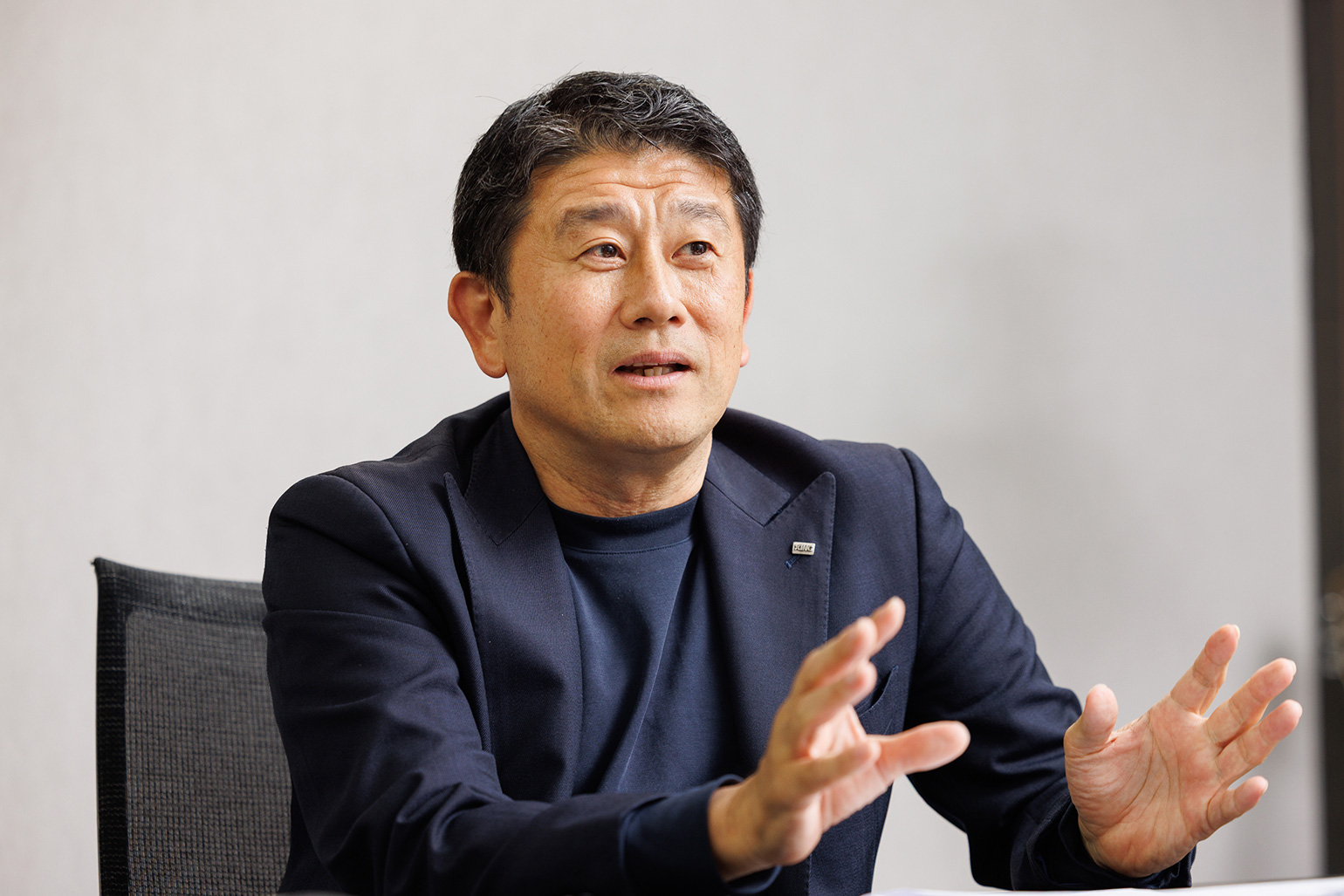
Yasui: To put it simply, I think it was “exceptional among the exceptional.” With regular karaoke, the typical flow is that an artist’s song is released, people listen to it, memorize it, and then sing it. In recent years, the speed of digital distribution has increased, so the time between hearing a song and singing it has become shorter.
However, this sound logo karaoke was different. It featured a sound that was already familiar to people’s ears, and because a phrase known to many was released as a karaoke track, it was sung en masse immediately after its release. This was a trend we hadn’t anticipated based on the typical flow of karaoke releases.
Morimoto: The way it spread on social media was unique, too, wasn’t it? People posted photos of their karaoke history screens filled with “Hakata no Shio,” and those who saw them reacted with, “Is there a song like this?”—which created a cycle where even more people went to sing it.
Yasui: That’s right. A screen filled with “Hakata no Shio” in the karaoke history is pretty striking (laughs). People who saw it thought, “What’s this?” and decided to try singing it themselves, then posted videos of themselves doing so on social media. I think that chain reaction was a major factor in making it a hot topic.
I myself was asked a few times, “Please sing the first song,” so I ended up singing “Hakata no Shio.” The moment I did, the atmosphere in the room would change instantly. People would be surprised, asking, “Is there really a song like this?” and conversations would branch out from there. I felt like a new form of communication was emerging—one that was different from the usual way people interact with artists’ songs.
Morimoto: Among the ways people enjoy karaoke—like singing their “favorite songs” or choosing “unexpected tracks”—the option of corporate or product sound logos has now been added. That was really refreshing, wasn’t it?
From “Catchy Ads” to “Singing Brand Experiences”: The Background Behind the Birth of Sound Logo Karaoke
Morimoto: The “Sound Logo Karaoke AWARD” was a project that began with the idea that JOYSOUND’s karaoke assets could be leveraged for corporate communication in a way that was different from before, wasn’t it?
Yasui: Yes. When people think of karaoke, they usually imagine singing songs that are 3 to 5 minutes long.We distribute songs created by artists, combined with lyrics on screen, audio tracks, and video—that’s our core service. On the other hand, this Sound Logo Karaoke is incredibly short. It’s truly “instant entertainment.” It starts in an instant and ends in an instant. That brevity is what makes it impactful. Recently, the term “time-efficient” has become popular, especially among younger generations, but there are things that can move people’s hearts even in a short amount of time. I felt that sound logos have that potential.
Morimoto: For people who don’t get to go to karaoke often, or those who aren’t confident singers, sound logos—which let you finish singing right away—are a real blessing, aren’t they?
Yasui: That’s a major point. We often hear people cite reasons for not going to karaoke, such as “I don’t know the latest songs,” “I feel bad if the song is too long,” or “I’m nervous because I’m not a good singer.” But with sound logos, singing ability doesn’t really matter—they’re over in a few seconds and still get everyone excited.I often say, “Let’s enjoy karaoke that leaves a lasting memory rather than just a high score,” and I think Sound Logo karaoke embodies exactly that. It’s not just about competing for scores; it helps lighten the mood and sparks conversation. Karaoke is a form of entertainment where anyone can take center stage with just a microphone. I believed this could be the catalyst for not only heavy users but also casual users to realize, “Karaoke is fun.”
Morimoto: JOYSOUND is also a pioneer in online karaoke. I feel it’s very significant that JOYSOUND has created a new karaoke experience that even people who aren’t great singers can enjoy.
Yasui: We value “entertainment that can be enjoyed anytime, anywhere, and with anyone.” Our company name, XING, embodies the spirit of continuously taking on challenges (ING) toward the unknown (X). Even when we first launched online karaoke—at a time when we couldn’t secure licensing for many songs—we kept asking ourselves what songs users truly wanted to sing and continued to take on those challenges. I believe this project is a natural extension of that spirit of challenge.There should be more diverse ways to enjoy karaoke. I believe Sound Logo Karaoke is an initiative that can propose these new ways of enjoying it.
We want to spark interest in salt by using our “lifeblood”—the Sound Logo—as a starting point
Morimoto: From here on, we’ll be hearing from Hakata Salt Industry. Mr. Inoue, what were your initial, honest thoughts when you first heard the proposal for the “Sound Logo Karaoke AWARD”?
Inoue: I thought it was a very interesting idea. I sometimes feel that, especially among the younger generation, people are becoming less particular about food. Given that, I believed it was crucial to create an opportunity for our products to become a trending topic on social media and spread organically.
In 2019, we held the “Second-Generation Voice Actor Audition,” and thankfully, it generated a huge response, particularly on social media. When I heard about this project, I felt that using the sound logo as a starting point could once again create a buzz centered on social media and serve as an opportunity to spark interest in Hakata Salt.
Morimoto: To begin with, what does the sound logo mean to Hakata Salt Industries?
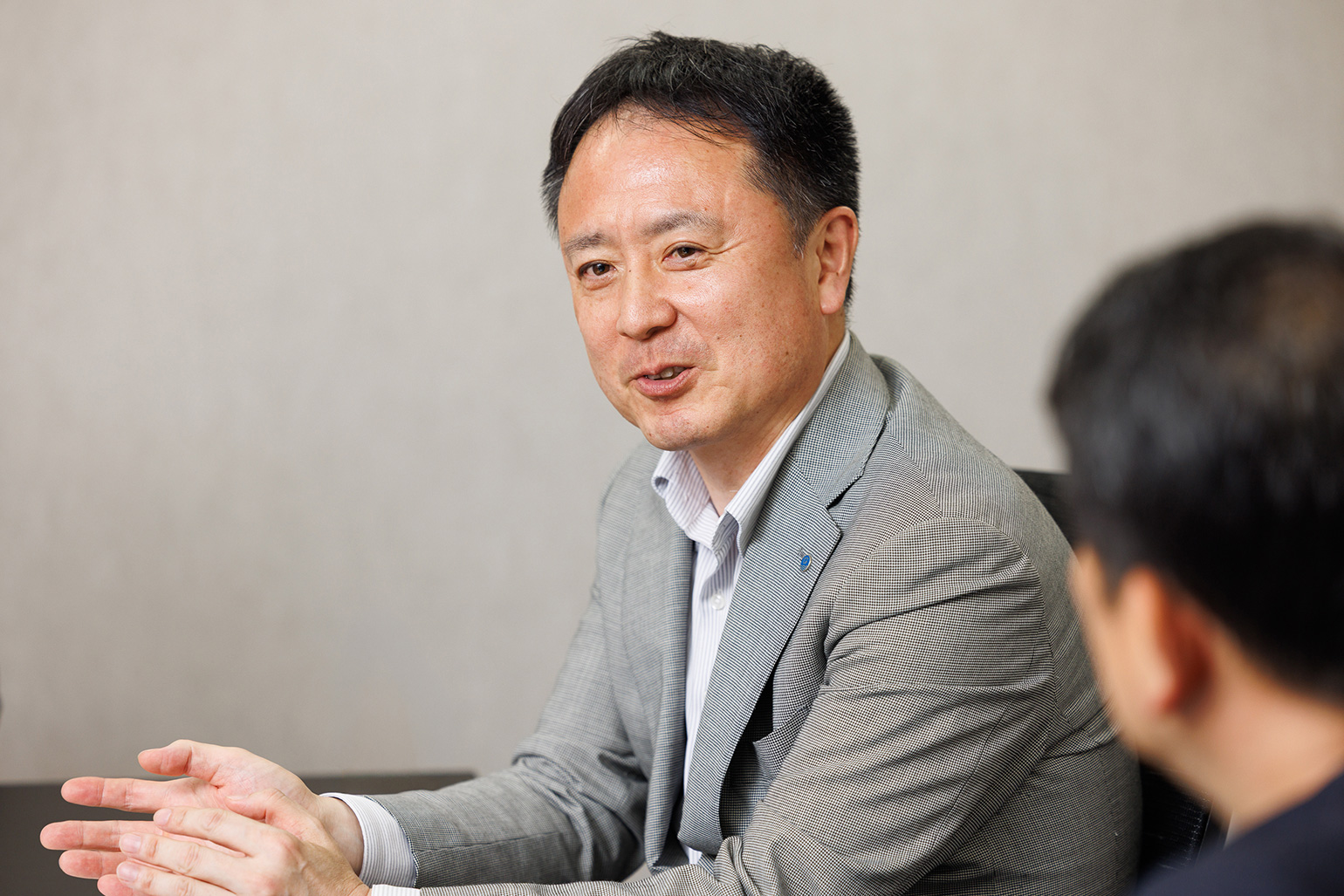
Inoue: As I described it as “life” during the final round, it is an indispensable part of who we are. Hakata Salt Industry was born out of a consumer movement that sought to preserve salt produced in traditional salt fields, even as legal reforms were promoting more efficient salt production methods. When we first started, we didn’t have sufficient funds, and we couldn’t have launched the company without the support of many people.
The same goes for our TV commercials—we certainly didn’t have a large budget at first, and they came to be thanks to the support of many people. By cherishing that sound logo and continuing to use it over the long term, we’ve made the product name “Hakata Salt” memorable to many people. Nowadays, people across a wide range of generations—from young children to the elderly—hum it. I truly believe the sound logo is a precious asset.
Yasui: By the way, was that powerful singing style something you intended from the very beginning?
Inoue: At the time, we had outsourced the commercial production to an agency, but to be honest, our company didn’t actually know who the voice belonged to. We only found out very recently—in 2023, when we celebrated our 50th anniversary. The only information we had prior to that was that the producer had requested someone “capable of shouting.”I’ve heard that when it first aired, people said things like, “Why is he angry?” or “It’s grating on the ears.” However, I think that sense of dissonance actually helped it stick in people’s memories, and as we continued using it over the long term, it grew on people’s ears.
Morimoto: While hit songs are driven by the desire to “sing well,” I think sound logos are also driven by the desire to “shout.” In that sense, “Hakata Salt” may have been a particularly good fit for karaoke.
Why Was “Hakata Salt” So Powerful?
Morimoto: I think the “Hakata Salt” sound logo karaoke was featured quite often on TV shows and other programs. What kind of feedback did you receive from both inside and outside the company?
Inoue: Of course, there were reactions like, “I saw it on TV,” but people also asked things like, “You have an amazing asset,” or “How did you get involved?” It was even featured on local TV programs, so I feel the response was significant.
Morimoto: From JOYSOUND’s perspective, how unusual was the way “Hakata no Shio” was sung?
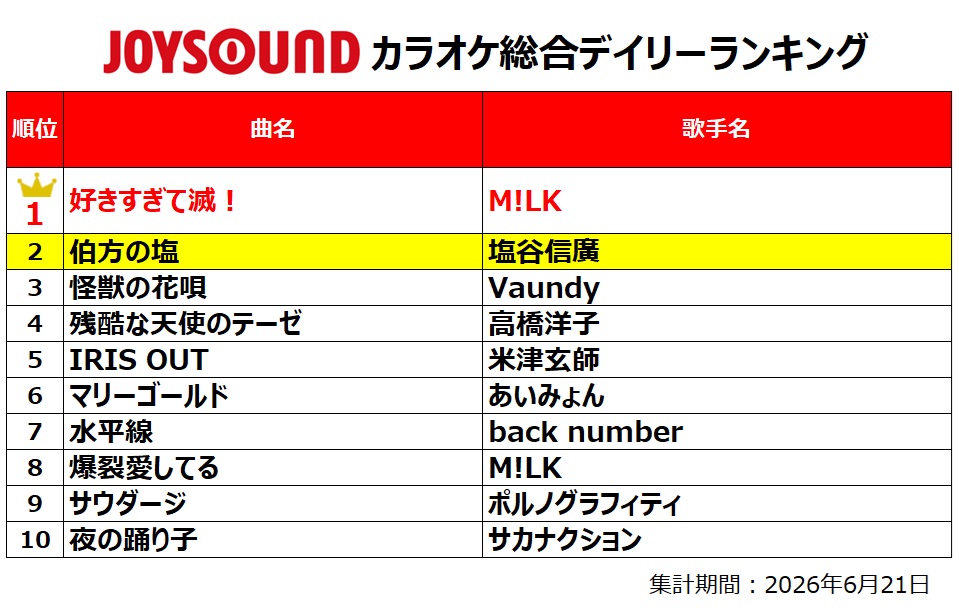
Yasui: Something incredible is happening. JOYSOUND currently offers over 440,000 songs. Among them, “Hakata no Shio” ranked 4th on the weekly chart (tracking period: June 15, 2026 – June 21, 2026).Furthermore, it peaked at No. 2 on the daily rankings. In terms of chart performance, this level of success puts it on par with songs by artists like Mrs. GREEN APPLE and Kenshi Yonezu.
Morimoto: That’s really amazing, isn’t it? And it’s not just a temporary spike right after the TV appearance—it’s been consistently holding its position near the top of the charts.
Yasui:That’s exactly right. Rather than some big marketing stunt creating a fleeting viral sensation, the buzz from the awards and social media has created a chain reaction, and people have just kept singing it. Some people probably even went out of their way to visit a store just to sing “Hakata no Shio,” and I think others sang it at karaoke thinking, “If there’s a song this fun, I’ll give it a try.” And when you actually sing it, it feels great. After singing it like you’re shouting, you can’t help but laugh. I think a lot of people have ended up repeating it over and over.
Morimoto: With traditional TV commercials, we often measure how much awareness they generate, but this time we can actually see “how much it’s been sung.” I think that’s what made it so innovative as a form of advertising communication.
Inoue: That’s right. Unlike TV commercials, the results are visualized in the form of a ranking, which I found really interesting. Actually, I hear our own executives went to karaoke and sang it a lot, too. I think this initiative has deepened many employees’ attachment to our company’s sound logo.
The Passion and Drama Between Companies That Emerged in the Finals
Morimoto: I’d also like to ask about the finals. Was there a specific moment when you, Mr. Yasui, felt this project was really taking off?
Yasui: First of all, it was the moment I sang the JOYSOUND sound logo as an example during my opening remarks (laughs). Surprisingly, my performance was deemed “unscorable,” but the audience burst into laughter. Feeling that warm atmosphere, I was convinced, “This is going to be a fun awards show.”
After that, the Servis Group, who went first, gave a presentation that was like a comedy routine, and the venue really warmed up all at once, didn’t it? The other presentations were truly wonderful as well, and I could really feel the enthusiasm with which all the participating companies approached this awards ceremony.
Even though I was on the judging panel, I was constantly excited, wondering, “What’s coming next?” I’ve judged many karaoke contests, but it’s rare to have such a fun judging experience.
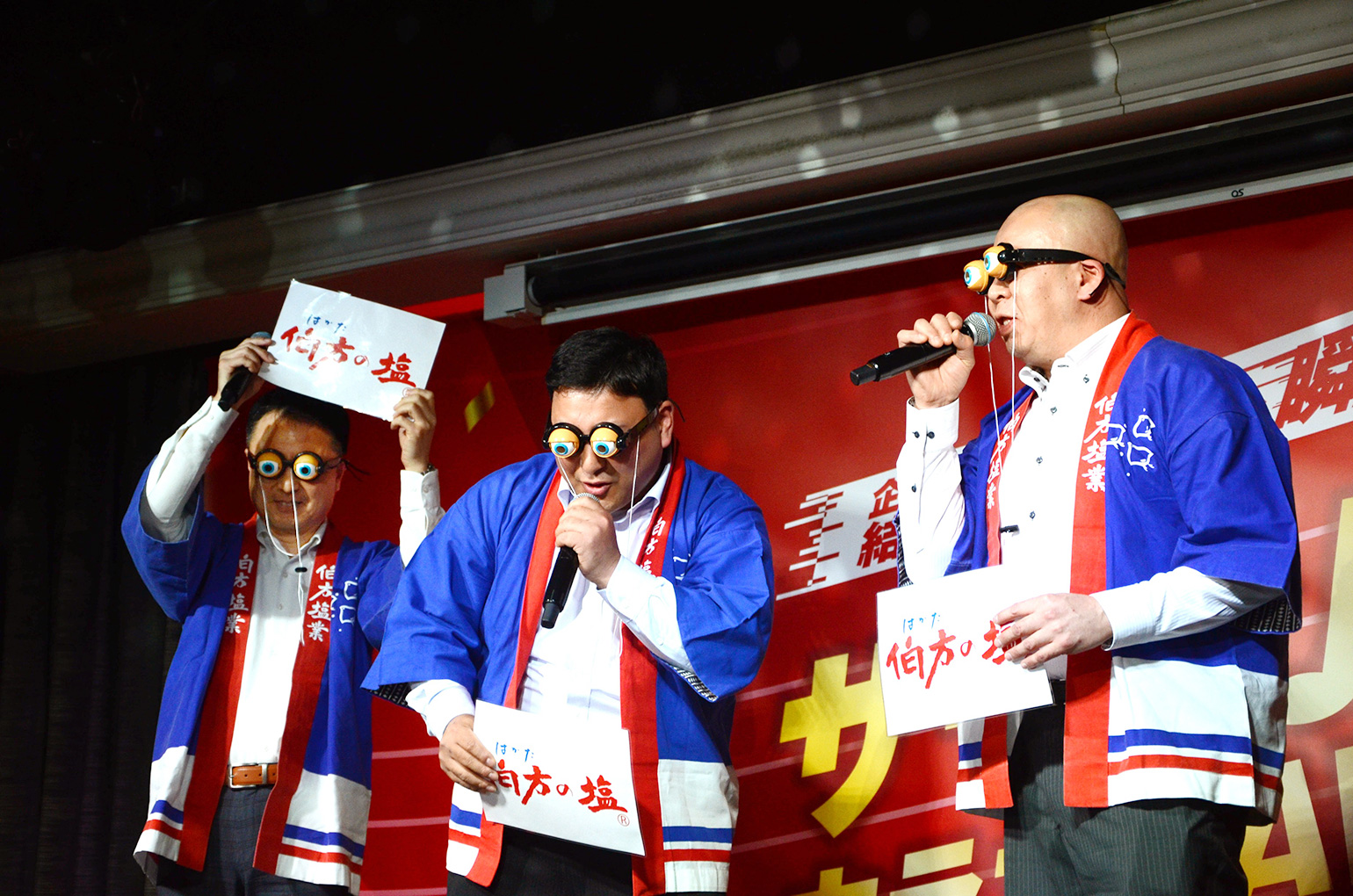
The Servis Group, who kicked things off with a comedy routine
Morimoto: It was moving right from the rehearsal stage, wasn’t it? Since each company had become aware of the others through online briefings and social media, and this was the first time they’d actually gathered in person, there was an atmosphere where—even though they were competitors—they felt more like partners creating new content together.
Yasui: That was really great. When I first heard about the award, to be honest, I couldn’t quite imagine how we’d judge a sound logo karaoke performance that lasted only a few seconds. But in reality, it wasn’t just about the singing—there was also time for presentations and for each company to explain “what the sound logo means to them.” That’s where the companies’ vision and culture really shone through. I think it became more than just a karaoke contest; it turned into content that truly conveyed the appeal of each company.
Morimoto: Mr. Inoue, what strategy did you use going into the finals?
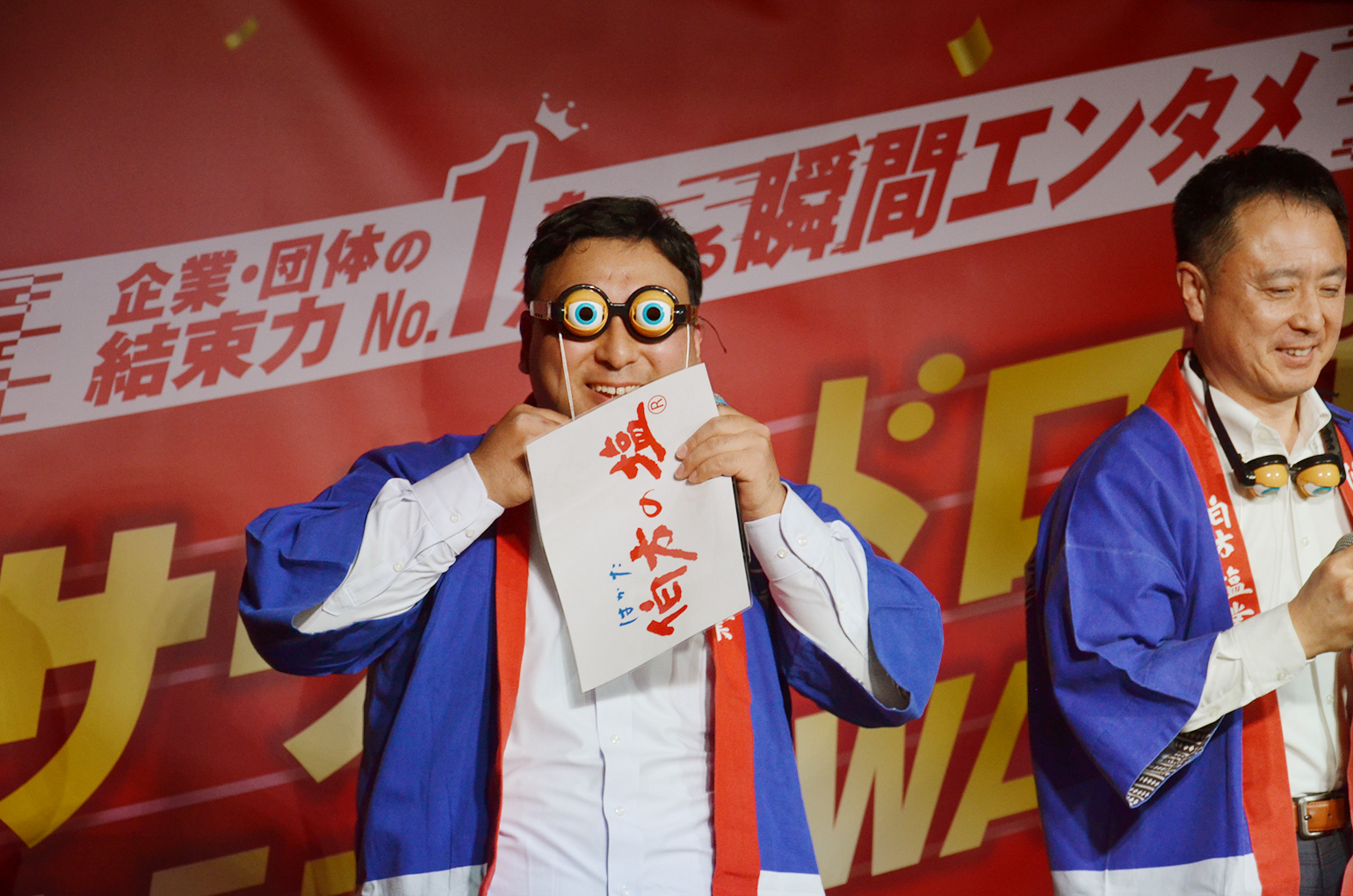
Inoue: To be honest, I hadn’t really thought much about a strategy. Servis Group’s opening presentation was truly impressive, and we were completely swept up by the atmosphere in the venue. On the day of the event, I brought a prop that made my eyes blink rapidly, and I was worried it might be a bit too silly. But after seeing the other companies’ presentations, I realized ours was actually on the tame side.
Morimoto: How did you decide on the team members for the finals?
Inoue: Our president, Ishimaru, suggested, “If we solicit volunteers from across the company and have them participate, wouldn’t that help foster interaction?” In the end, the team consisted of three of us: myself, based at the headquarters in Matsuyama City, and members working at the factory on Omishima Island in the Seto Inland Sea. Since there isn’t usually much personnel exchange between headquarters and the factory, it was really great to be able to work together with members from the factory whom I don’t normally have much contact with.
Yasui: If karaoke and singing served as a catalyst for interaction among colleagues within the same company who don’t usually have many opportunities to talk, that would make me very happy.
Inoue: After the stream began on JOYSOUND, I heard a story about an employee who had never had the habit of going to karaoke with their family before, but who ended up taking their child to karaoke. Just recently, when I was in the salt aisle at a supermarket, I saw a small child looking at the products and singing the “Hakata no Shio” sound logo. I thought this might have happened precisely because of the karaoke stream.
Morimoto: The phrase “Hakata Salt” has become a common language among all kinds of people, giving rise to new connections. I feel this recent phenomenon truly demonstrated exactly that.
Sound Logo Karaoke Is Becoming a New Touchpoint for Corporate Communication
Morimoto: Finally, I’d like to ask about sound logo karaoke and the potential of “corporate × music” collaborations. Mr. Yasui, based on this experience, how do you see the potential of sound logo karaoke?
Yasui: Companies use TV commercials, radio ads, and various other media to promote their products and brands. In that context, sound logos have traditionally been something consumers simply hear.But with Sound Logo Karaoke, people who hear it get to sing it themselves. And by sharing the song with those around them, the product name and brand value spread even further. In other words, it becomes content where people don’t just passively receive information—they actively participate and share it. I see tremendous potential there—potential that’s different from traditional media.
Morimoto: I think sound logos have often been viewed as mere advertising materials in the past. This project has proven that they can become participatory content, hasn’t it?
Yasui: That’s right.And music is a universal language. People overseas who can’t speak or read Japanese sometimes memorize Japanese anime songs by ear and sing them. At JOYSOUND, we’ve also made it possible for people overseas to sing Japanese songs by displaying lyrics in Romanized characters. Sound logos are similarly a form of content that people can memorize by ear and enjoy. Precisely because the phrases are short, I believe they have the potential to resonate with people overseas as well. It would be interesting to hear someone overseas sing “Hakata no Shio,” wouldn’t it? I’d love to see how they sing it, with a sensibility different from that of Japanese people.
Inoue: That’s a great idea. We export our products overseas, primarily to Southeast Asia and the United States, and we’ve set a goal to “become the world’s most famous salt manufacturer by 2030.” In that sense, I think having people both in Japan and abroad think, “What an interesting company!” or “What a great company!” through sound logo karaoke could serve as a catalyst for expanding our brand awareness.
Morimoto: It’s possible that people overseas might experience Japanese sound logo karaoke, take that inspiration back home, and create their own sound logos or turn them into karaoke songs in their own countries. That kind of expansion could very well happen. Now, Mr. Inoue, could you share a few words for companies considering participating in the 2027 competition?
Inoue: I felt that the “Sound Logo Karaoke AWARD” has the potential to become a valuable advertising tool. I think companies that are interested should actively step forward and participate. However, the level of competition in the finals is higher than you might imagine, so I recommend preparing thoroughly. Since our company didn’t win the Grand Prize at the awards, we’d like to participate again to redeem ourselves.
Yasui: Through this award, I was reminded once again that karaoke is, after all, just one means to an end. What’s important is how companies give shape to their vision and how they convey it. It’s not a song performed by an artist—it’s employees singing their company’s sound logo. I’d like more companies to experience that value. I’d be delighted if the “Sound Logo Karaoke AWARD” becomes an event that fosters corporate pride and corporate culture.
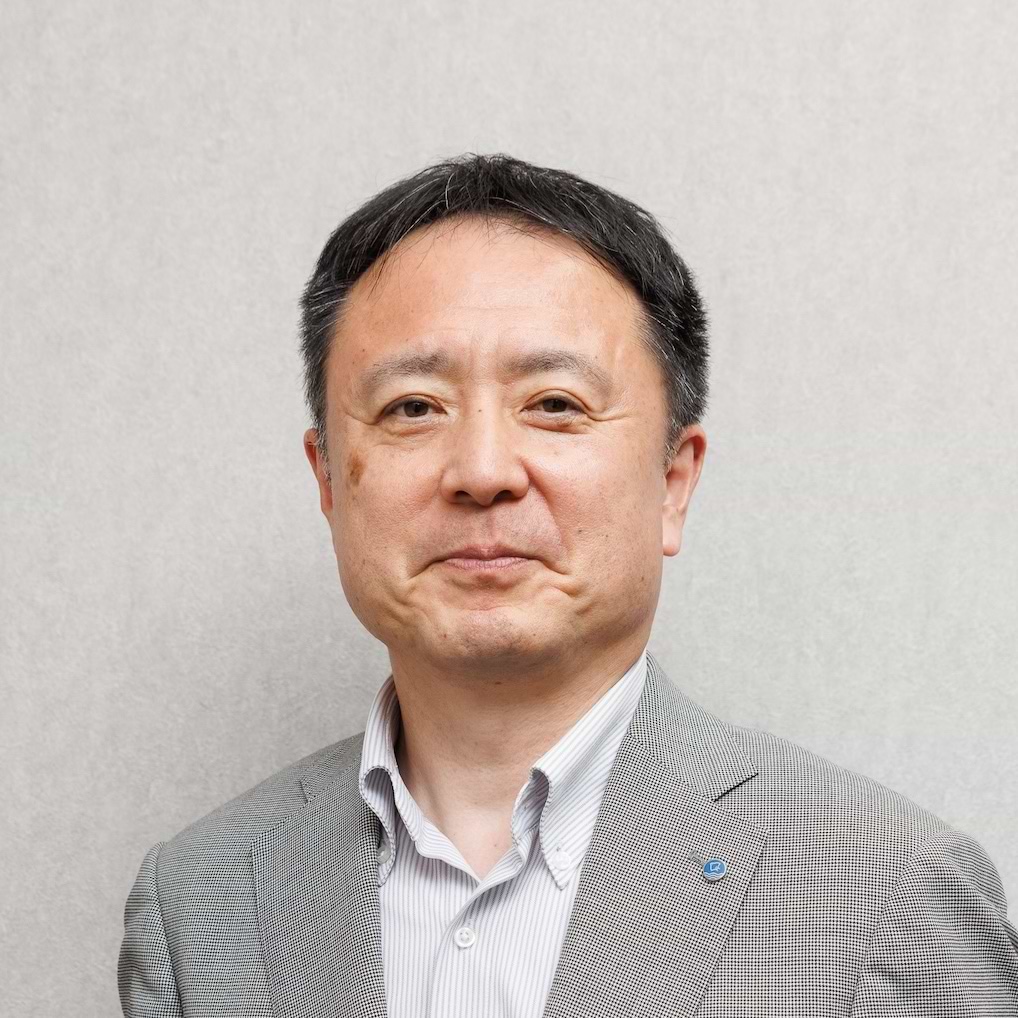
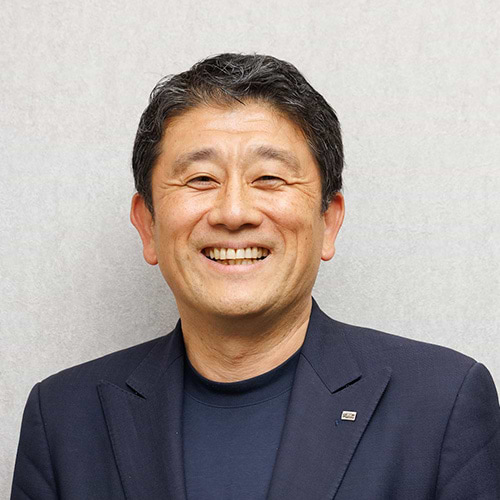
Born in Ehime Prefecture in 1972. While working in sales at a local printing company, a connection (salt) with Hakata Salt Co., Ltd.
led him to change jobs.After joining the company, he gained broad experience ranging from sales planning to product planning, sales promotion, and public relations,
expanding his career. In particular, the “Hakata Salt Second-Generation Voice Actor Audition” held in 2019 was a memorable project
that attracted nationwide attention. In his personal life, he deeply loves driving his beloved car and playing badminton,
and is the type who will keep driving on forever.
His theme for the future is—
“Creating an exciting future for salt, starting from Ehime Prefecture.”
Masahiro Yasui
XING Co., Ltd.
Senior Managing Director
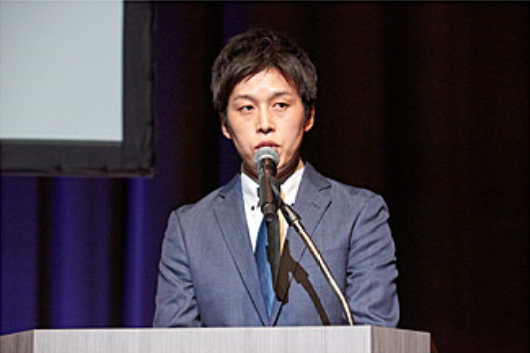
As Senior Managing Director at XING Co., Ltd., the operator of JOYSOUND, he oversees the Sales Division, Planning and Services, and Content Promotion. He has an unconventional background, having previously worked at a major city bank. Since joining the company, he has held roles including head of mobile content distribution (such as ringtones and ringback tones), corporate planning, marketing, and music publishing. He then served as General Manager of Special Sales and later as Head of the Sales Division, leading him to his current position.He is an avid karaoke enthusiast, and his signature repertoire is a parade of Showa-era pop hits by artists like Hideki and Match.
Kohei Morimoto
Dentsu Inc.
Marketing Division 8
Content Producer
We build and promote “co-creative content” that drives positive change in society, using corporate assets as a starting point. We have launched highly original and unprecedented initiatives with partner companies—such as the “Company Anthem Contest” and the “Sound Logo Karaoke AWARD”—which have generated significant buzz.These efforts are linked to solving business challenges such as corporate brand awareness, internal engagement, talent recruitment, sales, and fundraising. The company has received awards including the Grand Prize in the Innovative Approach category at the Dentsu Inc. Advertising Awards, a Bronze Prize at the PRSJ Awards, a Silver Prize in the Film category at ADFEST, and an award in the Planning & Marketing category at the Newspaper Advertising Awards. He is a former Koshien baseball player (captain of Chiben Wakayama High School / vice-captain of Keio University).

 Leveraging Business and Music in Management [3/3]