The “Information Media White Paper” has been published for 32 years as a leading source of research and data on Japan’s information media industry. Starting in 2026, with the aim of contributing broadly to the development of the media industry, it was released on Dentsu Inc.’s website as the new “ Information Media White Paper 2026.”
In this series, based on research and studies conducted by the Dentsu Inc. Media Innovation Lab, we will provide insights into changes in the media landscape and trends in the advertising market as part of a special feature report from the “Information Media White Paper 2026.”
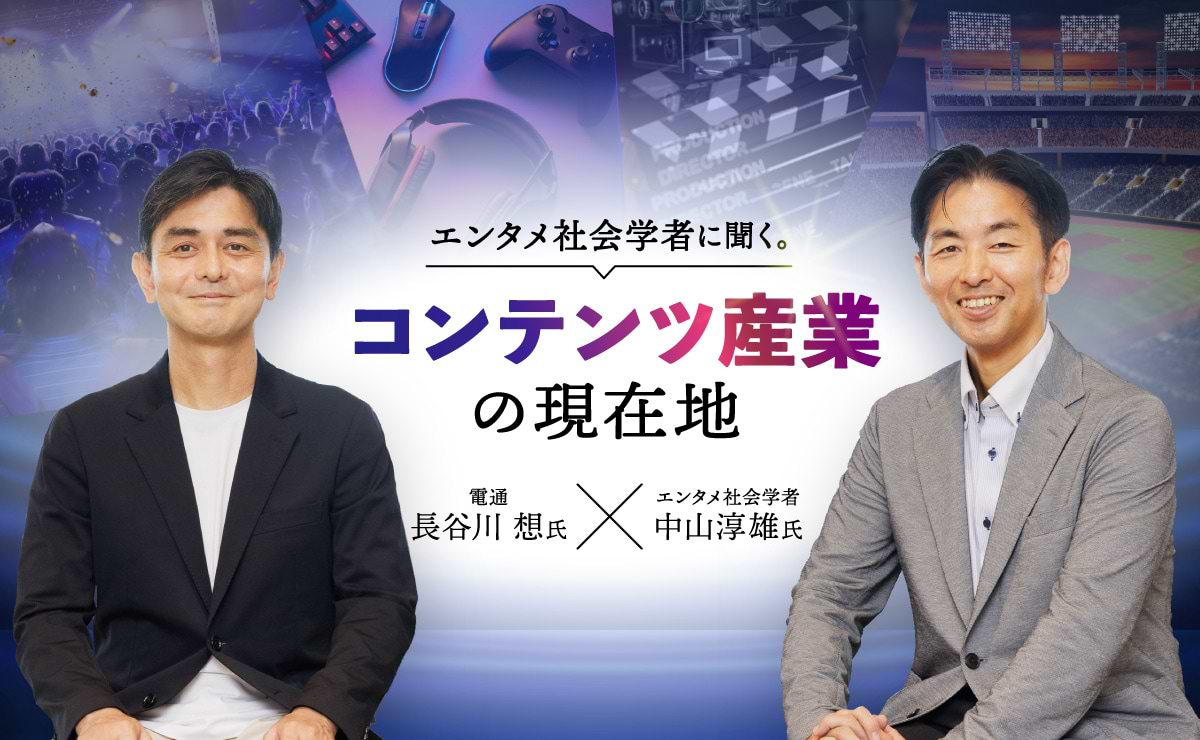
For the fourth installment, as a special feature, we welcome Mr. Atsuo Nakayama—who has been involved in business development and international expansion in the gaming and entertainment industries at companies such as Recruit, DeNA, Bandai Namco Studios, and Bushiroad, and currently works as an entertainment sociologist—for an interview conducted by Mr. So Hasegawa of the Dentsu Inc. Media Innovation Lab.Together with Mr. Nakayama, who researches over 150 years of entertainment industry history, we looked back on the evolution of music, film, anime, games, VTubers, and sports, while discussing the current state and future potential of Japan’s entertainment business.
The “Information Media White Paper” is like the newspaper of the entertainment business
Hasegawa: At Dentsu Inc., we have long analyzed the media industry and consumers’ information behaviors through the “Information Media White Paper,” which we have published as a printed report. I understand that you, Mr. Nakayama, have been using this white paper for some time. What aspects do you find particularly valuable?
Nakayama: The first one I picked up was the “Information Media White Paper 2012.” I started using it back then while working as a consultant for a game company at a general consulting firm. Since then, I’ve read it every year without fail for about 14 years now.
One of its appeals is its high readability and accessibility. In the past, if you were at a game company, you only needed to track trends in games, and if you were at an anime company, you only needed to track trends in anime. However, starting around the late 2010s, cross-industry collaborations increased, making it necessary to grasp trends across various media. In that context, the “Information Media White Paper” serves as a sort of newspaper for the entertainment business.It’s highly organized, allowing me to gain a solid understanding even of areas I’m not directly involved in. Plus, since I can refer to records dating back to the 1950s in some sections, it’s incredibly helpful for tracing the industry’s historical context.
I don’t think there are many people who’ve read the “Information Media White Paper” this thoroughly across all genres. If there were a ranking for that, I’m confident I’d make the top five (laughs).
Hasegawa: That’s a great honor. Since the “Information Media White Paper” will be available online starting in 2026, I hope even more people will be able to make use of it.
Now, let’s get to the main topic. Mr. Nakayama, you published a new book, *The Textbook of the Entertainment Business * (Keio University Press), in September 2026.I find it particularly fascinating how you’ve divided the entertainment business into 10 genres—(1) entertainment and music, (2) film, (3) manga, (4) anime, (5) video games, (6) sports, (7) theme parks, (8) art, (9) global media, and (10) VTubers and digital live streaming—and explain their overviews, histories, and business models.
In this article, we’ll focus on six of these genres and ask Mr. Nakayama about their current trends and topics worth watching.
Is the Music Industry the “Canary in the Media Business”⁉
Hasegawa: Let’s start with music. I was struck by the phrase “The music industry is the canary of the media business,” which you wrote about in one of your previous books. Could you explain what you mean by that?
Nakayama: Canaries are known as birds that detect toxic gases before humans do. Since miners used to take canaries with them into the mines, the term is now used as a metaphor for something that alerts us to changes or dangers at the earliest possible stage.
There are many examples of music serving as the “canary” of the media business, and copyright is a prime example. A comparison often cited is that between Mozart (1756–1791) and Puccini (1858–1924).
While Mozart is by far the better-known composer, it is said that, in modern terms, Mozart’s annual income would be approximately 20 million yen, whereas Puccini’s would be 200 to 300 million yen. In Mozart’s time, there was no system in place to adequately protect the rights to his works, and his primary sources of income were teaching piano and performing. On the other hand, by the time Puccini was active, a modern copyright system had begun to take shape, and it had become an era where the works themselves generated revenue.
Hasegawa: So music was the first field to establish a rights-based business model.
Nakayama:That’s right. As sheet music came to be protected by copyright, it became possible to monetize it in the same way as the book publishing business. Starting from there—with records in the 1920s and 1930s, LPs and CDs in the 1970s and 1980s, the issue of unauthorized file sharing in the late 1990s, the sharp increase in lawsuits over copyright infringement in the 2000s, and the development of streaming services in the 2010s—music has consistently been at the forefront of these game-changing developments.
Hasegawa: So, it’s about being the first to face challenges and the first to overcome them.
Nakayama: Exactly. A pattern has repeated itself where, five to ten years after the music industry struggles, other media face the same challenges. In other words, what video and sports content are facing now is something the music industry already experienced five to ten years ago.
Hasegawa: I hear the music market is doing well right now. What’s the current situation?
Nakayama: It’s performing at a level close to an all-time high. The rights business—including publishing rights and master rights—is growing steadily. A vast archive of songs, including older tracks, is now generating revenue every day through subscription services.
In Japan, royalty revenue surpassed CD package sales only after the 2020s began, but globally, this reversal had already occurred in the early 2010s. It seems Japan is about 10 years behind.
Hasegawa: Does that mean the model lasted relatively longer in Japan because package sales—which combined bonuses and fan-oriented initiatives—had become firmly established?
Nakayama: That’s right. But the point is that, no matter how long it takes, everyone eventually moves in the same direction.
The Japanese film industry has set a new record as the world’s largest market. Will this growth continue?
Hasegawa: Next, I’d like to hear your thoughts on the film industry. Japanese films are said to be booming in recent years, but what changes have occurred when viewed from a long-term perspective?
Nakayama: I feel that, among the many entertainment genres, film is one of the genres that has been most affected by changes in the environment.
The 1950s were a golden age for cinema both in Japan and around the world, and at that time, Toei was the company producing the most films globally. They even used to shoot two films a day.
Hasegawa: So there was a time in Japan, just like with Hollywood’s “Big Five,” when companies like Toho, Toei, Shochiku, and Nikkatsu were fiercely competing to produce films.
Nakayama: That’s right. However, after peaking around 1960–61—when television began to take hold—the number of moviegoers continued to decline, finally hitting rock bottom in 1997. The industry kept declining right up until the release of *Princess Mononoke*.
Hasegawa: You mentioned that while the music industry recovers quickly even after a slump, the film industry didn’t follow that pattern.
Nakayama: After television took the spotlight away from movies, the 1960s through the 1980s were truly tough. I’m really grateful that filmmakers managed to hang in there.
Hasegawa: On the other hand, from a global perspective, Hollywood is said to be struggling right now.
Nakayama: They say it’s in its worst shape in the last 40 years. There was the 2023 strike, and it’s also said that the Hollywood-centric structure of the film industry is beginning to waver. In contrast, Japan is on track to have its largest-ever film market in 2025, so it’s moving in a completely different direction from the rest of the world.
Hasegawa: What do you think are the factors behind this strong performance?
Nakayama: As far as Japanese films are concerned, one factor is the rise of “oshi-katsu” (supporting one’s favorite idol or character), which has led to more people watching the same film multiple times. However, this is supported not only by an increase in the number of moviegoers and the wider reach of the films themselves but also, to a large extent, by the passion of fan communities—so it can’t necessarily be called a sustainable model. While having IPs with a stable fan base—like *Detective Conan* and *Demon Slayer*—that bring people to the theaters is a strength, the question is how to produce hit films without relying solely on them.I believe the key to the film industry’s further growth lies in how we can overcome these challenges.
From Anime for TV to an Era Where Content Takes Center Stage
Hasegawa: This is a theme deeply connected to film as well, but what about anime?
Nakayama: I believe animation is an industry that truly embodies the shift from the media-driven model of the 20th century to the content-driven model of the 21st century.
It is said that the Japanese television animation industry truly began in 1963 with the start of broadcasts of *Astro Boy*. However, for about 30 years after that, animation was primarily produced as content for television programs. The catalyst that changed this trend was *Neon Genesis Evangelion*, which began airing in 1995.By the late 1990s, the production committee system (*1) had become widespread, with music companies, publishers, and talent agencies beginning to invest, thereby establishing the industry as a content business that included packaged media, merchandise, and music.
Hasegawa: In other words, anime evolved from being produced solely for the medium of television into a business that generates revenue centered on the content itself. Given that, did the mindset of the creators also change?
Nakayama: That’s right. Under the media-driven model, advertising revenue was the primary source of income. As we moved from an era focused on chasing viewership ratings to one where fan-oriented businesses—such as OVAs (Original Video Animations) (*2)—emerged, the concept of “having passionate fans pay directly” was born. Even if there were only 10,000 fans, if each paid 10,000 yen, that would amount to 100 million yen. Furthermore, as it became possible to expand into DVDs and related merchandise, a customer-centric, “content-first” mindset spread, particularly within the anime industry.
*1 Production committee system = A content production method unique to Japan in which multiple companies jointly invest to share production costs and risks.
*2 OVA (Original Video Animation) = An anime work produced from the outset for video (VHS or DVD) rather than for television broadcast.
The Japanese Video Game Industry: Dominating the Global Market
Hasegawa: Mr. Nakayama, given your background at Bandai Namco Studios, what are your thoughts on trends in the gaming market? The market has undergone significant changes, ranging from home consoles to smartphone games—how has the Japanese gaming industry evolved?
Nakayama: Having observed the evolution of various entertainment businesses over the years, I believe that games and VTubers are the only fields where Japan has been able to achieve global dominance on its own, without being influenced by the United States.
Hasegawa: Could you tell us how Japanese games came to dominate the world?
Nakayama: It all started with the “Atari Shock” of 1983. At the time, an American company called Atari was leading the market, but the North American gaming market plunged into a severe recession, losing nearly 95 percent of its market share. So when Nintendo tried to enter the U.S. market with the Family Computer (Famicom), they were repeatedly turned down with the response, “We can’t handle that market—it’s already over.”
Hasegawa: But in the end, they made a comeback.
Nakayama: That’s right. Since Japan was largely unaffected by the Atari Shock, we continued developing games domestically. Then, in 1986–87, with the success of *Super Mario Bros.*, we took on the U.S. market once again. In fact, around 1990, 90 percent of the global video game market consisted of Japanese-made titles.
Hasegawa: That’s amazing. Then came the entry of Sony and the Xbox, didn’t it?
Nakayama: With the progression from the Famicom to the Super Famicom to the PlayStation, a two-company system emerged between Sony and Nintendo. Microsoft’s Xbox didn’t enter the market until the 2000s. They entered the market trying to catch up with the Japanese companies. For 20 years, starting in the late 1980s, Japan held global dominance in the video game industry.
Hasegawa: Japan isn’t just strong in home video game consoles—it also has a strong presence in arcade games.
Nakayama: Japan has also demonstrated a unique presence in the arcade game sector. However, the business model of game centers has changed significantly, and their nature has completely transformed compared to the past. Today, 70 percent of revenue comes from prize machines (crane games), and they’ve evolved into a format that’s now more akin to pop-up merchandise stores.
Is the Golden Age of Internet-Born Content Just Around the Corner?
Hasegawa: Earlier, you mentioned that Japan has achieved global dominance in its own right through video games and VTubers. Could you tell us about trends in VTubers and live streaming, as well as the points Mr. Nakayama is focusing on?
Nakayama: All existing genres—such as games and music—underwent a paradigm shift during the television era and are now undergoing further transformation through the internet. On the other hand, VTubers are content born on the internet. I view this genre, which emerged in 2016, as a symbol of internet-born content.
Hasegawa: Are you saying that the appeal of live streaming lies precisely in that immediacy—the “here and now”?
Nakayama: That’s right. The idea is that archives—which can be viewed anytime, anywhere—have no value; the value lies in the live, “here and now” experience. I feel that Twitter had a major influence on this in the early 2010s. From there, the culture of live streaming grew, evolving through Niconico, YouTubers, live streaming apps, and finally to VTubers.
Hasegawa: As original content born on the internet, how do you see it evolving from here?
Nakayama: Both theater and television were still in their developmental stages during their first 20 years. It wasn’t until the ’70s through the ’90s that a large number of compelling works began to emerge. The same is true for internet-born content, represented by live streaming and VTubers—I believe the next 30 years will mark its golden age.
Hasegawa: That’s a unique perspective you have there, Mr. Nakayama.
Nakayama: That’s right. With the advent of AI and the constant emergence of new technologies, it feels as though the next era has arrived almost immediately. However, in reality, the evolution of content is much more gradual. The internet-born content that is just now taking off will mature over the next 30 years. It’s a perspective shaped by having observed 150 years of entertainment history.
The Rising Value of Sports Content in the Age of Video Streaming
Hasegawa: With many international sporting events scheduled for 2026, interest in sports content is on the rise. How is the global sports business changing?
Nakayama: I truly feel that sports and the arts are businesses that have flourished in the 21st century. In terms of the commercialization of sports, the starting point was around the 1984 Los Angeles Olympics and the founding of the Premier League in 1992, and commercialization progressed rapidly in the 1980s and 1990s.
Hasegawa: So that trend accelerated even further from the 2000s through the 2010s, then?
Nakayama: For example, if you track NFL broadcast rights fees back to the 1980s, you’ll see they’ve continued to rise steadily. Even on a global scale, the NFL and the Premier League stand out as exceptional examples.
Hasegawa: How does this relate to streaming?
Nakayama: Since the start of the 2020s, one of the areas where video streaming services have been spending the most money is acquiring rights to sports content. The value of live content—with its immediacy of “what’s happening right here, right now”—has surpassed that of pre-recorded dramas. It used to be said that the price gap for sports content licensing between Japan and the U.S. and U.K. was a factor of 10, but I feel that gap has now widened to a factor of 20 to 30.
New Value Created by IP and Fandom
Hasegawa: Given the changes in the entertainment business we’ve discussed so far, I feel that the importance of the IP business has been growing in recent years. I’d also like to ask you about the current state and potential of the IP business in Japan.
Nakayama: I think the first major change is that every content genre has become a competitor to every other. We’ve moved from an era of analyzing by media segments—such as publishing, games, and anime—to an era of cross-sector competition centered on the content itself: IP and fandom (*3).
Hasegawa: So it’s a scenario where companies from different industries are all targeting the same IP market.
Nakayama: Exactly. Companies with completely different backgrounds—such as film, music, games, toys, and publishing—are developing diverse ancillary businesses based on popular anime and character IPs. This marks a 21st-century turning point.
Hasegawa: Do you think Japan still has potential, including in terms of overseas expansion?
Nakayama: While American companies dominate the major streaming platforms, the competitiveness of the content itself is a different matter. If we can create a structure that generates revenue based on the content itself—that is, IP and fandom—I believe Japan’s strengths can be fully leveraged.
Just as video games took 20 years from the late 1980s to dominate the global market, anime is also gradually taking root worldwide.
Hasegawa: When combined with the view that a golden age of internet-born content is coming, it seems there’s still tremendous potential.
Nakayama: What people find entertaining doesn’t change overnight. It evolves only half a step at a time. That’s precisely why I think it’s important to lay the groundwork patiently. If you trace the 150-year history of entertainment, that becomes very clear.
*3 Fandom = A community or cultural sphere of fans who support specific works, characters, artists, etc.
Advertising Isn’t Going Away. What’s Needed Is “Context”
Hasegawa: Finally, I’d like to ask you about advertising and sponsorship. With the emergence of various new media platforms in recent years—in addition to television, newspapers, magazines, and radio—how do you think the nature of advertising and sponsorship will change?
Nakayama: Advertising will definitely not disappear. If you look at the ratio of advertising spending to GDP over the past 100 years, it’s said to have remained stable in the 1 percent range, so it’s not going away. However, I do think one challenge is that online ads are often delivered based solely on algorithms, which can result in a loss of context.
Hasegawa: What do you mean by “contextual advertising”?
Nakayama: Just as movie theater ads differ from TV ads, the question is: what kind of ads will people who enjoy VTubers find valuable? I think there’s room for new innovations in this area, and it holds great potential.
Hasegawa: So, it’s about considering sponsorships with a deep understanding of the fandom.
Nakayama: Personally, when I receive ads that are completely off-target even though my data is presumably being tracked, I sometimes feel as if I’m being ignored. In the 21st century, the importance of “fan business”—where content and users connect directly—is growing. That’s precisely why I feel we need to optimize the approach to advertising and sponsorship while understanding fandom.
Hasegawa: I get the sense that the very act of continuing to support content contributes to corporate value.
Nakayama: Even in the digital age, I don’t think the relationship between content with a dedicated fandom and companies that resonate with those values will change. Rather than being mere sponsors, partnerships that understand the fandom and stand alongside it—that’s what the future of advertising will look like, don’t you think?
Reflections on the Interview (Hasegawa) It was a truly impressive interview that viewed the entertainment industry from a perspective spanning over 100 years. I was keenly aware that as digitization advances further, media and content—which were traditionally inseparable—are becoming increasingly separated, and the entertainment industry as a whole is approaching a major turning point. It’s safe to say that advertisers and advertising agencies are now required to develop advertising strategies that not only improve targeting accuracy but also take into account the content itself and its fanbase.
“The Textbook of the Entertainment Business: Lecture Edition” by Atsuo Nakayama This book divides the entertainment business into 10 genres and provides easy-to-understand explanations of their overviews, histories, and business models. It breaks down the entertainment industry—which is often discussed from a creator’s perspective—into its business components and incorporates the perspective of global media convergence, which will be essential for the future of Japan’s entertainment industry. It is a definitive, comprehensive volume.
Entertainment sociologist. While serving as an entrepreneur (founder of Re entertainment, a management consulting firm specializing in entertainment), an executive and advisor at venture companies, and engaging in research and education (Specially Appointed Professor at Nihon University’s College of Arts; Visiting Researcher at Keio University and Ritsumeikan University), as well as serving on government advisory committees (including the Ministry of Economy, Trade and Industry’s Entertainment and Creative Industries Study Group and the Cabinet Office’s Intellectual Property and Content Strategy Working Group), he has made the global expansion of Japanese entertainment his life’s work.
Hasegawa So
Dentsu Inc.
Dentsu Inc. Media Innovation Lab
Director of Media Innovation Research
After working in the development and operation of information media services at a domestic telecommunications carrier, he joined Dentsu Inc. Following roles primarily in media planning and digital marketing, he assumed his current position. His interests include information behavior, media business, advertising medium development, and local media. He holds a Master’s degree in Interdisciplinary Information Studies and is a Marketing Meister certified by the Japan Marketing Association.
Launched in October 2017, leveraging Dentsu Inc.'s longstanding media and audience research expertise. Conducts research and disseminates insights to capture shifts in people's diverse information behaviors and understand the broader media landscape. Provides proposals and consulting on the communication approaches companies need within this context.

 Information Media White Paper Special Report 2026: “The Current State of Evolving Information Trends” [4/4]