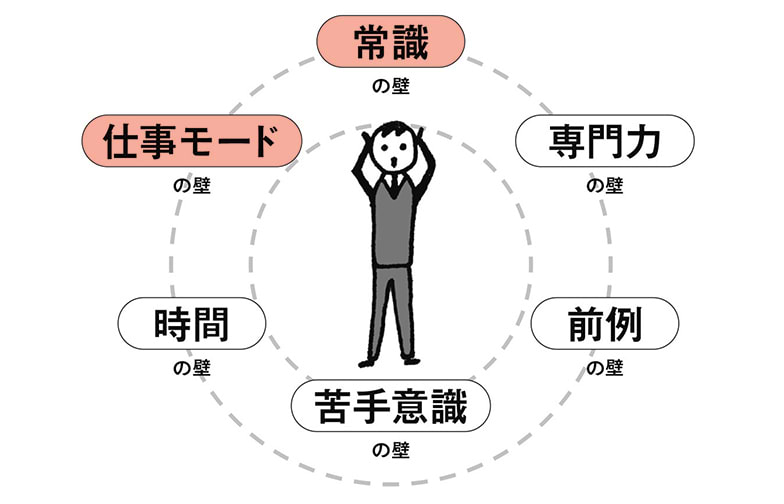
This time a continuation of the previous column , we explore the invisible walls that unconsciously trap us and hinder our ambitions. These walls cannot be dissolved by a simple change of scenery.
However, by strongly recognizing that you are within the wall, you can begin to break free and step outside.
Walls unknowingly narrow our perspective
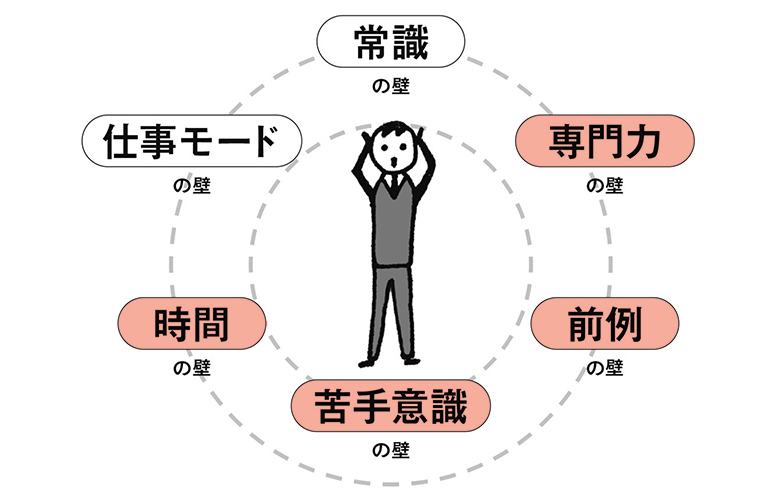
Specialized expertise can be seen as a weapon unique to the individual. Within a team, by pooling these specialized skills, we can generate and evaluate ideas from various angles, ultimately selecting what seems to be the best option.
However, we must also understand that this weapon carries the risk of harming ourselves or our teammates.
Unconsciously, you tend to generate specific ideas within your area of expertise. This happens even though you know that identifying the core issue is the most crucial part of planning.
For instance, during a product briefing, you might impulsively propose TV commercials or web campaigns—a clear drawback of being trapped within the walls of your expertise.
Furthermore, when interacting with others, our own expertise can make us prone to offering harsh opinions. This creates an atmosphere where people feel they should avoid discussing topics outside their own expertise, leading to excessive role division.
Sometimes, you need to put away the weapon of expertise.
Planning is always a race against time. The tighter the deadline, the more panicked you become, and it's true that you can lose your grip on the plan.
In such moments, I recommend first creating a plan that can achieve a solid 70%.
Having a plan you believe can pass the threshold creates the mental space to consider the project from a broader perspective. While you can certainly aim higher by refining that plan, you can also explore different directions.
Personally, when a project lands on my desk, I formulate a tentative answer as a hypothesis that very day.
Human memory fades daily, so advancing your thinking while your memory is still vivid kills two birds with one stone.
I highly recommend developing this habit, as it simultaneously boosts both efficiency and depth.
Beyond the wall lies the planned project
Precedents can be categorized into your own successes and failures, and the successes and failures of other team members. In the previous column discussed the wall of common sense, explaining the former—your own successes and failures—using the term "preconceptions."
However, in business, you are also easily influenced by the precedents of other members.
Examples include statements like, "The previous team proposed it, but it was rejected," or "I don't think that will resonate with that client."
Of course, knowing past information as experience is valuable.
What becomes crucial here is the ability to redefine challenges — the ability to redefine the problem.
If you can make them feel convinced by the newly defined challenge, it's entirely possible that proposals previously rejected could now be accepted. Ultimately, everything boils down to how the challenge is defined.
The biggest hurdle in planning is feeling uncomfortable with it.
This is because the label of "uncomfortable" we place on ourselves often stops our thinking.
In such cases, it's effective to imagine someone around you and mimic how they might think. Some may resist the idea of "mimicking," but since the origin of the word "learn" is "mimic," there's no need to feel aversion.
Using the ideas in this column as a reference means you're mimicking my approach. If any part resonates with you, I encourage you to actively adopt it.
Similarly, I think it's good to observe the methods of people you admire and actively incorporate them.
As you grasp the techniques and gradually become more capable, you'll develop your own successful patterns. When generating ideas becomes enjoyable, your reluctance will fade away before you know it. I've practiced and experienced this myself.
By consciously acknowledging and overcoming these invisible barriers, your ideas gain depth and your plans become more powerful. It's precisely because you're being your natural self that you can create plans born from unique perspectives only you can conceive.