Note: This website was automatically translated, so some terms or nuances may not be completely accurate.
 Planner's Retrospective Talk: What's Been & What's Next [2/3]
Challenges Amidst the Expanding Role of Planners
──As we continue to integrate more and more, the scope of what planners do is actually expanding. I sometimes wonder if the term "planner" itself is still appropriate. Are there any specific challenges you feel are pressing right now?
Kaneda: As the scope expands, the real challenge now is making the earlier discussion of horizontal and vertical integration a reality. We're in an era where planning demands both "horizontal integration" across the 4Ps and "vertical integration" from business strategy through marketing strategy to promotion (i.e., communication) strategy. (See diagram below)
First, horizontal integration has two layers. One is horizontal integration within Promotion, one of the 4Ps. This means integrating touchpoints with consumers. This means integrating all customer touchpoints like advertising, sales promotions, and PR. The other is horizontal integration across the entire 4Ps framework. This involves horizontally integrating pricing strategy, product strategy, distribution strategy, and communication strategy. People who can realistically propose and implement this are rare. Now, regarding vertical integration: this is vertically linking business strategy to marketing strategy and then to promotion strategy.
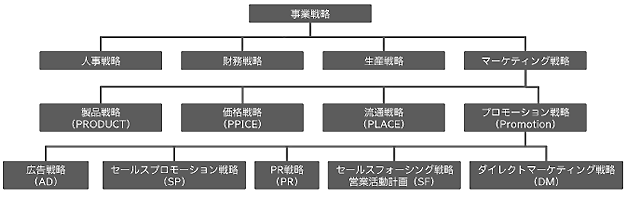
Attempting this requires engaging with management departments, demanding a significant shift in a planner's sense of domain and perspective. The next challenge for planners is whether they possess the knowledge and aptitude to handle this. I strongly feel lately that what's needed isn't just planner skills, but fundamental business acumen.
──Dentsu Inc. calls itself an advertising agency, but has it also evolved to be a company that says, "We solve the challenges our clients face, and we can actually assist with the execution too"? Is that the same idea?
Kaneda: Yes, that's correct. Partly, yes. We take challenges from every angle and concretize them into communication (promotion). However, I said "partly" because, as the diagram shows, advertising is just one means of promotion. Calling ourselves an advertising agency means we're only claiming a very small part of that. Dentsu Inc. has a much broader scope. But within that, another crucial point is this: the more we integrate, the more each department tends to become thinner. Yet, we actually need each department to become thicker. Another crucial role that emerges during integration is the "overlap." How to integrate each department—that "overlap" becomes increasingly vital. This can be replaced by a single planner, meaning as the planner's domain changes or expands, it becomes extremely important to ask: Where do my strengths lie? Where is my origin?
Who was I in the past? What are my current strengths? Taking a bird's-eye view to consider where my domain lies now—first and foremost, understanding oneself is crucial. Precisely because we're in an era of integration, isn't it necessary to grasp and be conscious of "Who am I?"
On the other hand, once the domain of "Who am I?" is clearly defined, you can leverage it in various directions from there. Leverage only becomes possible when you have your foundational strength—your domain. Forgetting this carries a significant risk: you might end up not knowing what kind of planner you truly are.
──If there's something future planners will need, what do you think it might be?
Kaneda: Becoming a professional in what's immediately before you right now. In other words, being conscious of your own domain. Then, having a broad, bird's-eye perspective—an integrative viewpoint. Possessing both of those qualities, I suppose. You can't become a so-called broad-ranging, integrative planner without first becoming a pro in some specific field. And without that bird's-eye perspective, you clearly can't leverage your strengths to create the next integration.
──This might sound rude, but isn't that just basic for working adults? (laughs)
Kaneda: That's true. But surprisingly, it's often hard to pinpoint your own strengths and weaknesses. Surprisingly so.
──So, what's the crucial commonality between planning centered around mass media and today's planning that includes social media?
Kaneda: What's common to all planning is that the "quantity" of thought is crucial. When preparing to disseminate information—deciding what information to share, in what context, and along what path—the amount of possibilities you consider, that "quantity" of thought, is essential. At the conceptual stage, you naturally consider not just one context, but also: What about this context? No, what about that context? What would the mechanism be then? You explore multiple possibilities. This "quantity" of thought is crucial—it's equally vital for both mass media planning and social media planning. It's about taking stock of all possible scenarios and the volume of thought required for that.
On the other hand, the difference in planning between the mass media era and the social media era lies in the ability to respond dynamically. Seeing that this context is quite effective and active, then deciding, "Okay, let's strengthen this context a bit more" – this kind of highly dynamic response was difficult with mass media, but with interactive media like social media, this trial-and-error, or dynamic response, is possible.
──So it's about preparing multiple contexts and changing them on the fly?
Kaneda: It's less about changing contexts while running, and more about the dynamic nature of how, when you introduce a context into the world, highly random elements can emerge. For example, an incident occurs creating a certain atmosphere, or a powerful figure makes a statement. Then, the prepared contexts either gain or lose strength.
So, it's about preparing several contexts and amplifying the ones that gain traction. It's inherently fluid, involving chance, but crucially, these chances only occur because of the necessity you've set in motion. It's a continuous cycle of that interplay.
──That interplay between chance and necessity is the second crucial point.
Kaneda: Yes. With technological advancement, reactions occurring in the world—whether by chance or necessity—have become visible and observable more quickly. Consequently, for those sending messages, it's become easier to design how to move things forward. The means of communication have also increased.
──As a planner, it's better to view this increase in means as a positive, right?
Kaneda: "Yes, that's true. But I do feel it's become more complex. This connects to the idea of 'social economy '—ultimately, social media has enabled very specific groups of people to gather intensely around their shared interests.
Communities are now formed around shared interests, not just local ties. The way we generate the energy to create and activate these communities has definitely changed compared to the mass media era. The perspective on how to mobilize and amplify that energy has shifted dramatically since social media emerged. This phenomenon is something we're experiencing for the first time now.
How this energy is generated and utilized is precisely what companies and brands are currently exploring in their communications strategies.
──In that sense, I think AKB, featured in 'Social Economy', generates this incredible energy. Butlooking at overseas examples in'Brand Community Strategy in the Social Era'by my colleague Keisuke Konishi, I feel Japan still has a long way to go.
Kaneda: It might not quite be a "national phenomenon" yet. There are plenty of cases where specific groups have become wildly enthusiastic, like the B-1 Grand Prix or AKB48. But we haven't yet seen a case where a company or brand created a genuine "wave" that became a national phenomenon for the Japanese public. Maybe that's simply impossible. However, by taking time to build a circle, warming that circle, and fostering a sense of harmony, I believe we could eventually create a festival. Right now, people are working towards that, believing in it and building it, but without seeing results, it's hard to keep going. I think that's the struggle.
──In the conversation betweenDentsu Inc.'s Shusaku Hirota and critic SatoshiHamano, they analyzed the same question: "What exactly is that specific element?" They concluded it likely comes down to the nature of live broadcasts.
The Olympics are the prime example. Beyond the Olympics, AKB, and the general election, what else is there? It's hard to create events that reach that level. For companies or brands to build something like that without it feeling fake must be incredibly difficult. I think even regular consumers are becoming more sensitive to things that obviously feel like advertising. In that sense, I'm really interested in how this will evolve.
Kaneda: There are several challenges. One is finding the right material. The book mentions "mutually beneficial material," but discovering that material is difficult. Why? Because it's not just one piece of material; you need a broad theme while constantly introducing fresh material to keep people engaged. And the reactions are unpredictable.
Another challenge is that it takes time. It's a battle against time, and the will to keep going is what wins that battle. The question is whether you can build a team that can sustain that will.
Therefore, when facing such communication challenges, it's essential to clearly communicate upfront that it will take time and to deliberately avoid rushing things. Rushing leads to burnout. Instead, nurture that harmony steadily, waiting for the right moment to strike – to launch the 'festival' as described in 'Social Economy' and make it a societal phenomenon. The biggest hurdle right now is whether both the client and the planner can share that patience to wait until the moment is ripe. That's the hardest part.
Was this article helpful?
Share this article


Newsletter registration is here
We select and publish important news every day
For inquiries about this article
Author
Ikuko Kaneda
Dentsu Inc.
PR Planning Bureau