
Note: This website was automatically translated, so some terms or nuances may not be completely accurate.
 Introduction to Robotics Business [6/10]
Is Japan a country where robots can easily penetrate? Asratec's Wataru Yoshizaki discusses the future of the robot industry.
Yoshizaki Wataru
Asratec Corporation
Nishijima Yorichika
Dentsu Inc.
In Part 1, we spoke with developer Wataru Yoshizaki about the possibilities offered by "V-Sido OS," software that enables intuitive operation of humanoid robots using a PC with a mouse or joystick, or even a smartphone. In Part 2, we delve deeper into the outlook for the direction in which Japan's robotics industry will develop.
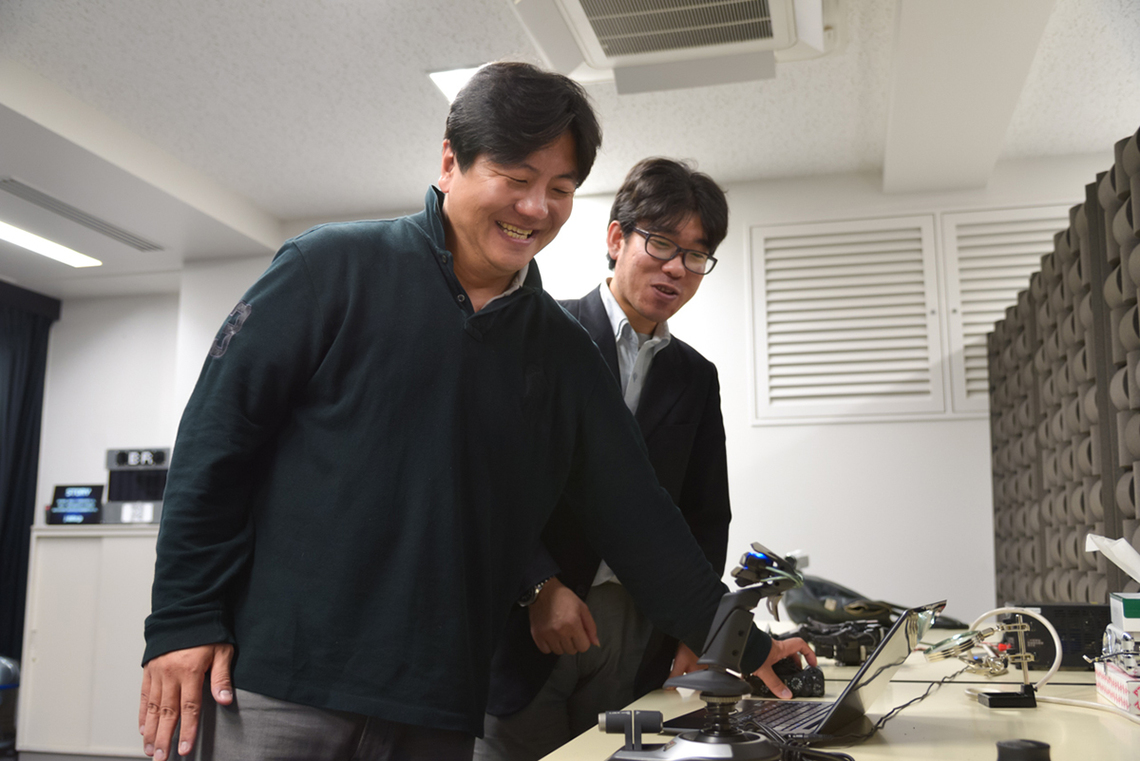
How will it develop in service and communication fields?
Nishijima: At the beginning of our discussion ( ※Part 1 ), we mentioned that Mr. Yoshizaki was the only member in his 20s participating in the "Robot Revolution Realization Council" hosted by Prime Minister Abe. This council includes not only researchers and electrical equipment manufacturers, but also representatives from service sectors where robot utilization is anticipated, such as nursing care businesses and inns.
At d-robo (Dentsu Inc. Robot Promotion Center), we receive many inquiries about the development of robots in service and communication fields—areas where single-function industrial robots are still rare. What directions do you see emerging here?
Yoshizaki: For example, in the inn and hotel industry, utilization is already advancing in the direction of "efficiency," simply replacing human tasks with robots. Front desk operations, which require flexible responses, are often handled by people. However, if these tasks can be transformed into teleoperation and entrusted to robots, it should ultimately lead to the realization of unmanned hotels.
Nishijima: Indeed, efficiency gains are being actively explored, like robots transporting meals in the back of inns. On the other hand, Amazon just announced it deployed 15,000 warehouse robots aiming for up to ¥100 billion in labor cost savings (*). Alongside such efficiency gains, is it possible to use robots to provide added-value services without reducing staff? Regardless of whether that's truly the case, public reaction includes a negative sentiment that "robot advancement will reduce human employment," which I sense is also a concern for companies.
※IT Media "Amazon Releases Video of Latest Logistics Center with Kiva Robots in Action" ( http://www.itmedia.co.jp/enterprise/articles/1412/01/news129.html )
Yoshizaki: Certainly, looking only at specific scenarios like hotel front desk operations, I understand the employment concerns. On the other hand, I believe there are definitely additional services robots can provide, as you mentioned.
But if we broaden our perspective, the development of the robotics industry will create mountains of new jobs. Robots require daily maintenance, and as operational efficiency improves, the number of customers they can handle increases. Consequently, more work will shift to other areas handled by people.
As long as efficiency improves, I believe the wave will inevitably flow in a positive direction. However, it's crucial that Japan takes the lead in pursuing this. As I mentioned earlier ( see Part 1 ), if we fall behind overseas, they'll take all the advantages, and that's something we want to avoid.
First, consider "efficiency gains" through humanoid robots
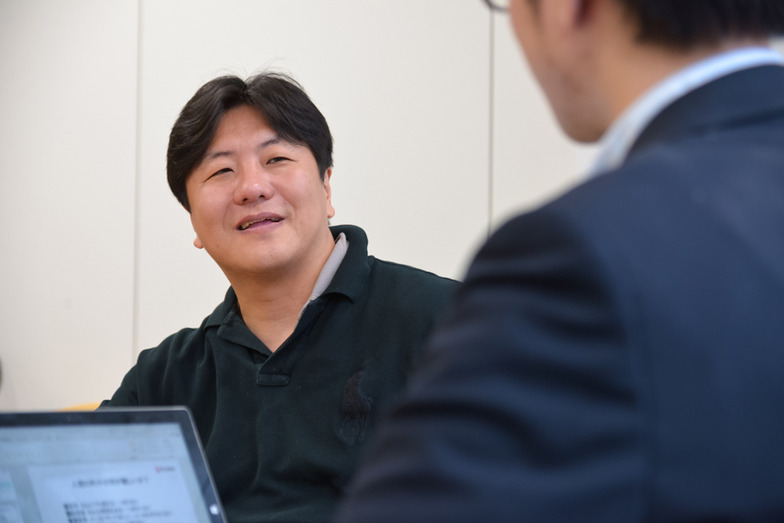
Nishijima: The idea that "efficiency creates new jobs" seems to apply not only to robot use in service and communication fields, but also to industrial robots.
Yoshizaki: Yes, I think that applies to robots in general. There are quite a few scenarios where industrial robots are already being used that could potentially be applied to other fields as well.
One example is the remote operation of heavy machinery using humanoid robots. At construction sites and disaster relief locations, the use of unmanned heavy machinery is being explored for the safety of operators. Rather than developing remotely operable heavy machinery itself, the approach is to develop a humanoid robot suited for existing heavy machinery, equip it with V-Sido, and then operate the heavy machinery by controlling that humanoid robot.
※ Asratec "Robot Equipped with V-Sido Participates in Disaster Recovery Field Verification" ( http://www.asratec.co.jp/2014/12/19/2089/ )
Nishijima: When you say robots for heavy machinery, I imagine the machinery itself becoming robotic and operating autonomously. But here, robots are riding existing heavy machinery instead of humans.
Yoshizaki: Exactly. Modifying the heavy machinery itself would take a considerable amount of time to recoup the costs, and it wouldn't utilize existing heavy machinery, which is expensive and doesn't break down easily. That's why humanoid robots that ride on the machinery are ideal. Even if a disaster occurs somewhere on Earth and only heavy machinery is available there, we can simply pack and send the humanoid robots compactly. This offers low cost and high utility.
The key point here is that the original operator can intuitively remote-control the robot, directly applying their existing experience. Far from reducing jobs, this allows people who can no longer work on-site due to age, injury, or physical limitations to continue working from home.
Nishijima: I see. The absence of "long-distance walking" is also a key point. Some overseas observers argue Japan is overly fixated on humanoid robots, but based on the perspective you just shared, I feel the significance of humanoid robots is indeed substantial. We can likely gain various insights from the field of industrial robots, where practical application is already leading the way.
Yoshizaki: Heavy machinery is one example, but many tools designed for human use have already been developed, and most of these are valuable assets. Simply developing humanoid robots capable of using these tools should significantly streamline operations and enable more effective utilization of assets in many cases.
Robots aren't solely about efficiency, so this is really about the transitional phase as robots become more widespread, but I believe their contribution to efficiency is substantial.Will the operators and users of these robots be organizations or individuals?
Yoshizaki: To clarify expectations for robots, I want to discuss something else. For robots to become increasingly commonplace, I believe we need to consider "robots that won't catch on immediately."
Nishijima: You mean they'll permeate slowly?
Yoshizaki: Yes. More specifically, I mean step by step. To be concrete, I believe separating the operators and users of robots into "organizations" and "individuals," and considering where development will start from, holds the key to long-term market formation.
For example, one type of robot already active is the security robot. Here, both the operator and user are security companies, and the purpose is clear: improving their own workforce efficiency or avoiding risks for employees. If any trouble arises, it can be resolved internally. When everything is contained within an organization like this, implementation is easier.
On the other hand, consider the care sector, which is widely anticipated. Here, the robot users are individuals. Operation also differs: if the setting is a care facility, it's the staff; if it's an elderly person living alone, it's the user themselves. This is distinct from the organization that developed the robot.
Nishijima: Thinking about it that way, it seems like consumer-facing robots won't be realized anytime soon.
Yoshizaki: Users need a certain level of literacy, and there are many issues like operational support and troubleshooting guarantees. It won't be as straightforward as security robots. Therefore, it's reasonable to expect robot utilization to first flourish in fields where "organizations operate and organizations use" them. That trend will gradually shift toward the individual side. Companies entering the market need to be aware of this.
Nishijima: What you just said seems like an important hint for how companies should think when entering the robotics business.
Yoshizaki: Since the market doesn't exist yet and the products aren't available, asking users about their needs won't yield very constructive feedback. Also, when people hear "robot," they tend to think "it can do anything," but achieving that level of capability is as difficult as creating human life. That leads to a dead end when considering which companies could actually build such a robot.
The realistic path, I believe, is for many single-function robots to emerge first, then gradually expand and integrate their capabilities. If a universal robot were to emerge, a realistic direction would be integrating all the electronic devices within a specific space – like just the room itself, or just the store interior for a convenience store. Depending on size, robots have limitations on how far they can move, so thinking in terms of location-based solutions is another viable approach.
The image of "robots as friends" is a uniquely Japanese value
Nishijima: Listening to you, I'm struck by how strongly you hold the perspective that Japan will lead the global robotics industry. How do you perceive Japan's value in advancing the robotics business?
Yoshizaki: Fundamentally, Japanese people tend to be conservative toward the unknown. Even with smartphones, people initially avoided them, saying "I won't use it" because they didn't understand what it could do. But with robots, many Japanese grew up familiar with them through manga and anime, holding a positive image like "robots are human friends." Works depicting "robot invasions," common overseas, are almost nonexistent in Japan. Therefore, I believe that by taking things step by step, we can pioneer the realization of a world where robots are deeply integrated into everyday life.
Nishijima: This ties into the earlier discussion about employment. As robots advance, we also hear negative concerns like "What if they get hacked?" What are your thoughts on this prevailing sentiment?
Yoshizaki: I actually see this as a very positive sign. It shows that insights into robot technology are reaching people with the literacy to recognize such possibilities. It's similar to when personal computers or automobiles became widespread. Isn't it, in a sense, the proper way for civilization to develop – starting with those who understand the risks and can make their own judgments? Through dialogue with such people, manufacturers and other providers can continuously refine their products, which I think is wonderful.
Nishijima: Alongside companies' exploration, as this awareness gradually spreads to ordinary people, it seems a market will develop over the long term.
If many prototypes emerge in the next five years or so, what happens beyond that? Could you share your plans for what you aim to tackle next?
Yoshizaki: First, we're targeting 2020 as a rough milestone. We'll collaborate with various Japanese companies to release a large number of robots into the world—whether it's 200 or 300 units, a mixed bag of quality. The next phase will be one where these are scrutinized, leading to an era where specialized robots for specific fields become established. Within that, we want to consider how much market share Asratec can gain in each field.
Beyond that, I foresee a scenario where robots in specific fields evolve to the point where one becomes "universal"—for example, a care robot that can also serve tea. This would transform the business model of the original care robot developer. Technology can indeed expand business models.
Nishijima: By progressing step by step from single-function devices, we'll reach an era where robots permeate our lives and become commonplace tools. Hearing your outlook, Mr. Yoshizaki, makes that path to the future feel more concrete. Thank you for your insightful discussion.
Was this article helpful?
Share this article


Newsletter registration is here
We select and publish important news every day
For inquiries about this article
Back Numbers
Author
Yoshizaki Wataru
Asratec Corporation
Chief Robot Creator
In 2009, Yoshizaki's project "Acting Instruction Software for Humanoid Robots" was selected for the "Uncharted IT Talent Discovery and Development Project" conducted by the IPA (Information-technology Promotion Agency, Japan), an independent administrative agency under the Ministry of Economy, Trade and Industry (METI). He announced "V-Sido". Based on these achievements, he was recognized as a "Super Creator" by METI as an exceptionally outstanding talent.
In 2010, he joined the Suidobashi Heavy Industries project led by Kogoro Kurata, contributing to the creation of the giant robot "Kratas" (responsible for its control via V-Sido).
In July 2013, he assumed the position of Chief Robot Creator at Asratec Corporation, where he develops V-Sido-related business.
Nishijima Yorichika
Dentsu Inc.
Business D&A Bureau