Note: This website was automatically translated, so some terms or nuances may not be completely accurate.
 Insight Memo [33/65]
Simultaneous TV and Internet Use and Multi-Screen Media Behavior
In recent years, the proliferation of smartphones and tablet devices has made internet usage increasingly commonplace.
In the 26th installment, we introduced survey data on the relationship between television viewing at home and the use of various internet-enabled devices. This time, we present part of the results from our original survey on the relationship between television viewing and the use of online services.
■ Differences in Internet Usage Between "While Watching TV" and "Not Watching TV"
This is somewhat obvious, but when we investigate the proportion of people who are "① using the internet while watching TV" versus "② using the internet without watching TV" at any given moment, almost every survey shows the latter (②) is more common.
Now, let's examine the differences in the breakdown of internet services used while watching TV versus not watching TV. This reveals some interesting findings. Even within the same internet usage context, certain online services show higher usage rates when people are watching TV compared to when they are not watching TV.
Figure 1 highlights several services where usage rates differed between "while watching TV (solid line)" and "while not watching TV (dashed line)" during the time respondents were using the internet.
Figure 1: Usage Rates of Major Internet Services
(By TV Viewing Status)
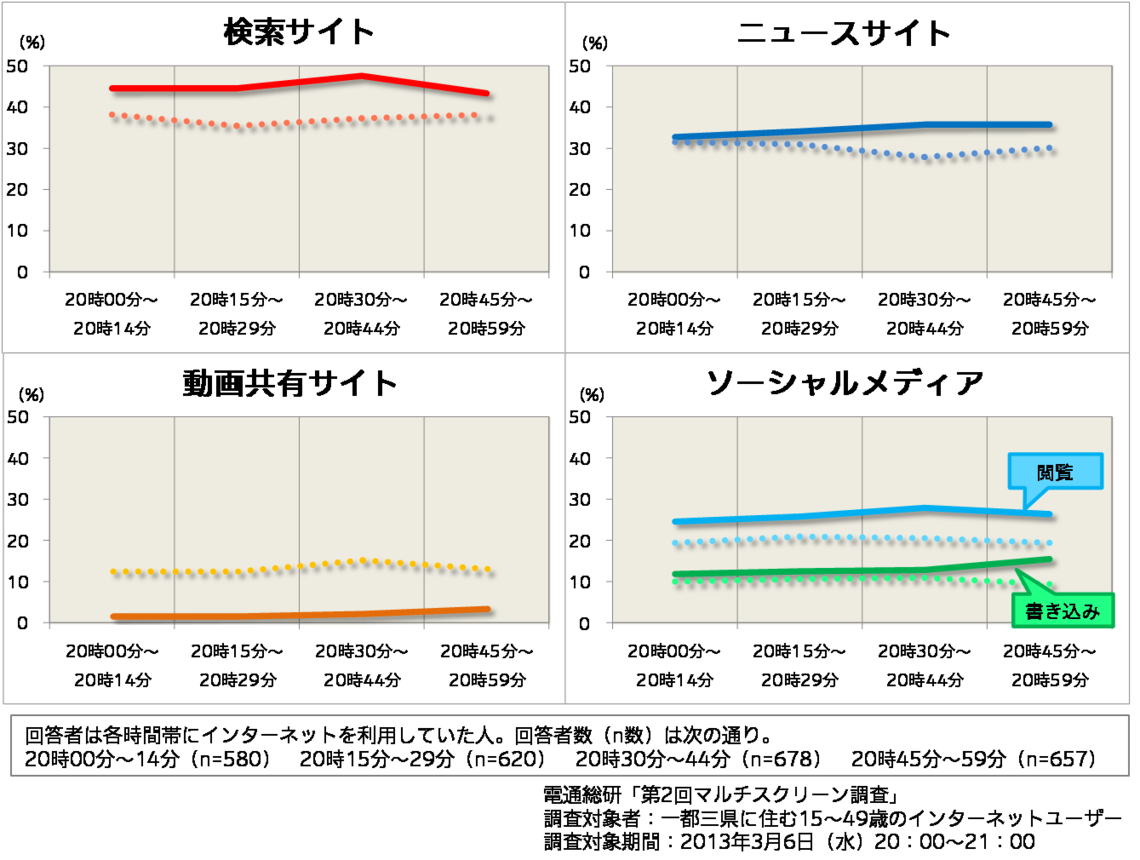
For services in the three categories of search engines, news sites, and social media, the solid line (when watching TV) exceeds the dashed line (when not watching TV). This indicates higher usage rates when watching TV. Conversely, video sharing sites showed higher usage rates when not watching TV.
■TV Viewing Affects Internet Usage Breakdown
Why do usage rates for some online services differ between when people are watching TV and when they are not?
Figure 2 provides a more detailed look at the usage patterns of the three services with high usage rates ("search engines," "news sites," and "social media [viewing/posting]") among the group identified earlier as "① People who used the internet while watching TV." The two horizontal bars for each service indicate usage rates. The upper bar represents users engaged in internet activities related to TV viewing, while the lower bar represents users who happened to be using the internet while watching TV, even if their activity was unrelated to TV content.
Figure 2: Internet Service Usage Rates (All-Day Average)
(By Whether Internet Activity Was Related to TV Viewing)
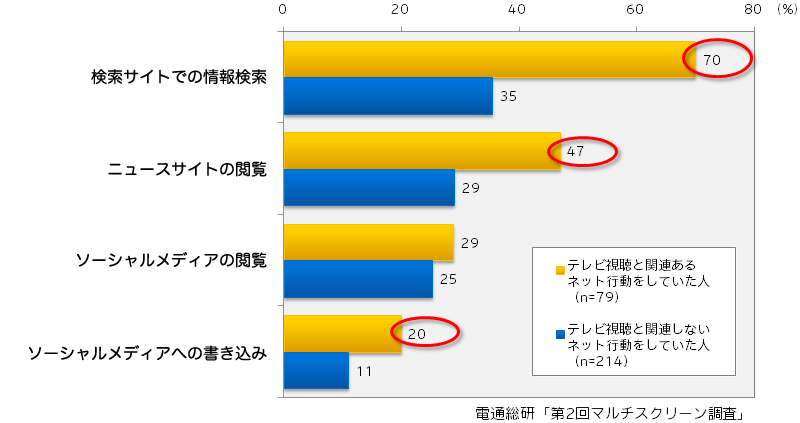
The usage rates for these services are noticeably higher among those engaged in internet activities related to the TV content they were watching, compared to those who happened to be using the internet while watching TV. The "internet activities related to the TV content being watched" mentioned here include actions such as: "Becoming interested in a TV program or commercial and searching for information online," "Looking up the latest news mentioned on a TV program via online news sites," or "Sharing thoughts about a TV program with friends on social media."
Thus, the survey results clearly show that television viewing can indeed trigger simultaneous, active internet use on search engines, news sites, social media, and other platforms.
■Focus on "Multi-Screen" Services
The survey introduced here confirmed, through specific daily and hourly behaviors of consumers, that as internet usage within households increases, a mutual influence relationship has emerged between traditional media like television and the internet.
While the duration and frequency of simultaneous engagement across both TV and the internet are limited compared to time spent exclusively on one medium, the potential for increased simultaneous TV and internet use exists. This is likely to grow as the use of portable internet devices like smartphones and tablets becomes even more prevalent within the home.
New multi-screen services are being conceived that combine the now equally familiar screens of television and internet devices to provide convenience and enjoyment. How these services will expand their usage going forward is a point of great interest.
※This content has been serialized on the Dentsu Inc. website until now, but will be serialized in WEB Dentsu Tsūhō going forward.
Back issues are also available on WEB Dentsu Inc. News.
Was this article helpful?
Share this article


Newsletter registration is here
We select and publish important news every day
For inquiries about this article
Back Numbers

Author

Akira Miwa
Dentsu Inc.
Dentsu Inc. Media Innovation Lab
Director of Media Innovation Research
Insight MemoSmartphones and the JapaneseShiodome Media Researcher CommentaryThe Future of Visual Communication with Dominique ChenThe Future of Video ServicesSmartphones: A Decade of Creative DestructionMedia Behavior Data × Social Sequence AnalysisThe 30 Years of the Heisei Era: The Transformation and Innovation of Information MediaThe Reiwa "New" Era! Where is the Media Society Headed?