Note: This website was automatically translated, so some terms or nuances may not be completely accurate.
 Insight Memo [32/65]
Niigata Prefecture Original Survey and Metropolitan Area Existing Surveys (d-camp, ACR, MCR) Potential in Area Communication Seen Through Media Contact Comparison
〈 Publication Date: November 7, 2013 〉
■ Focusing on Media Exposure in Local Areas vs. the Greater Tokyo Area
The era of local communities is quietly approaching. This is an age where "Satoyama Capitalism" became a bestseller and community design is gaining attention. Initiatives like installing high-speed internet infrastructure in marginal villages to attract satellite offices of venture companies are drawing interest.
Moreover, in recent years, local areas have skillfully leveraged media to elevate local idols and local mascots to national prominence, increasing opportunities to encounter diverse local information.
One factor behind this is said to be the narrowing of the information gap between local areas and the metropolitan area compared to the past, thanks to the spread of the internet.
So, with this narrowing information gap creating similar environments for information consumption and dissemination in both metropolitan and local areas, how do media consumption patterns actually differ between residents of these two regions?
Therefore, DENTSU SOKEN INC. conducted its own media exposure survey in local areas (*1). By comparing and analyzing this local area (*1) media exposure survey with data from Video Research Ltd.'s survey on the "daily lives" and "media exposure" of residents in the metropolitan area (Kanto urban area), we highlighted media exposure patterns in local areas (*1). This revealed distinctive characteristics, which we present here along with the data.
*For this survey, Niigata Prefecture was selected as the "local area" model region based on population, area, media environment, and sample availability. See [Survey Overview ②] for details.
≪Data Topics≫
■ Characteristics of Media Contact in Local Areas
1. "360° Omnidirectional Multi-Type" Media Contact Style
【Television】
● Watches for a certain amount of time almost every day
● Over 50% watch for 2 hours or more even on weekdays
● Compared to the metropolitan area (Kanto urban region), more viewing occurs in private rooms
● Compared to the Greater Tokyo Area (Kanto urban area), "local information" is watched across all age groups
【Radio】
● 66% listen to radio, with a higher frequency than in the Tokyo metropolitan area (Kanto urban area)
● Even among teens, the lowest group, nearly half listen
● 60% listen via car radio
【Newspapers】
● Newspaper readership stands at 77%, with over half of younger generations reading morning editions
● People spend more time reading on weekends than on weekdays
● Articles about local/regional topics are read more frequently than in the Tokyo metropolitan area (Kanto urban areas)
【Magazines】
● About half read magazines at least once a month
● Over half spend less than 30 minutes reading per day
● 30% take action after reading magazines, such as purchasing products, using services, or entering contests
【Insert Flyers】
● Reading rate is about 80%, exceeding the roughly 60% rate in the metropolitan area (Kanto urban region)
● Reading frequency is particularly high among teens to those in their 40s
● Over half read flyers at least twice a week
● 40% purchase new products after seeing insert flyers
【Free Papers/Free Magazines】
● Free paper readership is 56%, exceeding the approximately 40% rate in the metropolitan area (Kanto urban region).
● Primarily sought for "local information" such as shopping and outings
● Free papers delivered via newspaper inserts or door-to-door distribution are frequently read
● 30% decide which companies or stores to use after seeing free papers or free magazines
【Internet】
● About 60% use the internet for over 1 hour per day
● Smartphone ownership rate is about 30%
● Twitter, Facebook, and LINE are popular among younger users; 20% of those in their 40s also use them
● About 50% purchase new products after seeing them online, and about 40% "access the website"
As shown in the above data, media exposure in local areas (※1) tends to be comprehensive across all media types, including "TV," "radio," "newspapers," "magazines," "flyers," "free papers/magazines," and "the Internet." Exposure rates for "newspapers," "flyers," "radio," and "free papers" were over 5 percentage points higher compared to the metropolitan area (Kanto urban area).
2. Media engagement follows a "middle-of-the-road" style
While contact rates for "TV," "Radio," "Newspapers," "Magazines," "Flyers," "Free Papers/Free Magazines," and "Internet" are high, contact time is slightly lower than in the metropolitan area (Greater Tokyo). This indicates a characteristic of balanced, consistent contact with each medium, neither excessive nor insufficient.
Insights from media contact in local areas (*1)...
- A local area (※1) media engagement style suited for 'cross-communication'
- The power of local newspapers and flyers is immense; "prefectural media" is "print media"
■ Insights on media contact in local areas (※1)
People in local areas (※1) have established lifestyles and foundations that involve comprehensive, consistent contact with various media, more so than those in the metropolitan area (Kanto urban area).
DENTSU SOKEN INC. believes that local areas (※1) exhibiting these media contact characteristics possess properties that make them particularly effective, efficient, and conducive to achieving results in 'Cross Communication', without being inferior to the metropolitan area (Kanto urban region).
Furthermore, it has become apparent that media outlets in local areas (*1) accurately capture the needs of residents. Additionally, "print media" and "local information" are highly compatible, with print media being particularly favored as the "medium for obtaining local information."
Recently, even in local areas (*1), where internet access levels are comparable to the metropolitan area (Kanto urban region), print media has maintained its unique position without being threatened by digital media. This is likely because print media has permeated the lives of people in local areas (*1) as a 'prefectural media'.
As explained above, we have demonstrated that the "cross-communication" approach, which has historically been focused on large-scale campaigns in metropolitan areas, holds significant potential for achieving effective and efficient communication even in area-specific campaigns within local areas (*1). We have also shown that print media, rather than being diminished by digital, exists as a "prefectural media" deeply rooted in the local community's daily life. This survey also identified other factors, such as "media that particularly influence purchasing decisions (across several target categories) in local areas (*1)."
DENTSU SOKEN INC. continues to believe that the characteristics and uniqueness of local areas are a vital source of energy for Japan. We intend to explore the potential of local areas from various media-related perspectives.
*For this survey, Niigata Prefecture was selected as the "local area" model region based on population, area, media environment, and sample availability. See [Survey Overview ②] for details.
[Survey Overview ①]
● Survey Method: Internet survey
● Survey Participants: Men and women aged 10 to 60 residing in Niigata Prefecture at the time of the survey
● Sample Size: 1,600 respondents
Samples were collected to closely match the population composition ratio based on the 2010 National Census.
Weighted back calculation was performed because some sample segments fell below the population ratio.
・Number of samples collected

・Sample size after weighting

● Survey period: March 2013
● Survey organizations: DENTSU SOKEN INC., Dentsu Marketing Insight
【Survey Overview②】
● Regarding Niigata Prefecture as the Model Area for "Local Areas"
● Niigata Prefecture was selected as the model area for discussing local areas based on population, area, media environment, and sample availability.
● Niigata is an area not covered by existing surveys (d-camp, ACR, MCR) primarily targeting major metropolitan areas.
● Population: 2,349,485 (14th largest in Japan)
● Area: 12,582 square kilometers (5th largest in Japan)
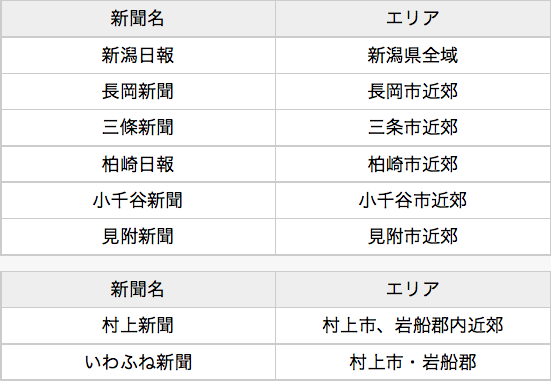
● Media Environment
<Terrestrial TV>

<Radio>

<Major Regional Newspapers>
【Survey Overview③】
● Comparison Method with the "Metropolitan Area (Kanto Urban Area)"
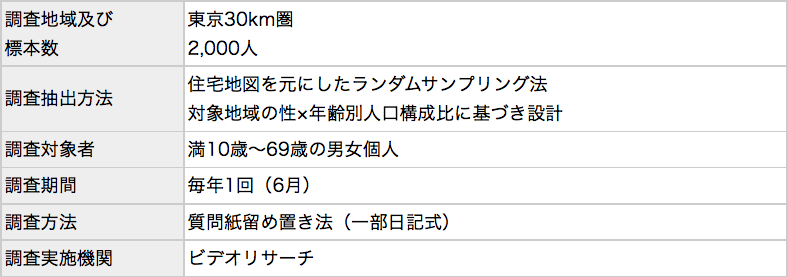
● Comparison with corresponding data from d-camp and MCR. Regional comparisons were not conducted for questions where differences in survey methodology made comparison difficult.
<d-camp Kanto>
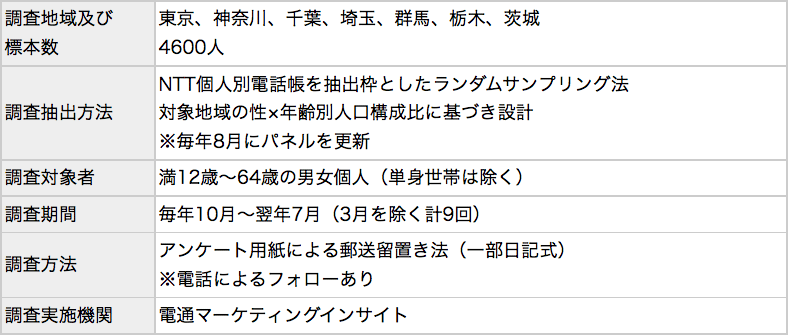
<MCR Kanto>
Was this article helpful?
Share this article


Newsletter registration is here
We select and publish important news every day
For inquiries about this article
Back Numbers
Author

dentsu Media Innovation Lab
Dentsu Inc.
Insight MemoSpecial Discussion: "Japan's Advertising Expenditures"Explore the Amazing World of YouTube Creators with UUUMInformation Media White Paper 2024: The Rapidly Changing Media Environment and Consumers100 years since its birth. Radio, today...College Students and the Future of Media, Communication, and Advertising in Ten YearsInformation Media White Paper 2025: New Horizons in Communication Shaping the FutureInformation Media White Paper Special Report 2026: “The Current State of Evolving Information Trends”