Note: This website was automatically translated, so some terms or nuances may not be completely accurate.
 Insight Memo [34/65]
What are the media behaviors of "Yesoto"?
The recent proliferation of smartphones has been remarkable, significantly altering how people behave outdoors. You notice more people walking or riding trains in the city with their eyes downcast, smartphones in hand. Based on the hypothesis that this smartphone proliferation has significantly altered the media environment outside the home, we categorized the space outside the home as "Yessoto" – seven distinct scenes (city streets / while driving / while riding in vehicles / inside trains/buses / inside stations / during schooling/work / inside facilities) – and examined the media contact environment within each.
■Over half of Japanese people are smartphone users
The nationwide average smartphone penetration rate has already exceeded 50%, reaching 50.8% (Figure 1). By prefecture: Tokyo 52.9%, Kanagawa 55.2%, Chiba 56.1%. In the Kansai region: Osaka 53.8%, Hyogo 52.3%, Nara 50.0%. Fukuoka Prefecture (including Fukuoka City, which was an early adopter of subway internet access) recorded 48.8%. Prefectures with relatively large populations show higher adoption rates. The development of high-speed communication environments like Wi-Fi and LTE in recent years has also contributed to this trend, suggesting that the behavior of consumers who have started using smartphones has changed. As evidenced by the increased PR activities aimed at preventing "distracted smartphone use" at stations and in public spaces, it is clear that smartphones are increasingly capturing consumers' attention in their daily lives.
Figure 1: Smartphone Penetration Rates in Major Prefectures and Top-Ranking Prefectures

■Smartphones Increasing Their Presence at Home
We gained a macro-level understanding of the information consumption behaviors consumers engage in during "home time" (Figure 2).
Figure 2: User Rates and Contact Duration for Major Information Media Outside the Home
(Table side: Information sources accessed; Table header: Out-of-home scenarios)
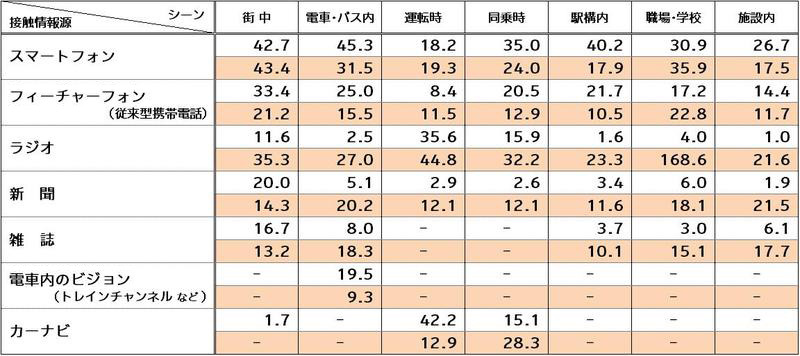
As a result, we found that smartphones are the primary reach medium for "Yesoto" from both the perspective of user rate and contact frequency. Except for relatively low usage during driving, smartphones have the highest usage rate for "Yesoto." Furthermore, smartphones show high contact rates with consumers on public transportation, such as 45.3% during use on trains/buses and 40.2% while inside stations. Indeed, it's a fact that many consumers are engrossed in social media or social games on their smartphones during daily commutes. Recent improvements in Tokyo subway communication infrastructure, enhancing mobile device convenience, likely contribute to this trend. Meanwhile, feature phones (traditional mobile phones) still maintain relatively high usage rates: 33.4% in [Urban Areas] and 25.0% on [Trains/Buses].
So, what are "Yesoto" users doing with their smartphones and mobile phones?
On trains and buses, 47.2% browse news sites. For SNS usage, LINE is at 34.1%, Twitter at 19.9%, and Facebook at 14.6%. In the city, email services are at 44.7% and calls at 39.2%. Inside stations, transfer map searches stand out at 34.6%, highlighting information-seeking behaviors unique to stations. While driving, phone calls accounted for 36.2%, email services 28.7%, and browsing news sites 22.3%. Drivers generally have lower usage rates because the law prohibits them from focusing on fixed devices like car navigation systems, not just mobile phones. However, using hands-free phones via Bluetooth or email read-aloud services does make phone calls and email services possible.
■Homework × Smartphone = ?
Recent "Yesoto" data reveals smartphones have a high contact rate among many information sources, dominating consumers' visual information intake. For example, initiatives linking station-based advertising with smartphones and O2O-style communication bridging physical stores and online platforms are expected to gain traction. Smartphone proliferation is accelerating changes in information behavior among consumers in recent "Yesoto" settings, making the ability to capture these shifts an increasingly critical factor. A battle for consumers' attention is already underway beneath the surface in the "iesoto" space.
*Survey Overview
・Survey Period: August 31 - September 1, 2013
・Survey Method: Internet survey
・Survey Participants: Men and women aged 15 to 69
・Survey Area: Nationwide
・Valid Sample Size: 2,400 respondents
Was this article helpful?
Share this article


Newsletter registration is here
We select and publish important news every day
For inquiries about this article
Back Numbers

Author

Manabu Tachiki
Dentsu Inc.
Future Business Research Institute
Insight MemoOmni-Viewing of Accelerating VideosShiodome Media Researcher CommentaryDigest of the Opening Feature: 'Information Media White Paper 2016'Women's Audience Insights Special FeatureExploring Pathways from the "Quality of Society Survey" to a "Society" Where People Find Meaning in LifeCurrent State of Public Awareness and Values as Seen in the "Quality of Society Annual Survey 2021"DENTSU DESIRE DESIGN's Approach to Marketing Reconstruction Based on "Theory of Desire"Building the future begins with visualizing the will of the future.