Note: This website was automatically translated, so some terms or nuances may not be completely accurate.
 Insight Memo [62/65]
The Reality of Today's Elementary School Children: "Digital Kids"
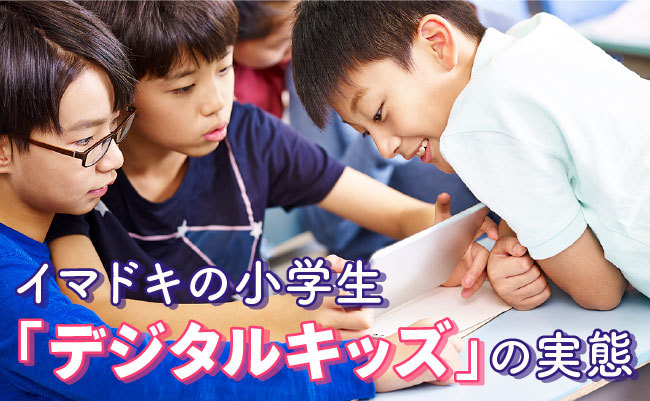
Take me somewhere with Wi-Fi!
At Dentsu Inc. Media Innovation Lab, we continuously research the rapidly changing media environment and shifts in audience behavior.While our research targets are diverse, "younger generations" are among the most critical targets shaping the future of Japanese information behavior. Since 2010, we have pioneered research in collaboration with Professor Yoshiaki Hashimoto of the University of Tokyo's Graduate School of Interdisciplinary Information Studies, developing terms like "Neo-Digital Natives" and "Post-Digital Natives."
Building on this lineage of youth research, we launched a new project: the "Elementary School Students and Media Survey" (commonly known as the Digital Kids Survey), conducted from November to December 2017. What emerged from this survey included children watching YouTube on the TV first thing in the morning or, while out, saying, "I want to go somewhere with Wi-Fi!"So, what exactly is the media environment surrounding today's elementary school students? This time, we'll share several findings extracted from the results of this survey.
"Asking Moms" Survey Method
Regarding the survey method: the research team grappled with how to survey elementary school children, who are fundamentally unfamiliar with (or have almost no experience with) "responding to surveys." After much deliberation, we decided to conduct the survey online with "mothers" nationwide who have children in elementary school (grades 1-6).For questions requiring direct knowledge of the child, mothers were asked to inquire and provide answers on their behalf. Note that when respondents had two or more elementary school children, they were instructed to answer based on the eldest child.
In addition to this "quantitative survey" where we collected data, we also conducted a "qualitative survey" (group interview survey, hereafter referred to as group interview). For this, we invited mothers of elementary school children who frequently use digital devices to gather at the group interview venue. The format involved parents speaking on behalf of their children about their usual behavior.
Moving to the results, we will refer to children who use all three devices—PC, smartphone, and tablet—at home as "Super Digital Kids," and those who use any one of these devices as "Digital Kids" (regardless of whether the device is personal or shared).
Children who do not use any of these devices at home will be called "non-digital kids" (they may still use one outside the home, such as at school).
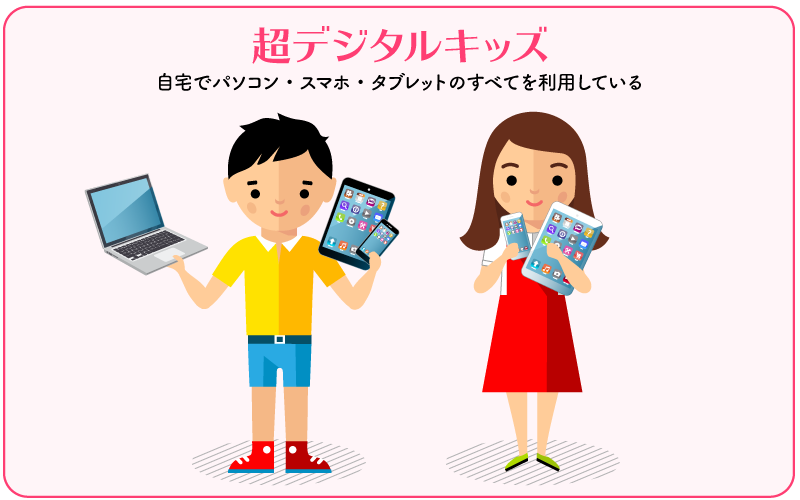
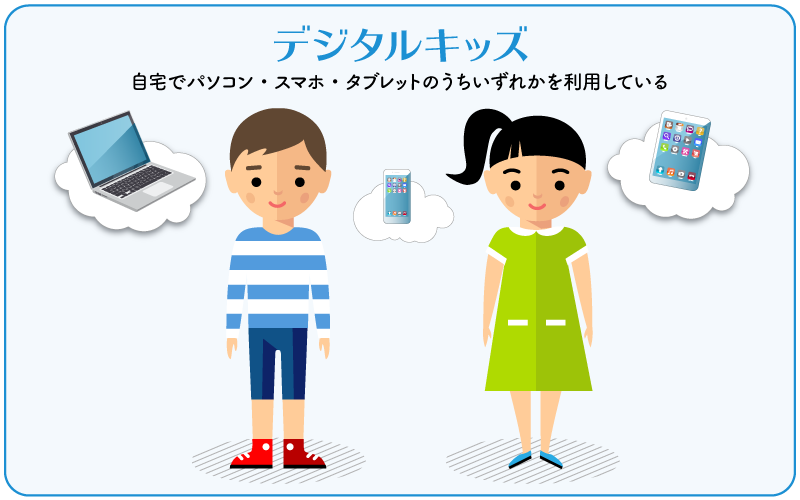
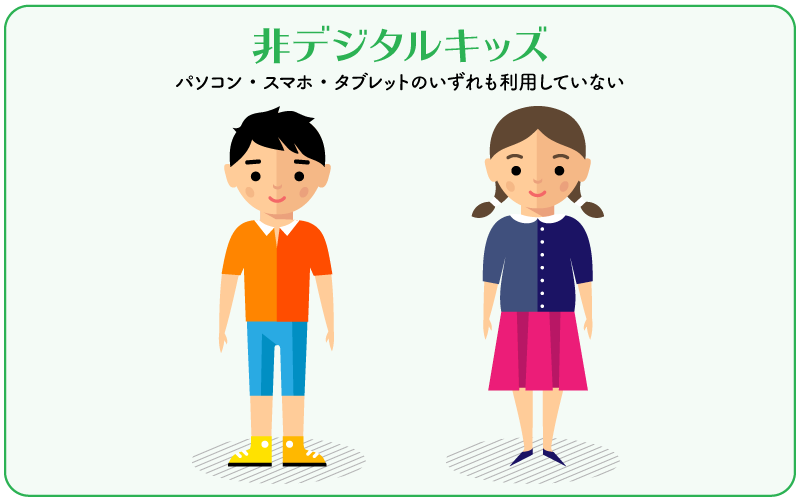
Digital technology is permeating even elementary school students' lives.
First, the overall rate of digital kids (i.e., the proportion) among all first to sixth graders was 72.5% (Figure 1). This means that over 70% of elementary school students now use some form of computer, smartphone, or tablet at home (27.5% do not use any, i.e., non-digital kids).
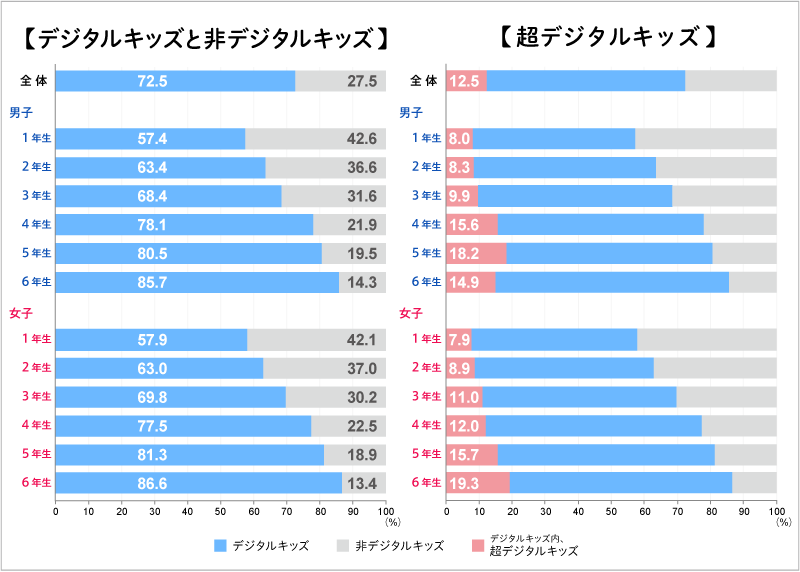
Meanwhile, super digital kids who use all three devices accounted for 12.5%, reaching about 20% among sixth-grade girls (Figure 1). Furthermore, digital usage steadily increases with each grade level, clearly showing that the digital wave is now steadily permeating even elementary school students.
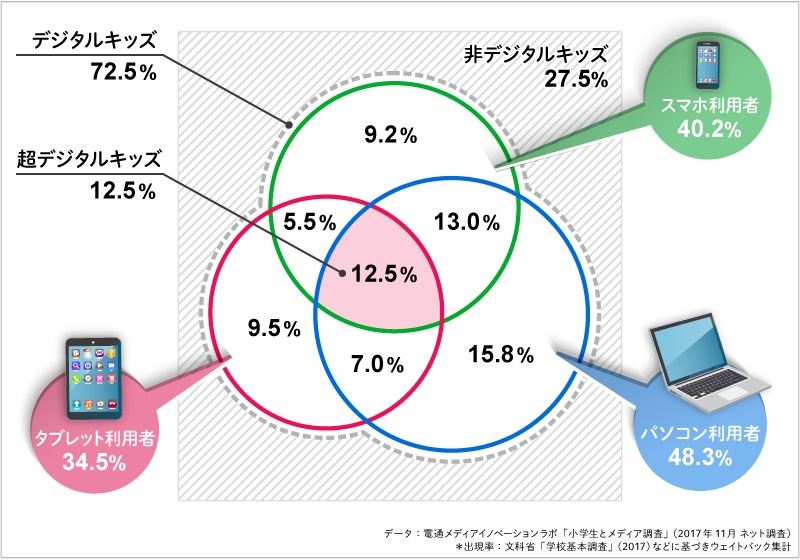
Figure 2 shows the individual usage rates and overlap rates for PCs, smartphones, and tablets. For example, smartphone users account for 40.2%, and the overlap rate between smartphone and tablet users is 18.0%. Note that regarding PC usage rates, the overwhelming majority involved shared family computers, not dedicated personal (child-only) devices.
Elementary school students spending a day immersed in digital devices
So, how do children interact with their various devices in their daily lives?
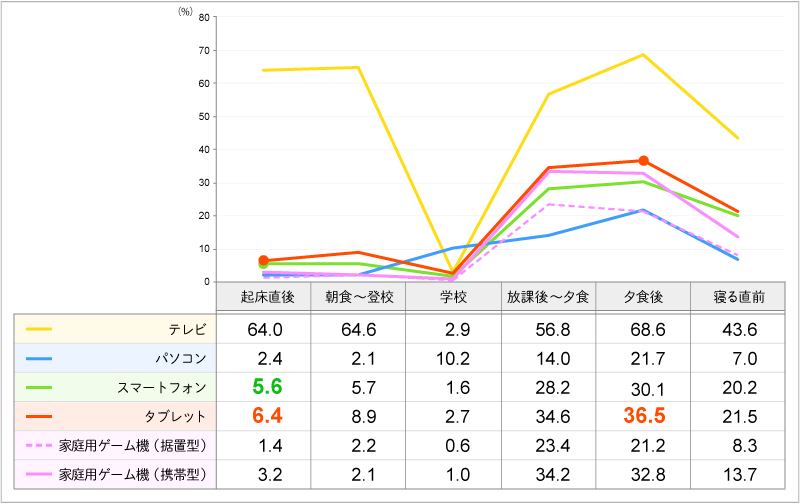
According to this survey, among ultra-digital kids on weekdays, 6.4% touched a tablet immediately after waking up, and 5.6% used a smartphone immediately after waking up (Figure 3). Tablet use after dinner reached as high as 36.5%, and about 20% of children touched smartphones or tablets right up until bedtime. When going out, 30% "want to go to places with Wi-Fi."
During group discussions, we heard about children who watch YouTube on the TV before even having breakfast after waking up. We also observed cases where they use smartphones or tablets alongside this, starting their day with YouTube and ending it with YouTube, continuing from after dinner until bedtime.Incidentally, regarding what kind of videos they watch on YouTube: for boys, it's mostly "YouTuber-style content" or "game playthroughs/strategy guides." For girls, it's similarly "YouTuber-style content" or "how-to videos for making squishies," among other things.
Chat activity via smartphones is especially active among girls. The following raw comments reveal their interactions with school friends:
"When I get home, we all chat on LINE. Mostly we confirm what to bring to school tomorrow and what to wear. We discuss things like 'Let's all wear jeans' or 'Let's wear white tops'." (5th grade girl)
"We take pictures of our rooms and outfit coordination and send them to each other." (5th grade girl)
Some children demonstrate highly advanced media behaviors. They are very skilled at using devices, showing high levels of literacy. Examples include "connecting the TV to the internet via a game console" to enjoy online videos on the TV's large screen, or "wirelessly transferring videos from smartphones or tablets to the TV."
Furthermore, this survey reveals that parents of digital kids are taking measures to protect their children from societal dangers and disruptions to daily life. These include restricting access to inappropriate websites and setting specific times when devices can be used.
What is the relationship between today's elementary school students and television?
We've highlighted the high level of digital literacy among elementary school students, but now we'd like to touch on their relationship with the traditional medium of "television."
Looking again at Figure 3, we see that even among these super-digital kids who heavily use digital devices, television remains the medium with the highest contact rate for most hours of the day outside of school. This shows that even the most digitally savvy children consider television the number one medium in terms of reach.
Furthermore, when asked about the indispensability of four digital devices—TV, PC, smartphone, and tablet—TV overwhelmingly topped the list in terms of perceived necessity.
When asked "Where do you watch TV?" (multiple answers allowed), approximately 98% of all children—from ultra-digital kids to non-digital kids—answered "in the living room." This suggests the traditional family gathering around the TV in the living room, the classic "living room scene," remains very much alive today (though about 10% of ultra-digital kids answered "in my own room").
We've introduced the realities of today's elementary school students, but there's one final point worth adding. While deeply immersed in digital life, these children simultaneously possess a very "real-life-focused" aspect.
For example, when asked via Gluin about current trends among them, boys mentioned "baseball," "soccer," and "kendama," while girls cited "making squishies" and "dancing (hip-hop, twin dances...)". Therefore, it's important to note that viewing today's elementary schoolers solely as "virtual-only" or "internet geeks" risks misinterpreting their reality.
[Survey Overview]
● Quantitative Survey (November 2017)
Region: Nationwide
Method: Internet survey targeting mothers with children in grades 1 through 6
Sample size: 5,728 people (3,682 digital kids, 2,046 non-digital kids)
● Qualitative Research (December 2017)
Region: Tokyo and three neighboring prefectures
Method: Group interview survey, mothers of children in grades 4–6
Sample Size: 12 participants (6 mothers of boys, 6 mothers of girls)Sample size: 12 people (6 mothers of boys, 6 mothers of girls)
Was this article helpful?
Share this article


Newsletter registration is here
We select and publish important news every day
For inquiries about this article
Back Numbers
Author

Yoshihide Nagao
Dentsu Inc.
Dentsu Inc. Media Innovation Lab
Director (Audience Research Organization Leader)



dentsu Media Innovation Lab
Dentsu Inc.
Insight MemoSpecial Discussion: "Japan's Advertising Expenditures"Explore the Amazing World of YouTube Creators with UUUMInformation Media White Paper 2024: The Rapidly Changing Media Environment and Consumers100 years since its birth. Radio, today...College Students and the Future of Media, Communication, and Advertising in Ten YearsInformation Media White Paper 2025: New Horizons in Communication Shaping the FutureInformation Media White Paper Special Report 2026: “The Current State of Evolving Information Trends”