
Note: This website was automatically translated, so some terms or nuances may not be completely accurate.
 App Reference Book [1/7]
The Seven Principles of Good Apps ①: The purpose can be stated in one sentence.
Masashi Yamasaki
Fuller Co., Ltd.
As many companies pursue digital transformation, the shift toward mobile as the primary customer touchpoint is accelerating. Apps are becoming increasingly vital, with research showing the average user installs 41 apps per month and spends 4.8 hours daily using them (*1).
In this series, we interview Fuller Inc., which collaborates with Dentsu Inc. on app development. For the first installment, we hear from Fuller's President Yamasaki, who has been tracking apps since the dawn of the iPhone era, about the "Seven Principles of a Good App."
(Planning: Dentsu Inc. 8MK Bureau, Makoto Sasagawa, Yosuke Otsubo, Yuki Sugiyama)
Fulla Inc.
Fulla supports corporate business initiatives in the digital domain, with app design and development as one of its core services. They meticulously analyze apps and their markets, handling everything from strategy development to product creation and growth. Their creative teams—comprising engineers, designers, data scientists, and directors—produce outstanding apps for diverse companies.
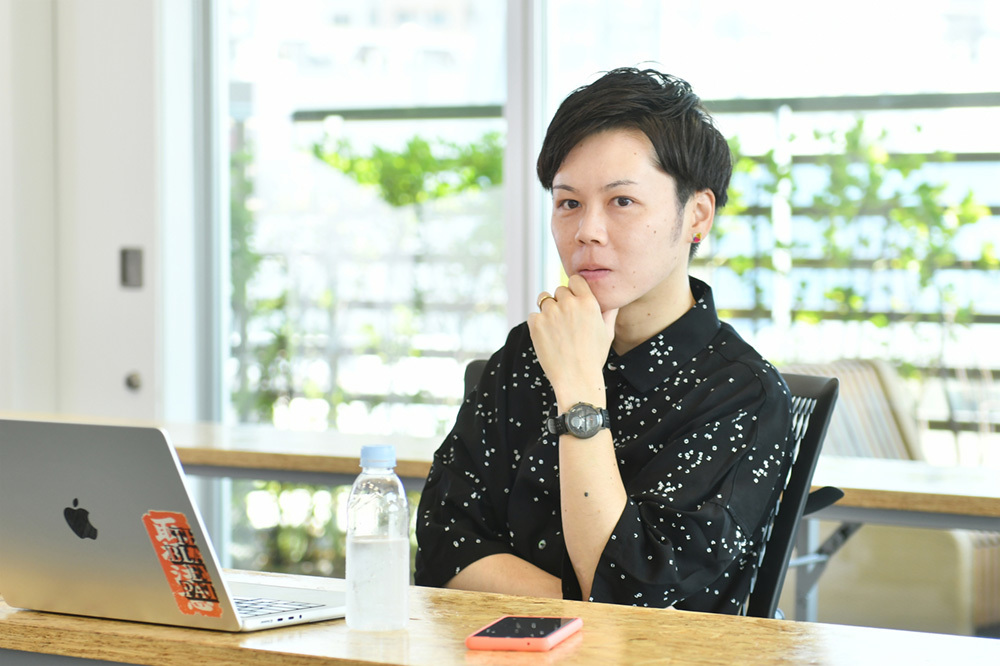
What are the 7 principles of a good app?
I've been involved in app development for over 15 years since my university days. While developing various apps, I felt there weren't many established criteria for evaluating their quality. Of course, they weren't entirely absent. For usability, a prominent example is the "Ten Usability Principles" proposed by Jakob Nielsen, an American Ph.D. in engineering. These principles are broadly as follows:
Ten Usability Principles (Fowler's Research)
- Visually convey the service's status in real time
- Communicate information using familiar words and meanings
- Allow users to undo mistakes and navigate freely
- Maintain consistent and common design
- Prevents operational errors
- Can be understood without relying on memory
- Accessible to both beginners and advanced users
- Minimalist and aesthetically pleasing design
- Assists users in recognizing and recovering from errors
- Provides help and manuals
However, I personally feel that while these principles help reduce negative aspects of an app, they fall short when it comes to adding positive elements. Beyond the above 10 principles, I believe there should be additional criteria to meet in order to get more people to use the app. Therefore, drawing on my experience in app development, I have formulated the following seven criteria as "conditions for a good app."
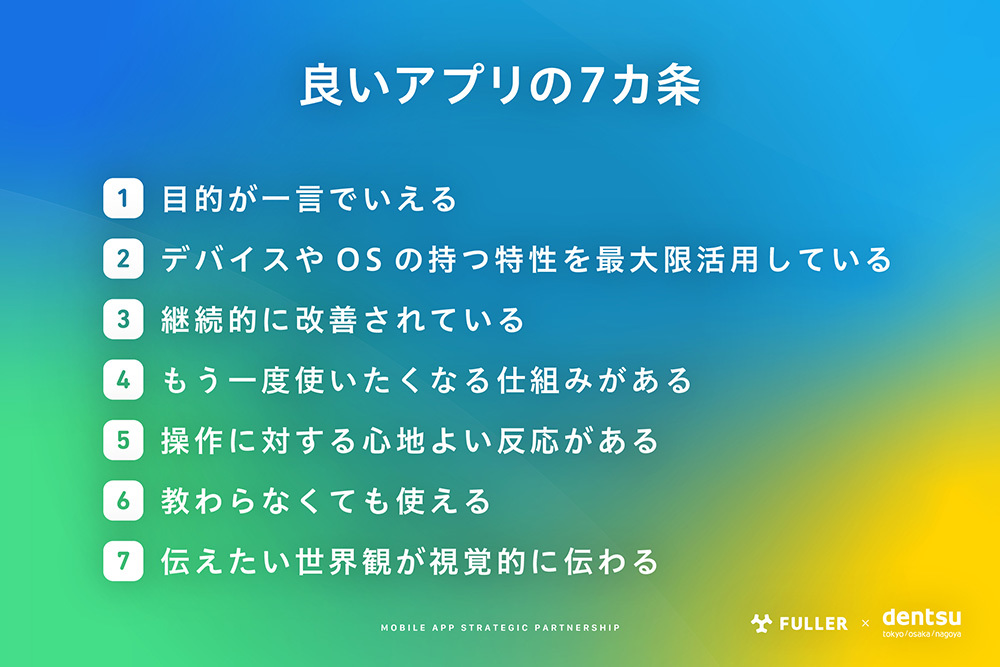
I believe an app can be considered good if it meets even one of these seven points. Naturally, meeting as many as possible makes it even better. In this series, I will explain each of these seven points one by one, using specific app examples.
The Seven Principles of a Good App ①: Its Purpose Can Be Stated in One Sentence
This time, we'll explain the first principle: "The purpose can be stated in one sentence." Among the seven principles, this is one we particularly focus on during our daily app development. Clearly defining what the app is for makes it easier for people to use it.
For example, "You absolutely open this app at this store," or "You absolutely use this app when performing a certain action." When the purpose can be stated in one sentence, users can easily explain it to others, increasing the likelihood of gaining more users. I feel that many apps widely and long-term used by people around the world meet this condition.
However, many apps today boast rich features yet remain unclear about their core purpose. This likely stems from fears that users won't adopt the app without various functions and information, or the belief that offering more capabilities makes it more convenient and attracts more users. Ironically, this approach can obscure the app's purpose and risk driving users away.
Adding features is relatively easy in app development, but removing a feature once users have adopted it requires considerable resolve. A designer once said, "Reducing features requires philosophy," and this is true. Reducing features cannot happen without someone proposing it with the strong conviction that "removing it will make it better." Furthermore, when an app has multiple purposes, it becomes difficult to perform accurate analysis of the app and its users.
When we approach app development, we focus on identifying core functions, stripping away everything else, and aiming to release with as few features as possible. This approach makes it easier to determine whether users will genuinely utilize those features.
Two Apps with Clear Purpose, Loved for Years
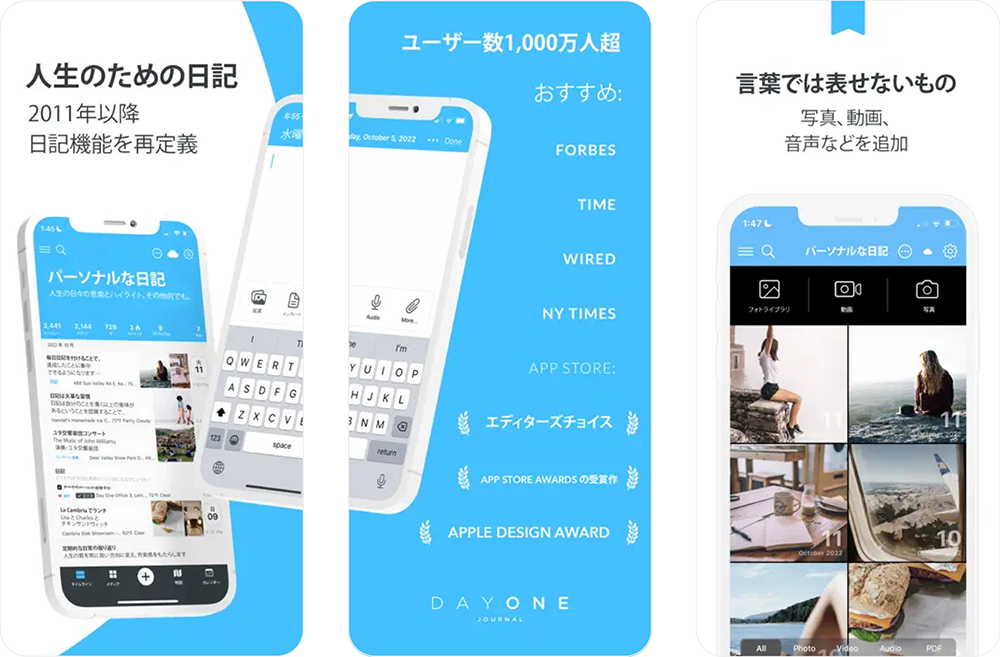
Two products stand out for their ability to articulate their purpose in a single sentence. One is the journaling app "Day One Journal," released by an American company in 2011. It won Mac App of the Year in 2012 and the Apple Design Award in 2014, and remains an excellent app with ongoing updates. As of 2021, it has been downloaded over 15 million times worldwide since its release (*2).
The strength of this app lies in its focus on the core function of "writing a journal." Many journaling services, in pursuit of diversification and monetization, tend to add features like sharing capabilities or intrusive ad placements—elements that risk distracting from the essential purpose of a journaling service. This app, however, concentrates solely on "writing a journal in private, undisturbed," continuously enhancing that core functionality.
Another is "Substack," a service for distributing and subscribing to email newsletters. "Substack" was launched by an American company in 2017, with the iOS app released in 2022.
This app is primarily focused on subscribing to email newsletters. The newsletter content itself can only be written on a PC browser; the app is mainly for receiving them. While you can write simple comments about the received newsletter content or send chat messages, these are secondary features. The design allows users to concentrate on reading what they want without being distracted by ads or comments from people they're not interested in.
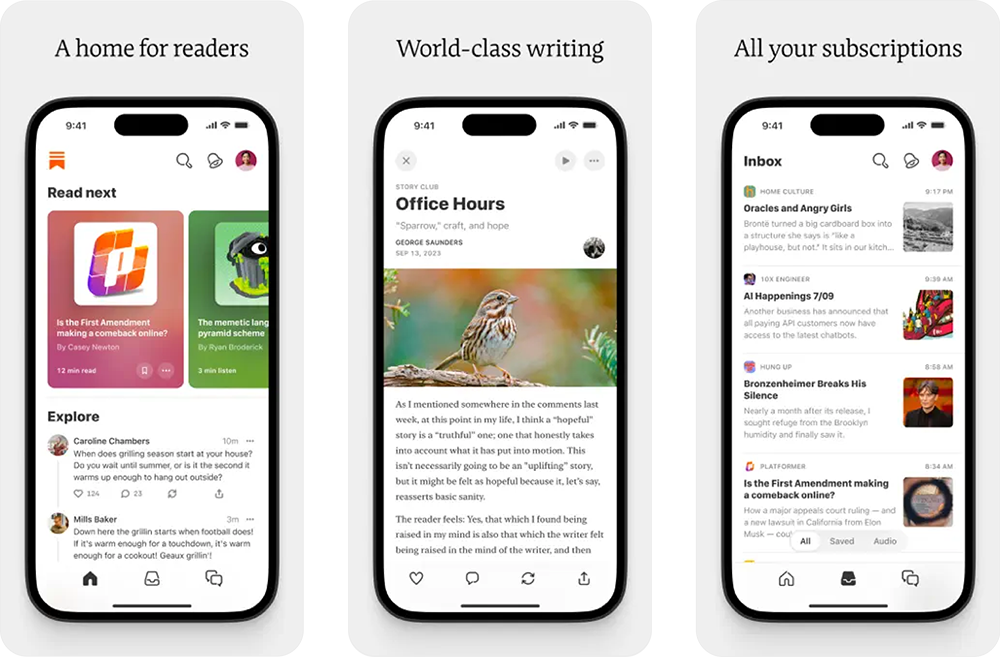
With social media now mature, I feel the way users interact on these platforms is beginning to change. One manifestation of this shift is the growing support for apps like "Substack," which specialize in receiving content.
While email newsletters are sometimes seen as an outdated culture in Japan, the US has a culture of paying to read them. Influencers across various fields use this app to distribute their content independently and earn income. By 2023, the service had 35 million active subscribers and over 2 million paid subscribers (※3).
Apps shouldn't be "use once and done"
While I mentioned that narrowing down features helps clarify an app's purpose, this isn't the same as never adding new features. If a feature is necessary to achieve the app's purpose, adding it during updates is perfectly fine.
Apps require repeated use; they cannot be a one-time experience. Apps differ significantly from websites in how they are used. Apps require installation, and the barrier to entry is quite high. Furthermore, apps must be updated regularly to align with smartphone OS updates, often resulting in higher operational costs than websites. Therefore, to ensure the companies we collaborate with are prepared for a long-term commitment, we sometimes propose a three-year plan when suggesting an app.
Having a clear objective you want to achieve through the app, and then taking the time to improve the path to that goal step by step. Doing this leads to many users using it for a long time. We expressed this belief as the important condition: "The purpose can be stated in one sentence."
Next time, we'll explain "The Seven Principles of Good Apps Part 2: Maximizing the Unique Features of Devices and OS."
※1 Source: Flare 2022 "App Market White Paper"
※2 Reference: https://techcrunch.com/2021/06/14/wordpress-com-owner-automattic-acquires-journaling-app-day-one/
※3 Reference: https://on.substack.com/p/introducing-notes
We also recommend these articles on the "7 Principles of Good Apps"!
①: The purpose can be stated in one sentence (This article)
②: Maximizes the inherent characteristics of the device and OS
③: Is continuously improved
④: Has mechanisms that make you want to use it again
⑤: Provides pleasant feedback for actions
⑥ : Can be used without instruction (Coming soon)
⑦: Visually conveys the intended worldview (Coming soon)

Was this article helpful?
Share this article


Newsletter registration is here
We select and publish important news every day
For inquiries about this article
Author
Masashi Yamasaki
Fuller Co., Ltd.
President and CEO