Note: This website was automatically translated, so some terms or nuances may not be completely accurate.
 Insight Memo [2/65]
Unraveling "Audience Insight" Through Generational Theory ~Differences in "Information Acquisition Tools" from the '76 Generation to the '96 Generation~
〈 Publication Date: June 4, 2010 〉
This time, we introduce the main differences in "information acquisition tools" by generation.
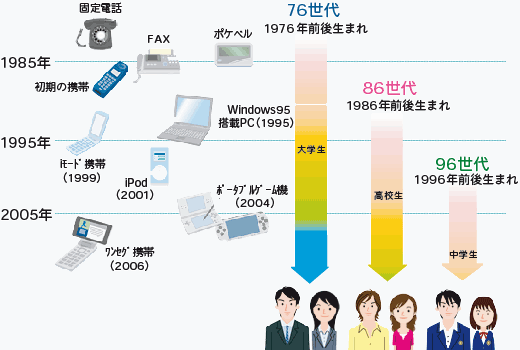
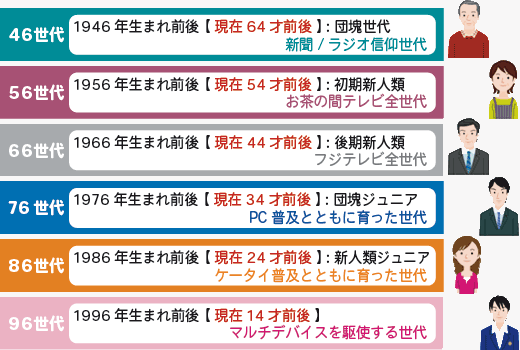
The '76 Generation (born around 1976, now around 34 years old) is a generation that obtained much of their information from PCs and established their lifestyles based on that. Around the time this generation reached adulthood, the PC operating system Windows 95 was born. This made PCs a tool capable of truly accessing the vast information on the internet. The 76 Generation, who were entering university at this time, acquired this powerful tool and began obtaining cutting-edge information from PCs rather than TV.
While the '76 generation is the PC generation, the '86 generation (born around 1986, currently around 24 years old) is the mobile phone generation. The '86 generation is the "new generation" that came to handle most things a PC could do via their mobile phones. Around the time the '86 generation entered high school, NTT DoCoMo's "i-mode" service was launched. This allowed the '86 generation to begin discovering the world of the internet through their mobile phones. In 2004, NTT DoCoMo introduced its "Pakehodai" service, further accelerating mobile information usage. They carried their phones everywhere, even "porting" them around the house, achieving a 24/7 constant internet connection environment. Thus, the mobile phone became the primary information device for the 86 Generation.
The '96 Generation (born around 1996, currently around 14 years old) are junior high students today. They are the multi-device generation, unconstrained by any single media platform and adept at using multiple devices with ease. They are growing up surrounded by an even wider array of information devices: the arrival of iPods capable of playing videos, the birth of portable game consoles with internet connectivity, and mobile phones with One Seg TV reception. Since they are still junior high students, those who haven't gotten a cell phone yet play around with the family PC in the living room. The '96 generation doesn't need manuals. They master PCs and the internet purely by feel.
As described above, the first device they encountered and the primary device they used for communication significantly shape each generation's media literacy.
Was this article helpful?
Share this article


Newsletter registration is here
We select and publish important news every day
For inquiries about this article
Back Numbers
Author

dentsu Media Innovation Lab
Dentsu Inc.
Insight MemoSpecial Discussion: "Japan's Advertising Expenditures"Explore the Amazing World of YouTube Creators with UUUMInformation Media White Paper 2024: The Rapidly Changing Media Environment and Consumers100 years since its birth. Radio, today...College Students and the Future of Media, Communication, and Advertising in Ten YearsInformation Media White Paper 2025: New Horizons in Communication Shaping the FutureInformation Media White Paper Special Report 2026: “The Current State of Evolving Information Trends”