Note: This website was automatically translated, so some terms or nuances may not be completely accurate.
 Insight Memo [7/65]
The "Image Multiple Effect" of Audio Media
〈 Publication Date: November 8, 2010 〉
This time, we present the results of a collaborative study conducted with Professor Masao Kasuga, Associate Professor Koji Hasegawa, and Associate Professor Mie Sato of the Graduate School of Utsunomiya University. The study aimed to examine the unique value of "audio media," represented by radio.
■ Research Objective
To investigate the unique effects of audio media through empirical experiments. Additionally, to examine the impact these effects have on consumer psychology.
■ Experiment Overview
① Prepare multiple commercial materials containing both audio and video, and present them to two groups.
ⅰ) A group that listened only to the audio (audio-only presentation), with the video cut out.
ⅱ) A group that viewed both video and audio normally (audio + video presentation)
② After exposure to the commercials, both groups were given 3 minutes to freely describe, in short words, various events and images that came to mind. The described words were analyzed under the following three categories:
(a) Descriptions of content originally included in the commercial
(b) Newly associated or recalled content not present in the commercial
(c) Other (e.g., comments about the commercial itself)
③ After commercial exposure, participants answered composite questions* regarding changes in their psychological distance toward the advertised product/service.
*Composed of "usage image," "overlap with past experiences," "familiarity," "sense of exclusivity," "homey feeling," "favorability," "purchase/usage intent," etc.
■ Experimental Results
① Information from audio media promotes the expansion of free association among listeners.
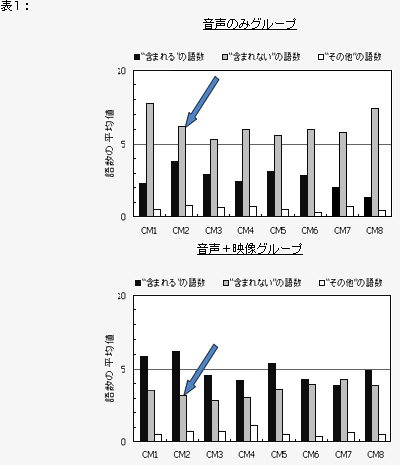
Table 1 lists the average number of words freely written by subjects after commercial exposure, categorized into three groups: (a) words originally contained in the commercial content, (b) words not contained in the commercial content, and (c) other words. Focusing on the black bars (number of words "contained"), values were larger for "audio + video presentation" compared to "audio-only presentation." Conversely, the gray bars (number of words in the "not included" category) show that the values for "audio-only presentation" were higher than those for "audio + visual presentation" in all cases. This proves that information from audio media promotes the expansion of free association among listeners.
The DENTSU SOKEN INC. + Utsunomiya University joint research team named this effect of expanding free association the "Image Multiple Effect."
② A relationship can be observed between "expansion of associations" and "reduction in psychological distance"
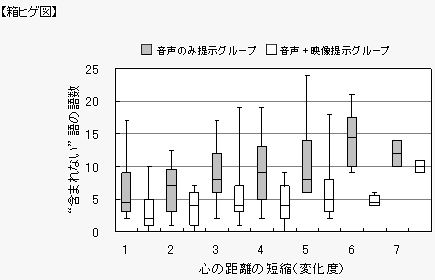
The box-and-whisker plot below illustrates the relationship between the number of words not included in the commercial and the change in psychological distance observed in this experiment. The horizontal axis represents how much the psychological distance to the product/service decreased after commercial exposure. A higher position on the right indicates subjects with a greater reduction in "psychological distance." The vertical axis shows the distribution of how many "unincluded" words were described by each group, based on the degree of psychological distance reduction.
The results show that participants who experienced a greater reduction in mental distance after commercial exposure described more associated words, indicating a relationship between "expanded association" and "reduced mental distance."
Furthermore, the upward trend was more pronounced in the "audio-only presentation" group (gray box) compared to the "audio + video presentation" group (white box), suggesting that this relationship may be stronger in audio media.
(Note) Experimental results are also significantly influenced by the creative (expressive) approach of the commercial material.
※ For more detailed explanations regarding this research, please contact the Media Innovation Research Department at DENTSU SOKEN INC.
(E-mail: mediainnovation@dentsu.co.jp )
Was this article helpful?
Share this article


Newsletter registration is here
We select and publish important news every day
For inquiries about this article
Back Numbers

Author

dentsu Media Innovation Lab
Dentsu Inc.
Insight MemoSpecial Discussion: "Japan's Advertising Expenditures"Explore the Amazing World of YouTube Creators with UUUMInformation Media White Paper 2024: The Rapidly Changing Media Environment and Consumers100 years since its birth. Radio, today...College Students and the Future of Media, Communication, and Advertising in Ten YearsInformation Media White Paper 2025: New Horizons in Communication Shaping the FutureInformation Media White Paper Special Report 2026: “The Current State of Evolving Information Trends”