Note: This website was automatically translated, so some terms or nuances may not be completely accurate.
 Insight Memo [13/65]
E-book Usage Trends During the Era of Smart Device Proliferation
〈 Publication Date: November 4, 2011 〉
Since 2010, new smart devices such as smartphones, tablet devices, and e-book readers have been introduced one after another. As many of these devices feature touch panels and have ample display size, high expectations have been placed on e-books.
This time, we present part of the analysis results on usage trends for e-books (books, comics, magazines) added to D-CAMP (Kanto), the consumer database operated by Dentsu Inc.
■ A Medium Centered on Men in Their 20s and 30s
Over the past year, 11.9% of the total population reported using some form of e-book (books, comics, or magazines). By format, e-books accounted for 7.4%, e-comics for 6.9%, and e-magazines for 3.1%.
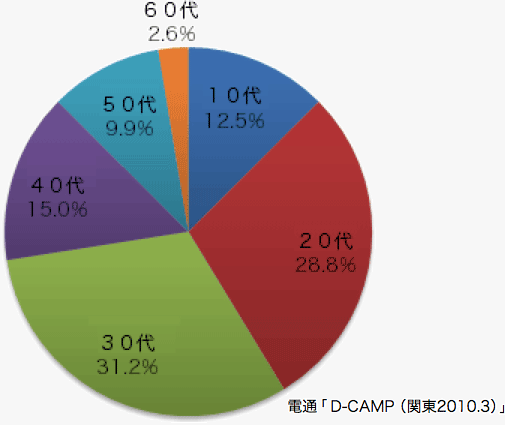
Breaking down users by gender, males accounted for 58.9% and females 41.1%, showing a male majority. By age group, those in their 20s and 30s comprised 60% of the total, suggesting this is currently a media primarily centered on younger demographics (Figure 1). This trend is particularly pronounced for comics, where the proportion of users in their 20s and 30s rises to 71.1%.
Figure 1: Age Composition of E-book Readers (Books, Comics, Magazines)
Age Composition of Readers
■ Smartphone/Tablet Usage and E-book Experience
Regarding smartphones, which are rapidly gaining popularity especially among younger demographics, 42.1% of users reported e-book usage in the past year (compared to 13.3% among non-smartphone users). Similarly, approximately 60% of tablet users had experience with e-books.
As these devices become more widespread, the base of e-book users is expected to expand.
■ E-book readers are also frequent readers of printed books
Concerns have been raised that the spread of e-books might reduce purchases of printed editions, but at this point, the impact does not appear to be particularly significant.
Those who read "digital comics" in the past year purchased an average of about 1.0 "paper comics" per month, compared to 0.6 for those who did not read them.
Furthermore, among those who have read "e-books" in the past year, the average monthly purchase of "paper books" is 1.6 volumes, compared to about 1.0 volumes for those who have not read e-books.
It appears that enthusiasts of books and comics, upon learning of the emergence of e-books, are anticipating more reading opportunities than before.
■ The range of e-book genres used remains quite limited
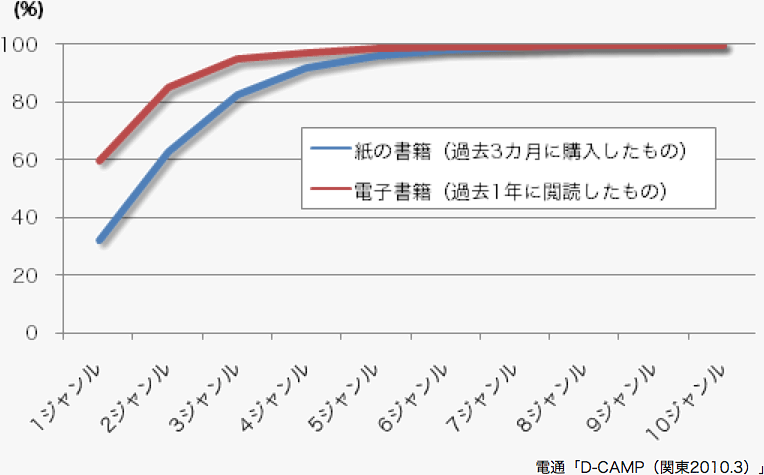
On the other hand, even among those with e-book experience, the range of genres read remains quite narrow. Comparing the number of genres encountered for print books versus e-books, a full 60% of e-book readers read only one genre (Figure 2).
Figure 2: Number of Genres Read (Cumulative)
(Comparison of print books and e-books)
(Note)
* "Genre" refers to responses obtained for 10 major categories: literary works, practical books, SF/mystery, etc.
※ For print books, this indicates the number of genres "purchased" within the "last 3 months." For e-books, it indicates the number of genres "read (regardless of purchase)" within the "past year."
Over the next few years, smart devices are expected to rapidly proliferate, and new usage styles will likely emerge. In this context, increasing the number of e-book users will fundamentally require offering diverse genre content that appeals to a broad range of readers.
Was this article helpful?
Share this article


Newsletter registration is here
We select and publish important news every day
For inquiries about this article
Back Numbers
Author

dentsu Media Innovation Lab
Dentsu Inc.
Insight MemoSpecial Discussion: "Japan's Advertising Expenditures"Explore the Amazing World of YouTube Creators with UUUMInformation Media White Paper 2024: The Rapidly Changing Media Environment and Consumers100 years since its birth. Radio, today...College Students and the Future of Media, Communication, and Advertising in Ten YearsInformation Media White Paper 2025: New Horizons in Communication Shaping the FutureInformation Media White Paper Special Report 2026: “The Current State of Evolving Information Trends”