Note: This website was automatically translated, so some terms or nuances may not be completely accurate.
 Insight Memo [18/65]
The Key to Popularization Seen in Tablet Usage Patterns in Japan and the United States
〈 Publication Date: July 17, 2012 〉
In the United States, as of January 2012, approximately 20% of the population aged 18 and over owned a "tablet" device, and this momentum continues today. For a digital product that began full-scale deployment in the spring of 2010, its adoption rate is progressing at an astonishingly rapid pace, less than two years later.
In Japan, while many people show some interest in tablet devices, many still hesitate to use them. The distinct role of tablet devices, different from PCs and smartphones, does not seem to be as clearly recognized in Japan as it is in the US.
Therefore, in February of this year, we conducted a comparative survey of tablet usage in Japan and the United States.
■ Significant Difference in Usage Frequency Between Japanese and American Tablet Owners
・The graph shows how frequently owners use various media and content on their tablet devices.
Media Usage on Tablets
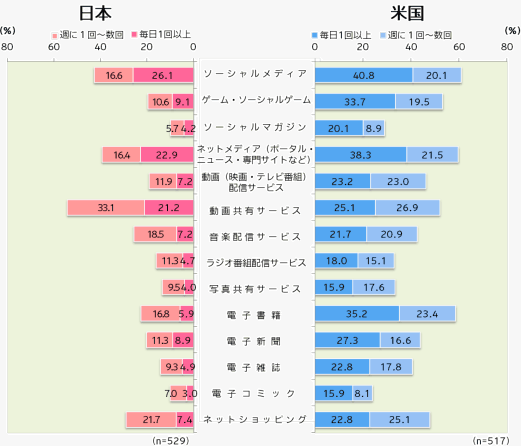
・First, looking at commonalities between Japan and the US, "social media," "online media (portals, news, specialized sites, etc.)," and "video sharing services" rank relatively high. These are essentially free services provided online for various devices.
・Next, let's examine the differences between Japan and the US. Overall, US tablet owners demonstrate more active usage across all services compared to their Japanese counterparts. Only in a few areas, such as video sharing services, did Japanese usage levels approach those of the US.
・Judging from the graph, it is clear that usage among tablet owners in the US is more established than in Japan. Conversely, in Japan, there is still significant room for growth across all media services.
■ The Impact of E-books on Tablet Usage Penetration
・E-books showed the most significant difference in usage frequency between Japan and the U.S.
In the US, major retailers entered the e-book market by launching dedicated e-readers in late 2007. Since then, a veritable e-book boom has persisted. When full-featured multi-functional tablets for general consumers launched in spring 2010, US consumers' initial expectations centered on tablets serving as devices for reading e-books.
・The current survey results also show that the percentage of people using tablet devices to read e-books exceeds the percentage using other media or services, remaining the highest group. Thus, uses like e-books and similar applications such as e-newspapers and e-magazines can be considered major motivations for owning and using tablet devices.
・Tablet devices offer two key advantages: the ability to display large amounts of information, including images, on a screen larger than a mobile phone, and the freedom to use them in a more relaxed posture than a personal computer. E-book services are well-suited to fully leverage these two unique strengths of tablet devices.
■ Potential for Tablet Adoption and Usage Stabilization
・Based on survey results, the conditions for tablet usage to become established include:
① Core services unique to tablets that cannot be replicated by other devices, and
② Services reflecting individual user preferences.
・What is needed for tablet adoption in Japan to accelerate and become more established than it is now?
・In the US, tablets proliferated with the proliferation of e-books as a central driving force, and diverse services are blossoming around them. Japan also anticipates the full-scale development of e-book services.
・Beyond e-books, Japan is exploring unique catalysts for adoption, such as creating compelling video-centric services integrated with TV broadcasts. Attention is focused on how and in what order this "growth potential" will materialize after 2012.
Was this article helpful?
Share this article


Newsletter registration is here
We select and publish important news every day
For inquiries about this article
Back Numbers
Author

dentsu Media Innovation Lab
Dentsu Inc.
Insight MemoSpecial Discussion: "Japan's Advertising Expenditures"Explore the Amazing World of YouTube Creators with UUUMInformation Media White Paper 2024: The Rapidly Changing Media Environment and Consumers100 years since its birth. Radio, today...College Students and the Future of Media, Communication, and Advertising in Ten YearsInformation Media White Paper 2025: New Horizons in Communication Shaping the FutureInformation Media White Paper Special Report 2026: “The Current State of Evolving Information Trends”