
Note: This website was automatically translated, so some terms or nuances may not be completely accurate.
 Cashless Japan Survey [4/4]
Over half have adopted it. The cashless shift among stores accelerating during the pandemic.
Amid the third wave of the novel coronavirus, Dentsu Inc. Cashless Project conducted a "Survey on Cashless Awareness During the Pandemic" in December 2020.
With lifestyles drastically altered by COVID-19, how have consumers' payment methods changed, and which methods will become mainstream going forward? This time, we examine the steady shift towards cashless payments observed in stores (small and medium-sized businesses) based on the survey results.
Steady Growth in Cashless Payment Adoption
The survey first asked about the adoption status of "cashless payments," such as credit cards and electronic money.
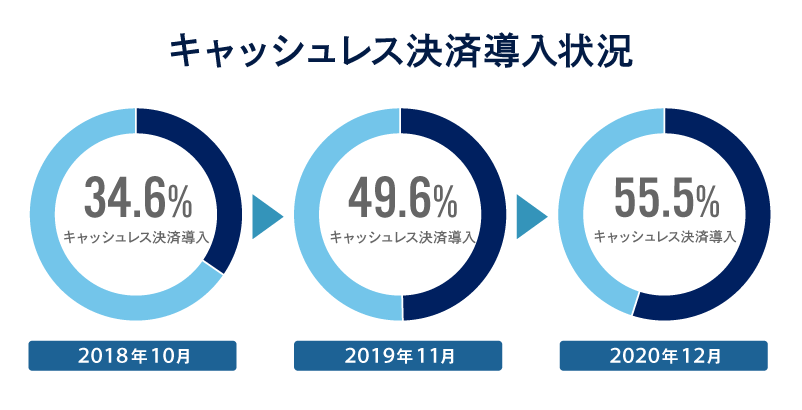
The results showed that 55.5% of stores "have introduced cashless payments," indicating that over half have already adopted them. Compared to past survey results, the adoption rate has steadily increased: 34.6% (October 2018) → 49.6% (November 2019) → 55.5% (December 2020).
The payment method seeing the most recent growth is smartphone payments
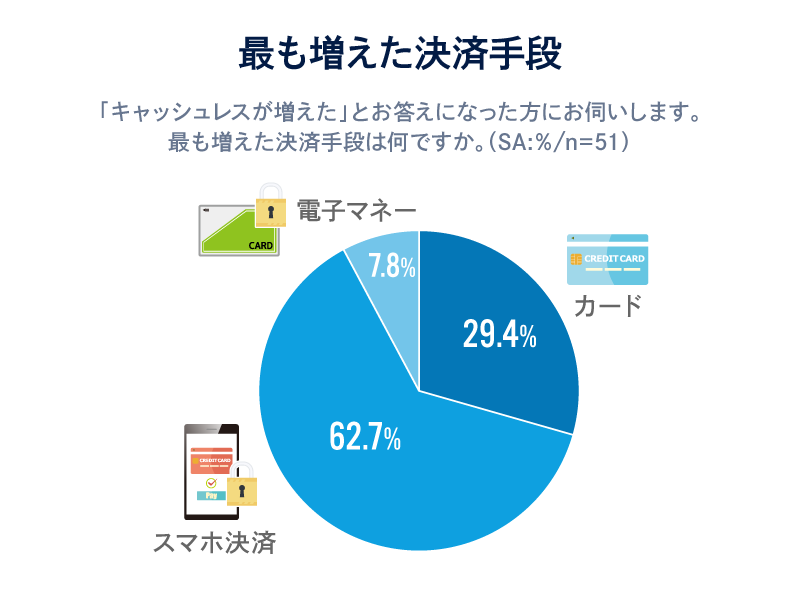
So, which cashless payment methods are growing? We asked stores that reported "an increase in customers paying with cashless methods" about the payment method seeing the most growth. The results showed smartphone payments were the highest at 62.7%. This indicates smartphone payments are significantly driving the progress of cashless payments during the COVID-19 pandemic.
"Reduced checkout time," "No need for change," "Broader customer base," and "Hygienic" rank high among adoption benefits
What are the benefits for stores implementing cashless payments?
When asked about effects felt after introducing cashless payments,
Reduced checkout time: 21.6%
Less hassle preparing change: 20.7%
Expanded customer base: 18.9%
Hygienic payment acceptance: 17.1%
were the top responses.
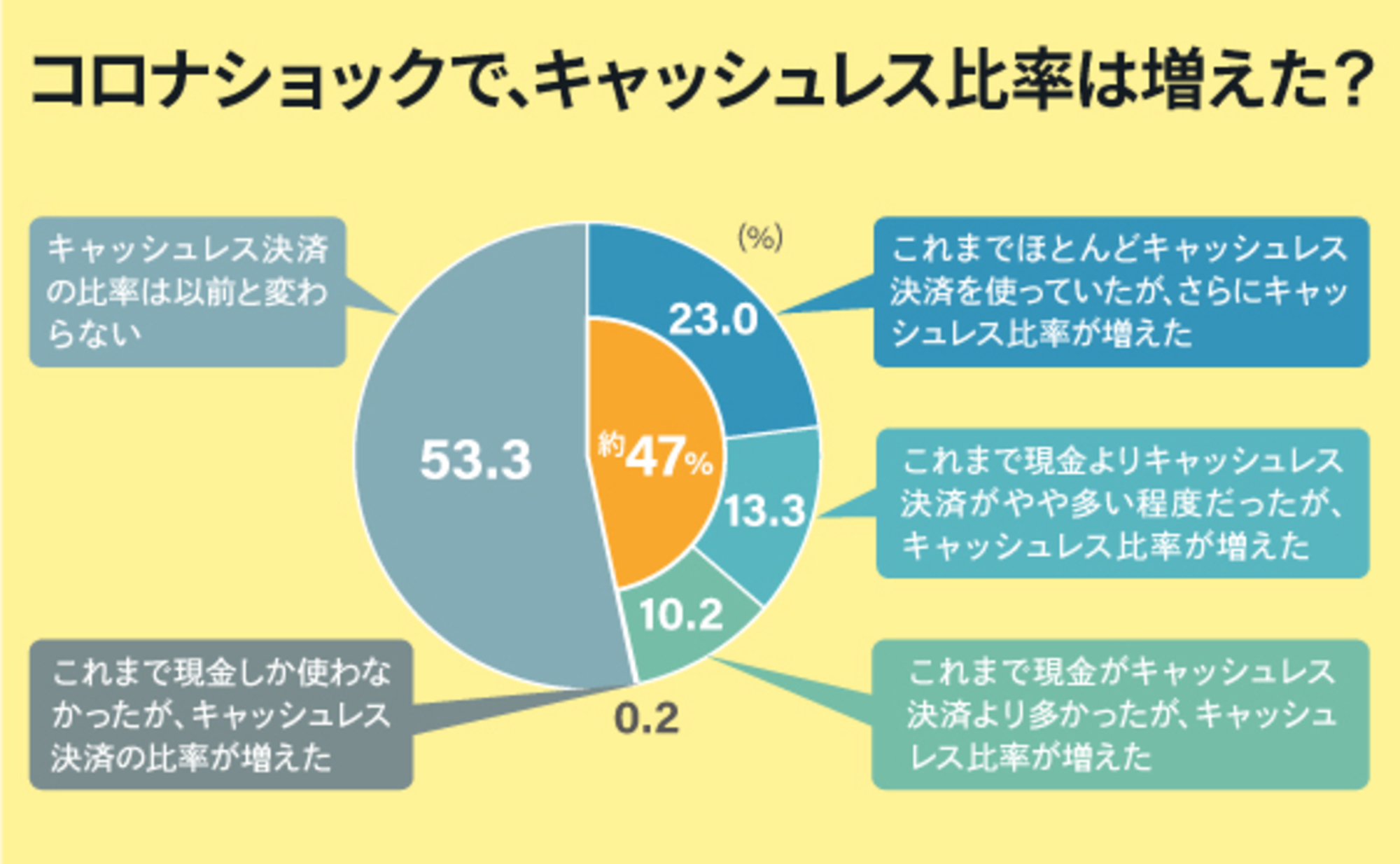
The fact that cost-saving factors related to "efficiency," such as "reduced checkout time" and "no need for change," were more strongly emphasized than sales-boosting factors like "expanded customer base" may be attributed to the impact of the COVID-19 pandemic, where restrictions on going out continued and attracting customers was difficult. Furthermore, the high ranking of the "hygienic" factor is also a characteristic of the post-COVID shock era.

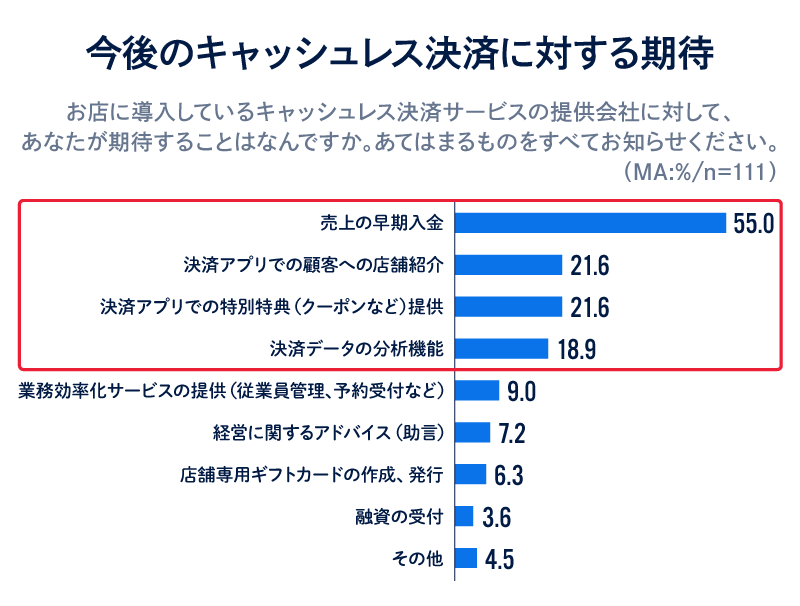
Expectations for cashless payments going forward include "faster deposits," "customer referrals via payment apps," and "payment data analysis."
Furthermore, when asked about future expectations for cashless payments:
Early payment of sales: 55.0%
Store introductions to customers via payment apps: 21.6%
Offering special benefits (coupons, etc.) via payment apps: 21.6%
Payment data analysis functionality: 18.9%
These results indicate expectations for shortening the time from payment to deposit and for cashless payments to boost top-line sales.
Japan's cashless payments will expand as stores progress with their "cashless shift"
This time, we examined the actual state of cashless usage at stores under the theme "Cashless Shift at Stores During the Pandemic." The results show that
- cashless adoption among stores has grown to a level exceeding half.
- This indicates that increased consumer use of smartphone payments is significantly supporting the progress of cashless adoption by stores during the pandemic.
- The benefits of cashless payments include cost reductions through increased productivity, such as "shortened checkout times" and "eliminating the need for change," as well as top-line (sales) growth through "expanding customer demographics."
- Looking ahead, expectations are growing for smartphone payments, particularly as a mechanism to boost top-line revenue, such as through "app-based payment-driven customer referrals."
These are the key findings.
Dentsu Inc. Cashless Project views Japan's cashless payments as continuing to expand significantly, based on both the "everyday use" of cashless by consumers revealed in the previous report and the "cashless shift" by stores revealed this time.
<DENTSU Inc. Cashless Project>
For details regarding cashless initiatives, please contact Yoshitomi at the New Industry Development Department, Business Co-creation Bureau ( cash-less@dentsu.co.jp ).
[Survey Overview]
Survey Method: Online survey
Survey Period: December 24-25, 2020
Survey Area: Nationwide
Survey Subjects: ① General consumers, ② Small and medium-sized enterprise (SME) owners*
① 500 men and women aged 20–69 (weighted based on population composition)
② 200 men and women aged 20–69
※ SMEs in the food service or retail industry with 100 or fewer employees and capital of 50 million yen or less
Was this article helpful?
Share this article


Newsletter registration is here
We select and publish important news every day
For inquiries about this article
Back Numbers

Author

Yoshitomi Sairyo
Dentsu Inc.
BX Creative Center, Experience Design Department
Senior Planning Director
Financial Project: "Survey on Payment Methods Among Consumers"Cashless Japan SurveyCashless Japan Survey 2021: Cashless Payment Drives Digital TransformationCashless Inferences: Unraveling the Present and Future of Japan's Cashless Society Through ResearchCashless Insights 2024: Japan's Latest Cashless Trends from Both Consumers and RetailersCashless Insight 2025: Structural Changes in Japan's Cashless Landscape
