Note: This website was automatically translated, so some terms or nuances may not be completely accurate.
 How has media consumption changed in response to the COVID-19 pandemic? [2/3]
Strong Demand for Online Media! Media "Rediscovered" During the Pandemic
This series introduces parts of the opening feature from Dentsu Inc. Media Innovation Lab's " Information Media White Paper 2021 " (published by Diamond Inc.). Last time, we reported on data from the MCR/ex survey (※1) for the first half of 2020 in the Tokyo 50km radius area, showing how opportunities to use various media at home increased significantly in June 2020, when time spent at home rose due to the pandemic.
Media consumption patterns during this unique pandemic period may offer insights into the future relationship between media and audiences. Based on the premise that disposable time at home influences media usage, we compared the growth rates of usage for each media type, using the year-on-year increase in the rate of people staying home after waking up as a benchmark.
*1 = MCR/ex survey
A diary-style survey conducted by Video Research Ltd. over a specific week. It captures consumers' actions—including basic daily activities and media contact—by day of the week along a time axis, in minimum 15-minute increments.
The at-home rate after waking increased across all time slots except early morning
Media usage needs and opportunities change throughout the day. Therefore, we will divide the day into five time slots and examine behavior within each.
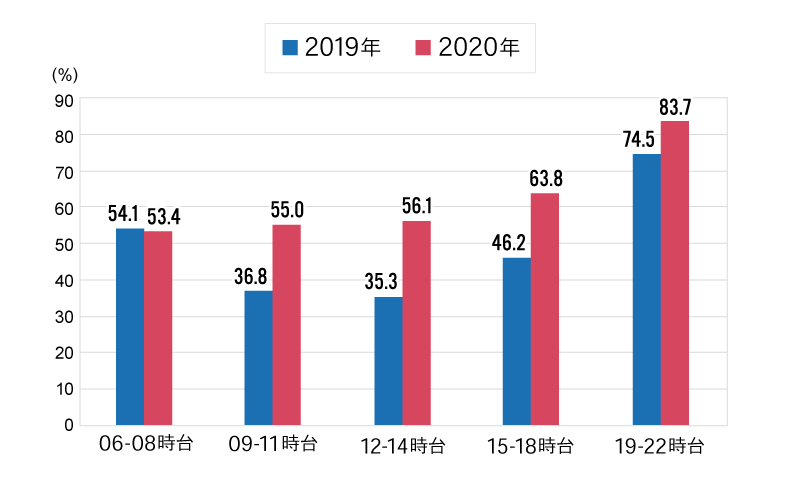
Figure 1 shows how the 2020 weekly average wake-up at home rate (for all individuals aged 12-69) changed compared to the previous year. The wake-up at home rate significantly exceeded the previous year's level in all time slots except early morning (6-8 AM). The largest increase was in the 12-2 PM slot, where the 2020 wake-up at home rate was 56.1%, approximately 1.6 times the previous year's rate.
[Figure 1] At-Home Rate During Awake Hours (Weekly Average / Ages 12–69)
With no need for commuting or going to school, wake-up times shifted later
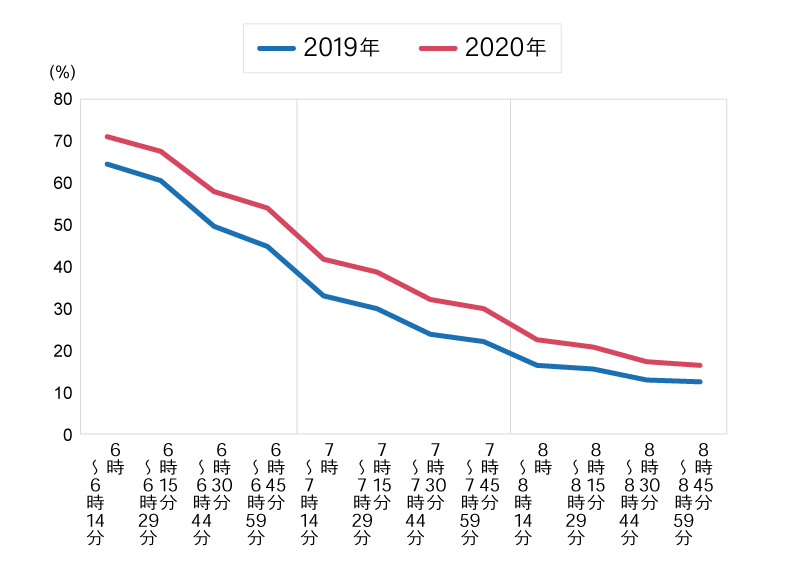
The background to the lower early morning at-home rate compared to the previous year is that wake-up times shifted later overall. Figure 2 shows the ratio (weekly average) of people sleeping between 6:00 AM and 8:00 AM for the entire population (ages 12-69).
[Figure 2] Percentage of people sleeping between 6:00 and 8:00 a.m. (weekly average / ages 12–69)
The high potential of online media is particularly evident
When comparing the growth rate of wake-up at-home rates from the previous year across different time slots, how does the growth rate of media usage vary throughout the day? Generally speaking, media showing usage growth exceeding the increase in wake-up at-home rates likely indicate strong audience demand and suggest potential for continued active use in the future (*2).
※2
The following analysis is based on comparing the growth rate of the awake-at-home rate with the growth rate of usage rates for each media type. It is particularly important to note that even if a media type's year-over-year usage growth rate does not exceed the benchmark growth rate of the awake-at-home rate, this does not negate the growth rate of that media type itself or its developmental potential.
Internet-based media show the most significant growth. Figure 3 illustrates the growth rate (weekly average) of internet-based media usage at home among the entire individual population (ages 12-69), with the baseline growth rate of waking-up-at-home set to 1. Internet (web browsing, etc.), online video, and SNS all exceed the baseline growth rate of waking-up-at-home across all time periods.
[Figure 3] Growth Margin of Internet-Based Media Relative to Waking-Up-at-Home (Weekly Average / Ages 12-69)
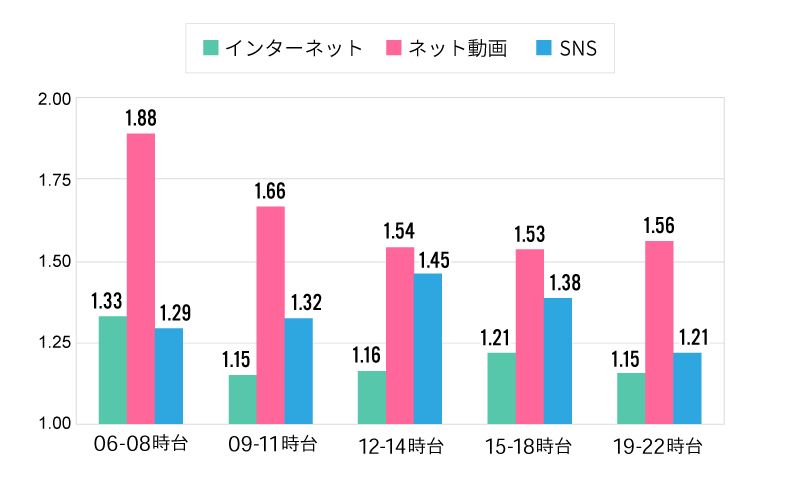
As noted earlier, it is necessary to consider that the growth rate of the awake-at-home rate in the early morning hours (6-8 AM) slightly underperformed the previous year. However, it is clear that demand for online media is very strong throughout most of the day, with particularly strong demand for online video. While online media is already deeply integrated into our lives, the pandemic, with its increase in time spent at home, appears to have spurred especially active usage.
Media "Rediscovered" in Daily Life
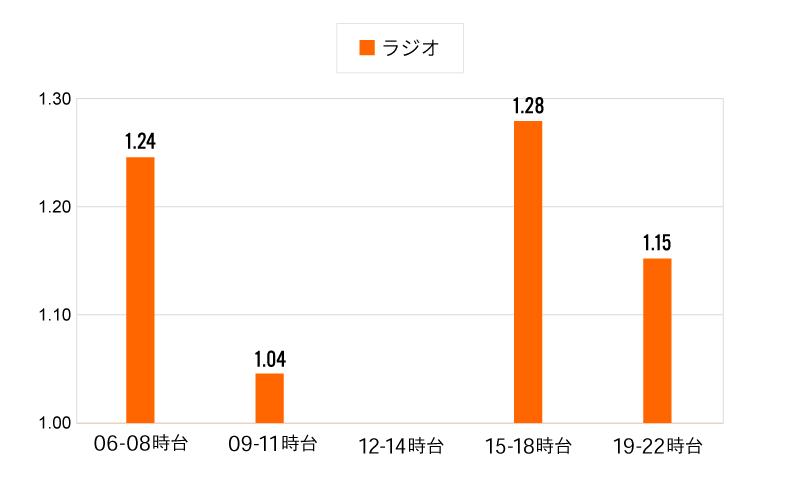
Finally, we present trends for non-internet media showing distinctive patterns. Figure 4 shows the growth rate of radio usage, also measured against the baseline of the wake-up at-home rate. On a weekly average, usage exceeded the baseline in all time slots except 12:00-14:00. As time spent at home increased, radio usage, including streaming services like radiko, likely grew substantially.
[Figure 4] Radio Usage Growth Rate Based on Morning At-Home Rate (Weekly Average / Ages 12-69)
Newspaper usage increased among specific target demographics and during certain time slots. Notably, on Saturday and Sunday mornings, the usage rate among younger age groups exceeded the baseline. This situation may reflect younger individuals in newspaper-subscribing households, who previously had little exposure to newspapers, now picking them up.
Television, which already had high usage rates, generally saw increased usage compared to the previous year, though the overall growth rate did not exceed the baseline. However, looking at specific demographics, for example, the weekly average shows growth rates exceeding the baseline for men in their 30s and 60s and women in their teens during the early morning, and for men in their 20s and women in their 30s during the evening. This suggests that if conditions align, such as programming suited to home situations and needs, there may be opportunities to further engage younger audiences during specific time slots.
Individuals' media needs and engagement styles vary. The pandemic revealed people's proactive engagement with media that meets their needs. The increased use of radio and newspapers, which were essentially "rediscovered" within daily life, suggests media that respond to changing consumer needs have the potential for even more active use going forward.
[Survey Overview]
Survey Name: MCR/ex
Conducted: Annually in June and December
Survey Method: Electronic questionnaire survey
Survey Areas: Tokyo 50km radius, Kansai region, Nagoya region, Northern Kyushu region, Sapporo region, Sendai region, Hiroshima region
Survey Participants: Individuals aged 12 to 69 (area-random sampling)
Survey Company: Video Research Ltd.
Was this article helpful?
Share this article


Newsletter registration is here
We select and publish important news every day
For inquiries about this article
Author

Mariko Morishita
Dentsu Inc.
Marketing Administration Center, Media Innovation Research Department (Dentsu Inc. Media Innovation Lab)
Insight MemoThe Reiwa "New" Era! Where is the Media Society Headed?How has media consumption changed in response to the COVID-19 pandemic?New Approaches Discovered Through Audience ResearchInformation Media White Paper 2022: Unraveling Media Consumption and Dissemination in the "With COVID-19" EraInformation Media White Paper 2023: What You Need to Know Now—The Past, Present, and Future of Media and SocietyInformation Media White Paper 2024: The Rapidly Changing Media Environment and Consumers100 years since its birth. Radio, today...Information Media White Paper 2025: New Horizons in Communication Shaping the FutureA Space for Collective ThoughtInformation Media White Paper Special Report 2026: “The Current State of Evolving Information Trends”