
Note: This website was automatically translated, so some terms or nuances may not be completely accurate.
 How AI Is Changing Consumers’ Information Behavior and the Future of Corporate Communication [2/2]
How to Become a Brand That Is Chosen by AI and Leaves a Lasting Impression
As consumers’ access to information shifts to AI, the way companies create information and approach communication will also change. Until now, the information companies have delivered has been primarily aimed at people. However, going forward, there will be a need for information design that can be understood not only by people but also by their personal AI agents.
In Part 2, we’ll explore how companies should create information and build relationships with consumers in an era where AI is becoming a medium. We’ll also reexamine the value of real-world experiences and physical spaces, which is increasing precisely because more information is being accessed through AI.
Click here for key terms to remember in the coming AI era: “Corporate Information Design Edition”
<Table of Contents>
▼AI Becomes a New Form of Media
▼Companies Will No Longer Deal Exclusively with “People”
▼Rather Than “Cutting Back for Simplicity,” Keep “Plenty of Information” for AI
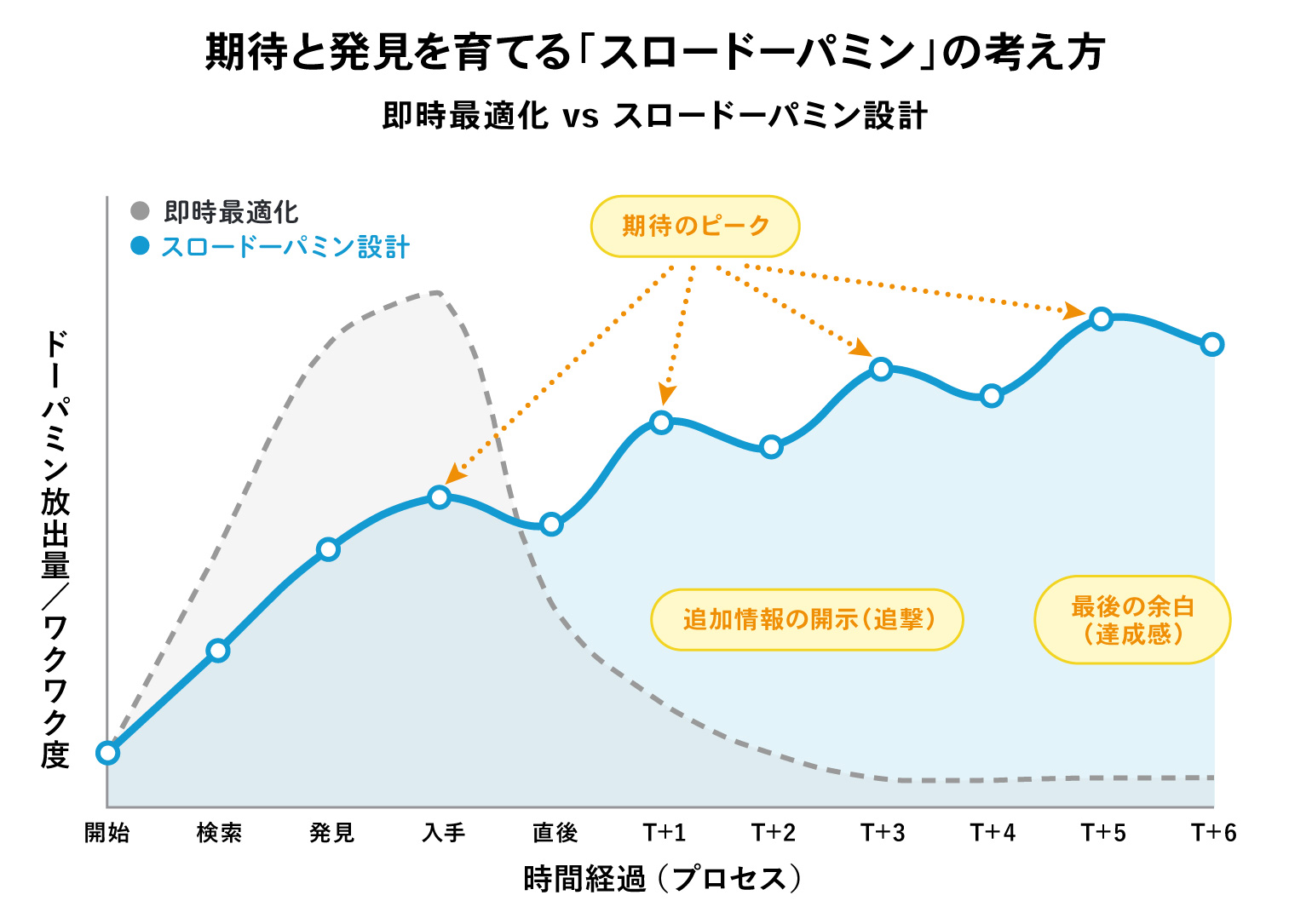
▼“Slow Dopamine” Is Essential for Information Design in the AI Era
▼The Value of Real-World Experiences Will Continue to Rise
AI Is Becoming a New Form of Media
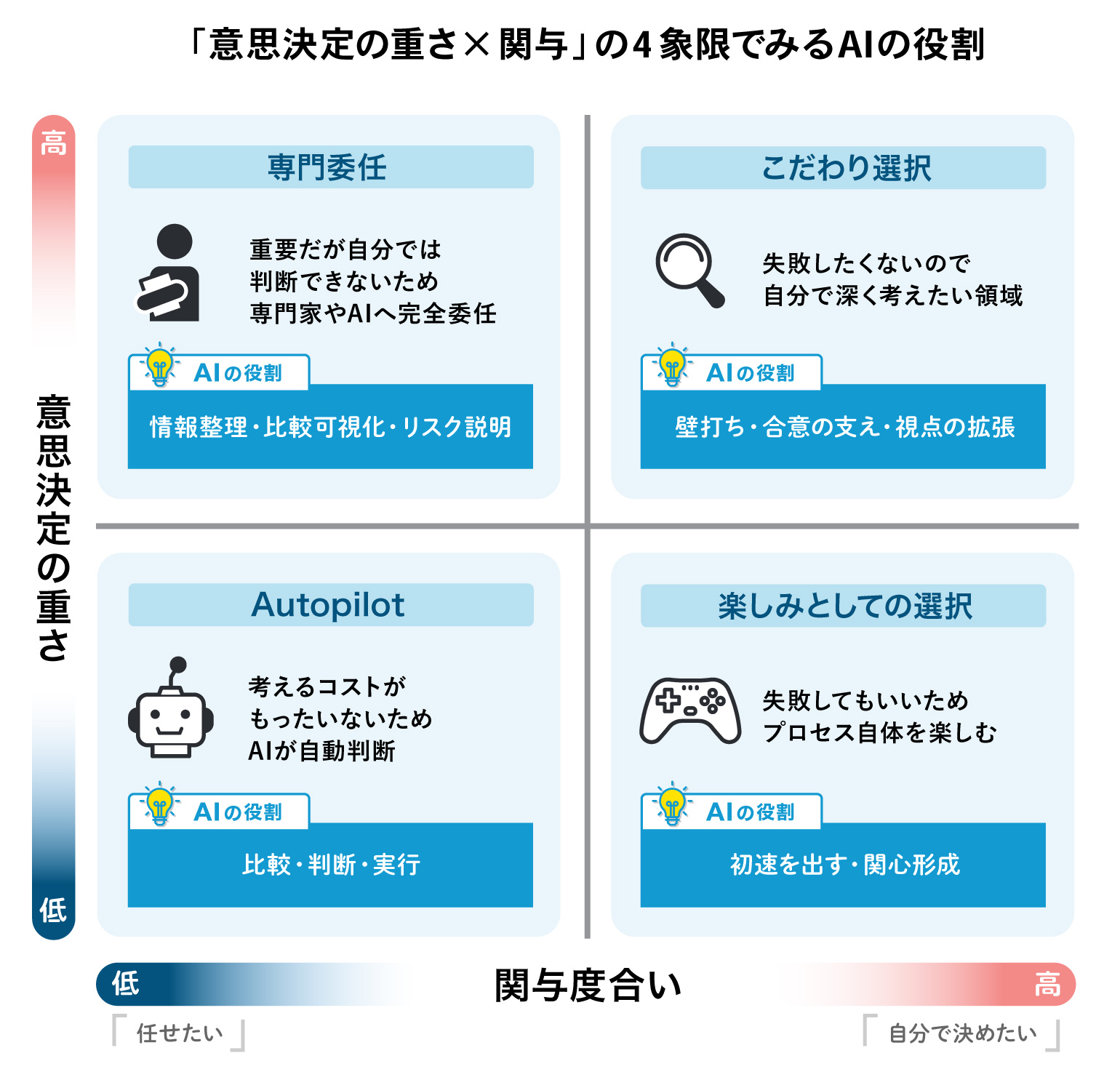
Until now, it has been the norm for consumers to access information through mass media, websites, social media, search engines, and other channels. However, as AI becomes more widespread, opportunities for consumers to view information directly with their own eyes will decrease, while situations where AI organizes necessary information and answers consumers’ questions will increase. This means it is highly likely that personal AI agents will become consumers’ first point of contact with information.
This trend is referred to as the “mediatization of AI.” In corporate communications, companies will increasingly need to consider not only humans but also AI as an audience. It will also become increasingly important to design information that can be accurately interpreted and evaluated by AI and effectively conveyed to consumers.
First, we will enter a phase known as B2A (Business to Agent), in which the point of contact between companies and consumers shifts from humans to personal AI agents. Eventually, an A2A (Agent to Agent) communication model will take hold, in which personal AI agents interact with corporate AI agents to execute processes such as the purchasing process.
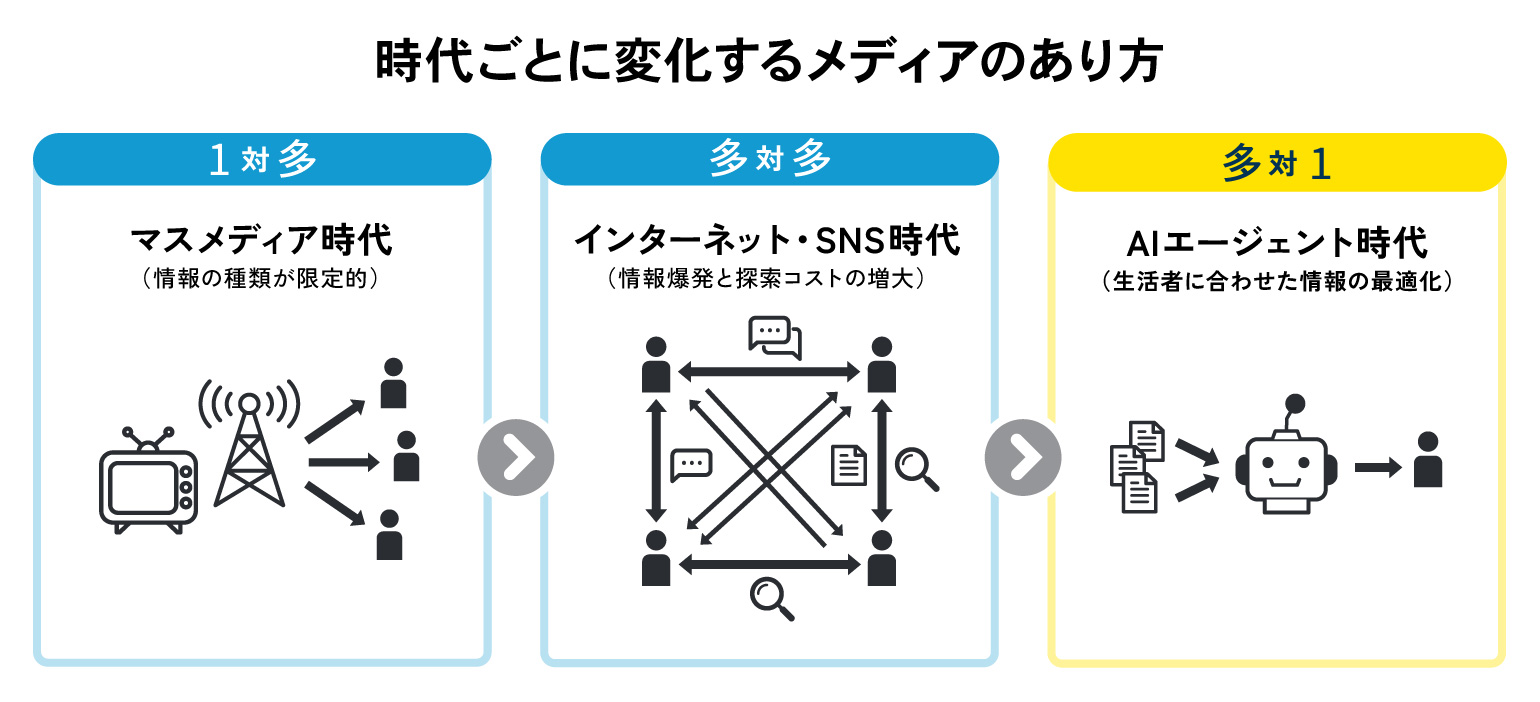
Based on the concept of the “four quadrants of ‘weight of decision-making × engagement’” discussed in Part 1, companies will need to organize information so that AI can reliably make selections—for example, in the case of daily necessities—while in the realm of hobbies, they will need to design experiences that make the selection process itself enjoyable.Furthermore, in areas where it is difficult for individuals to make decisions on their own—such as insurance and mortgages—AI will need to provide evidence and clear explanations to be perceived as neutral; whereas in areas where people want to make their own decisions—such as career choices, higher education, and marriage—aligning with consumers’ values will be of great significance.
AI does not uniformly simplify consumers’ decision-making; rather, it changes the rules of the game for each quadrant. While everyday items and “routine bookings” can easily be entrusted to AI, in areas where the process itself is important—such as hobbies, learning, careers, and higher education—AI functions as a sounding board, and it is ultimately desirable for people to make the final decision.
What is required of companies is not simply to feed information to AI, but to design how their products and services fit into consumers’ decision-making domains and what meaning they hold within specific contexts.
Companies will no longer be dealing solely with “people”
Until now, the key to advertising and PR has been how to narrow down information, create a buzz, and attract attention. That value will not disappear in the future. On the other hand, the information AI references spans a wide range, including corporate websites, PR articles, comparative data, product reviews, and social media sentiment.
If AI searches for, compares, summarizes, and recontextualizes information for each individual, companies must provide information that is easy for AI to read and evaluate. Therefore, they must design both “information that reaches people” and “information that is read by AI.”
Key to this are the concepts of B2A (Business to Agent), where companies deliver information to AI agents, and A2A (Agent to Agent) communication, in which consumers’ personal AI agents interact with corporate AI agents to play a role in the purchasing and consideration processes.Companies will need to be mindful of creating “information that AI can understand,” and marketing and content distribution methods may expand beyond those centered on surveys and CRM (Customer Relationship Management) to include direct communication with personal AI agents.
Rather than “paring down to simplicity,” retain as much information as possible for the AI
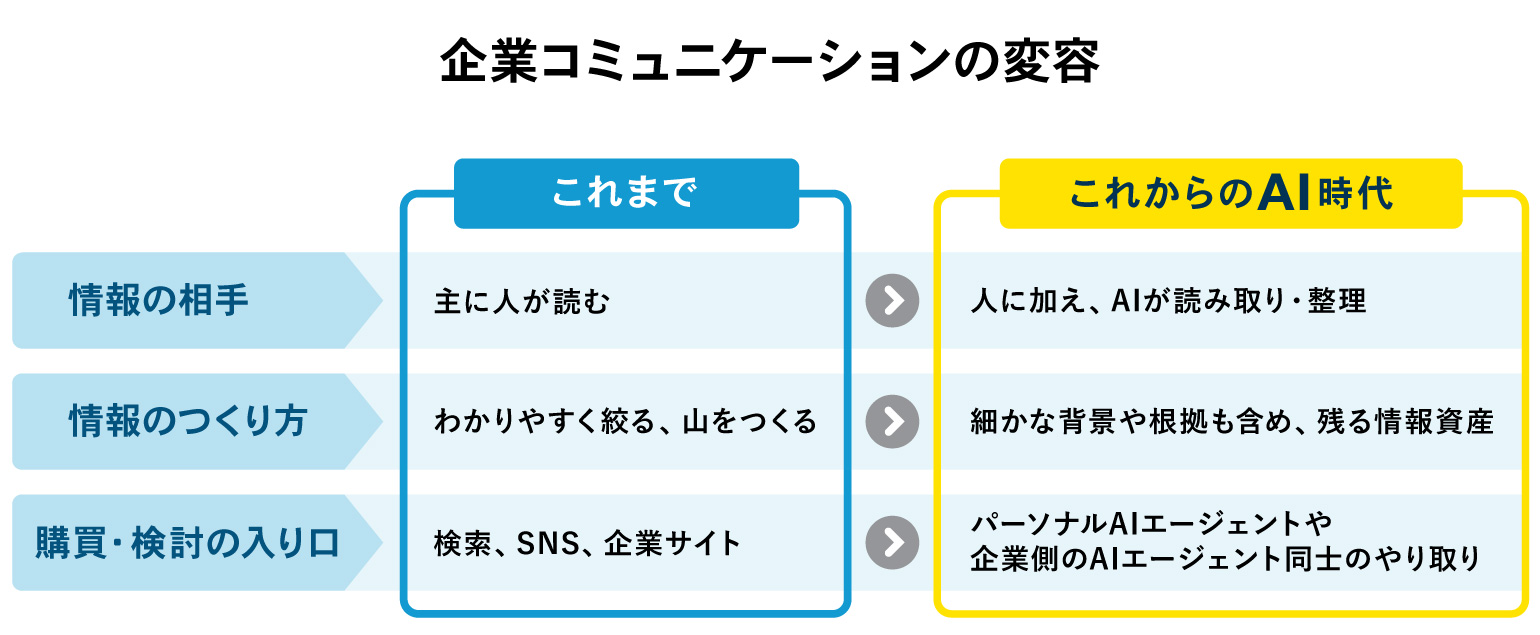
Information that has traditionally been omitted in human-to-human communication to prioritize clarity will become a vital information asset in the AI era, as AI reorganizes it to align with consumers’ areas of interest.
For example, even for the same product, information will be restructured and presented in different contexts for each consumer: for those with a strong ethical awareness, the background of raw material sourcing and the development story; for those interested in functionality, ingredients, benefits, and detailed specifications; and for those focused on improving their quality of life, the effects of the product in their daily lives.
Even the background and value chain of products—information that companies have not previously disclosed—will become tools for conveying brand value. It’s not just about features or price; it’s about why the product was created, what materials were chosen, and what consumer challenges it aims to solve. It will be crucial to continuously disclose this information in a format that AI can easily interpret. As a result, consumers will find it easier to interpret the brand as “this brand suits me” or “this product aligns with my values.”
Since the value of information is determined not only by “easy-to-understand soundbites” but also by “the depth necessary for it to hold meaning for consumers,” companies must consider what information to retain and at what level of detail to make it accessible for AI to reference.
In the past, PR often prioritized exposure volume and short-term buzz. However, in an era where AI references information, it is important not only for information to be consumed instantly but also for it to endure over time and be repeatedly referenced. How to accumulate “enduring information assets” that AI can continuously reference will become a key issue in future information and PR strategies.
“Slow Dopamine” Is Essential for Information Design in the AI Era
Now that AI has accelerated the pace of information consumption, consumers’ interests arise more quickly—but they are also overwritten by the next piece of information and forgotten just as fast. While it has become easier than ever to capture momentary attention, this does not necessarily mean that information will take root in consumers’ memories or influence their behavior. Furthermore, as AI begins to proactively provide optimal answers, the processes of searching, hesitating, stumbling upon things by chance, and making independent choices may be further shortened.
This is why we are focusing on the concept of “ Slow Dopamine.” Dopamine is a hormone associated with feelings of pleasure and happiness; it is believed to be involved not only in the moment of obtaining something but also in the anticipation of “being on the verge of getting it” and the motivation to work toward that goal.
We’ve applied this to AI experience design, and we call an experience that cultivates enjoyment—one that includes the processes of anticipation, discovery, and making one’s own choices, rather than immediately reaching satisfaction—“Slow Dopamine.” Our hypothesis is that, precisely because we’re living in an era of increasing AI optimization, value may emerge from the very time it takes to reach satisfaction.
This does not simply mean doling out information in small doses or making consumers wait. Take travel, for example: the fun lies not only in having AI determine the optimal itinerary, but also in the time spent researching destinations, imagining what to do once there, and adding places discovered by chance to the itinerary. In areas where the selection process itself becomes the experience—such as hobbies or travel—it is important for AI not to anticipate the “correct answer” too much, but rather to leave room for consumers to enjoy exploration and discovery on their own.
What is required of companies is not to constantly grab people’s attention with intense stimuli. Rather, advertisements and information should serve as catalysts that prompt people to conduct their own research, encounter other information and real-world experiences, and ultimately come to the conclusion that “this is right for me.” While AI should lighten the burden of exploration and comparison for users, it must also leave room for them to engage in the things they want to enjoy and the choices they want to make for themselves.
In experience design for the AI era, it is crucial to discern where to streamline processes and where to leave room for anticipation and discovery.
The Value of Real-World Experiences Will Continue to Grow
In the AI era, the value of real-world experiences—where people actually see and interact with a brand—may actually increase. Outdoor promotions, events, retail stores, and experiential exhibits serve as crucial touchpoints where people can directly see, touch, and remember a brand.
AI cannot replace the sense of “why does this matter to me?” or “why is this significant to me?” When a person tells their personal AI agent, “I saw that” or “That experience caught my attention,” that experience is recorded by the AI and incorporated into the context of future recommendations and information interactions. Real-world experiences are not merely one-off interactions; they can also serve as data that helps AI better understand consumers’ interests.
Organizing information digitally and allowing consumers to experience a brand in real-world settings are not separate strategies; rather, they are becoming mutually complementary. Companies are expected not only to provide the correct answer via the shortest route but also to design the “breathing room” that allows consumers themselves to make discoveries, reach their own conclusions, and deepen their interest. We may even see a trend toward “media-izing” physical spaces—turning them into platforms where people can experience a brand’s worldview and identity.
The concept of nurturing long-term relationships by accumulating both “lasting information assets” that AI continuously references and “lasting experiences” that remain in people’s memories will become the new competitive edge in brand-building in the AI era.
Corporate communication in the AI era cannot be limited to simply adding new channels or creating brands with information structures that AI can interpret. The key challenge lies in how to combine information intended for people with information that AI can understand—and how to link brand imagery with information for each individual consumer to create narratives that are meaningful to them personally.
What will become increasingly important is ensuring that the questions “Why this product?” and “Why this brand?” are naturally understood within the consumer’s own context.
Brands that will be chosen in the AI era are those that offer consumers the freedom to feel they “want to choose for themselves,” while also leaving a lasting impression through authentic experiences and a distinct worldview. Designing these two elements in tandem will likely serve as the starting point for a new form of communication in the AI era.
<Research Collaborators>
Yuichi Yoda, Professor, College of Business Administration, Ritsumeikan University (Specialization: Business Systems)
Yuichiro Hidaka, Professor, College of Business Administration, Ritsumeikan University (Specialization: Marketing)
Shinichiro Terasaki, Professor, College of Business Administration, Ritsumeikan University (Specialization: Marketing)
Satoshi Goto, Professor, College of Business Administration, Ritsumeikan University (Specialization: Design Management)
Mari Hisashi, Associate Professor, School of Business and Information Science, Fukui University of Technology, and Visiting Researcher, OIC Comprehensive Research Institute, Ritsumeikan University (Specialization: Marketing)
Key Terms to Remember in the Coming AI Era: Corporate Information Design
・The Mediaization of AI
The shift in which AI becomes the primary information touchpoint, replacing search engines and social media, and takes on a central role in information distribution
・B2A (Business to Agent)
An approach in which companies deliver information not only to consumers themselves but also to AI agents
・A2A (Agent to Agent) Communication
A concept in which AI agents on the consumer side and the corporate side exchange information and carry out procedures
・Slow Dopamine
An experiential value centered on enjoying the process of anticipation, discovery, and making one’s own choices, rather than immediate gratification
Was this article helpful?
Share this article


Newsletter registration is here
We select and publish important news every day
For inquiries about this article
Author

Kentaro Yoshida
Dentsu Inc.
第4マーケティング局 未来シナリオコンサルティング部/未来事業創研ファウンダー
Optimizing IoT EnvironmentsDentsu Inc. Smart PlatformWhat will the world "after" smartphones look like?The future isn't something you "wait" for—it's something you "create"! Transforming Japan's career education through future-oriented thinkingBuilding the future begins with visualizing the will of the future.Changes in Consumers' Lives Revealed by 20 Years of Tracking Surveys: Mobile Phones and SmartphonesMonthly CXDentsu Group's 72 Visions of the Future: "Future Mandala"How AI Is Changing Consumers’ Information Behavior and the Future of Corporate Communication

Yoko Kibata
Dentsu Inc.
CXクリエイティブセンター 未来の暮らし研究部
Producer

Yasuhiro Tsuchiya
Dentsu Inc.
zero/Dentsu Lab Tokyo
Creative Technologist / Researcher

Kishimoto Kazuya
Dentsu Inc.
Dentsu Lab Tokyo
Creative Technologist / Communication Designer
The Future of Communication: Insights from AI ChatbotsI tried using AICO2 with that person everyone's been talking about!Hitachi, Ltd. × Dentsu Inc. × Dentsu Digital Inc.: Tackling Social Issues with Generative AI!How AI Is Changing Consumers’ Information Behavior and the Future of Corporate Communication
Rei Tai
Dentsu Inc.
Future Scenario Consulting Department, Marketing Division 4
Associate Planner