Note: This website was automatically translated, so some terms or nuances may not be completely accurate.
 How AI Is Changing Consumers’ Information Behavior and the Future of Corporate Communication [1/1]
How Will AI Change Consumers’ Information Behavior?
With the widespread adoption and evolution of generative AI—and the anticipated rise of personal AI agents in the future—consumers’ “information behavior”—including how they find, utilize, and make decisions based on information—is reaching a major turning point. The shift from an era of searching for information via search engines and social media to an era of obtaining information through dialogue with AI is already beginning to influence both consumer decision-making and corporate marketing strategies.
As companies are called upon to respond quickly, we held discussions on the future of consumers, businesses, and the media with members of AI Labs within the Dentsu Japan AI Center, members of the AI Research Group of the Japan Marketing Association, and faculty members from the College of Business Administration at Ritsumeikan University, among others. Here, we summarize the key points that emerged from these discussions.
In Part 1, we will examine how consumers’ access to information, decision-making, and self-understanding are changing; in Part 2, we will explore how these changes will reshape corporate communication, brand-building, and the value of advertising and in-person experiences.
Click here for key terms to remember in the coming AI era: “Changes in Consumers”
“The AI-ization of Smartphones” Is Changing the “Premises of Search”
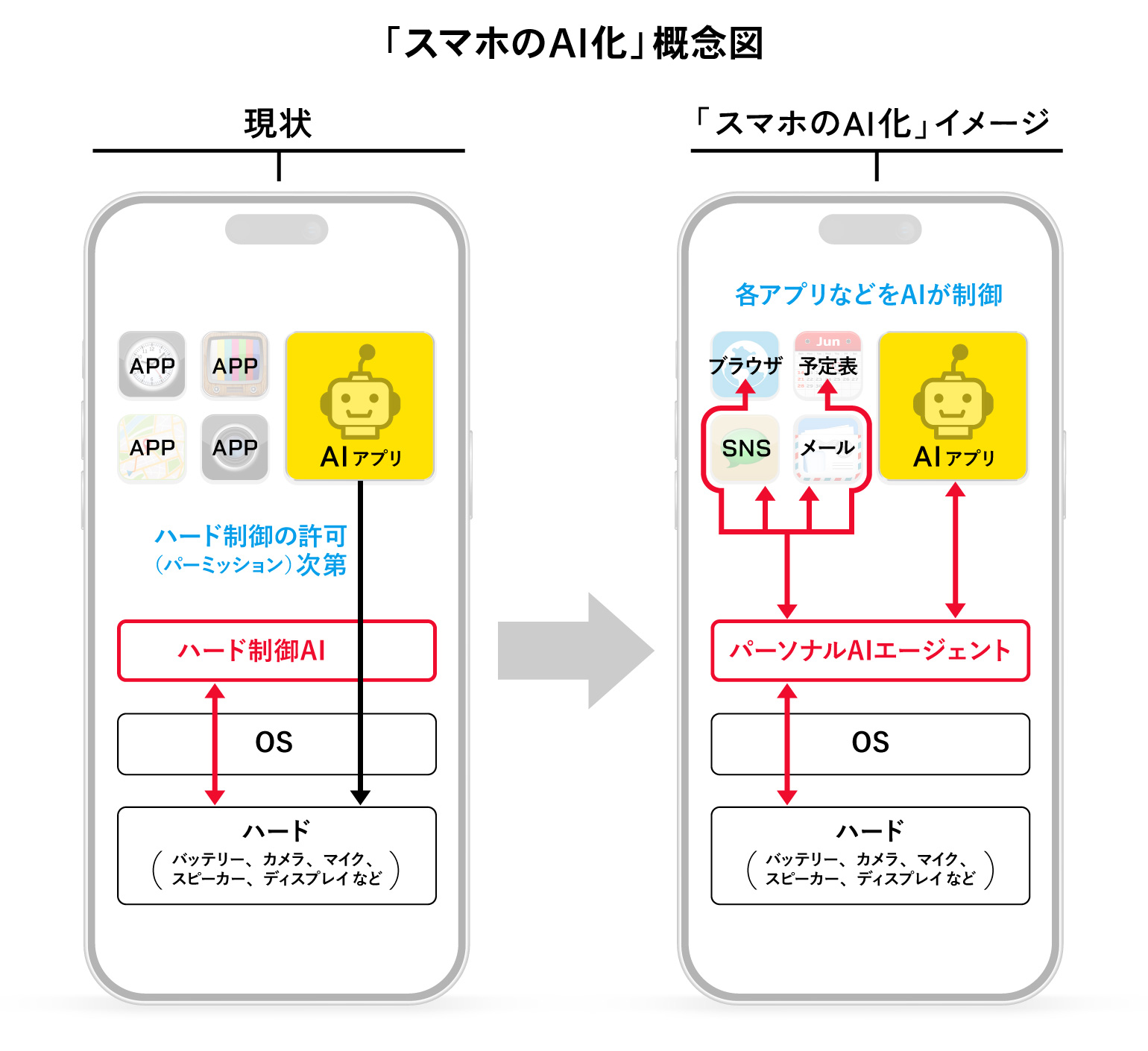
Generative AI is no longer a tool reserved for tech-savvy users; it is beginning to evolve into a tool that broadly supports consumers’ everyday decision-making. Furthermore, generative AI has begun shifting from apps that consumers operate and use to autonomous agents that function independently.AI, upon receiving requests from users, will begin to gather information and carry out tasks across various apps—such as calendars, email, maps, social media, and e-commerce sites. Rather than being treated merely as just another app, AI will become integrated into the smartphone’s operating system. In fact, as evidenced by Apple’s personal assistant Siri AI and Google’s announcement of “Gemini Intelligence,” the “AI-ification of smartphones ” is set to accelerate.
By granting AI agents permission to access apps, users will, for example, receive notifications when products they’ve previously searched for appear on secondhand marketplace apps. Based on their schedules and location, the AI will suggest nearby stores that are easy to visit, taking into account reviews and crowd levels. It will also research news related to people they’re meeting that day and summarize the key points—rather than users having to type queries into a search engine, AI—having accumulated a history of interactions with users—will gather, organize, and propose information on its own.
Moving beyond the current use of generative AI—where users ask questions and give instructions based on specific goals—we will see the widespread adoption of “personal AI agents ” that autonomously make decisions and take action tailored to each individual’s preferences and objectives.
Areas Left to AI vs. Areas Decided by Humans
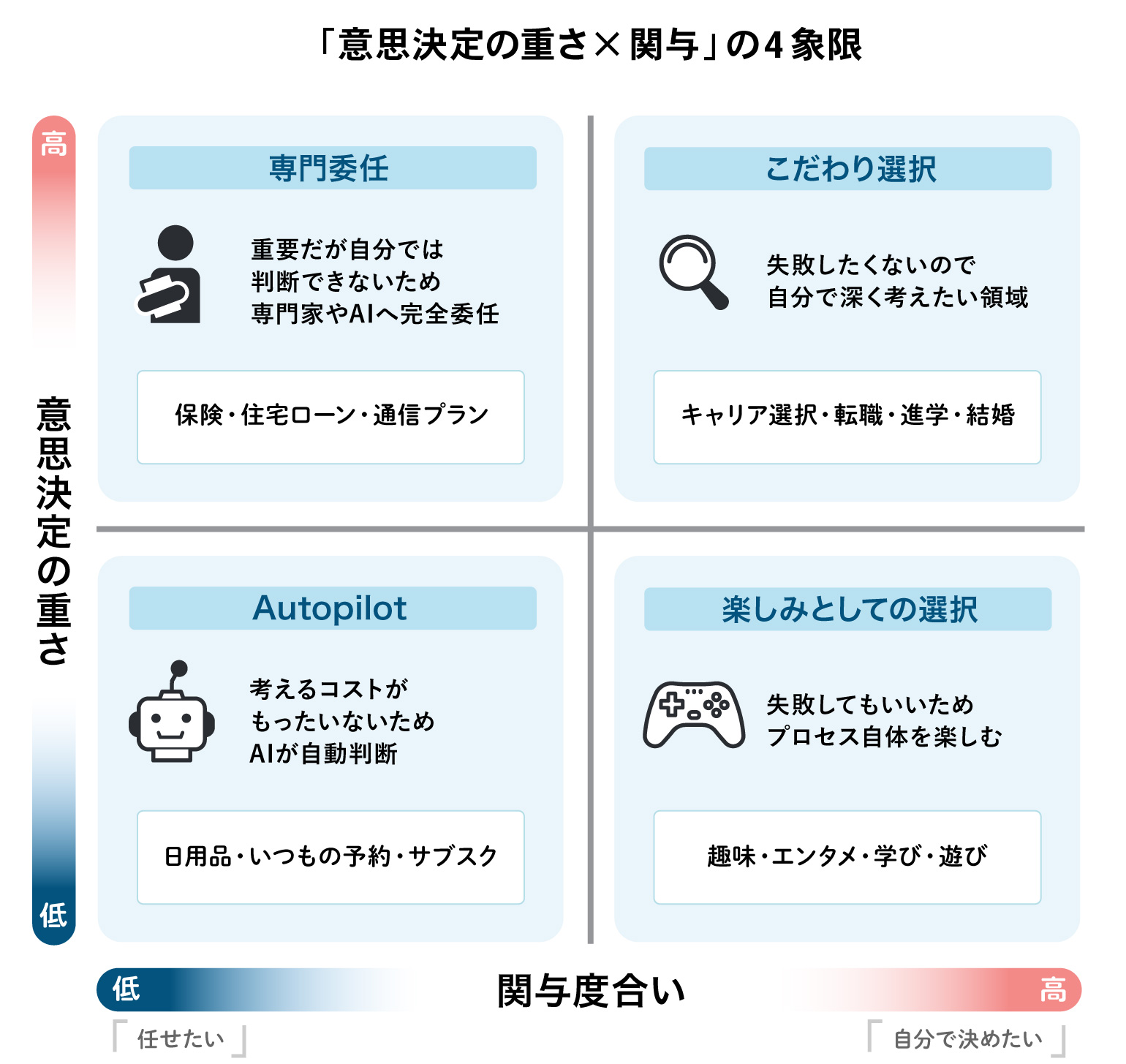
Even as personal AI agents that autonomously make judgments and take actions on behalf of individuals become more widespread, not all decision-making will be replaced by AI. In today’s world, where the volume of information continues to grow, the challenge individuals face is “what to choose from among too much information.” While an increase in options is an indicator of prosperity, finding the optimal choice is not easy.
Whether to entrust a decision to AI or to make it oneself with AI serving as a support tool can be organized into a four-quadrant framework. This framework is based on two axes: the “degree of involvement”—whether one wishes to be involved—and the “weight of the decision”—how significantly the decision impacts one’s life.For example, everyday items like toilet paper—where the decision is minor and the level of involvement is low—are likely areas where we’ll entrust AI with the decision-making and purchasing. On the other hand, in areas like hobbies, learning, and leisure—where it’s okay to make mistakes and we want to enjoy the process itself—we’re more likely to continue making our own choices and taking action.
Is Not Using AI the Key to Happiness?
One of the key terms of the AI era is “ optimization.”
But what does “optimization” actually mean? It’s a commonly used term, but it’s highly abstract and often employed without a strict definition. A major predicted shift in the AI era is a transition from optimization focused on improving investment efficiency from a corporate perspective to optimization centered on the user’s perspective. We define user-centric optimization—as evidenced by the inclusion of “choices” and “self-determination” as elements of well-being—as providing people with options they can decide on for themselves.
In other words, as the volume of information continues to grow, what consumers seek is a way to more easily arrive at information that is meaningful and convincing to them, while reducing the burden of searching, comparing, and choosing. As optimization progresses, information that is unnecessary to consumers will decrease, and they will be able to obtain the information they need more quickly. Optimization will likely expand as a means of meeting consumer needs.
On the other hand, how we address the “invisibility of the decision-making process” will become crucial. The more optimization advances, the less visible the decision-making process becomes. AI will handle the steps that precede the consumer’s decision—such as eliminating candidates, prioritizing options, timing, and adjusting phrasing.Even if consumers feel they have “chosen for themselves” or “decided for themselves,” it is possible that, at that moment, the majority of the options presented to them and the direction of their decision-making have already been shaped in advance by AI. In other words, what remains for consumers is not the decision of “what options to present,” but rather the final decision of “which of the presented options to choose.”
How we address this “invisibility of the decision-making process”—which arises with the widespread adoption of AI—is a critical issue. For example, consumers are likely to feel happier and perceive greater value in items they bought because they wanted them, rather than those they bought on a whim. Since independent judgment and self-determination are sources of happiness for people, a new value system may even emerge in which happiness is defined by not using AI.
AI That Deepens Consumers’ Self-Understanding
As a backlash against excessive optimization, there is a possibility that the desire for “serendipity”—unplanned discoveries and chance encounters—will increase. This also leads to individuals assigning their own unique meanings to words, products, and services.
This is where “narrative” becomes crucial.
It is a framework that enables individuals to form their own interpretations by projecting their personal values and experiences onto products and services. AI does more than simply summarize information; it reconstructs facts to match the consumer’s level of knowledge and circumstances, translating them into a “context that makes sense to this person” before delivering the information.
For example, suppose a male college student who previously had little interest in beauty is told by AI, “Lately, you’ve been worrying more about how others perceive you.” Based on factors such as how often he looks in mirrors or at station windows, as well as experiences where friends have told him he “looks tired,” the student becomes aware of the gap between the impression he has of himself and the one others have of him.This gives rise to the context of “wanting to improve his complexion and facial expressions,” and he begins to take an interest in concealer and skincare as options for looking more energetic. At that point, these products take on meaning not as beauty products, but as “means to bridge the gap between the impression he has of himself and the impression others have of him.”
Similarly, since AI can infer a user’s wake-up time and sleep duration based on smartphone usage time and frequency, asking, “Have you been sleeping well lately?” could spark their interest in sleep-related solutions.
How Will Conversations with AI Change “Ourselves”? What Is the AI Droste Effect?
Traditionally, self-understanding has been shaped through introspection, dialogue with others, and posts on social media; however, AI will increasingly become part of this process.
Personal AI agents verbalize, organize, and rephrase users’ experiences, emotions, and the reasons behind their decisions. Conversations with AI then take place based on this organized self-image. As one’s personal narrative is recursively reinforced, a structure emerges in which self-understanding cycles rapidly through the dialogue between the individual and the AI. This phenomenon is called the “AI Droste Effect,” named after the “Droste Effect”—an infinite nested structure in which a scaled-down version of an image is embedded within the image itself.
While dialogue with AI can deepen self-understanding by helping users recognize their own values and patterns that had not previously been articulated, caution is also necessary, as there is a risk that one’s self-image could become fixed, or that opportunities to learn from diverse perspectives and through friction with others might diminish. It is also possible that communication between humans themselves might decrease.
Self-understanding in the AI era is akin to acquiring a convenient mirror, but at the same time, we’ll need to design systems that prevent us from placing too much faith solely in the self reflected by that mirror.

These changes in self-understanding are not limited to the individual’s inner world. As AI begins to deliver information based on consumers’ interests, states of mind, and personal narratives, the way companies communicate and build their brands is also likely to change. In Part 2, we will explore how corporate communication and brand-building will evolve in response to these shifts in consumer behavior.
<Research Collaborators>
Yuichi Yoda, Professor, College of Business Administration, Ritsumeikan University (Specialization: Business Systems)
Yuichiro Hidaka, Professor, College of Business Administration, Ritsumeikan University (Specialization: Marketing)
Shinichiro Terasaki, Professor, College of Business Administration, Ritsumeikan University (Specialization: Marketing)
Satoshi Goto, Professor, College of Business Administration, Ritsumeikan University (Specialization: Design Management)
Mari Hisashi, Associate Professor, School of Business and Information Science, Fukui University of Technology, and Visiting Researcher, OIC Comprehensive Research Institute, Ritsumeikan University (Specialization: Marketing)
Key Terms to Remember in the Coming AI Era: Changes in Consumers’ Lifestyles
・Personal AI Agent
An AI that understands an individual’s preferences and goals and autonomously assists with everything from gathering information to making choices and taking action
・AI Integration into Smartphones
A shift in which AI is no longer merely a feature within an app but operates at a level closer to the OS to support behavior and decision-making
・Optimization
Reducing the burden of information search and selection, making it easier to arrive at options that suit the user
・Narrative
A framework for interpretation that allows users to connect products and information to their own experiences and values to give them meaning
・AI Droste Effect
A cyclical structure in which self-understanding deepens through dialogue with AI, and that self-image is further reflected in the dialogue
Was this article helpful?
Share this article


Newsletter registration is here
We select and publish important news every day
For inquiries about this article
Author

Kentaro Yoshida
Dentsu Inc.
第4マーケティング局 未来シナリオコンサルティング部/未来事業創研ファウンダー
Optimizing IoT EnvironmentsDentsu Inc. Smart PlatformWhat will the world "after" smartphones look like?The future isn't something you "wait" for—it's something you "create"! Transforming Japan's career education through future-oriented thinkingBuilding the future begins with visualizing the will of the future.Changes in Consumers' Lives Revealed by 20 Years of Tracking Surveys: Mobile Phones and SmartphonesMonthly CXDentsu Group's 72 Visions of the Future: "Future Mandala"How AI Is Changing Consumers’ Information Behavior and the Future of Corporate Communication


Yoko Kibata
Dentsu Inc.
CXクリエイティブセンター 未来の暮らし研究部
Producer

Yasuhiro Tsuchiya
Dentsu Inc.
zero/Dentsu Lab Tokyo
Creative Technologist / Researcher
Articles by this person


Kishimoto Kazuya
Dentsu Inc.
Dentsu Lab Tokyo
Creative Technologist / Communication Designer
The Future of Communication: Insights from AI ChatbotsI tried using AICO2 with that person everyone's been talking about!Hitachi, Ltd. × Dentsu Inc. × Dentsu Digital Inc.: Tackling Social Issues with Generative AI!How AI Is Changing Consumers’ Information Behavior and the Future of Corporate Communication

Rei Tai
Dentsu Inc.
Future Scenario Consulting Department, Marketing Division 4
Associate Planner