Note: This website was automatically translated, so some terms or nuances may not be completely accurate.
 Insight Memo [9/65]
Do "TV viewing time" and "Internet usage time" compete?
〈 Publication Date: May 18, 2011 〉
The Media Innovation Research Department at DENTSU SOKEN INC. launched a joint project with Professor Yoshiaki Hashimoto of the University of Tokyo's Graduate School of Interdisciplinary Information Studies to understand Japanese information behavior, conducting the "2010 National Survey on Japanese Information Behavior." This time, we present an analysis from that survey focusing on television viewing and internet usage.
Professor Hashimoto's analysis based on the survey results indicates that internet usage does not necessarily reduce television viewing time.
Comparing days when PC internet users "used" the internet with days when they "did not use" it, it was found that on "days of use," television viewing time was actually longer. This indicates that internet usage time does not necessarily eat into television viewing time.
Similarly, analysis of mobile internet users revealed that on days they used mobile internet, television viewing time was longer than on days they did not use it.
So why do television viewing and internet use not compete for time, but rather result in longer television viewing on days the internet is used?
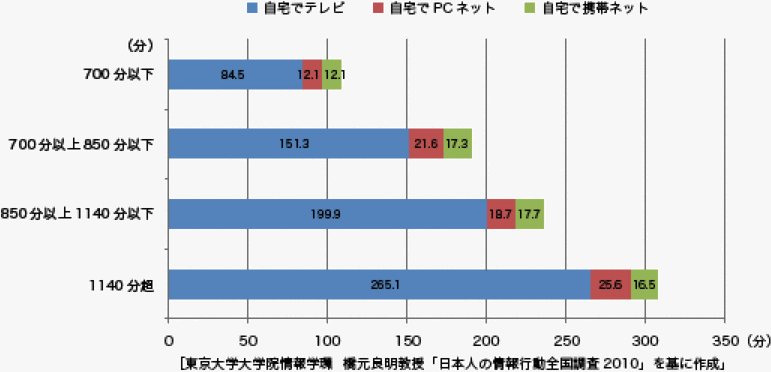
One perspective proposed by Professor Hashimoto is the 'Time Allocation Theory Based on Time Spent at Home'. This theory suggests that, within the limited time spent at home, media consumption time is not competed for, but rather allocated to each medium according to the amount of time available at home.
*For more detailed information on this topic, please refer to the "Information Media White Paper 2011" (compiled by DENTSU SOKEN INC., published by Diamond Inc.).
Media Usage Time by At-Home Category
Was this article helpful?
Share this article


Newsletter registration is here
We select and publish important news every day
For inquiries about this article
Back Numbers

Author

dentsu Media Innovation Lab
Dentsu Inc.
Insight MemoSpecial Discussion: "Japan's Advertising Expenditures"Explore the Amazing World of YouTube Creators with UUUMInformation Media White Paper 2024: The Rapidly Changing Media Environment and Consumers100 years since its birth. Radio, today...College Students and the Future of Media, Communication, and Advertising in Ten YearsInformation Media White Paper 2025: New Horizons in Communication Shaping the FutureInformation Media White Paper Special Report 2026: “The Current State of Evolving Information Trends”