Note: This website was automatically translated, so some terms or nuances may not be completely accurate.
 Insight Memo [20/65]
Smart Device Usage Among Modern Housewives ~Based on Group Interview Findings~
〈 Publication Date: August 15, 2012 〉
Housewives are the main players in daily consumption and purchasing activities. According to the Ministry of Health, Labour and Welfare's "2010 Survey on the Actual Conditions of Working Women," we now live in an era where over 50% of married women aged 25 to 64 are employed. So, how do these two major factors influencing a housewife's lifestyle – "whether she works" and "whether she has children" – impact her media consumption?
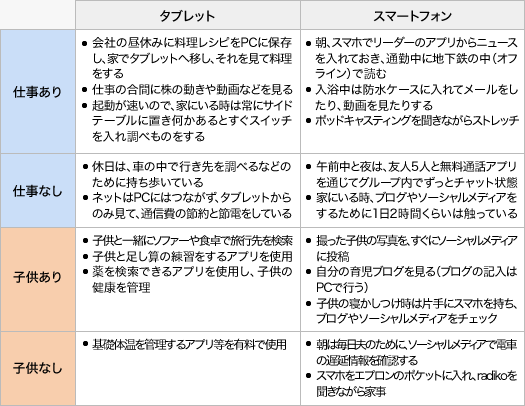
This issue highlights characteristic comments from group interviews with housewives conducted by the Media Innovation Research Department in May 2012. Specifically, we focus on remarks regarding contact with tablets and smartphones, which have become increasingly prevalent in recent years. These comments are categorized into four distinct types based on whether the respondent has a job and whether she has children.
≪Respondent Criteria≫
Housewives in their late 20s to mid-30s with relatively high information sensitivity and IT literacy. We divided them equally into "housewives using tablets (+ mobile phones)" and "housewives owning only smartphones," then further categorized them into full-time housewives (half with children, half without), working housewives (with children), and working housewives (without children) for interviews. Children's ages were defined as the youngest being elementary school age or younger.
■ Working Housewives
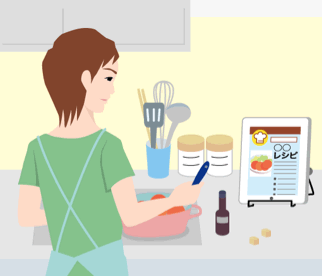
Working housewives frequently used smart devices during commutes and lunch breaks. Comments like "I save recipes on my PC during my company lunch break, transfer them to my tablet at home, and use them to cook" indicate they efficiently manage cooking time by using multiple tools. The statement, "In the morning, I download news from a reader app on my smartphone and read it offline during my subway commute," shows a clever use of smartphone reader apps. By taking the extra step of saving content once, they enable information consumption even in offline commuting environments—a practical solution unique to busy working mothers.
■ Non-working housewives
For homemakers without work, a key characteristic is strong awareness of saving money and conserving electricity, as seen in statements like, "I don't connect to the internet on my PC; I only use my tablet to save on communication costs and electricity." Furthermore, the statement, "In the mornings and evenings, I'm constantly chatting in a group with five friends using a free calling app," suggests that free calling apps are an ideal communication tool for homemakers who have ample free time but want to keep expenses low.
■ Housewives with Children
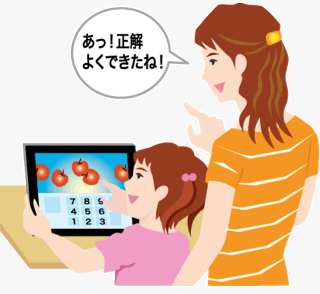
Housewives with children showed many child-specific uses, as seen in statements like "using an app on the tablet to practice addition with my child" or "using an app to look up medicine and manage my child's health." One housewife who "immediately posts photos of her child taken with her smartphone to social media" mentioned that this saves the hassle of transferring photos from a digital camera to a PC, making it simpler and more convenient.
■ No Children
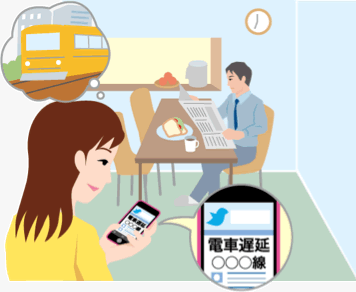
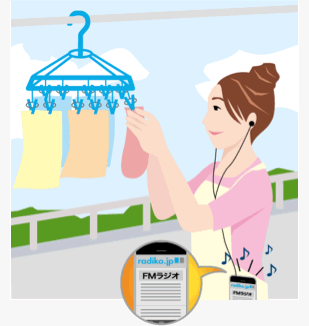
Childless housewives, with more free time, showed diligent efforts in managing their health and gathering information for their spouses. Examples include using paid apps on tablets to "track basal body temperature" and checking train delay information on social media "every morning for their husbands." They also exhibited multitasking behaviors like "housework + listening to radio on smartphone" – a "while-doing" approach unique to housewives who move frequently around the home.
As smart devices become widespread among housewives, it's clear they are devising usage methods tailored to their diverse lifestyles.
Was this article helpful?
Share this article


Newsletter registration is here
We select and publish important news every day
For inquiries about this article
Back Numbers
Author

dentsu Media Innovation Lab
Dentsu Inc.
Insight MemoSpecial Discussion: "Japan's Advertising Expenditures"Explore the Amazing World of YouTube Creators with UUUMInformation Media White Paper 2024: The Rapidly Changing Media Environment and Consumers100 years since its birth. Radio, today...College Students and the Future of Media, Communication, and Advertising in Ten YearsInformation Media White Paper 2025: New Horizons in Communication Shaping the FutureInformation Media White Paper Special Report 2026: “The Current State of Evolving Information Trends”