Note: This website was automatically translated, so some terms or nuances may not be completely accurate.
 Insight Memo [22/65]
Information Behavior in the Era of Temporal Chains
〈 Publication Date: October 23, 2012 〉
The Media Innovation Research Department at DENTSU SOKEN INC., in collaboration with Professor Yoshiaki Hashimoto of the University of Tokyo's Graduate School of Interdisciplinary Information Studies, established the "Audience Insight Laboratory" to study changes in audiences (i.e., recipients of information from media). We continue various research projects on human information behavior. This presentation highlights findings from that research.
Our research team formulated a hypothesis regarding recent information behavior patterns among audiences. We hypothesized that traditional mass media, such as television and newspapers, function as "initial news awareness tools (establishing foundational understanding)," while online media function as "trend-tracking tools (confirming the latest developments)" for that news.
Therefore, we included the following question in our quantitative survey:
"Q: Regarding news you learned about through TV news programs or newspapers, do you ever check the latest developments online as the situation changes moment by moment?"
(This survey was conducted nationwide in June 2012, targeting 1,050 male and female respondents aged 15 to 49.)
The survey results were as follows:
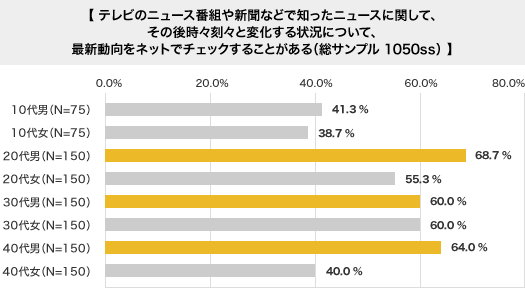
Over 60% of men in their 20s and older engage in this information-seeking behavior pattern. Specifically, among those in their 20s, more than two out of three respondents reported doing so.
Looking at this data, it suggests we may be entering an era where, as convenient devices like smartphones and tablets become increasingly widespread, information-seeking behaviors originating from TV or newspapers are becoming chronologically linked to online actions within the same day. For example, a behavioral model where people first learn about major news events in the morning, then continuously check the latest, rapidly changing developments about that event on PCs, smartphones, or tablets.


Morning: Learning about major news "occurrences"

On the way to work, follow the news on your smartphone

Frequently checking subsequent developments on a PC at work
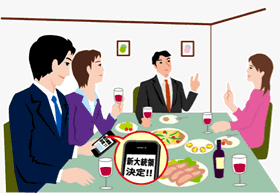
Check the final status of the day in the evening
This "chronological chain model of information" could also be leveraged in advertising communication. For instance, a morning newspaper ad could declare, "We'll now introduce how to use this product throughout the day, segmented by time of day, online." Then, on the website, it could deliver real-time, up-to-date information perfectly suited to the moment—like usage tips matching the morning mood, adapting to daytime weather conditions, or fitting the pre-bedtime atmosphere.
As IT evolves, people's information behaviors are constantly changing. In advertising too, planning that swiftly captures these shifts is likely to be effective.
Was this article helpful?
Share this article


Newsletter registration is here
We select and publish important news every day
For inquiries about this article
Back Numbers
Author

dentsu Media Innovation Lab
Dentsu Inc.
Insight MemoSpecial Discussion: "Japan's Advertising Expenditures"Explore the Amazing World of YouTube Creators with UUUMInformation Media White Paper 2024: The Rapidly Changing Media Environment and Consumers100 years since its birth. Radio, today...College Students and the Future of Media, Communication, and Advertising in Ten YearsInformation Media White Paper 2025: New Horizons in Communication Shaping the FutureInformation Media White Paper Special Report 2026: “The Current State of Evolving Information Trends”